ICT Order Block is one of the important price action concepts taught by Inner Circle Trader.
Many traders define an Order Block very simply.
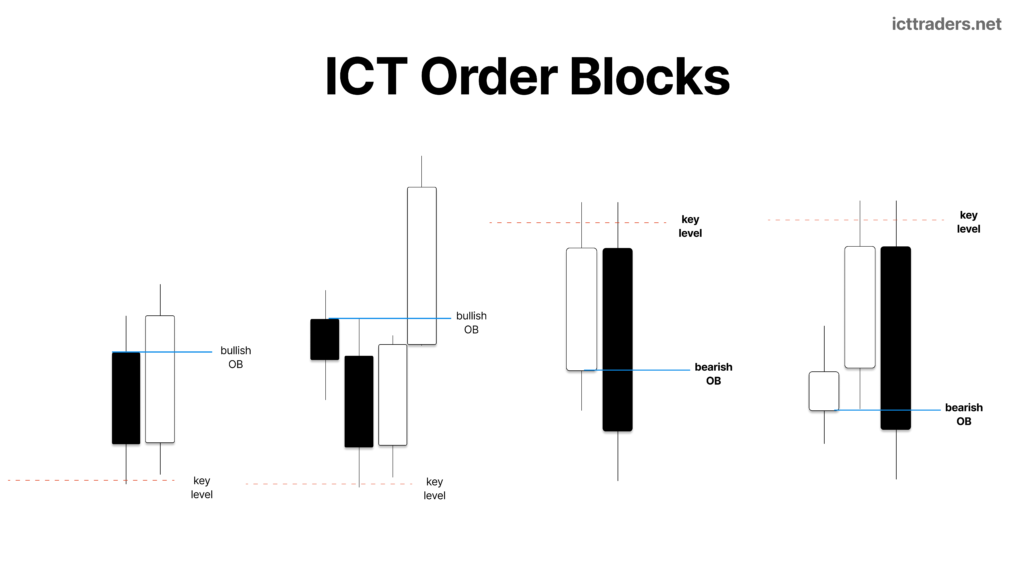
The last bearish candle before a bullish move is called Bullish Order Block.
The last bullish candle before a bearish move is called Bearish Order Block.
But according to ICT Order Block theory, this definition is incomplete.
A candle is not automatically an Order Block only because price moved strongly after it.
First the candle is considered as a possible or suspected Order Block.
Price must later validate that candle.
The location of the candle is also important.
Higher time frame direction is important.
Support or resistance level is important.
And price must show a willingness to move away from the candle.
So Order Block should not be selected only by candle colour.
What is ICT Order Block?
An Order Block is a price bar or candle associated with directional price delivery.
For a Bullish Order Block, ICT defines it as the lowest down-close candle or price bar with the largest open-to-close range near a support level.
The candle first appears while price is trading lower.
At this moment, it is only a suspected Bullish Order Block.
The trader does not know yet whether the candle will become a valid Order Block.
Price must later move higher and trade through the high of the down-close candle.
When this happens, the Bullish Order Block becomes validated.
The bearish concept is the opposite.
A Bearish Order Block is an up-close candle associated with bearish price delivery near a resistance or premium area.
Price must later trade through the low of that candle to validate the bearish Order Block.
The simple idea is–
Possible Order Block → Price moves away → Candle level is violated → Order Block validated → Price retraces → Entry opportunity
Why Does an Order Block Form?
To understand Order Block, trader first needs to understand the ICT idea of price delivery.
Suppose the higher time frame market is bullish.
The monthly, weekly and daily chart are showing bullish price movement.
Price may still move lower on the 4-hour or lower time frame.
This lower movement does not always mean the whole market has become bearish.
It may be a correction or retracement.
Price moves towards a discount area.
It may also trade into Sell-side Liquidity or an important support level.
According to ICT theory, larger market participants may use the lower price area to obtain long exposure at a cheaper price.
When large flows participate in the market, the effect should become visible in price action.
Price starts moving strongly higher.
This movement away from the lower price area gives evidence of bullish price delivery.
The down-close candle associated with the beginning of this movement can become a Bullish Order Block after validation.
So the Order Block forms around a price area from where a significant directional movement becomes visible.
For bullish condition–
Price trades lower.
A support or discount area is reached.
Buying interest appears.
Price starts moving higher.
The high of the down-close candle is traded through.
The Bullish Order Block is validated.
For bearish condition–
Price trades higher.
A resistance or premium area is reached.
Selling pressure appears.
Price starts moving lower.
The low of the up-close candle is traded through.
The Bearish Order Block is validated.
In ICT theory, the strong movement away from the area is considered evidence that larger flows are participating in the move.
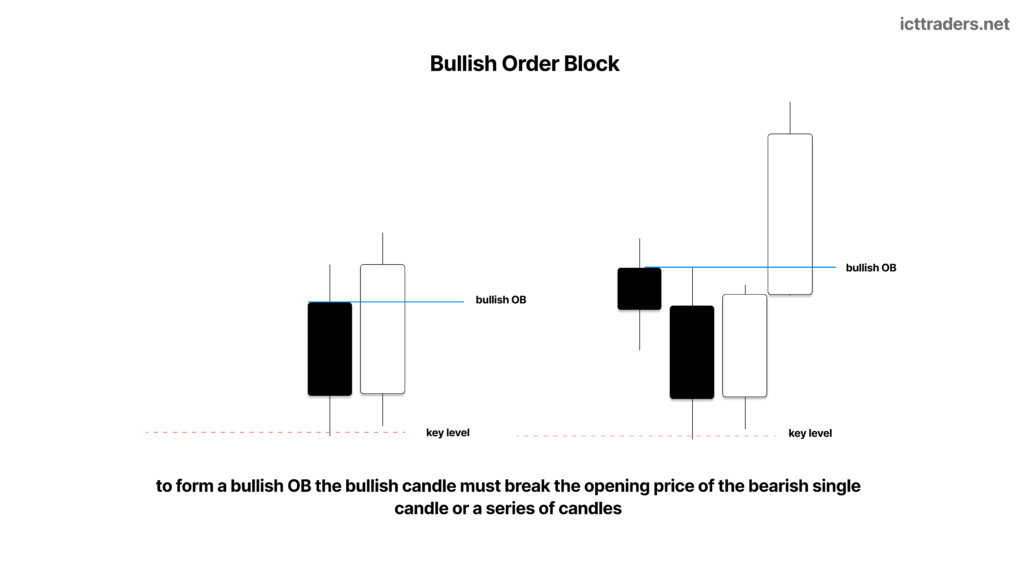
Bullish Order Block
A Bullish Order Block starts with a down-close candle.
A down-close candle means the candle closes below its opening price.
The trader should look for the lowest important down-close candle near a support level.
ICT also gives importance to the open-to-close range of the candle.
The candle with the larger body range may become important.
But initially the candle is only a possible Bullish Order Block.
Suppose price is trading into a higher time frame support level.
A down-close candle forms.
After this, price moves higher.
A later candle trades through the high of the down-close candle.
Now the down-close candle is validated as a Bullish Order Block.
The basic formation is–
Support Area → Down-close Candle → Bullish Movement → Candle High Violated → Valid Bullish Order Block
After validation, the trader waits for price to retrace towards the Bullish Order Block.
The return into the Order Block can give a possible buying opportunity.
Bearish Order Block
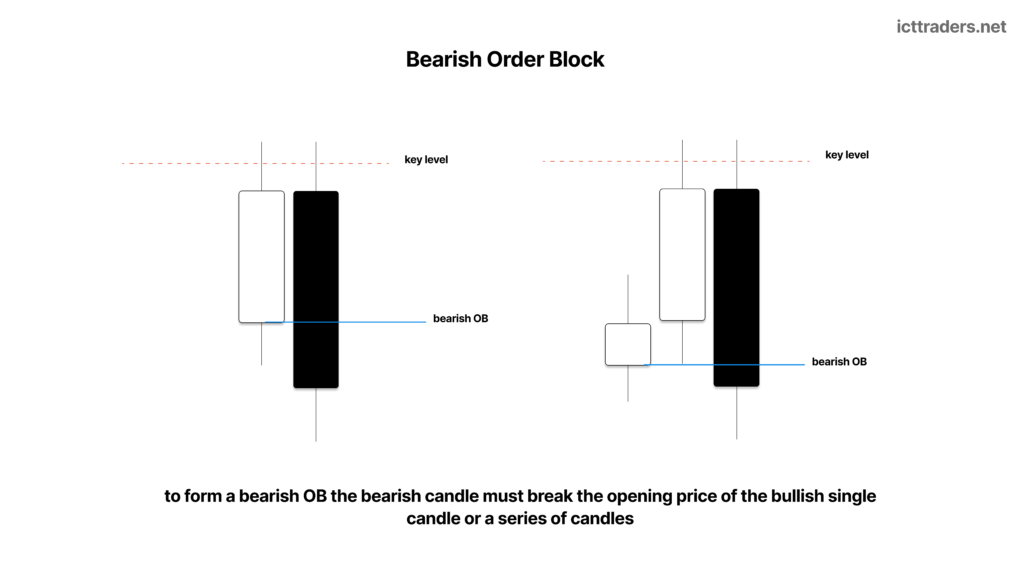
Bearish Order Block follows the opposite logic.
Price may be trading into a higher time frame resistance or premium area.
An up-close candle forms.
An up-close candle closes above its opening price.
Price then starts moving lower.
A later candle trades through the low of the up-close candle.
This validates the Bearish Order Block.
The basic formation is–
Resistance Area → Up-close Candle → Bearish Movement → Candle Low Violated → Valid Bearish Order Block
After validation, price may retrace higher towards the Bearish Order Block.
The return into the block can provide a possible selling opportunity.
Everything explained for a Bullish Order Block can generally be reversed for a Bearish Order Block.
A Candle Is Not an Order Block Until It Is Validated
This is one of the important rules from the ICT Order Block teaching.
Suppose price is trading near support.
A bearish candle forms.
The trader may think–
This is a Bullish Order Block.
But at this stage, it is only a suspected Order Block.
The candle needs validation.
For a Bullish Order Block, a later candle must trade through the high of the down-close candle.
When the high is violated, price has shown a willingness to move higher.
The candle can now be treated as a validated Bullish Order Block.
For bearish condition, the opposite rule is used.
The low of the up-close candle should be traded through.
Without this validation, trader should not automatically classify every opposite candle as an Order Block.
How to Identify ICT Order Block on Chart
The following process can be used to identify an Order Block.
Step 1– Start from Higher Time Frame
First look at the monthly, weekly and daily chart.
The objective is to understand the main directional bias.
For bullish condition–
Monthly chart may be bullish.
Weekly chart may be bullish.
Daily chart may be bullish.
Price may be forming higher highs and higher lows.
Resistance levels may be giving way.
Support areas may be respected.
In this condition, the trader mainly looks for bullish opportunities.
The 4-hour and lower time frame may retrace lower.
These lower movements can bring price towards Bullish Order Blocks, Fair Value Gaps or other discount areas.
For bearish condition–
Monthly chart may be bearish.
Weekly chart may be bearish.
Daily chart may be bearish.
Price may form lower highs and lower lows.
Support levels may break.
Resistance areas may be respected.
The trader mainly searches for bearish setups.
The 4-hour and lower time frame rally can provide a selling opportunity.
Higher time frame direction is therefore used before selecting an Order Block.
Step 2– Find a Support or Resistance Level
For a Bullish Order Block, look for an important support area.
The support level can be–
An old higher time frame low.
A previous resistance level which price has already moved above.
Monthly support.
Weekly support.
Daily support.
Another important higher time frame level.
Price can touch the support level.
It may also trade slightly through the level.
The exact touch is not the main point.
The trader waits to see whether price shows a willingness to move away from the support.
For bearish condition, reverse the idea.
Look for resistance or an important premium area.
Step 3– Find the Important Down-close or Up-close Candle
For bullish condition, look for the down-close candle near support.
According to ICT’s definition, focus on the lowest down-close candle with an important open-to-close range.
Do not immediately call it a Bullish Order Block.
Mark the candle as a possible Order Block.
Now wait.
For bearish condition, find the important up-close candle near resistance.
Again, the candle remains a possible Bearish Order Block until price validates it.
Step 4– Wait for Validation
For Bullish Order Block–
Mark the high of the down-close candle.
Wait for a later candle to trade through that high.
When price trades through the high, the Bullish Order Block is validated.
For Bearish Order Block–
Mark the low of the up-close candle.
Wait for price to trade through the low.
When the low is violated, the Bearish Order Block becomes validated.
This is the confirmation that price is showing directional movement away from the candle.
Step 5– Look for Displacement Away from the Order Block
ICT wants to see price move away from the Order Block.
A weak movement is less attractive.
Price should show responsiveness.
Suppose a Bullish Order Block is validated.
Price should rally away from the block.
In the mentorship lesson, ICT gives an additional observation.
He prefers to see price move approximately two to three times the height or range of the Order Block away from the area.
For example–
Order Block body range is 10 pips.
A movement of around 20 to 30 pips away can give a better indication of meaningful price movement.
This is not simply about counting candles.
The trader wants to see a clear separation between price and the Order Block.
The market should show a willingness to expand away.
After this move, a retracement back into the Order Block becomes more meaningful.
Step 6– Wait for Price to Retrace into the Order Block
After the Bullish Order Block is validated and price moves higher, the trader waits.
Do not chase price.
Price may eventually retrace lower.
The trader watches the Bullish Order Block level.
ICT mainly focuses on the candle body when studying Order Blocks.
For a down-close candle, the opening price is at the upper side of the candle body.
This opening or upper body area can become an important reference level.
When price retraces back into the Bullish Order Block, the trader can look for a long entry.
The important idea is–
Price validates the block first.
Price moves away.
Then price returns.
The return gives the entry opportunity.
For a Bearish Order Block, price moves lower after validation.
Then price retraces higher into the bearish block.
The return can provide a selling opportunity.
Order Block Body or Wick – Which Should Be Used?
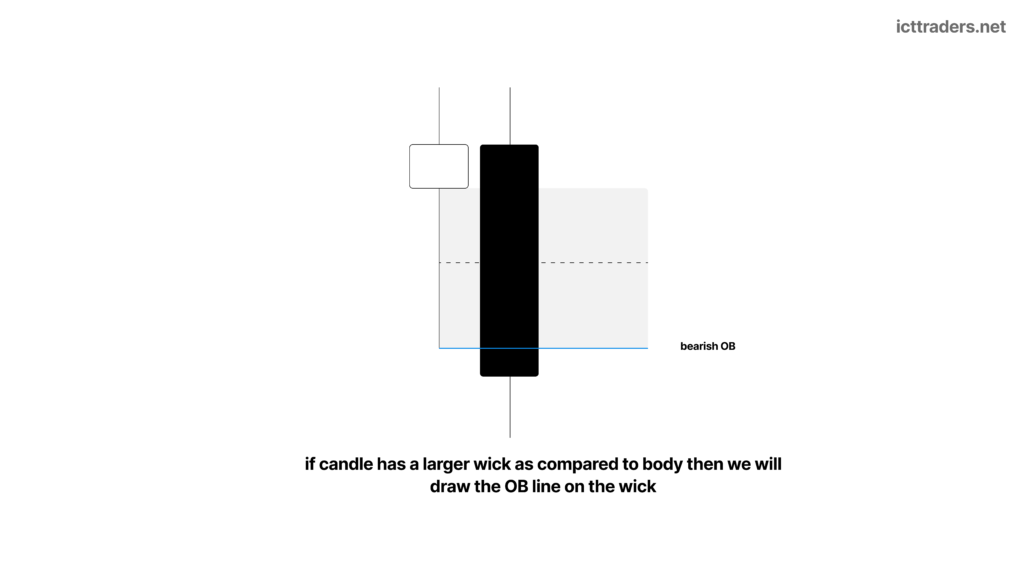
ICT places primary focus on the candle bodies when teaching Order Blocks.
The open and close of the candle define the body.
For a Bullish Order Block, trader mainly studies the body of the down-close candle.
For a Bearish Order Block, trader mainly studies the body of the up-close candle.
The wick may sometimes become important.
But ICT specifically tells the student to first focus on the bodies of the candles.
Wick usage can overlap with Fair Value Gap and other price delivery concepts.
So beginner traders should avoid marking every complete wick range without understanding the reason.
For basic Order Block study–
Focus on the candle body.
Mark the open and close.
Study how price responds to the body.
Then observe the wick according to the surrounding price action.
Mean Threshold of an Order Block
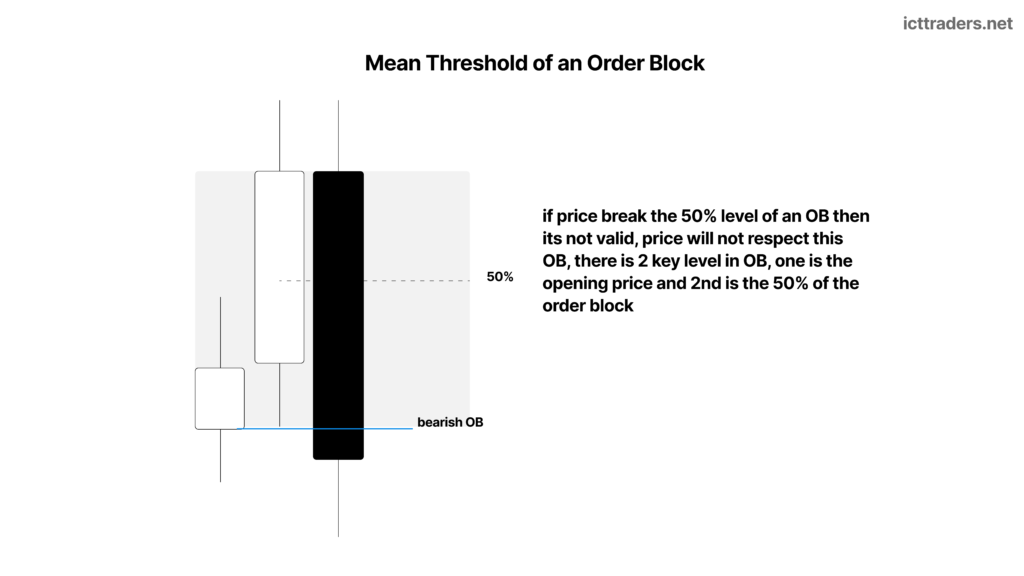
Mean Threshold is the 50% level of the Order Block candle body.
This is another important Order Block rule.
Suppose a Bullish Order Block is a down-close candle.
Measure from the candle open to the candle close.
Do not use the wick high and wick low for this calculation.
Find the midpoint of the body.
This 50% level is called the Mean Threshold.
The formula is simple–
Mean Threshold = 50% of Order Block Body
For a Bullish Order Block, the better Order Blocks generally should not allow price to trade deeply below the Mean Threshold.
Price may slightly pierce the midpoint.
A small movement through the level can occur.
But according to ICT, the better Order Blocks often show respect around or above the Mean Threshold.
Suppose price retraces into a Bullish Order Block.
Price enters the body.
It reacts from the upper portion of the block.
The Mean Threshold remains respected.
Then price expands higher.
This can show a stronger Bullish Order Block reaction.
If price continuously trades deeply through the body and below the Mean Threshold, the block may be less attractive.
The same concept is reversed for a Bearish Order Block.
Why the Mean Threshold Is Important
The Mean Threshold helps the trader study the depth of the retracement.
Suppose price validates a Bullish Order Block and moves strongly higher.
Later price returns.
A shallow return into the upper portion of the Order Block shows stronger responsiveness.
Price does not need to use the full block.
If price trades deeply through the complete candle body, the bullish response is weaker.
The Mean Threshold therefore acts as an important reference inside the Order Block.
It is not a magical entry line.
It is used to judge how price is respecting the block.
Consecutive Candles Can Form One Order Block
An Order Block does not always contain only one candle.
ICT explains that when two down-close candles appear together, they may need to be blended as one complete Bullish Order Block.
For example–
Down Candle 1 forms.
Down Candle 2 forms immediately after it.
Then price strongly moves higher.
The two down-close candles can be studied together as one full Order Block range.
The same logic can be reversed for bearish conditions.
This is important because many traders search only for one last opposite candle.
Sometimes the actual price range contains multiple connected candles.
The candles should be studied as one combined price area.
Refining a Higher Time Frame Order Block
Order Blocks can be refined from higher time frame to lower time frame.
Suppose a Bullish Order Block is identified on the monthly chart.
Price trades into the monthly Order Block.
Now move into the weekly chart.
Look for a weekly down-close candle.
Wait for price to trade through its high.
The weekly Bullish Order Block becomes validated.
Now the monthly Order Block has been refined into a more precise weekly level.
The same process can continue.
Monthly Order Block → Weekly Order Block → Daily Order Block → Intraday Order Block
The trader can move down into the 4-hour or even 5-minute chart for more precise execution.
But the lower time frame Order Block should support the higher time frame direction.
The purpose of refinement is not to randomly search for the smallest candle.
The purpose is to find a more precise Order Block inside the higher time frame area.
Higher Order Block Refinement
Sometimes a new down-close candle forms at a higher price inside the same bullish move.
According to the ICT, the trader can refine the Bullish Order Block level towards the newer higher down-close candle after it is validated.
Suppose–
A Bullish Order Block is identified.
Price moves higher.
A new down-close candle forms above the original block.
Price again moves higher and violates the new candle high.
The new down-close candle can become a higher Bullish Order Block.
The trader can refine the level towards this newer block.
This process allows the trader to follow bullish price delivery as the market moves higher.
For bearish conditions, the logic is reversed.
Order Block and Internal Range Liquidity
ICT connects Order Block with Internal Range Liquidity.
Suppose a market range has already been identified.
There is a low below.
There is a high above.
Price retraces into a Bullish Order Block inside the range.
The trader is buying inside the range.
This is described as working with Internal Range Liquidity.
The trader expects price to expand away from the internal area.
The next objective may be liquidity outside the range.
This is called External Range Liquidity.
For bullish trade–
Enter from Internal Range Liquidity.
Buy at Bullish Order Block.
Target Buy-side Liquidity above an old high.
For bearish trade–
Enter from Internal Range Liquidity.
Sell at Bearish Order Block.
Target Sell-side Liquidity below an old low.
The Order Block gives the entry area.
External Range Liquidity gives the potential exit objective.
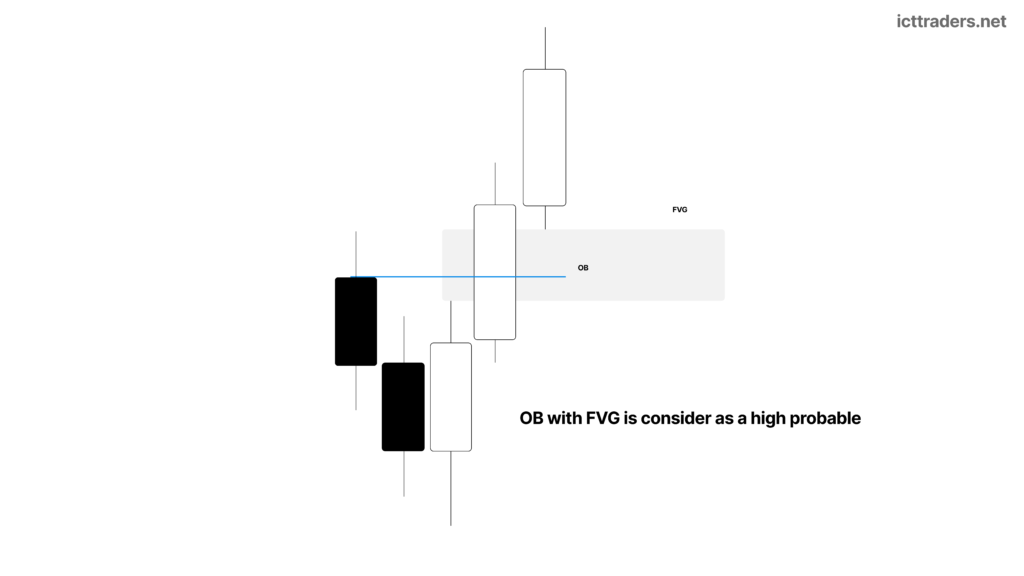
How to Use Bullish Order Block
Suppose monthly, weekly and daily charts are bullish.
The higher time frame market suggests higher prices.
Now the 4-hour chart is retracing lower.
Price moves into a discount area.
An old higher time frame support is present.
A down-close candle forms near the support.
Do not immediately buy.
Mark the high of the down-close candle.
Wait for a later candle to trade through the high.
The candle is now validated as a Bullish Order Block.
Observe the movement away from the block.
Price should show responsiveness and move higher.
The trader may prefer a rally of two to three times the Order Block body range.
Now wait for a retracement.
Price returns towards the Bullish Order Block.
Focus mainly on the body and opening price of the down-close candle.
Observe the Mean Threshold.
A long entry can be searched from the Bullish Order Block.
The stop is placed at a logical area below the Bullish Order Block.
The target is Buy-side Liquidity above a recent high.
The complete bullish model is–
Bullish Higher Time Frame Bias → Support or Discount → Down-close Candle → High Violated → Bullish Order Block Validated → Price Moves Away → Retracement into Order Block → Buy → External Range Liquidity
How to Use Bearish Order Block
Now reverse the concept.
Suppose monthly, weekly and daily charts are bearish.
Price is expected to move lower.
The 4-hour chart is correcting higher.
Price enters a premium or resistance area.
An up-close candle forms.
Mark the low of the candle.
Wait for price to trade through the low.
The candle becomes a validated Bearish Order Block.
Price moves lower.
The trader waits for price to retrace higher into the Order Block.
The candle body becomes the main area of interest.
A sell entry can be searched.
The stop is placed above the logical Bearish Order Block invalidation area.
The target is Sell-side Liquidity below a recent low.
The complete bearish model is–
Bearish Higher Time Frame Bias → Resistance or Premium → Up-close Candle → Low Violated → Bearish Order Block Validated → Price Moves Away → Retracement into Order Block → Sell → External Range Liquidity
ICT Order Block Rules
The following are the important rules of ICT Order Block–
Rule 1– Use Higher Time Frame Bias
Start from monthly, weekly and daily chart.
Trade Order Blocks which support the higher time frame institutional order flow.
Rule 2– Order Block Needs Proper Location
Bullish Order Block should be connected with support, discount or another important bullish area.
Bearish Order Block should be connected with resistance, premium or another important bearish area.
Rule 3– Candle Colour Alone Is Not Enough
A down-close candle is not automatically a Bullish Order Block.
An up-close candle is not automatically a Bearish Order Block.
Rule 4– Order Block Must Be Validated
For Bullish Order Block, the high of the down-close candle should be traded through.
For Bearish Order Block, the low of the up-close candle should be traded through.
Rule 5– Wait for Price to Show Responsiveness
Price should show willingness to move away from the Order Block.
Strong separation from the block is preferred.
Rule 6– Look for Two to Three Times Expansion
ICT explains that he prefers to see price move approximately two to three times the Order Block range away before looking for a meaningful retracement.
Rule 7– Focus Mainly on Candle Bodies
Order Block study should primarily use the open and close of the candle.
Do not immediately depend on the entire wick range.
Rule 8– Mean Threshold Uses the Candle Body
Measure the 50% level from open to close.
Do not calculate the Mean Threshold from wick high to wick low.
Rule 9– Better Order Blocks Respect Mean Threshold
The better Bullish Order Blocks generally do not trade deeply below the 50% body level.
The opposite idea is used for Bearish Order Blocks.
Rule 10– Consecutive Candles May Be Blended
Two or more connected down-close candles may form one complete Bullish Order Block.
Reverse the idea for Bearish Order Blocks.
Rule 11– Refine Higher Time Frame Levels
Monthly Order Blocks can be refined on weekly chart.
Weekly Order Blocks can be refined on daily chart.
Daily areas can be refined on intraday charts.
Rule 12– Trade in the Direction of Higher Time Frame Flow
When monthly, weekly and daily charts are bullish, focus mainly on Bullish Order Blocks.
When higher time frames are bearish, focus mainly on Bearish Order Blocks.
When to Avoid an Order Block
Order Block should be avoided when it directly opposes the clear higher time frame direction.
Suppose monthly, weekly and daily charts are bullish.
Price is showing accumulation and higher price delivery.
A small Bearish Order Block appears on the weekly or daily chart.
The trader should not immediately use the Bearish Order Block as a reason to sell.
According to ICT, bearish blocks during a bullish higher time frame condition may sometimes act as temporary profit-taking areas.
Price may pause.
Price may consolidate.
But the main expectation is still higher prices.
The trader should focus on buying Bullish Order Blocks during retracements.
The bearish areas can sometimes be used as profit objectives rather than short entries.
The opposite rule applies in a bearish higher time frame market.
Do not buy every Bullish Order Block against strong bearish institutional order flow.
Order Block and Profit Target
Before entering from an Order Block, the target should already be identified.
Suppose the trader is buying from a Bullish Order Block.
Look above price.
Find an old high.
Buy stops may be resting above the high.
This Buy-side Liquidity can become the profit objective.
The trader enters inside the range from Internal Range Liquidity.
The long position is later sold into willing buyers around External Range Liquidity.
Possible bullish targets include–
Recent Daily High.
Previous Day High.
Weekly High.
Previous Month High.
Equal Highs.
Other Buy-side Liquidity.
For bearish condition, target the liquidity below price.
Possible bearish targets include–
Recent Daily Low.
Previous Day Low.
Weekly Low.
Previous Month Low.
Equal Lows.
Other Sell-side Liquidity.
The trader should not enter from an Order Block without knowing where the market may deliver next.
Stop Loss and Risk
For a Bullish Order Block, ICT discusses placing the protective sell stop below the Order Block low or another logical lower portion of the Order Block structure.
Depending on the candle, the wick low may become relevant.
In other conditions, the close or body level may provide the important reference.
The main point is that the stop should be below the level which protects the bullish Order Block idea.
After price moves higher away from the Order Block, the Mean Threshold can also become useful for managing risk.
The trader may reduce risk as price continues to move in the expected direction.
For Bearish Order Block, reverse the logic.
Risk should be planned before entry.
Before price retraces into the Order Block, trader should already know–
Entry area.
Stop loss.
Position size.
Profit objective.
The waiting period before price reaches the Order Block should be used to create the trading plan.
Simple Bullish Order Block Example
Suppose the daily chart is bullish.
An old high is above price.
Buy-side Liquidity is resting above the high.
Price retraces lower towards support.
A large down-close candle forms near the support area.
The candle is marked as a suspected Bullish Order Block.
Price starts moving higher.
A later candle trades through the high of the down-close candle.
The Bullish Order Block is now validated.
Price rallies two to three times the Order Block body range.
The trader waits.
Price retraces lower.
It returns towards the opening price and body of the Bullish Order Block.
The Mean Threshold is observed.
Price does not show a deep sustained movement below the midpoint.
A long entry is taken.
The stop is placed below the logical Order Block invalidation level.
Price expands higher.
Partial or full profit is taken near the old high and Buy-side Liquidity.
Simple Bearish Order Block Example
Suppose the daily chart is bearish.
Sell-side Liquidity is present below a previous low.
Price temporarily rallies higher.
A resistance area is reached.
An up-close candle forms.
The candle is marked as a suspected Bearish Order Block.
Price begins moving lower.
A later candle trades through the low of the up-close candle.
The Bearish Order Block is validated.
Price expands lower.
Later, price retraces higher into the Bearish Order Block.
The trader observes the candle body and Mean Threshold.
A sell entry is searched.
Stop loss is placed above the logical invalidation area.
Price moves lower towards the old low.
The short position is closed into Sell-side Liquidity.
Common Mistakes in Order Block Trading
Calling every opposite candle an Order Block– A candle needs proper location and validation.
Entering before validation– The trader assumes a down candle is bullish before its high is traded through.
Ignoring higher time frame direction– The trader sells Bearish Order Blocks during strong bullish monthly, weekly and daily flow.
Using candle colour only– No support, resistance or directional context is considered.
Ignoring displacement– Price does not show clear willingness to move away from the area.
Chasing price after expansion– Trader enters after price has already moved far from the Order Block.
Using wick-based Mean Threshold– The 50% level should be measured from the body open to close in this Order Block teaching.
Marking only one candle every time– Consecutive connected candles may need to be blended.
No liquidity target– Trader enters from the block but does not know where price may move.
Trading opposite higher time frame Order Blocks– Trader fights the main directional flow.
ICT Order Block Checklist
Before using an Order Block, check–
What is the monthly direction?
What is the weekly direction?
What is the daily direction?
Is price near support or resistance?
Is price in discount or premium?
Where is the Draw on Liquidity?
Which down-close or up-close candle is important?
Has the candle been validated?
For bullish setup, has the candle high been traded through?
For bearish setup, has the candle low been traded through?
Did price show clear movement away from the block?
Did price move around two to three times the Order Block range?
Is price now retracing into the block?
Where is the candle body?
Where is the Mean Threshold?
Is the Mean Threshold being respected?
Where is the stop loss?
Where is External Range Liquidity?
Where will profit be taken?
If these points are not clear, the Order Block setup can be avoided.
Final Concept
ICT Order Block is not simply the last opposite candle before a strong price move.
First identify the higher time frame direction.
Find an important support or resistance area.
For bullish condition, find the important down-close candle near support.
For bearish condition, find the important up-close candle near resistance.
Treat the candle as a suspected Order Block first.
Wait for validation.
Bullish Order Block is validated when a later candle trades through the high of the down-close candle.
Bearish Order Block is validated when price trades through the low of the up-close candle.
Then observe price movement away from the block.
A clear expansion is preferred.
Wait for price to retrace.
Focus mainly on the Order Block candle body.
Use the 50% body level as the Mean Threshold.
Then enter in the direction of the higher time frame flow.
The simple Bullish Order Block model is–
Higher Time Frame Bullish Bias → Support or Discount → Down-close Candle → Candle High Violated → Order Block Validated → Price Moves Away → Retracement → Bullish Order Block Entry → Buy-side Liquidity
The bearish model is–
Higher Time Frame Bearish Bias → Resistance or Premium → Up-close Candle → Candle Low Violated → Order Block Validated → Price Moves Away → Retracement → Bearish Order Block Entry → Sell-side Liquidity
First find the direction.
Then find the location.
Wait for validation.
Wait for the retracement.
Then use the Order Block.