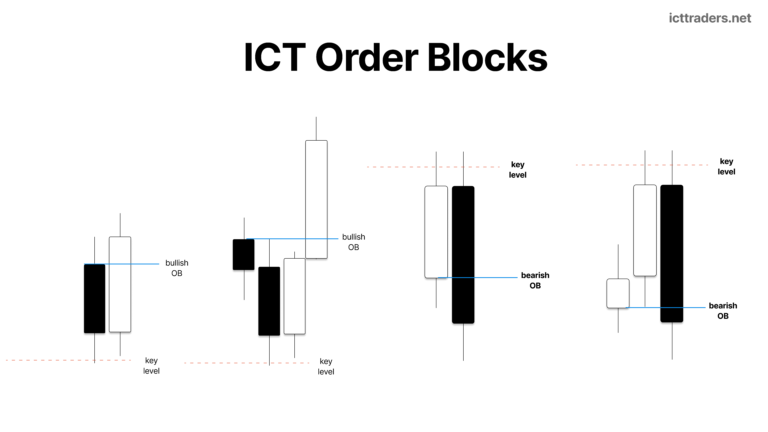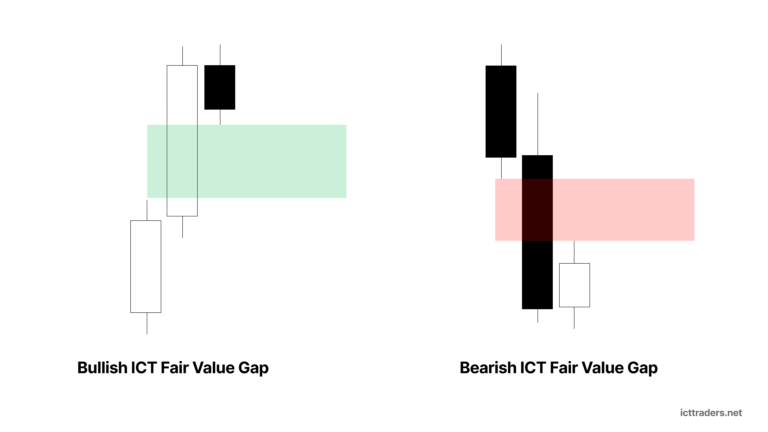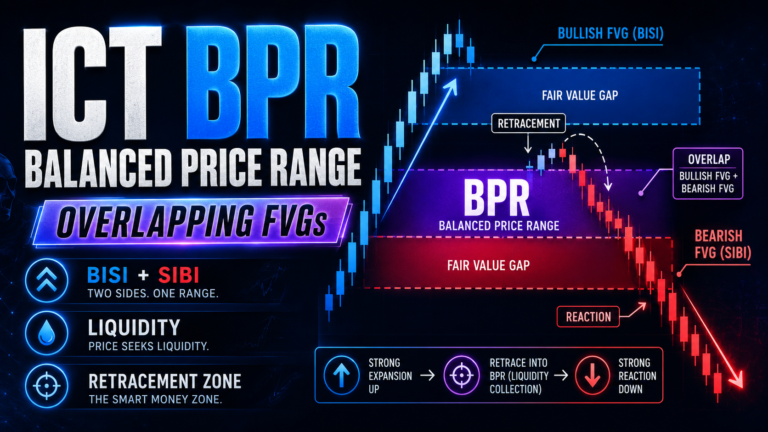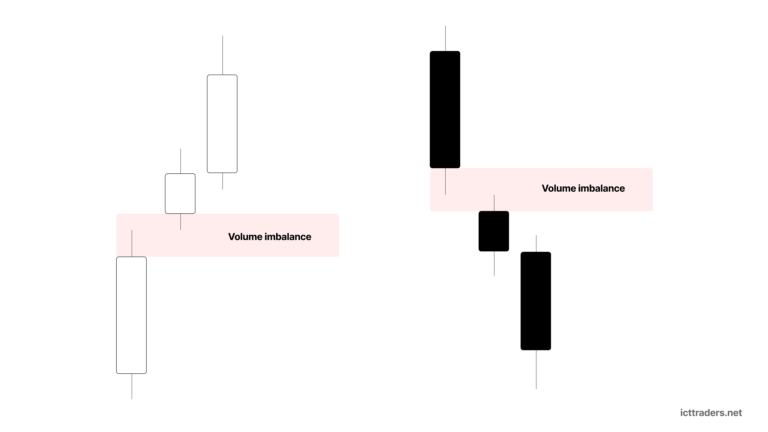
ICT Order Block is one of the most popular concepts used by Inner Circle Trader or ICT traders.
But one common problem is very simple.
Traders mark too many Order Blocks.
Every down-close candle before a bullish move becomes a Bullish Order Block.
Every up-close candle before a bearish move becomes a Bearish Order Block.
Soon the whole chart is filled with ICT Order Blocks.
This makes the concept confusing.
A high-probability ICT Order Block needs more context.
The candle location is important.
The liquidity level is important.
Higher time frame key level is important.
The range used for confirmation is important.
And price must show a clear Change in State of Delivery or CSD.
This article explains how to identify high-probability ICT Order Blocks, different types of ICT Order Blocks and how to use correct timeframe alignment for better trade entries.
What is an ICT Order Block?
An ICT Order Block is an up-close or down-close candle connected with an important change or continuation in price delivery.
In a bullish market, a down-close candle may support higher price delivery.
In a bearish market, an up-close candle may support lower price delivery.
But candle colour alone does not make it a high-probability ICT Order Block.
The candle should form at a meaningful location.
For example–
Previous Session High or Low.
Previous Day High or Low.
Previous Week High or Low.
Previous Month High or Low.
Important range high or low.
Higher time frame Fair Value Gap.
Higher time frame Order Block.
Higher time frame Volume Imbalance.
Another important ICT PD Array.
Price should trade into or through the important area.
Then the trader waits for evidence that the state of price delivery has changed.
The simple idea is–
Important Level → Liquidity Taken → ICT Order Block Candle → CSD → Entry or Retracement
What Makes an ICT Order Block High Probability?
Not every ICT Order Block has the same probability.
A high-probability ICT Order Block normally has several important characteristics.
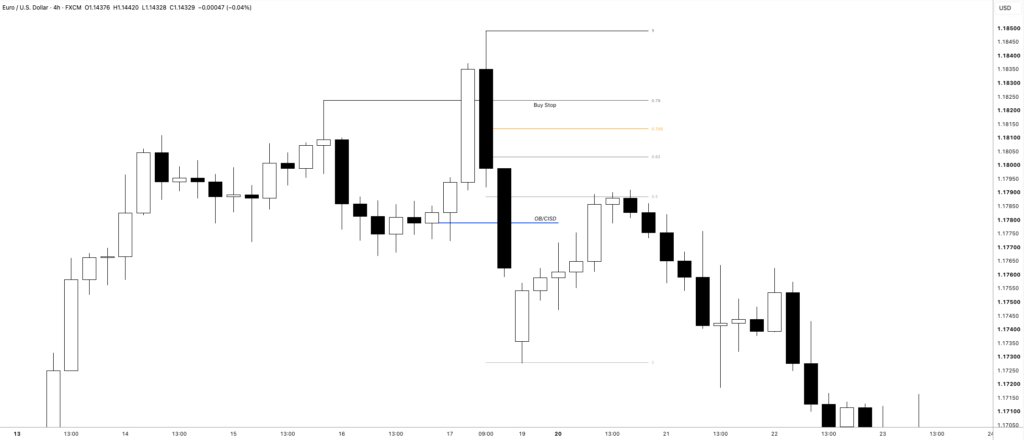
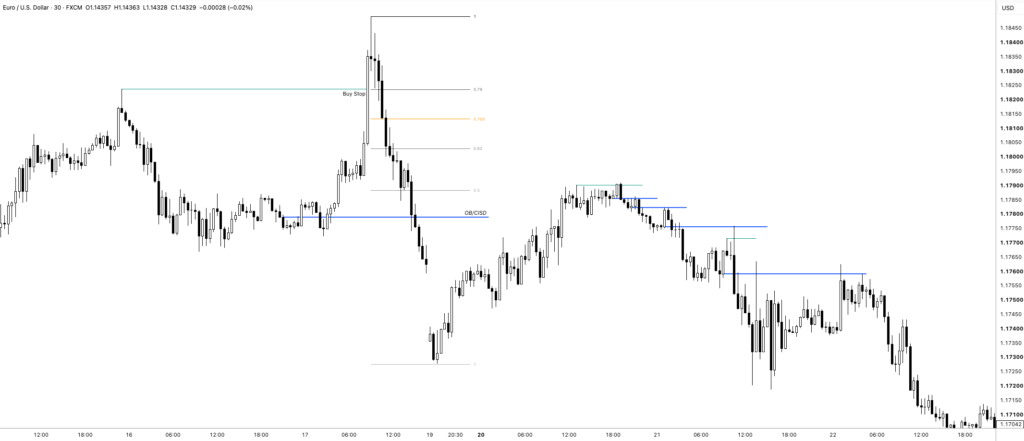
Thick Up-close or Down-close Candle
First look for a thick candle.
For a Bullish ICT Order Block, this is generally a strong down-close candle.
For a Bearish ICT Order Block, this is generally a strong up-close candle.
A thick candle means the body and complete candle range are clearly visible.
The candle should have some importance in the price movement.
A very small random candle inside consolidation may not give the same quality.
The Candle Digs into an Important High or Low
The ICT Order Block candle should trade into an important liquidity level.
For a Bullish ICT Order Block–
The down-close candle may dig into an important low.
For a Bearish ICT Order Block–
The up-close candle may dig into an important high.
The important high or low can be–
Previous Session High or Low.
Previous Day High or Low.
Previous Week High or Low.
Previous Month High or Low.
Important previous swing high or low.
Range Buy-side or Sell-side Liquidity.
The importance of the level gives context to the ICT Order Block.
For example–
Price trades above Previous Month High.
Buy-side Liquidity is taken.
A thick up-close candle forms.
Price then changes its delivery from bullish to bearish.
The up-close candle may become an important Bearish ICT Order Block.
Higher Time Frame Key Level
A high-probability ICT Order Block can also form around a higher time frame key level.
For example–
Monthly Fair Value Gap.
Weekly Fair Value Gap.
Daily Fair Value Gap.
Higher time frame Order Block.
Volume Imbalance.
Important premium or discount PD Array.
The higher time frame level gives the main location.
The lower time frame ICT Order Block gives a more precise trade setup.
This is important.
Do not randomly find an Order Block first.
First find the important market location.
Then find the ICT Order Block inside or around the area.
Fair Value Gap with ICT Order Block
A Fair Value Gap is not compulsory for every ICT Order Block.
An ICT Order Block can work without an FVG.
But if a Fair Value Gap is present with the Order Block, it may add more confluence to the setup.
For example–
Price trades above an important high.
A thick up-close candle forms.
The candle is engulfed.
Bearish displacement creates a Bearish Fair Value Gap.
Now the setup has–
Important liquidity.
Higher time frame location.
Bearish CSD.
Bearish ICT Order Block.
Fair Value Gap.
This can add more value to the trading setup.
Types of ICT Order Blocks
The ICT mainly focuses on three types of ICT Order Blocks.
These are–
Change in State of Delivery Order Block.
Retracement Order Block.
Continuation Order Block.
Each ICT Order Block has a different use.
ICT Change in State of Delivery Order Block
The first type is the ICT Change in State of Delivery Order Block or CSD OB.
This Order Block is used when price changes from one type of delivery into another.
For example–
Price is delivering higher.
Buy-side Liquidity is taken.
An important up-close candle forms.
The complete up-close candle is engulfed towards the downside.
Price delivery changes from bullish to bearish.
The up-close candle becomes the CSD Order Block in the framework explained in the video.
For bullish condition–
Price is delivering lower.
Sell-side Liquidity is taken.
A down-close candle forms.
The complete candle is engulfed towards the upside.
The state of delivery changes from bearish to bullish.
The down-close candle becomes the bullish CSD OB.
The simple bearish flow is–
Important High → Up-close Candle → Entire Candle Engulfed → Bearish CSD → Bearish ICT Order Block
The bullish flow is–
Important Low → Down-close Candle → Entire Candle Engulfed → Bullish CSD → Bullish ICT Order Block
Full Candle Engulfing Rule for CSD Order Block
One important rule explained in the video is full candle engulfing.
Do not only look at the candle body.
The complete candle is used.
This includes the wick.
Suppose a bullish CSD setup is expected.
A thick down-close candle forms at an important low.
The next price movement only wicks above the high of the candle.
But the complete candle has not yet been properly engulfed according to this CSD framework.
The trader waits.
Another candle later completely engulfs the down-close candle.
Now the CSD is confirmed.
This is very important when trading the ICT CSD Order Block model explained in the ICT lecture video .
A simple wick through the candle should not automatically be treated as full CSD confirmation.
The trader wants to see the entire Order Block candle taken.
Immediate ICT Order Block Entry
After the CSD Order Block is confirmed, sometimes price gives an immediate entry.
Suppose price takes an important low.
A thick down-close candle forms.
The entire candle gets engulfed higher.
Price immediately taps the bullish ICT Order Block.
The trader may search for a long entry from the immediate tap.
For bearish condition–
Important high is taken.
Up-close candle forms.
The entire candle gets engulfed lower.
Price immediately taps the bearish ICT Order Block.
A short entry can be searched.
But an immediate tap does not always happen.
Sometimes price expands strongly away.
This leads to the second ICT Order Block entry model.
ICT Retracement Order Block
The Retracement Order Block is used when price moves away from the CSD OB and later returns.
This can provide a low-risk buy or sell opportunity.
Suppose price confirms a Bearish ICT Order Block.
Price immediately sells off.
The trader misses the first entry.
Many beginners now think the trade is gone.
They chase the bearish movement.
But price may make a deep retracement back into the Bearish Order Block.
This retracement can provide another selling opportunity.
The same thing happens with a Bullish ICT Order Block.
Price confirms bullish delivery.
Price expands higher.
Later, price retraces deeply back into the down-close candle.
The return into the Bullish ICT Order Block can give a buying opportunity.
The basic retracement model is–
CSD Order Block → Price Expands Away → Deep Retracement → Return into ICT Order Block → Entry
Why Does Price Make a Deep Retracement into an ICT Order Block?
Deep retracement is one of the important ideas discussed in the ICT lecture video .
Suppose price forms a Bearish ICT Order Block.
After confirmation, price sells aggressively lower.
The trader enters short.
Then price suddenly retraces deeply higher.
It moves back towards the highest up-close candle.
Many traders become afraid.
They think the bearish setup has failed.
Some traders close their short position.
Some move the stop loss to breakeven.
Other traders may even start buying.
Then price reaches the Bearish ICT Order Block and aggressively sells lower.
According to the framework explained in the video, these deep retracements can help engineer liquidity and remove weak hands.
Stops may build around the retracement.
Traders may move out of their original positions.
More liquidity becomes available.
Then price continues towards the original direction.
For this reason, an ICT trader should not automatically fear every deep retracement.
When the higher time frame context and CSD OB remain valid, the deep retracement may create the actual Order Block entry.
Do Not Chase Price Away from the ICT Order Block
Suppose an ICT Order Block is confirmed.
Price immediately expands 50 or 100 points away.
The trader missed the first entry.
Do not chase price only because the movement looks strong.
Mark the ICT Order Block.
Wait.
Price may retrace deeply into the candle.
The retracement can provide a better entry.
For bearish setup–
Wait for the highest important up-close candle.
For bullish setup–
Wait for the lowest important down-close candle.
The strong expansion creates excitement.
The deep retracement creates fear.
The ICT Order Block trader waits for the price area instead of reacting emotionally to both movements.
Correct Timeframe Alignment for ICT Order Blocks
Timeframe alignment is one of the most important parts of this Order Block model.
The trader combines a higher time frame key level with a correctly aligned lower time frame range.
The same lower time frame is also used to identify the CSD Order Block.
The timeframe alignment explained in the ICT is–
Monthly Key Level → Daily Range → Daily CSD Order Block
Weekly Key Level → 4-Hour Range → 4-Hour CSD Order Block
Daily Key Level → 1-Hour Range → 1-Hour CSD Order Block
This timeframe alignment helps to filter unnecessary ICT Order Blocks.
Monthly Key Level and Daily ICT Order Block
Suppose price enters a Monthly Fair Value Gap.
This is the higher time frame key level.
Now move to the Daily chart.
Find a Daily range.
The range should have a connected high and low.
Buy-side Liquidity is present above the range high.
Sell-side Liquidity is present below the range low.
Now use the Daily range to observe the Monthly key level.
Suppose price trades below the Daily range low.
A thick down-close candle forms.
The complete down-close candle is later engulfed higher.
A Daily bullish CSD OB is confirmed.
Now the trader can search for a bullish ICT Order Block entry.
The framework is–
Monthly Key Level → Daily Range Liquidity → Daily CSD → Daily ICT Order Block Entry
Weekly Key Level and 4-Hour ICT Order Block
Suppose price enters a Weekly Fair Value Gap.
The Weekly FVG gives the higher time frame location.
Now move to the 4-hour chart.
Identify a 4-hour range.
Mark the range high.
Mark the range low.
Suppose price trades above the 4-hour range high.
Buy-side Liquidity is taken.
A thick up-close candle forms.
Price then completely engulfs the candle lower.
This creates bearish CSD.
The 4-hour Bearish ICT Order Block can now be used.
The trade framework becomes–
Weekly Key Level → 4-Hour Range Buy-side Liquidity → 4-Hour Bearish CSD → 4-Hour ICT Order Block → Short
Daily Key Level and 1-Hour ICT Order Block
Suppose price reaches a Daily key level.
This may be a Daily Fair Value Gap or Daily Volume Imbalance.
Now move to the 1-hour chart.
Find the important 1-hour range.
Mark Buy-side Liquidity and Sell-side Liquidity.
Suppose price trades below the range low.
A down-close candle forms.
The entire candle is engulfed higher.
Bullish CSD occurs.
The 1-hour Bullish ICT Order Block can now be used for a possible long entry.
The framework is–
Daily Key Level → 1-Hour Range Sell-side Liquidity → 1-Hour Bullish CSD → 1-Hour ICT Order Block → Buy
Why Timeframe Alignment Is Important in ICT Order Block Trading
Suppose price reaches a Daily key level.
The trader immediately moves to the 1-minute or 5-minute chart.
The chart may show many Order Blocks.
Many highs and lows are taken.
Multiple CSD patterns appear.
The trader becomes confused.
This happens because the execution timeframe is too low for the higher time frame level.
Too many false movements may appear.
Too many ICT Order Blocks are marked.
Too many liquidity raids are seen.
On the other side, using a timeframe which is too high can also create a problem.
Price may complete the movement before the trader receives a practical entry.
Correct timeframe alignment creates a balance.
Not too low.
Not too high.
The timeframe should match the higher time frame key level.
This is why the model uses–
Monthly with Daily.
Weekly with 4-Hour.
Daily with 1-Hour.
Timeframe-Aligned ICT Order Block Table
| Higher Time Frame Key Level | Range Timeframe | CSD Order Block |
|---|---|---|
| Monthly | Daily | Daily CSD OB |
| Weekly | 4-Hour | 4-Hour CSD OB |
| Daily | 1-Hour | 1-Hour CSD OB |
The range timeframe and the CSD Order Block timeframe remain aligned.
Do not jump randomly from a Monthly level directly into a 1-minute ICT Order Block.
First understand the correct range.
Then observe the CSD OB on the aligned timeframe.
What Is an ICT Continuation Order Block?
The third type is the ICT Continuation Order Block.
This type is used with higher time frame institutional order flow.
In a bearish market, up-close candles may support lower price delivery.
In a bullish market, down-close candles may support higher price delivery.
These Order Blocks are not necessarily used to catch a major reversal.
They are used to join the existing market direction.
For bearish continuation–
Bearish order flow is present.
Highs are being rejected.
Lows are being broken.
Bearish Fair Value Gaps are holding.
An up-close candle is engulfed lower.
Price retraces into the up-close candle.
The candle supports price lower.
A bearish continuation trade can be searched.
For bullish continuation–
Bullish order flow is present.
Lows are being rejected.
Highs are being broken.
Bullish Fair Value Gaps are holding.
A down-close candle is engulfed higher.
Price retraces into the down-close candle.
The candle supports price higher.
A bullish continuation trade can be searched.
How ICT Continuation Order Blocks Show Order Flow
Continuation ICT Order Blocks can also be used to probe order flow.
Suppose the market is bearish.
Price repeatedly shows the following behaviour–
Up-close candle forms.
The candle is engulfed lower.
Price retraces into the candle.
The up-close candle rejects price.
Market continues lower.
Then another up-close candle forms.
The same process repeats.
This shows bearish price delivery.
Up-close candles are supporting lower prices.
Now suppose price reaches an opposing Monthly discount key level.
The market begins changing.
Down-close candles start getting engulfed higher.
Price retraces into these down-close candles.
The candles start supporting price higher.
This can show the development of bullish order flow.
So ICT Order Blocks are not only entry zones.
The reaction from consecutive up-close or down-close candles can help the trader understand current price delivery.
Singular CSD Order Block vs Collection of Candles
Many ICT traders mark a collection of up-close or down-close candles as one Order Block.
The video explains a more selective approach.
The main focus is on the singular CSD OB.
For bullish condition–
Focus on the important single down-close candle.
For bearish condition–
Focus on the important single up-close candle.
When the correct higher time frame key level, aligned range and CSD are present, a large collection of candles may not be required.
This gives a more precise ICT Order Block level.
However, the collection may sometimes become useful when SMT is present.
For example–
One correlated asset trades deeper into the singular down-close candle.
Another asset only reacts from the candle collection.
The difference between the correlated assets may provide SMT information.
In this specific condition, the wider collection can be considered.
But the primary focus remains the singular CSD Order Block.
ICT Order Block and SMT
SMT can become important when a CSD Order Block setup does not give the exact expected entry.
Suppose two correlated markets are being studied.
For example–
NQ and ES.
NQ trades deeply into a bullish CSD Order Block.
ES does not trade into the same relative area.
Or one market takes important liquidity while the correlated asset fails to take the corresponding liquidity.
This difference can give SMT divergence.
SMT may explain why one ICT Order Block appears slightly different from another correlated market.
For this reason, traders using NQ, ES or other correlated assets can compare both markets before ignoring a CSD OB setup.
How to Trade a Bullish ICT Order Block
The following is a simple bullish ICT Order Block process.
Step 1– Find a Higher Time Frame Key Level
Look for an important Monthly, Weekly or Daily key level.
For example–
Monthly Fair Value Gap.
Weekly Order Block.
Daily Volume Imbalance.
Important higher time frame discount area.
Step 2– Select the Correct Timeframe
Use the timeframe alignment.
Monthly level– Use Daily range.
Weekly level– Use 4-hour range.
Daily level– Use 1-hour range.
Step 3– Find Sell-side Liquidity
Mark the important range low.
Previous Session Low, Previous Day Low or another important low may also be present.
Wait for price to dig into the low.
Step 4– Find the Thick Down-close Candle
Observe the down-close candle which trades into the important low or higher time frame key level.
Mark the entire candle.
Include the wick for the CSD engulfing framework explained in the video.
Step 5– Wait for Bullish CSD
Price should engulf the complete down-close candle.
A simple wick above the candle is not enough for this model.
Wait for the complete candle to be engulfed.
Now bullish state of delivery is confirmed.
Step 6– Look for Immediate Tap or Retracement
Price may immediately tap the Bullish ICT Order Block.
This can give the first entry.
If price expands strongly higher, do not chase.
Wait for a deep retracement into the down-close candle.
Step 7– Enter with Bullish Order Flow
When price returns into the ICT Order Block and the bullish narrative remains valid, a long entry can be searched.
The expected direction is towards higher liquidity.
How to Trade a Bearish ICT Order Block
For a bearish ICT Order Block, reverse the process.
Step 1– Find Higher Time Frame Key Level
Look for a Monthly, Weekly or Daily premium key level.
For example–
Monthly Fair Value Gap.
Weekly Bearish Order Block.
Daily Volume Imbalance.
Important higher time frame premium area.
Step 2– Use Correct Timeframe Alignment
Monthly key level– Daily range.
Weekly key level– 4-hour range.
Daily key level– 1-hour range.
Step 3– Find Buy-side Liquidity
Mark the important range high.
Previous Session High, Previous Day High or another major high may also become important.
Wait for price to dig into Buy-side Liquidity.
Step 4– Find the Thick Up-close Candle
Mark the important up-close candle which trades into the high.
Use the entire candle.
Step 5– Wait for Bearish CSD
The complete up-close candle should be engulfed lower.
Now price is changing from bullish delivery into bearish delivery.
The Bearish CSD OB is confirmed.
Step 6– Wait for the Order Block Entry
An immediate tap may occur.
If no immediate entry is offered, wait for price to retrace.
A deep retracement back into the highest up-close candle may provide the short entry.
Step 7– Trade with Bearish Order Flow
Enter according to the trading plan.
The expectation is lower price delivery towards Sell-side Liquidity.
Example of Bullish ICT Order Block Setup
Suppose NQ trades into a Daily bullish key level.
According to timeframe alignment, move to the 1-hour chart.
A clear 1-hour range is present.
Price trades below the range low.
Sell-side Liquidity is taken.
A thick 1-hour down-close candle forms.
The next bullish movement initially only wicks above the candle.
The complete candle is not yet engulfed.
Do not enter.
Price moves lower again.
Another important down-close candle forms.
Now a bullish candle completely engulfs the full down-close candle.
Bullish CSD occurs.
The Bullish ICT Order Block is confirmed.
Price may immediately tap the Order Block.
A long entry can be searched.
If price expands without an entry, wait for a deep retracement.
Price returns to the down-close candle.
The bullish ICT Order Block supports higher price delivery.
The target can be Buy-side Liquidity above the range.
Example of Bearish ICT Order Block Setup
Suppose NQ trades into a Weekly Fair Value Gap.
Now use a 4-hour range.
The 4-hour range has a clear high and low.
Price trades above the range high.
Buy-side Liquidity is taken.
A thick up-close candle forms.
The entire candle is later engulfed lower.
Bearish CSD occurs.
The 4-hour Bearish ICT Order Block is confirmed.
Price sells lower.
The trader misses the first entry.
Do not chase.
Price makes a deep retracement.
It returns into the highest up-close candle.
The Bearish ICT Order Block supports price lower.
A short entry can be searched towards Sell-side Liquidity.
Rules of High-Probability ICT Order Blocks
The important ICT Order Block rules from this framework are–
Rule 1– Start with an important level
Do not mark a random Order Block in the middle of price action.
Use important Session, Daily, Weekly or Monthly highs and lows.
Higher time frame key levels can also be used.
Rule 2– Look for a thick candle
Use an important thick up-close or down-close candle.
Avoid treating every small candle as a high-probability ICT Order Block.
Rule 3– The candle should dig into liquidity
Bullish setups should connect with important lows.
Bearish setups should connect with important highs.
Rule 4– Use correct timeframe alignment
Monthly Key Level → Daily CSD OB.
Weekly Key Level → 4-Hour CSD OB.
Daily Key Level → 1-Hour CSD OB.
Rule 5– Use the entire candle for CSD engulfing
The full candle, including the wick, should be engulfed in this model.
A wick through the candle is not the same confirmation.
Rule 6– Do not chase expansion
If the immediate ICT Order Block entry is missed, wait for retracement.
Rule 7– Expect deep retracement
Price may retrace deeply into the highest up-close or lowest down-close candle.
Do not automatically treat the retracement as failure.
Rule 8– Trade with higher time frame order flow
Use bullish continuation Order Blocks in bullish markets.
Use bearish continuation Order Blocks in bearish markets.
Rule 9– Fair Value Gap adds confluence
An FVG is not compulsory.
But an ICT Order Block with a supporting FVG may increase the quality of the setup.
Rule 10– Focus on singular CSD OB
Do not automatically mark a large candle collection.
Use the important single CSD Order Block when the full framework is present.
Common ICT Order Block Mistakes
Marking every opposite candle– This creates too many Order Blocks.
Ignoring liquidity– The trader does not check whether an important high or low was taken.
No higher time frame key level– A random lower time frame Order Block is traded.
Wrong timeframe alignment– Trader jumps from Monthly directly to 1-minute chart.
Using body engulf only– The complete candle is ignored in the CSD framework.
Entering after a wick– Trader enters before the full candle is engulfed.
Chasing displacement– Price expands and the trader enters far away from the Order Block.
Fearing deep retracement– Trader closes before price reaches the actual ICT Order Block.
Moving stop too early– The stop is moved to breakeven during a normal deep retracement.
Ignoring higher time frame order flow– Bullish OBs are bought during strong bearish continuation or bearish OBs are sold during strong bullish delivery.
Simple ICT Order Block Checklist
Before taking an ICT Order Block trade, check–
What is the higher time frame key level?
Is it Monthly, Weekly or Daily?
What is the correct aligned range timeframe?
Where is the range high?
Where is the range low?
Where is Buy-side Liquidity?
Where is Sell-side Liquidity?
Has price taken an important high or low?
Is there a thick up-close or down-close candle?
Has the entire candle been engulfed?
Has Change in State of Delivery occurred?
Is there an FVG with the ICT Order Block?
Is an immediate tap available?
Has price already expanded away?
Should I wait for a deep retracement?
Is the ICT Order Block aligned with higher time frame order flow?
Where is the final liquidity target?
If the complete narrative is not clear, the ICT Order Block can be avoided.
Final Concept
ICT Order Block trading should not be based on finding every last opposite candle.
First find an important higher time frame key level.
Then use the correct timeframe-aligned range.
Monthly key level uses Daily range and Daily CSD OB.
Weekly key level uses 4-hour range and 4-hour CSD OB.
Daily key level uses 1-hour range and 1-hour CSD OB.
Mark the important range liquidity.
Wait for price to dig into an important high or low.
Find the thick up-close or down-close candle.
Wait for the complete candle to be engulfed.
This shows the Change in State of Delivery in the framework explained here.
Then look for the ICT Order Block entry.
Sometimes price gives an immediate tap.
Other times price expands away and later makes a deep retracement.
Do not chase price.
Wait for the return into the ICT Order Block.
For continuation setups, follow the higher time frame order flow.
Bullish market–
Down-close candles can support price higher.
Bearish market–
Up-close candles can support price lower.
The simple ICT Order Block model is–
Higher Time Frame Key Level → Correct Timeframe Range → Important Liquidity → Thick Candle → Full Candle Engulfed → CSD → ICT Order Block → Immediate Tap or Deep Retracement → Entry
Do not mark more Order Blocks.
Mark better ICT Order Blocks.