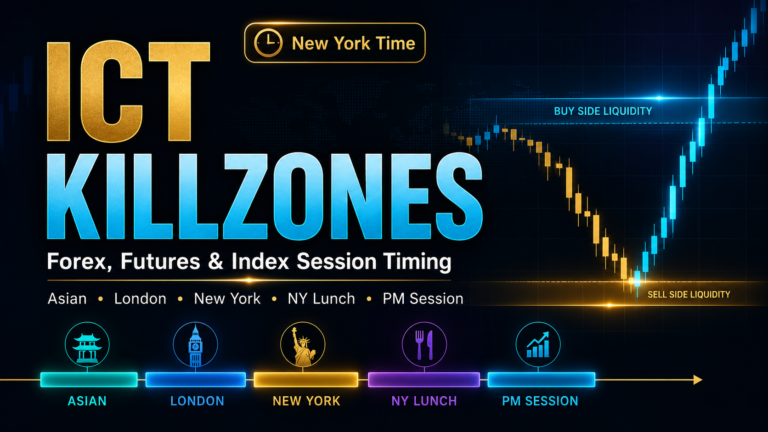
ICT Silver Bullet is a time-based trading model used to find short-term intraday trade setup.
The model does not require the trader to search setup for whole day.
Instead of watching every market movement, trader focuses on three specific one-hour time windows.
During these time windows, price may create a Fair Value Gap and move towards a liquidity objective.
The main concept is simple.
Find where price likely wants to go.
Wait for the Silver Bullet time.
Look for displacement and Fair Value Gap.
Then use the retracement into the Fair Value Gap for trade entry.
What is ICT Silver Bullet?
ICT Silver Bullet is a time-based ICT trading model.
It mainly combines time, liquidity and Fair Value Gap.
The trader first identifies the expected Draw on Liquidity.
After this, price is observed during the specific Silver Bullet time window.
When price creates displacement in the expected direction and forms a Fair Value Gap, the gap can be used as entry area.
So Silver Bullet is not only an FVG setup.
Time is important.
The Fair Value Gap should form during the Silver Bullet window and support the expected price direction.
ICT Silver Bullet Time Windows
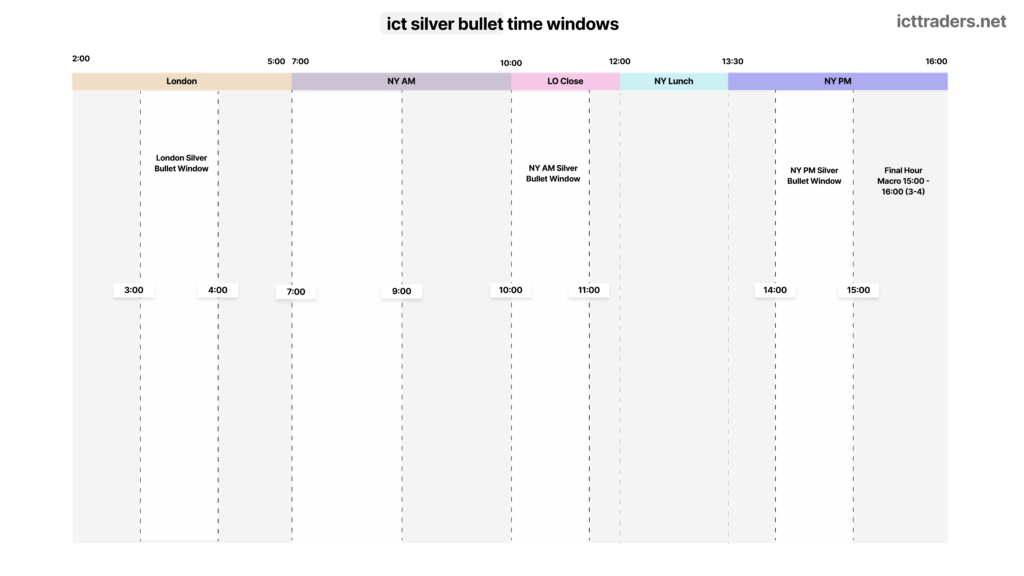
There are three main Silver Bullet windows.
All times are based on New York local time.
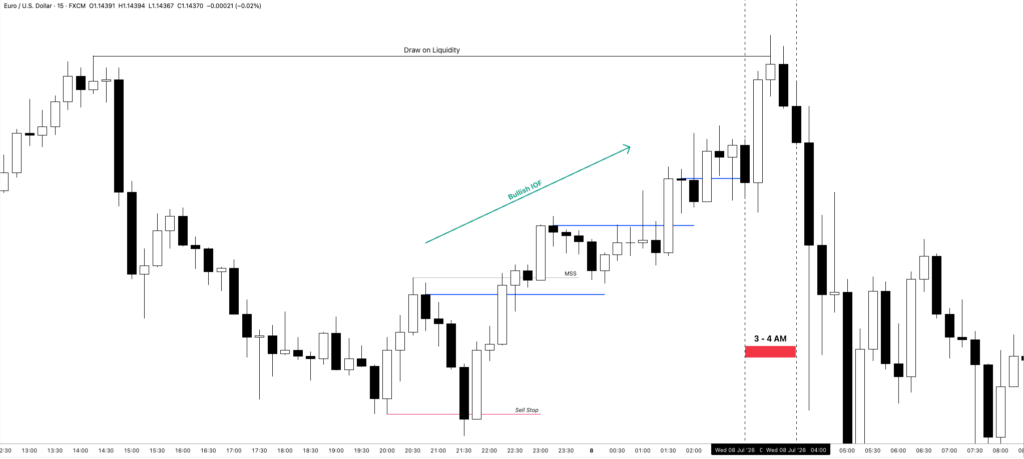
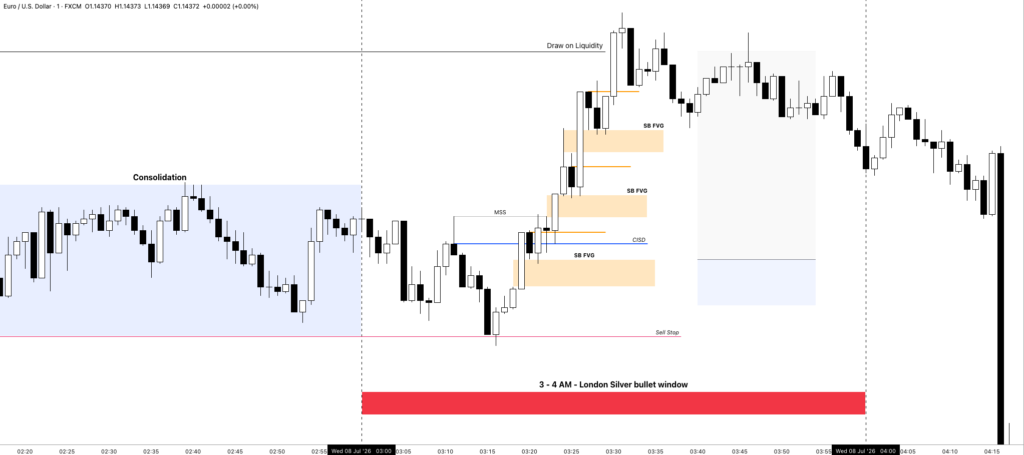
London Open Silver Bullet– 03:00 to 04:00
This window occurs around London Open movement.
Mainly useful for Forex pairs.
EUR/USD and GBP/USD may show good movement during this period.
New York AM Silver Bullet– 10:00 to 11:00
This is the New York morning Silver Bullet window.
It occurs after the 09:30 New York equity open.
Useful for NQ, ES and other indices.
Forex and Gold may also form Silver Bullet setup during this time.
New York PM Silver Bullet– 14:00 to 15:00
This is the New York afternoon Silver Bullet window.
Price may use the morning or lunch session liquidity for its PM movement.
It can give continuation or reversal setup according to the Draw on Liquidity.
The trader should use New York local time on chart.
Do not treat GMT-4 as fixed for whole year because New York time changes between daylight and standard time.
Main Idea of Silver Bullet
The main question before trading Silver Bullet is–
Where does price want to go next?
This is called Draw on Liquidity or DOL.
Price may be attracted towards a previous high or low.
The following liquidity levels can be observed–
Previous Day High– Buy-side liquidity may remain above this level.
Previous Day Low– Sell-side liquidity may remain below this level.
Previous Week High or Low– Important higher time frame liquidity level.
Previous Session High or Low– Asian, London or New York session liquidity.
Equal Highs or Equal Lows– Multiple highs or lows where liquidity may be present.
Intraday Swing High or Low– Short-term liquidity level formed during the current day.
Before Silver Bullet time starts, trader should have an idea about the next possible Draw on Liquidity.
Without a clear target, every FVG may look like a setup.
Step 1– Find the Draw on Liquidity
First look at the higher and intraday time frame.
Identify important liquidity above and below current price.
Suppose price is trading below the Previous Day High.
The market is bullish and price is showing upward delivery.
Previous Day High may become the Draw on Liquidity.
So the trader develops bullish expectation.
Now only bullish Silver Bullet setup is mainly searched.
For bearish condition, price may show weakness and Sell-side Liquidity can be the next objective.
In this case, trader searches bearish setup.
This gives one-sided trading narrative.
Step 2– Wait for the Silver Bullet Time
After finding the expected direction, wait for the correct Silver Bullet time window.
For example–
New York AM Silver Bullet starts at 10:00.
The trader should not take a random FVG at 09:15 and call it a Silver Bullet.
The time window is part of the model.
From 10:00 to 11:00, price is observed for the setup.
If no proper setup forms, no Silver Bullet trade is taken.
Do not force a trade only because the time window is active.
Step 3– Observe Liquidity Movement
During or before the Silver Bullet window, price may attack liquidity.
For a bullish setup, price may move below a short-term low and take Sell-side Liquidity.
After taking the low, price can reverse higher.
For a bearish setup, price may move above a short-term high and take Buy-side Liquidity.
Then price can reverse lower.
This liquidity raid can provide a good setup condition.
But liquidity sweep alone is not the entry.
The trader still waits for proper price delivery and Fair Value Gap.
Also every Silver Bullet does not need the exact same liquidity sweep pattern.
The important point is understanding the next likely Draw on Liquidity.
Step 4– Wait for Displacement
After the liquidity movement, trader looks for displacement.
Displacement means a strong and aggressive movement in one direction.
For bullish condition–
Price moves strongly higher.
Large bullish candle may form.
A short-term high may be broken.
Imbalance develops between candles.
For bearish condition–
Price moves strongly lower.
Large bearish candle may appear.
A short-term low can be broken.
Imbalance forms during the movement.
Displacement shows that price is repricing strongly towards one direction.
A weak and overlapping price movement is generally not preferred.
Step 5– Find the Fair Value Gap
During the displacement, a Fair Value Gap may form.
Fair Value Gap is a three-candle price formation.
In bullish FVG, there is an imbalance between the high of Candle 1 and low of Candle 3.
In bearish FVG, imbalance remains between the low of Candle 1 and high of Candle 3.
The trader marks this imbalance area.
For a proper Silver Bullet setup, the Fair Value Gap should form during the Silver Bullet time window.
The FVG should also support the expected Draw on Liquidity.
Do not select every small FVG present on chart.
The FVG should be connected with meaningful displacement.
Step 6– Wait for Retracement into FVG
After forming the Fair Value Gap, price may retrace back into the imbalance.
This retracement gives the possible entry.
For bullish Silver Bullet–
Price forms bullish displacement.
Bullish FVG appears.
Price retraces lower into the FVG.
Trader searches buy entry.
For bearish Silver Bullet–
Price forms bearish displacement.
Bearish FVG appears.
Price retraces higher into the FVG.
Trader searches sell entry.
The trader does not need to chase the displacement candle.
Wait for price to return into the Fair Value Gap.
If price never returns, the entry may be missed.
No need to enter late only because the market is already moving towards the target.
Bullish ICT Silver Bullet Setup
A bullish Silver Bullet can develop in the following way–
First, bullish Draw on Liquidity is identified.
A liquidity target is present above price.
Silver Bullet time window starts.
Price may move lower and attack Sell-side Liquidity.
After this, strong bullish displacement occurs.
A bullish Fair Value Gap is formed during the Silver Bullet window.
Price retraces into the bullish FVG.
Buy entry is searched from the FVG.
Stop loss can be placed below the important swing low or the level which invalidates the bullish idea.
Target is placed towards the expected Buy-side Liquidity or Draw on Liquidity.
The basic flow is–
Sell-side Liquidity → Bullish Displacement → Bullish FVG → Retracement → Buy → Buy-side Liquidity
Bearish ICT Silver Bullet Setup
A bearish Silver Bullet works in the opposite direction.
First, bearish Draw on Liquidity is identified.
A liquidity objective is present below price.
During Silver Bullet time, price may attack Buy-side Liquidity.
Price then shows strong bearish displacement.
A bearish Fair Value Gap forms.
Price retraces higher into the bearish FVG.
Sell entry is searched from the gap.
Stop loss can be placed above the important swing high or bearish invalidation level.
Target is the expected Sell-side Liquidity.
The basic flow is–
Buy-side Liquidity → Bearish Displacement → Bearish FVG → Retracement → Sell → Sell-side Liquidity
Example of New York AM Silver Bullet
Suppose NQ is trading below an important intraday high.
Higher time frame and intraday price action show bullish condition.
The high above price is expected to be the Draw on Liquidity.
At 09:30, New York equity market opens.
Price becomes volatile and moves lower.
A short-term low is taken.
The trader does not immediately buy.
At 10:00, the New York AM Silver Bullet window starts.
Price gives strong bullish displacement.
A short-term high is broken and bullish Fair Value Gap forms.
Now the FVG is marked.
Price retraces lower into the gap.
A bullish entry can be searched.
Stop loss is placed below the important swing low or another logical invalidation point.
The target is the liquidity above price.
The trader is not buying only because price swept a low.
The trade is based on–
Bullish Draw on Liquidity.
Correct Silver Bullet time.
Bullish displacement.
Fair Value Gap.
Retracement entry.
Liquidity target.
Which Time Frame to Use?
Higher time frame can be used to find market direction and liquidity.
Daily chart– Used for higher time frame liquidity and daily direction.
4-hour chart– Used for larger dealing range and important PD Arrays.
1-hour chart– Used for intraday structure and important levels.
15-minute chart– Used to mark session highs, lows and intraday liquidity.
For Silver Bullet execution, lower time frame is mainly used.
5-minute chart– Gives cleaner structure and less noise.
3-minute chart– Useful for more detailed Silver Bullet execution.
1-minute chart– Gives precise FVG and entry but contains more market noise.
Beginner trader can first study the setup on 5-minute chart.
After understanding the model properly, 3-minute or 1-minute execution can be observed.
Is Liquidity Sweep Compulsory?
Many traders think every Silver Bullet must start with a liquidity sweep.
This can create confusion.
Liquidity raid is an important and common price action condition.
It can create a strong reversal setup.
But the main Silver Bullet framework is based on time, expected Draw on Liquidity and a Fair Value Gap formed with meaningful price delivery.
The trader should not mechanically search–
Sweep → MSS → FVG
on every day.
First understand where price likely wants to go.
Then observe how price delivers during the Silver Bullet window.
A liquidity sweep can give additional confirmation.
But the whole market narrative should not depend only on seeing one candle move above or below a previous high or low.
Market Structure Shift and Silver Bullet
Market Structure Shift or MSS can also help in Silver Bullet execution.
Suppose Sell-side Liquidity is taken.
Price then strongly moves higher and breaks a short-term high.
This can show bullish Market Structure Shift.
If bullish displacement creates an FVG, the retracement into the gap can give entry.
For bearish setup–
Buy-side Liquidity is taken.
Price moves aggressively lower.
A short-term low is broken.
Bearish FVG forms.
The retracement can give sell entry.
MSS should come with displacement.
A small weak break without strong repricing may not give the same confirmation.
Stop Loss Placement
Stop loss should be placed at a logical invalidation point.
Do not place stop only according to random number of points.
For bullish setup, stop can be placed below the swing low responsible for the bullish movement.
For bearish setup, stop can be placed above the important swing high.
The stop position should represent invalidation of the trading idea.
If price aggressively moves through the level and continues against the expected Draw on Liquidity, the original setup may be wrong.
Risk should be calculated before entering the trade.
Target Selection
The target should be identified before taking entry.
Common targets include–
Previous Day High.
Previous Day Low.
Asian High or Low.
London High or Low.
New York intraday High or Low.
Equal Highs.
Equal Lows.
Short-term Buy-side Liquidity.
Short-term Sell-side Liquidity.
The main objective is to trade towards the Draw on Liquidity.
Do not enter from FVG first and then randomly search a target.
Target should already be part of the market narrative.
Common Mistakes in ICT Silver Bullet
Trading outside the time window– A similar FVG setup outside the Silver Bullet time is not the same time-based model.
Taking every FVG– Not every Fair Value Gap is a valid entry. The FVG should support the expected price delivery.
No Draw on Liquidity– Trader enters without knowing where price may move.
Entering only from liquidity sweep– A swept high or low alone is not enough for entry.
Ignoring displacement– Weak price movement and small random FVG may give poor setup.
Chasing price– Trader enters after price already expanded away from the FVG.
Changing bias continuously– Trader buys, then sells and again buys during the same session.
Forcing daily trade– Some market or session may not give a clean Silver Bullet setup.
Simple ICT Silver Bullet Checklist
Before taking the trade, check–
What is the higher time frame condition?
Where is the Draw on Liquidity?
Which liquidity is above price?
Which liquidity is below price?
Is the Silver Bullet time window active?
Did meaningful displacement occur?
Did a Fair Value Gap form during the window?
Does the FVG support the expected Draw on Liquidity?
Has price retraced into the FVG?
Where is the invalidation point?
Where is the final liquidity target?
If the setup does not answer these questions clearly, the trade can be avoided.
Final Concept
ICT Silver Bullet is a time-based trading model.
The trader does not need to trade whole day.
First find the Draw on Liquidity.
Then wait for one of the Silver Bullet time windows.
03:00 to 04:00 for London Open.
10:00 to 11:00 for New York AM.
14:00 to 15:00 for New York PM.
During the window, observe price delivery.
Look for displacement towards the expected direction.
Mark the Fair Value Gap formed during the movement.
Wait for retracement into the gap.
Enter towards the Draw on Liquidity.
The simple Silver Bullet idea is–
Time Window → Draw on Liquidity → Displacement → FVG → Retracement Entry → Liquidity Target
The main advantage is focus.
Instead of finding a setup in every candle, the trader waits for a specific time and specific price condition.
Wait for the time.
Know the target.
Find the FVG.
Then trade towards liquidity.