The ICT Breaker Block is an important price action concept taught by ICT (Inner Circle Trader). It is mainly used to find a potential trade setup after liquidity has been taken and the market shows a clear shift in price direction.
At first, a Breaker Block may look like a normal support or resistance level. Price breaks a level and later comes back to the same area. But in the ICT concept, there is a deeper logic behind this price movement.
The market first runs a pool of liquidity. Traders become trapped on the wrong side of the market. Price then quickly reprices in the opposite direction and breaks an important short-term swing. When price later returns to that swing area, the orders inside the area may be mitigated.
This area is known as an ICT Breaker Block.
What is an ICT Breaker Block?
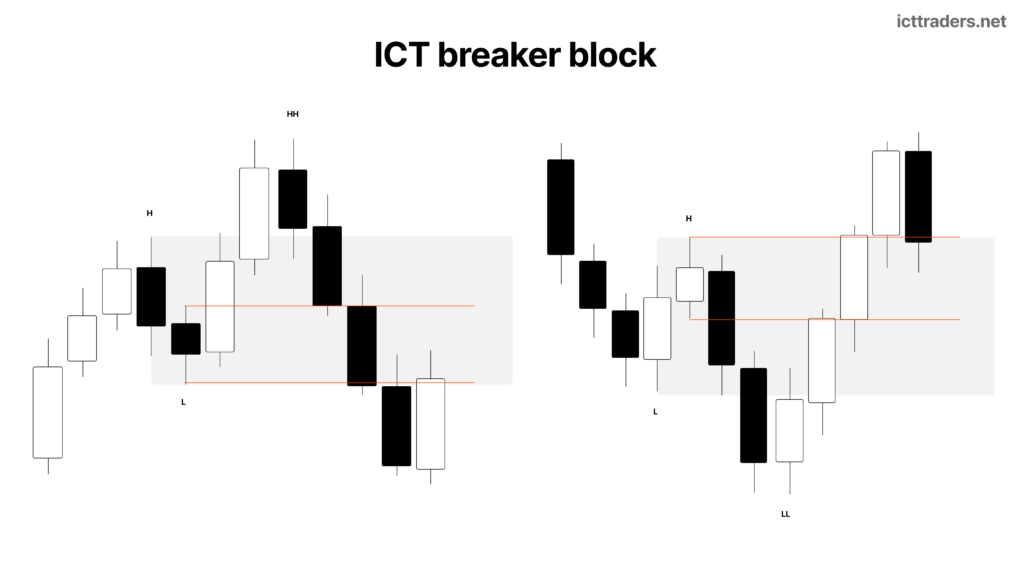
An ICT Breaker Block is a price range formed around a previous short-term swing high or swing low after liquidity is taken and market structure shifts in the opposite direction.
In a bullish condition, price first trades below an old low and takes the sell stops resting below it. The market then rallies and trades above the short-term high located between the two lows.
That old short-term high becomes the area of interest.
When price retraces back into this range, the old resistance area may act as support. This becomes a Bullish ICT Breaker Block.
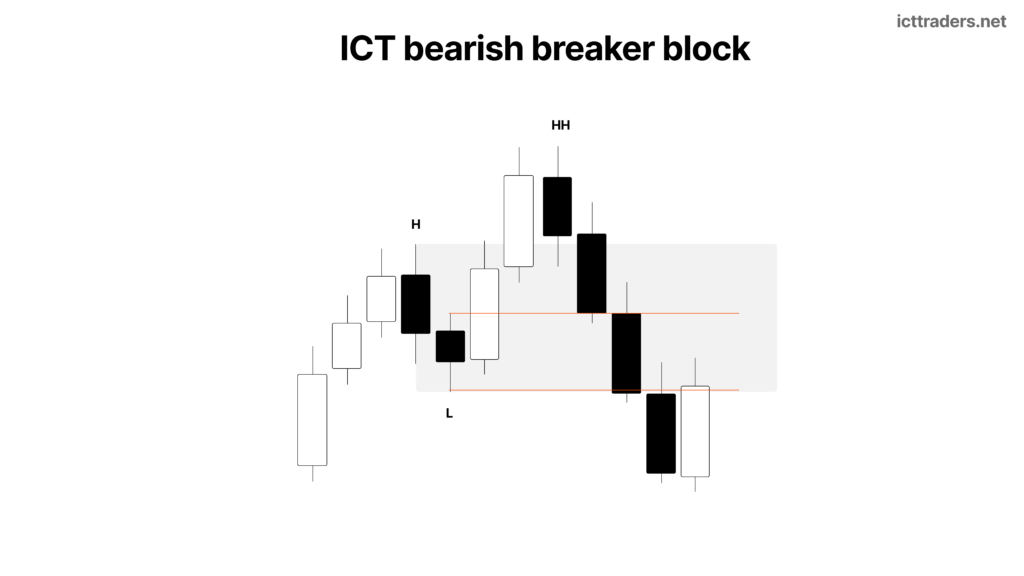
In a bearish condition, price first trades above an old high and takes the buy stops resting above it. The market then reprices lower and breaks the short-term low located between the two highs.
That previous swing low becomes the area of interest.
When price retraces back into the range, the old support area may act as resistance. This becomes a Bearish ICT Breaker Block.
So, an ICT Breaker Block is not identified only because a support or resistance level has broken. A liquidity raid and market structure shift must form the storyline behind the setup.
Why Does an ICT Breaker Block Form?
According to the ICT (Inner Circle Trader) concept, a Breaker Block is related to liquidity and mitigation of previous orders.
Suppose price creates a short-term low. Below this low, sell stops are normally expected to rest. These stops may include stop losses of traders holding long positions and sell stop orders from breakout traders.
Price trades below the old low and takes this sell-side liquidity.
Some traders may see the breakdown and enter short positions. But instead of continuing lower, price quickly moves higher.
The sellers who entered around the lower price area may now become trapped.
When price creates a strong range expansion higher and breaks the previous short-term high, the market has shown a change in price structure.
The previous swing high becomes important because selling orders associated with the previous move may still need to be mitigated.
When price returns to the swing high area, these previous sell positions may be reduced or closed and buying may replace them.
This mitigation process is the logic behind a Bullish ICT Breaker Block.
The same process occurs in reverse for a bearish breaker. Buy-side liquidity is taken above an old high, buyers become trapped and price sharply reprices lower. When the short-term swing low is violated, the market confirms bearish structure. A later retracement into the old swing low provides the bearish Breaker Block area.
Types of ICT Breaker Block
There are mainly two types of ICT Breaker Block:
- Bullish Breaker Block
- Bearish Breaker Block
Both formations follow the same general liquidity logic. The main difference is the direction of the liquidity raid and subsequent market structure shift.
Bullish ICT Breaker Block
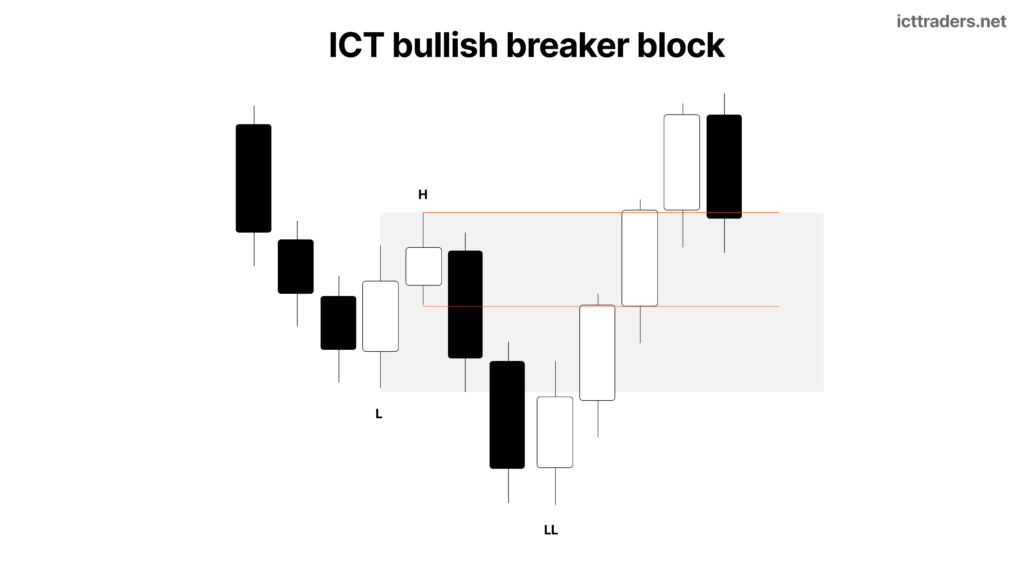
A Bullish ICT Breaker Block forms when price takes sell-side liquidity below an old low and then creates a strong market structure shift to the upside.
The important formation starts with two lows.
Price creates an initial short-term low. After some upward movement, a short-term high is formed. Price then trades lower again and violates the previous low.
Sell stops below the old low are taken.
At this point, traders should not immediately assume that price will move higher. The liquidity raid itself is not enough to confirm the Breaker Block.
ICT explains that traders should wait for a significant repricing higher.
Price must move upward and violate the short-term high located between the two lows.
This break of the swing high supports a bullish market structure shift.
The swing high area now becomes the focus.
When price retraces back into the old swing high, the range may act as support. This area is the Bullish ICT Breaker Block.
Bullish ICT Breaker Block Formation
The basic formation is:
Old Low → Short-Term High → Sell-Side Liquidity Raid → Bullish Repricing → Short-Term High Broken → Retracement to Breaker → Expansion Higher
The short-term high between the two lows is very important.
One low must be traded below and sell stops must be taken. After this, price must run through the short-term high between the two lows.
The previously respected resistance is broken and may later act as support.
This is the basic logic of a Bullish ICT Breaker Block.
How to Identify a Bullish ICT Breaker Block on Chart
First, find an old low or short-term low on the chart.
Look below the low and consider the sell-side liquidity resting in this area.
Wait for price to trade below the old low.
The move below the low may appear as a false breakout or a Turtle Soup type liquidity raid.
After sell stops are taken, observe the reaction of price.
Price should show a significant move higher. A weak bounce is not the main confirmation explained in the ICT lesson.
Find the short-term swing high located between the two lows.
Wait for price to trade above this high.
The movement above the swing high confirms the bullish market structure shift and repricing higher.
Now mark the relevant bullish range or up-close candle associated with the most recent swing high before the old low was violated.
In the chart example explained by ICT, attention is given to the last up candle at the highest point before the drop that took the sell stops.
The entire range of the candle is used as the Breaker Block area.
Wait for price to retrace into this range.
The retracement into the old swing high area is where a potential bullish trade setup may be considered.
Rules of Bullish ICT Breaker Block
A valid Bullish ICT Breaker Block should have a clear sell-side liquidity raid.
An old low should be violated. There should be sell stops resting below the low that price can trade into.
A short-term high must exist between the two lows.
Price must show significant repricing higher after the sell stops are taken.
The short-term high between the lows must be violated.
This break supports the bullish market structure shift.
The Breaker Block is located around the relevant bullish range or up-close candle at the previous swing high.
Price should retrace back into the Breaker Block after the bullish structure shift.
The expected price delivery is a range expansion higher towards a higher objective or liquidity level.
Without the break of the short-term high, the bullish Breaker Block is not properly confirmed.
Bearish ICT Breaker Block
A Bearish ICT Breaker Block forms when price trades above an old high, takes buy-side liquidity and then creates a strong market structure shift lower.
The formation normally contains two highs with a short-term swing low between them.
Price first creates an old high.
The market trades lower and creates a swing low. Later price moves higher again and trades above the previous high.
Buy stops above the old high are taken.
Buyers may enter the market because they believe price has created a bullish breakout.
But price rejects the higher price and quickly reprices lower.
The short-term swing low between the two highs is then violated.
This break confirms a bearish market structure shift.
The previous swing low becomes the main area of interest.
When price retraces back into this range, it may act as resistance.
This area is known as the Bearish ICT Breaker Block.
Bearish ICT Breaker Block Formation
The basic formation is:
Old High → Short-Term Low → Buy-Side Liquidity Raid → Bearish Repricing → Short-Term Low Broken → Retracement to Breaker → Expansion Lower
The short-term low between the two highs is the important reference point.
Price must first raid the buy stops above an old high.
After this liquidity has been taken, price should quickly reprice lower.
The swing low between the two highs must then be violated.
When price returns to the old swing low, the area may provide a bearish Breaker Block setup.
How to Identify a Bearish ICT Breaker Block on Chart
First, identify an old high or short-term high.
Buy-side liquidity is expected above this high.
Wait for price to trade above the old high and run the buy stops.
Now observe how price reacts after taking the liquidity.
A significant and quick repricing lower is important.
Find the short-term swing low formed between the two highs.
Wait for price to violate this low.
The break of the short-term low supports a bearish market structure shift.
Now focus on the relevant bearish range or down-close candle at the recent swing low before the old high was violated.
This range becomes the Bearish ICT Breaker Block.
Wait for price to retrace higher into the old swing low area.
The retracement into the Breaker Block may provide a potential bearish trade setup with the expectation of another price leg lower.
Rules of Bearish ICT Breaker Block
A clear buy-side liquidity pool should be present above an old high.
Price must trade through the old high and take the buy stops.
The liquidity raid should be followed by a strong repricing lower.
A short-term low must be located between the two highs.
Price must violate this swing low.
The break of the swing low confirms bearish market structure.
The relevant bearish range or down-close candle around the swing low becomes the Breaker Block.
Price should later retrace into the Bearish ICT Breaker Block.
The expectation is a new range expansion lower towards a lower price objective or sell-side liquidity.
Without a market structure break lower, the bearish breaker formation is not properly confirmed.
The Role of Liquidity in ICT Breaker Block
Liquidity is one of the most important parts of the ICT Breaker Block concept.
For a bullish breaker, the market first trades below an old low.
Sell stops are taken.
The market then shows that it does not want to continue lower by aggressively repricing higher.
For a bearish breaker, price first trades above an old high.
Buy stops are taken.
The market then shows rejection of the higher price by rapidly repricing lower.
This is why simply finding a broken support or resistance level is not enough.
There must be a reason why the level is important.
The liquidity raid gives the first part of the story.
The market structure shift gives confirmation.
The retracement into the previous swing gives the mitigation opportunity.
Together, these conditions create the ICT Breaker Block model.
Market Structure Shift and ICT Breaker Block
The market structure shift is an important confirmation when identifying an ICT Breaker Block.
Suppose price trades below a previous low.
A trader may immediately believe a Bullish Breaker Block has formed because sell-side liquidity was taken.
This is incorrect.
Price can take a low and continue moving lower.
The trader must wait for price to show a meaningful repricing higher.
The short-term high between the two lows must be violated.
This shows that the previous bearish price structure has been broken.
After this occurs, retracements may be viewed as potential buying opportunities.
The same logic applies to the bearish model.
After buy-side liquidity is taken, the short-term low between the two highs must be violated.
Only then does the bearish market structure shift support the Breaker Block setup.
The structure break helps separate a possible liquidity raid from a market that is simply continuing in the same direction.
Mitigation in ICT Breaker Block
The Breaker Block is described in the ICT lesson as a form of mitigation.
In a Bullish ICT Breaker Block, selling was used during the move that pushed price below the old low.
After sell-side liquidity is taken, price moves higher and breaks the short-term high.
The previous selling may now be underwater or no longer positioned with the new direction of price.
When price retraces into the old swing high area, these sell orders can be mitigated.
At the same time, new buying may enter the market.
This is why price can show a strong bullish reaction from the breaker range.
For a bearish breaker, the opposite process occurs.
Buying associated with the move above the old high becomes incorrectly positioned when price reprices lower.
After the swing low is violated, a retracement back to the old swing low gives an area where previous buying may be mitigated and selling can replace it.
Understanding this mitigation logic helps explain why ICT gives importance to the specific swing between the two liquidity points.
How to Draw an ICT Breaker Block
To draw a Bullish ICT Breaker Block, first identify the sell-side liquidity raid below an old low.
Then find the short-term high between the two lows.
Price must break above this high.
At the swing high, identify the relevant bullish range or up-close candle before price moved lower and raided the sell-side liquidity.
According to the example discussed in the ICT lesson, the last up candle at the highest area before the drop is used.
Mark the entire candle range.
This range is the Bullish ICT Breaker Block.
For a Bearish ICT Breaker Block, identify the buy-side liquidity raid above an old high.
Find the short-term swing low between the two highs.
Price must trade below this low.
Identify the relevant bearish range or down-close candle associated with the swing low before the buy-side liquidity raid.
Mark its range as the Bearish ICT Breaker Block.
The important thing is not to randomly select any candle around the area.
The candle must be connected with the correct swing point in the liquidity and market structure formation.
How to Trade ICT Breaker Block
The first step is to understand the expected direction of price.
A Breaker Block should not be traded only because a candle range has been marked on the chart.
For a bullish setup, first identify an old low with sell-side liquidity below it.
Wait for the liquidity to be taken.
Then wait for bullish repricing and a market structure shift above the short-term high.
Mark the Bullish ICT Breaker Block.
Wait for price to retrace into the breaker range.
The breaker retracement becomes the potential area for finding a long setup.
The expectation is for price to move higher towards a higher price objective.
For a bearish setup, identify buy-side liquidity above an old high.
Wait for price to take the buy stops.
Price should then aggressively reprice lower and violate the short-term swing low.
Mark the Bearish ICT Breaker Block.
Wait for price to retrace into the range.
The retracement provides an area where a short setup may be considered.
The expected price movement is towards a lower objective.
The Breaker Block is the area of interest. Traders can combine the area with their entry model and risk management rather than assuming every touch must immediately reverse.
ICT Breaker Block vs Normal Support and Resistance
An ICT Breaker Block may appear similar to normal support and resistance.
In a bullish breaker, old resistance is broken and later acts as support.
In a bearish breaker, old support is broken and later acts as resistance.
A traditional support and resistance trader may simply draw a horizontal line and trade the retest.
The ICT concept looks for a storyline behind the level.
Where was the liquidity?
Was an old high or low violated?
Were buy stops or sell stops taken?
Did price quickly reprice in the opposite direction?
Was the short-term swing between the two highs or lows violated?
Has market structure shifted?
Is price now retracing back into the correct swing range for mitigation?
These questions help explain why one support or resistance level may be important while another level is ignored.
The ICT Breaker Block is therefore based on liquidity, structure and mitigation rather than only a horizontal price line.
Common Mistakes When Trading ICT Breaker Block
One common mistake is marking every broken support or resistance as a Breaker Block.
A proper ICT Breaker Block needs a liquidity raid and market structure shift.
Another mistake is entering immediately after an old high or old low is violated.
The liquidity sweep itself does not confirm a reversal.
Price should show significant repricing in the opposite direction.
Traders also mark the wrong swing.
For a bullish breaker, the focus is the short-term high between the two lows.
For a bearish breaker, the focus is the short-term low between the two highs.
Another mistake is selecting a random candle near the swing area.
The relevant candle should be connected with the swing that formed before the liquidity raid.
Traders may also ignore the retracement.
The ICT Breaker Block becomes especially important when price returns to the previous swing range after the market structure shift.
Without understanding the sequence of liquidity raid, repricing, structure shift and mitigation, the Breaker Block can easily be confused with normal support and resistance.
Simple ICT Breaker Block Checklist
Before considering an ICT Breaker Block setup, check the following conditions:
Liquidity: Has an old high or old low been violated?
Stop Raid: Were buy stops or sell stops taken?
Repricing: Did price quickly move in the opposite direction after taking liquidity?
Swing Point: Can you identify the short-term high between two lows or the short-term low between two highs?
Market Structure Shift: Has price violated the important short-term swing?
Breaker Range: Have you marked the correct bullish or bearish candle range around the swing?
Retracement: Has price returned to the Breaker Block?
Objective: Is there a logical higher or lower price objective for the expected range expansion?
When these conditions are present, the Breaker Block has a clear price action storyline.
Final Understanding of ICT Breaker Block
The ICT Breaker Block is a liquidity and mitigation concept used to identify a potential trade area after the market shows a clear change in price direction.
A Bullish ICT Breaker Block forms after price raids sell-side liquidity below an old low, aggressively reprices higher and violates the short-term high between the two lows. When price returns to that swing high range, the area may act as support and provide a bullish trade setup.
A Bearish ICT Breaker Block forms after price raids buy-side liquidity above an old high, reprices lower and violates the short-term low between the two highs. A retracement into the old swing low range may act as resistance and provide a bearish trade setup.
The main idea taught by ICT (Inner Circle Trader) is to look beyond a simple support or resistance level.
First understand where liquidity was taken.
Then look for repricing and a market structure shift.
After that, identify the correct swing range and wait for price to return for mitigation.
This complete sequence is what gives the ICT Breaker Block its real meaning in price action.