When To Avoid The London Session is an important risk-management concept taught by Michael J. Huddleston, the founder of ICT (Inner Circle Trader), in the 2017 ICT Private Mentorship Core Content Month 08.
Many traders focus only on finding reasons to enter the market. However, experienced traders also need clear rules for recognizing when market conditions are unsuitable.
The London session can produce some of the best intraday trading opportunities, but it is not ideal every day. Certain conditions reduce the probability of a clean manipulation and expansion profile.
“You do not trade every single trading day.”
— Michael J. Huddleston
Why Traders Should Sometimes Avoid London
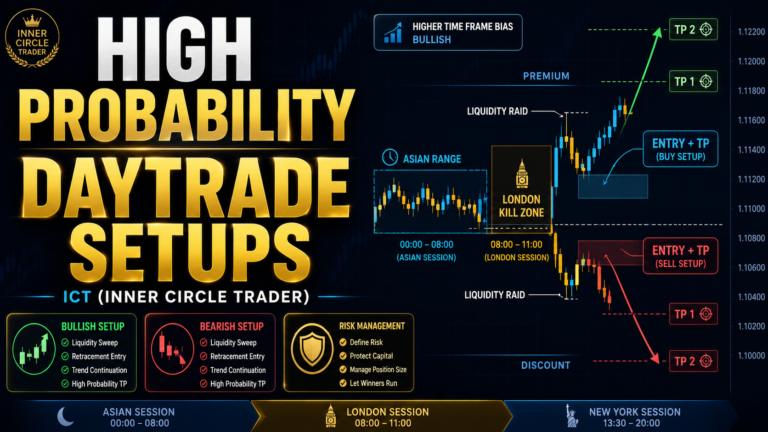
The ICT London session model works best when price is held inside a narrow consolidation before the London Kill Zone.
This consolidation allows liquidity to build above and below the range. London can then manipulate one side before expanding toward the higher-timeframe objective.
When the market is already volatile, trending, erratic, or affected by unusual news conditions, the normal London profile may not form properly.
In those situations, the trader should:
- Avoid the London session completely
- Wait for the New York session
- Reduce position size significantly
- Remain on the sidelines until conditions improve
Avoiding a trade is a valid trading decision.
Avoid London After an Extremely Large Range Day
One of the clearest reasons to avoid London is when the previous trading day produced an unusually large daily range.
Compare the previous day’s range with the five-day Average Daily Range.
Avoid the following London session when the previous day moved more than:
- Two times the five-day Average Daily Range
After an extremely large expansion, the market may:
- Consolidate
- Become choppy
- Produce a deep retracement
- Trade without clear direction
- Deliver a smaller-than-normal range
The market has already released a significant amount of volatility. It may need time to rebalance before offering another clean expansion.
Three Consecutive Up-Close Days
After three consecutive bullish daily candles, traders should avoid buying during the next London session.
This does not automatically mean the market must reverse. However, after three consecutive up-close days, price may:
- Pause
- Consolidate
- Retrace lower
- Create a long lower wick
- Form a bearish daily candle
- Delay further bullish continuation
Buying the fourth consecutive London session can place the trader inside a deep retracement.
A bullish higher-timeframe bias may remain valid, but the London session may not provide the ideal entry.
Three Consecutive Down-Close Days
After three consecutive bearish daily candles, traders should avoid selling during the next London session.
The market may produce:
- A bullish retracement
- Sideways price action
- A long upper wick
- A temporary reversal
- A pause before continuing lower
Selling the fourth consecutive bearish day can result in entering at the end of an already extended move.
The objective is not to predict a complete reversal. The rule simply warns that the probability of a clean London short has decreased.
Avoid London After Extreme FOMC Whipsaw
FOMC announcements are commonly released around 14:00 New York time.
If an FOMC event creates extreme movement in both directions, the following London session should usually be avoided.
Extreme whipsaw can disrupt:
- The Central Bank Dealers Range
- The Asian Range
- Normal accumulation
- London manipulation
- Standard protractionary profiles
The problem is not whether interest rates changed.
What matters is how price reacted.
If the market moved violently up and down after the announcement, the following overnight ranges may become too wide or erratic for a clean London setup.
Avoid London Before Non-Farm Payroll
Non-Farm Payroll is usually released on the first Friday of the month, although the schedule can occasionally differ.
ICT traders should generally avoid the London session on Non-Farm Payroll Friday.
Before the announcement, the market may:
- Consolidate
- Produce false movement
- Create weak technical signals
- Hold liquidity for the news release
- Remain directionless until New York
Even when London produces movement, the risk-to-reward conditions may not justify participation before such a major scheduled event.
Avoid London Before Holidays and Long Weekends
The London session should also be avoided on trading days leading into:
- Major holidays
- Long weekends
- Early market closures
- Reduced institutional participation
Many institutional traders may reduce exposure or leave the market early.
This can produce:
- Lower liquidity
- Weak follow-through
- Slow movement
- Irregular volatility
- Sudden but unreliable price spikes
There may be exceptions where price moves aggressively before a holiday. However, ICT trading is based on probability, not isolated examples.
Multiple High- or Medium-Impact News Events
Check the economic calendar before trading London.
The session becomes less attractive when several high- or medium-impact events are scheduled for the same currency.
For example:
- One news event at 02:00
- Another event at 03:00
- A further release near 05:00
Multiple news drivers can create repeated manipulation cycles.
Instead of one clean liquidity raid followed by expansion, price may:
- Reverse several times
- Produce false breakouts
- Remain choppy between releases
- Delay the real directional move
The ideal condition is generally one meaningful news event that supports one primary manipulation and expansion sequence.
No Scheduled London News
An absence of London news is not always a reason to avoid the session, but it creates uncertainty.
A news-free London session may become:
- A clean technical day
- A quiet consolidation
- A continuation session
- A sudden reaction to unexpected political or economic information
Unexpected announcements can create aggressive market movement without appearing on the scheduled calendar.
Therefore, a session without news should be treated as a possible wild card.
Price structure and range conditions become even more important.
Central Bank Dealers Range Is Too Wide
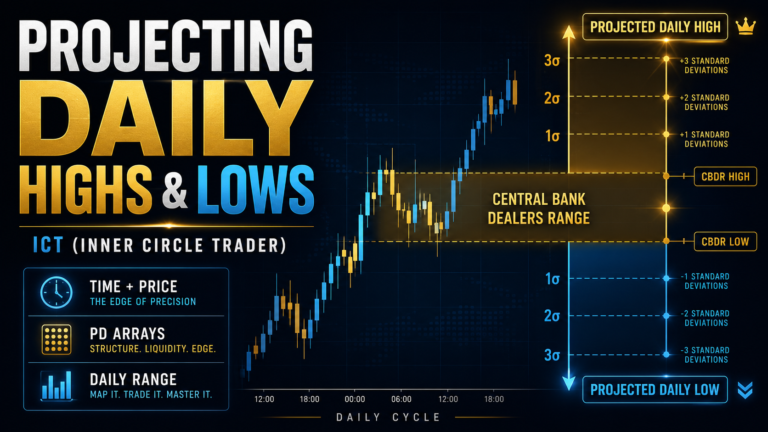
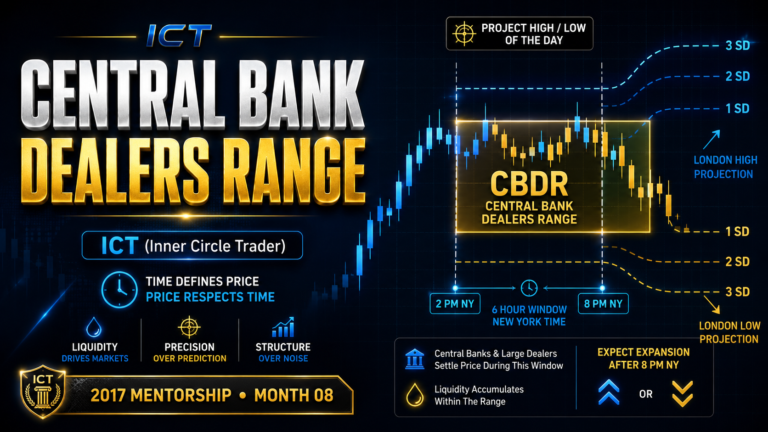
The Central Bank Dealers Range is measured between:
- 14:00 and 20:00 New York time
For an ideal London setup, this range should appear as a small and clear consolidation.
ICT suggests becoming cautious when the Central Bank Dealers Range is greater than:
- 50 pips
A wide Central Bank Dealers Range suggests that price has already been active instead of quietly accumulating orders.
This reduces the probability of a clean London manipulation.
A wide range does not guarantee failure, but it is a strong warning sign.
Asian Range Is Too Wide
The Asian Range is measured from:
- 20:00 to 00:00 New York time
The range should ideally be narrow and visually obvious.
When the Asian Range exceeds approximately:
- 40 pips
The normal London setup becomes less reliable.
A wide Asian Range may indicate that:
- The primary move has already started
- Liquidity has already been taken
- The market is not accumulating
- London may continue without retracing
- London may become choppy
A delayed protraction profile may occasionally form, but all required conditions must be present.
Otherwise, the trader should move to the sidelines.
Market Trending From 20:00 New York Time
An ideal Asian session normally consolidates.
If price begins a sustained rally or decline from 20:00 New York time, the London session may become difficult to trade.
The main move may have already started at the beginning of the global trading day.
Price may continue through London with:
- Very shallow retracements
- No clear manipulation
- Poor entry locations
- Fast directional movement
- Sloppy price delivery
In such conditions, the better opportunity may appear during New York.
Central Bank Dealers Range and Asian Range Must Consolidate
The Central Bank Dealers Range and Asian Range should both show clear signs of accumulation.
The ideal condition is:
- Small range
- Tight consolidation
- Clear upper and lower boundaries
- Liquidity building on both sides
- No sustained directional movement
When price is held inside a narrow range, orders accumulate above and below the market.
This creates the conditions for:
- Accumulation
- Manipulation
- Distribution
If either range is wide, trending, or erratic, the normal London manipulation cycle becomes less likely.
What Is London Slop?
London slop describes a session where price lacks clean structure and directional delivery.
Common characteristics include:
- Repeated reversals
- Wide candles
- Overlapping price action
- False breakouts
- Unclear liquidity sweeps
- No obvious protractionary move
- Poor follow-through
- Difficult stop placement
When London slop is likely, the best decision is often:
- Sleep through London
- Wait for New York
- Reassess the daily bias
- Look for cleaner price delivery later
Trading more frequently does not create a greater statistical edge.
The Importance of Daily Bias
Even when London conditions appear favorable, the trader still needs a clear higher-timeframe bias.
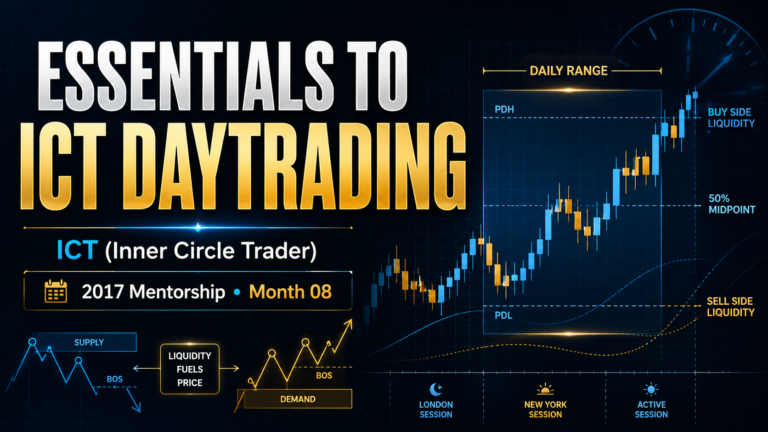
The daily chart should be respecting a recognizable PD Array.
Examples include:
- Order Block
- Fair Value Gap
- Liquidity Void
- Breaker Block
- Previous high or low
- Premium or discount zone
If price is expected to move toward a premium PD Array, London longs may be favored.
If price is expected to move toward a discount PD Array, London shorts may be favored.
However, a valid daily bias does not cancel the London avoidance rules.
Even when the market is bullish or bearish, poor overnight range conditions can make London unsuitable.
When the London Session Is Ideal
The London session becomes more attractive when:
- The daily chart has a clear directional bias
- Price is respecting PD Arrays
- The Central Bank Dealers Range is narrow
- The Asian Range is narrow
- Liquidity has accumulated above and below the range
- No extreme FOMC whipsaw occurred
- The previous day was not excessively extended
- There are no major holiday concerns
- News conditions support one clear manipulation
- The market has not been trending since 20:00
- The five-day Average Daily Range has not recently been exceeded
These conditions increase the probability of a clean London profile.
Low Volatility Before Expansion
A major expansion day may form when the market has recently remained below its five-day Average Daily Range.
If several days have produced limited movement, volatility may be ready to expand.
This condition becomes more valuable when:
- Daily bias is clear
- A higher-timeframe target remains open
- The Central Bank Dealers Range is narrow
- The Asian Range is narrow
- London provides a clear manipulation setup
Large-range days do not occur every day.
The trader does not need many of them each month to produce meaningful results.
Why Trading Every Day Is Dangerous
Trading every London session can create:
- Overtrading
- Repeated small losses
- Poor-quality entries
- Emotional fatigue
- Unnecessary drawdown
- Dependence on one large winning day
A trader may appear profitable only because one large winner covers many poor decisions.
A healthier approach is to filter out low-probability sessions and participate only when conditions are favorable.
This can support a smoother equity curve and reduce avoidable losses.
Common Mistakes
Ignoring the Previous Day’s Range
A market that has already moved twice its normal range may not offer another clean expansion immediately.
Trading the Fourth Consecutive Directional Day
Buying after three bullish closes or selling after three bearish closes increases the risk of entering a retracement.
Ignoring FOMC Price Action
Extreme whipsaw can damage the overnight ranges required for a clean London profile.
Trading Before Non-Farm Payroll
Price may remain controlled until the New York release.
Ignoring Holidays
Reduced participation can create weak or irregular movement.
Trading a Wide Asian Range
A wide Asian Range indicates that the market may have already delivered part of the move.
Trading a Trending Asian Session
If price has already moved directionally from 20:00, London may provide no suitable retracement.
Forcing a Setup Because Bias Is Clear
A bullish or bearish bias does not make every London session tradable.
When To Avoid The London Session Checklist
Avoid or become highly cautious when:
- The previous day exceeded two times the five-day Average Daily Range
- The daily chart has three consecutive bullish closes
- The daily chart has three consecutive bearish closes
- The previous FOMC event produced extreme whipsaw
- Non-Farm Payroll is due later that day
- The session leads into a major holiday or long weekend
- Multiple high- or medium-impact news events are scheduled
- The Central Bank Dealers Range exceeds 50 pips
- The Asian Range exceeds approximately 40 pips
- Price is trending from 20:00 New York time
- The Central Bank Dealers Range is not consolidating
- The Asian Range is not consolidating
- Daily bias is unclear
- Price is not respecting a clear PD Array
- The London profile appears sloppy or irregular
What to Do When London Is Not Ideal
When the conditions are unsuitable:
- Do not force a trade
- Protect trading capital
- Wait for New York
- Review the higher-timeframe draw on liquidity
- Mark London’s high and low
- Observe whether New York provides a cleaner reversal or continuation
- Use very little risk if participation is unavoidable
Waiting is part of the trading process.
“The best rules are the ones that help you stay out of the marketplace.”
— Michael J. Huddleston
Final Thoughts
Knowing When To Avoid The London Session is just as important as knowing how to trade it.
The best London setups usually form after a narrow Central Bank Dealers Range and a narrow Asian Range. These consolidations allow liquidity to build before price enters manipulation and distribution.
When the overnight market is wide, trending, erratic, or influenced by unusual news conditions, the statistical edge decreases.
A disciplined ICT trader does not need to trade every London session. The goal is to participate when the daily bias, PD Arrays, liquidity, volatility, and time-based profile all support the same idea.
When those conditions are missing, staying out of the market is often the highest-probability trade.