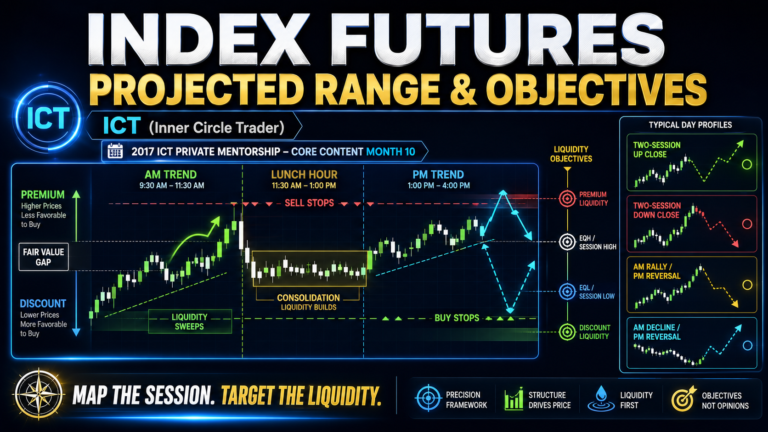
Index Futures – PM Trend is an ICT framework for analysing the afternoon price swing in US index futures after the New York lunch period.
This concept was taught by Michael J. Huddleston, the founder of ICT (Inner Circle Trader), in the 2017 ICT Private Mentorship Core Content Month 10.
The PM Trend focuses on the price movement that usually develops between 13:00 and 16:00 New York time in markets such as the E-mini S&P 500, Nasdaq futures and Dow futures.
Michael J. Huddleston explains:
“The PM Trend can be a continuation of the AM Trend direction or an intraday reversal going into the close.”
The main purpose of the concept is to help traders understand how afternoon price delivery relates to the morning session, New York lunch, institutional order flow and the final hour of the trading day.
What Is the Index Futures PM Trend?
The Index Futures – PM Trend is the directional price swing that commonly forms after the New York lunch period.
The primary PM session runs from:
13:00 to 16:00 New York time
This period may produce:
- Continuation of the AM trend
- Reversal of the AM trend
- A move from an order block
- A liquidity run
- An SMT divergence
- A final expansion into the closing hour
The strongest part of the move often begins around:
14:00 New York time
However, the PM Trend can begin as early as 13:00.
New York Lunch Period
The New York lunch period separates the AM session from the PM Trend.
The most common lunch window is:
12:00 to 13:00 New York time
However, it may begin earlier or last longer depending on the morning session.
A broader lunch window may extend from:
11:00 to 14:00 New York time
The duration depends on market conditions.
If the morning session was fast and volatile, traders may work through lunch. In that case, price may show only a short consolidation or retracement.
If the morning session was slow, lunch may produce a longer period of inactivity.
During lunch, price commonly forms:
- Consolidation
- Retracement
- Accumulation
- Distribution
- A new order block
- A fair value gap
- Short-term liquidity
The trader should avoid treating the lunch period as the main directional session.
PM Trend Time Window
The main PM Trend window is:
13:00 to 16:00 New York time
This three-hour period can be divided into two parts.
Early PM Session
13:00 to 15:00 New York time
This period may establish the direction of the afternoon move.
Price may:
- Trade into an AM order block
- Complete a lunch retracement
- Form an SMT divergence
- Begin accumulation or distribution
- Target intraday liquidity
Final Trading Hour
15:00 to 16:00 New York time
This final hour frequently creates the opposite end of the daily range.
If the AM session formed the low of the day, the final hour may form the high.
If the AM session formed the high of the day, the final hour may form the low.
The bond market closes around 15:00 New York time, and index futures may accelerate after that point.
Continuation PM Trend
A continuation PM Trend moves in the same direction as the AM session.
For example, a bullish continuation day may develop as follows:
- The AM session forms the low of the day.
- Price expands higher during the morning.
- Lunch produces only a shallow retracement.
- The PM session trades into a bullish PD Array.
- Price resumes higher.
- The high of the day forms between 15:00 and 16:00.
A bearish continuation day may follow the opposite sequence:
- The AM session forms the high of the day.
- Price declines during the morning.
- Lunch produces a shallow retracement.
- The PM session trades into a bearish PD Array.
- Price resumes lower.
- The low of the day forms during the final hour.
Continuation is more likely when the morning move has strong institutional sponsorship.
Reversal PM Trend
The PM Trend can also reverse the AM session.
For example:
- Price rallies during the morning.
- The morning move reaches higher-timeframe premium.
- Lunch creates distribution.
- The PM session runs buy-side liquidity.
- A bearish market structure shift forms.
- Price declines into the close.
The opposite may occur on a bullish reversal day:
- Price declines during the morning.
- The market reaches higher-timeframe discount.
- Lunch creates accumulation.
- The PM session runs sell-side liquidity.
- Bullish displacement develops.
- Price rallies into the close.
The PM reversal should align with the broader higher-timeframe narrative.
PM Trend and the AM Session
The PM Trend should not be analysed in isolation.
The trader must first understand what occurred during the AM session.
Important questions include:
- Did the AM session form the probable high or low of the day?
- Did price reach a higher-timeframe PD Array?
- Was the AM move supported by displacement?
- Did the market take overnight liquidity?
- Was there an opening-range stop run?
- Did the AM session create an order block?
- Did lunch retrace into that order block?
The afternoon move often reacts to levels created during the morning.
AM Order Blocks Used in the PM Session
A common PM Trend setup occurs when price returns to an order block formed during the AM session.
A bullish example may look like this:
- The morning session expands higher.
- A bullish order block forms during the AM session.
- Price consolidates during lunch.
- The PM session retraces into the bullish order block.
- Sell-side liquidity is taken.
- Price displaces higher.
- The market trades toward the high of the day.
A bearish setup is the reverse:
- The morning session declines.
- A bearish order block forms.
- Lunch retraces higher.
- The PM session enters the bearish order block.
- Buy-side liquidity is taken.
- Price displaces lower.
- The market trades toward the low of the day.
The AM session often provides the PD Array, while the PM session provides the second entry opportunity.
Lunch-Hour Order Blocks
Not every important PM setup comes from the morning.
An order block may form during the lunch period itself.
For example:
- Price consolidates from 12:00 to 13:00.
- A final down-close candle forms before bullish displacement.
- The PM session returns to that candle.
- The bullish order block supports price.
- Price expands toward afternoon buy-side liquidity.
Lunch-hour order blocks can be useful because they form immediately before PM activity resumes.
Rejection Blocks in the PM Session
Rejection blocks may also guide afternoon price delivery.
A bullish PM move may target a bearish rejection block formed during the morning.
A bearish PM move may target a bullish rejection block below price.
The rejection block can act as:
- Entry location
- Resistance
- Support
- Profit target
- Liquidity reference
Price may trade from one morning PD Array to another during the PM session.
PM Trend Measured Moves
Afternoon moves may develop faster than morning moves.
Michael J. Huddleston states:
“Measured moves in the afternoon tend to be faster than that which was seen in the AM session.”
This acceleration may occur because:
- Lunch liquidity has accumulated.
- Morning positions are being adjusted.
- Traders are preparing for the close.
- Institutional orders enter around 14:00.
- The bond market approaches its closing time.
- Short-term positions are liquidated.
The PM Trend may travel the same distance as the AM move in less time.
Why 14:00 New York Time Matters
Although the PM session begins at 13:00, the directional movement often becomes more obvious around:
14:00 New York time
This period can introduce:
- Increased institutional participation
- Afternoon rebalancing
- New economic information
- Closing-position activity
- Stronger displacement
- A liquidity run
The trader should be especially attentive from 14:00 onward.
However, trades should still be based on price action and institutional order flow, not time alone.
Why 15:00–16:00 Matters
The final hour of equity trading often creates the second major extreme of the day.
Suppose the opening range and AM session formed the low.
If price remains bullish throughout lunch and the PM session, the high may form between 15:00 and 16:00.
Suppose the AM session formed the high.
If bearish order flow remains intact, the final hour may form the low.
The relationship can be summarised as:
- AM low may lead to PM high.
- AM high may lead to PM low.
This is not guaranteed, but it provides a useful intraday expectation.
The Bond Market Close
The bond market closes around:
15:00 New York time
This can influence index futures.
After the bond market closes, equity indices may complete their final directional move.
The final hour can see:
- Increased volatility
- Position adjustments
- Closing imbalances
- Stop runs
- Final daily range expansion
The trader should understand that 15:00 can act as an important timing reference.
Index SMT in the PM Session
Index SMT is one of the most useful confirmation tools for the PM Trend.
The trader compares the highs and lows of:
- E-mini S&P 500
- Nasdaq futures
- Dow futures
The comparison is especially useful between:
12:00 and 15:00 New York time
The purpose is to identify whether one index fails to confirm the movement of the others.
This non-confirmation can reveal accumulation or distribution.
Bullish PM SMT Divergence
Bullish PM SMT occurs when one or more indices fail to confirm a lower low.
For example:
- Nasdaq makes a lower low.
- ES forms a higher low.
- Dow forms a higher low.
The lower low in Nasdaq is not confirmed by ES and Dow.
This suggests that ES and Dow are showing relative strength.
If institutional order flow is bullish, the divergence can support a PM long setup.
The trader may then look for:
- Bullish market structure shift
- Bullish displacement
- Fair value gap
- Order block entry
- Buy-side liquidity objective
Bearish PM SMT Divergence
Bearish PM SMT occurs when one index fails to confirm a higher high.
For example:
- Nasdaq makes a higher high.
- ES forms a lower high.
- Dow forms a lower high.
The higher high is not confirmed by the other indices.
This may indicate distribution and relative weakness.
If the broader narrative is bearish, the trader may look for a PM short setup.
Which Index Should Be Traded?
SMT can be used to confirm the setup, but the trader does not need to trade every index.
Michael J. Huddleston explains that he used the relationship between the three indices to confirm trades in the E-mini S&P 500.
A trader may use:
- ES as the execution market
- NQ and YM as confirmation markets
The purpose of SMT is to identify the crack between correlated markets.
The divergence reveals the institutional footprint.
Bullish PM Trend Setup
A practical bullish PM setup may develop as follows:
- The higher-timeframe bias is bullish.
- The AM session trades into discount.
- The probable low of the day forms in the morning.
- Price rallies into lunch.
- Lunch creates a shallow retracement.
- The PM session trades into a bullish order block.
- ES and YM form higher lows while NQ makes a lower low.
- Bullish SMT divergence appears.
- Price creates bullish displacement.
- The market targets the AM high or external buy-side liquidity.
- The high of the day may form between 15:00 and 16:00.
Bearish PM Trend Setup
A bearish PM setup may develop through the opposite sequence:
- The higher-timeframe bias is bearish.
- The AM session trades into premium.
- The probable high of the day forms during the morning.
- Price declines into lunch.
- Lunch produces a retracement.
- The PM session trades into a bearish order block.
- One index makes a higher high while the others fail to confirm it.
- Bearish SMT divergence appears.
- Price creates bearish displacement.
- The market targets the AM low or external sell-side liquidity.
- The low of the day may form during the final hour.
PM Trend Continuation Checklist
A continuation setup becomes more likely when:
- The AM session created a strong directional move.
- The morning extreme remains protected.
- Lunch retracement is shallow.
- Institutional order flow remains aligned.
- Price respects an AM order block.
- SMT supports the existing direction.
- No opposing higher-timeframe PD Array blocks the move.
- The market has an obvious external liquidity target.
- Displacement appears after 13:00 or 14:00.
The trader should avoid fading a strong AM trend without clear evidence of reversal.
PM Trend Reversal Checklist
A reversal becomes more likely when:
- The AM move reaches a higher-timeframe target.
- Price enters premium or discount.
- The morning move loses momentum.
- Lunch creates accumulation or distribution.
- Buy-side or sell-side liquidity is taken.
- SMT divergence appears.
- Market structure shifts.
- Displacement confirms the new direction.
- The opposing side of the daily range remains open.
The reversal should be supported by several factors, not a single candle pattern.
PM Trend Targets
Common PM Trend objectives include:
- AM session high
- AM session low
- Opening Range High
- Opening Range Low
- Previous day high
- Previous day low
- Equal highs
- Equal lows
- Morning rejection block
- Higher-timeframe PD Array
- External buy-side liquidity
- External sell-side liquidity
The most appropriate target depends on whether the PM Trend is a continuation or reversal.
PM Trend and Small Daily Ranges
Not every afternoon move will be large.
Index futures often move through:
- Consolidation
- Small expansion
- Retracement
- Another expansion
Some sessions may offer only a modest move from one intraday PD Array to another.
The trader should not expect every PM Trend to produce a major directional expansion.
The structure and liquidity objective matter more than the number of points.
Common Mistakes
Trading During Lunch
Lunch commonly produces low-quality, overlapping price action.
Wait for the PM session to begin.
Assuming the PM Trend Must Continue the AM Trend
The afternoon can continue or reverse the morning move.
Higher-timeframe context must determine which scenario is more likely.
Ignoring AM PD Arrays
Morning order blocks and rejection blocks often become afternoon entry or target levels.
Ignoring SMT Divergence
Comparing ES, NQ and YM can reveal accumulation or distribution that is not obvious on one chart.
Entering Only Because It Is 14:00
Time creates an opportunity window, not an automatic signal.
Wait for liquidity, PD Arrays and displacement.
Holding Beyond the Logical Closing Objective
The PM Trend is designed around the closing session.
Once the expected liquidity is taken, the trader should avoid unnecessary greed.
Expecting Large Movement Every Day
Many index sessions produce small ranges.
Targets should reflect the actual market environment.
How to Study the PM Trend
A practical daily study process may look like this:
- Mark the 09:30–10:30 opening range.
- Identify the AM session high and low.
- Determine which extreme is likely to remain protected.
- Mark order blocks formed during the AM session.
- Mark lunch consolidation from approximately 12:00 to 13:00.
- Compare ES, NQ and YM from noon onward.
- Look for SMT divergence between 12:00 and 15:00.
- Observe whether price trades into an AM or lunch PD Array.
- Wait for displacement after 13:00 or 14:00.
- Identify the likely final-hour liquidity target.
- Monitor whether the daily high or low forms between 15:00 and 16:00.
Repeating this process will make the afternoon price-delivery pattern easier to recognise.
Why the PM Trend Matters
Many traders focus only on the opening bell and morning volatility.
However, the afternoon session can provide a second high-quality trading opportunity.
The PM Trend allows traders to use information already created during the day.
By the afternoon, the trader may already know:
- The opening range
- The AM direction
- The probable protected high or low
- The morning order blocks
- Lunch consolidation
- Which index is strongest
- Which index is weakest
- The remaining daily liquidity
This additional information can make the PM setup more structured than an early morning trade.
Final Thoughts
Index Futures – PM Trend provides ICT traders with a structured framework for analysing the afternoon swing in ES, NQ and YM.
The main PM session runs from:
13:00 to 16:00 New York time
The move often becomes more active around 14:00, while the final daily high or low frequently forms between 15:00 and 16:00.
The PM Trend may:
- Continue the AM direction
- Reverse the AM move
- React from an AM order block
- Begin from a lunch-hour PD Array
- Use SMT divergence as confirmation
- Target the opposite end of the daily range
The most important principle is to connect the afternoon session with everything that happened earlier in the day.
The AM session creates the structure. Lunch creates the pause or retracement. The PM session completes the next phase of price delivery.
By combining time, institutional order flow, PD Arrays, liquidity and Index SMT, traders can better determine whether the afternoon is likely to continue the morning trend or reverse into the close.