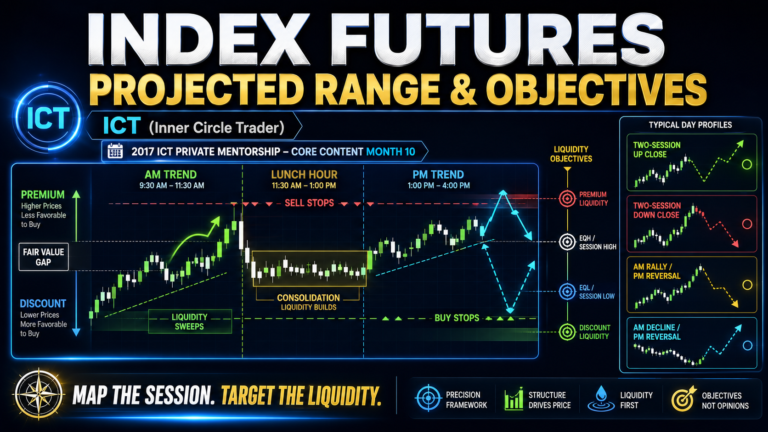
Index Futures – Index Trade Setups is an ICT framework for organising intraday opportunities in the E-mini S&P 500, Nasdaq futures and Dow futures into repeatable AM and PM session profiles.
This concept was taught by Michael J. Huddleston, the founder of ICT (Inner Circle Trader), in the 2017 ICT Private Mentorship Core Content Month 10.
The framework combines:
- Index SMT divergence
- Time of day
- Premium and discount arrays
- AM and PM session structure
- Lunch-hour liquidity
- Higher-timeframe institutional order flow
- Daily range projections
The goal is not to search for complicated patterns. It is to recognise a small number of recurring daily profiles and understand where price is likely to move during each session.
Michael J. Huddleston explains:
“It’s rather simplistic, which is exactly what you should be looking for when looking for setups.”
The main execution market may be the E-mini S&P 500, while Nasdaq and Dow futures are used to confirm strength, weakness and divergence.
The Three Main Index Futures
The ICT Index Trade Setups framework compares three highly correlated US index futures:
- E-mini S&P 500
- Nasdaq futures
- Dow futures
These markets normally move in the same general direction.
However, they do not always create matching highs and lows.
When one index fails to confirm the movement of the others, it creates Index SMT divergence.
This divergence can reveal institutional accumulation or distribution before the next intraday expansion.
Why Index SMT Is Important
Index SMT compares corresponding swing highs or lows across ES, NQ and YM.
For bullish setups, compare the lows.
For bearish setups, compare the highs.
A bullish divergence may appear when:
- ES makes a lower low.
- NQ makes a lower low.
- YM forms a higher low.
YM fails to confirm the weakness shown by ES and NQ.
This can indicate underlying accumulation and support a rally.
A bearish divergence may appear when:
- NQ makes a higher high.
- ES makes a higher high.
- YM forms a lower high.
YM fails to confirm the strength shown by the other indices.
This can indicate distribution and support a decline.
The index creating the divergence does not have to be the market used for execution.
The divergence can confirm a trade in ES even when NQ or YM provides the non-confirmation.
The Importance of Time of Day
These setups are highly dependent on time.
The primary intraday reference periods are:
- London session into the 09:30 equity open
- AM session
- 10:30 to 11:00 New York time
- New York lunch
- 13:00 PM session opening
- 14:00 afternoon expansion
- 15:00 bond market close
- 16:00 equity close
The setup must form at a logical time.
An SMT divergence appearing at an important session transition carries more meaning than a random divergence forming in the middle of inactive price action.
The Role of the AM Session
The AM session commonly provides the first major directional move of the New York trading day.
The trader compares ES, NQ and YM from the London session into the 09:30 opening.
The morning move may begin from:
- A discount array
- A premium array
- A fair value gap
- An order block
- A liquidity void
- A run on overnight liquidity
- A higher-timeframe PD Array
Once the AM move begins, ICT generally looks for price to continue toward approximately:
10:30 to 11:00 New York time
This period may complete the morning expansion before the market enters lunch.
The Role of New York Lunch
New York lunch normally develops around:
12:00 to 13:00 New York time
During lunch, price may:
- Consolidate
- Retrace
- Form equal highs
- Form equal lows
- Create an order block
- Fill a fair value gap
- Build liquidity for the PM move
The highs and lows formed during lunch become important reference points.
After 13:00, the trader compares the indices again and looks for a second SMT divergence.
Lunch often acts as the transition between the AM and PM session profiles.
The Role of the PM Session
The PM session normally begins after:
13:00 New York time
The afternoon move may:
- Continue the AM trend
- Reverse the AM trend
- Run the lunch high
- Run the lunch low
- Revisit an AM PD Array
- Reach a higher-timeframe objective
- Complete the projected daily range
The PM move should ideally be held toward:
- 14:00
- 15:00 bond close
- 16:00 equity close
The appropriate holding time depends on the daily profile.
Holding for Time and Price
A common mistake is taking profit too early simply because the trade has moved a few points in favour.
ICT teaches traders to consider both time and price.
Michael J. Huddleston explains:
“We have to do what we can to hold for time.”
If a bullish PM move begins at 14:00 and the daily range remains incomplete, taking profit immediately may leave most of the expected move unrealised.
The trader should consider:
- Current time
- Remaining session duration
- Higher-timeframe target
- Daily range projection
- Opposing liquidity
- Bond market close
- Equity close
The trade should not be held blindly, but time should be allowed to support the expected range expansion.
The Six Main Index Trade Setups
The ICT framework outlines six primary intraday profiles:
- Two-session up-close
- Two-session down-close
- AM rally and PM reversal
- AM decline and PM reversal
- Consolidation, AM decline and PM rally
- Consolidation, AM rally and PM decline
Each profile describes how the AM and PM sessions may combine to form the daily candle.
Two-Session Up-Close Setup
The two-session up-close profile occurs when both the AM and PM sessions contribute to a bullish daily close.
The market advances during the morning, consolidates or retraces during lunch and continues higher in the afternoon.
AM Session Structure
During the AM session:
- Price returns to a discount array.
- The lows of ES, NQ and YM are compared.
- Bullish Index SMT develops.
- One index fails to make a lower low.
- Price begins a bullish expansion.
- The trader holds toward 10:30 or 11:00.
The morning objective may be a:
- 15-minute premium array
- 60-minute premium array
- Previous high
- Buy-side liquidity pool
Lunch Structure
During lunch:
- Price may consolidate.
- Price may retrace below a lunch low.
- A bullish order block may form.
- A fair value gap may remain open.
- Sell-side liquidity may build beneath the range.
PM Session Structure
After 13:00:
- Compare the lunch and post-lunch lows.
- Look for bullish SMT divergence.
- One index may fail to confirm a lower low.
- Price may retrace into a bullish order block.
- The PM session then continues higher.
The afternoon target is normally another premium PD Array.
The daily high may form late in the session, sometimes after a two-stage PM expansion.
Two-Session Down-Close Setup
The two-session down-close profile is the bearish opposite.
Both the AM and PM sessions contribute to a bearish daily close.
AM Session Structure
During the morning:
- Price returns to a premium array.
- The highs of ES, NQ and YM are compared.
- Bearish Index SMT develops.
- One index fails to confirm a higher high.
- Price begins a bearish decline.
- The trader holds toward 10:30 or 11:00.
The AM target may be a:
- 15-minute discount array
- 60-minute discount array
- Previous low
- Sell-side liquidity pool
Lunch Structure
During lunch:
- Price may consolidate.
- Price may retrace higher.
- A bearish order block may form.
- Price may close a liquidity void.
- Buy-side liquidity may develop above lunch highs.
PM Session Structure
After 13:00:
- Compare the highs across all three indices.
- Look for bearish SMT divergence.
- Price may run above the lunch high.
- Price may enter a bearish order block.
- The decline then resumes.
The trader should attempt to hold toward 15:00 or 16:00 when the downside daily range remains incomplete.
AM Rally and PM Reversal
This profile begins bullishly but reverses lower during the afternoon.
AM Bullish Move
The morning setup may include:
- Bullish SMT divergence at the lows
- A return to a discount array
- A run on sell-side liquidity
- Bullish displacement
- A rally toward a premium PD Array
The AM rally is normally held toward 10:30 or 11:00.
Lunch Transition
Near lunch:
- Profit-taking may appear.
- Price may consolidate.
- The market may approach a higher-timeframe premium array.
- Buy-side liquidity may form.
PM Bearish Reversal
After lunch:
- Price rallies into a premium array.
- The premium array may be nested across the 15-minute, 60-minute, four-hour or daily chart.
- Bearish SMT develops at the highs.
- Price shifts lower.
- The afternoon decline begins.
The strength of the reversal depends on whether the AM high reached a meaningful higher-timeframe premium array.
Nested Premium Arrays
A nested premium array occurs when lower- and higher-timeframe resistance overlap.
For example:
- A 15-minute bearish order block
- A 60-minute fair value gap
- A four-hour premium array
- A daily premium objective
When these levels align, the PM reversal can become stronger.
The lower-timeframe PD Array provides the execution reference.
The higher-timeframe PD Array provides the broader reason for reversal.
AM Decline and PM Reversal
This profile begins with a bearish AM move and reverses higher in the afternoon.
AM Bearish Move
The morning setup may include:
- Bearish SMT divergence at the highs
- A return to a premium array
- A run on buy-side liquidity
- Bearish displacement
- A decline toward discount
The morning move may continue toward 10:30 or 11:00.
Lunch Transition
During lunch:
- Price may consolidate near the low.
- Sell-side liquidity may form.
- The market may approach a higher-timeframe discount array.
- A bullish PD Array may develop.
PM Bullish Reversal
After lunch:
- Price may run the lunch low.
- Price may run the AM low.
- Bullish SMT appears across the indices.
- Price enters a nested discount array.
- Bullish displacement confirms the reversal.
The trader may then target:
- Lunch high
- AM high
- Daily high
- Higher-timeframe buy-side liquidity
Nested Discount Arrays
A nested discount array may include:
- A 15-minute bullish order block
- A 60-minute fair value gap
- A four-hour discount array
- A daily discount objective
The afternoon low becomes more meaningful when several timeframes identify the same general area as undervalued.
This can support a stronger bullish reversal.
Consolidation, AM Decline and PM Rally
This profile begins with consolidation, moves lower during the AM session and then rallies in the afternoon.
Initial Consolidation
The market may begin the day without a clear expansion.
Liquidity builds above and below a narrow range.
AM Decline
During the morning:
- Price rallies into a premium array.
- Bearish SMT forms at the highs.
- One index fails to confirm a higher high.
- Price declines toward a discount array.
- The trader holds toward 10:30 or 11:00.
Lunch Retracement
After the decline:
- Price consolidates.
- A modest retracement develops.
- Sell-side liquidity remains below.
- The morning low becomes an important reference.
PM Rally
After 13:00:
- Compare the lows across ES, NQ and YM.
- Look for bullish SMT.
- Price may run the lunch low.
- Price may run the AM low.
- A discount PD Array supports price.
- Price rallies toward equilibrium.
This profile does not always continue higher into the close.
The PM rally may create an early afternoon high around 14:00 and then retrace toward the middle of the daily range.
Will the AM Low Be Taken Again?
The answer depends on the location of the AM low.
If the AM low forms at a nested higher-timeframe discount array, the PM session may respect it.
In that case, price may only run the lunch low before rallying.
If the AM low forms above the true higher-timeframe discount objective, the PM session may trade below the AM low before reversing.
The PD Array location determines whether the morning low is likely protected or vulnerable.
Consolidation, AM Rally and PM Decline
This is the bearish opposite of the previous profile.
Initial Consolidation
Price begins in a narrow or indecisive range.
AM Rally
During the morning:
- Price moves into discount.
- Bullish SMT appears at the lows.
- One index fails to make a lower low.
- Price rallies toward a premium array.
- The trader holds toward 10:30 or 11:00.
Lunch Retracement
During lunch:
- Price may consolidate.
- A modest decline may occur.
- Buy-side liquidity remains above.
- The AM high becomes a reference point.
PM Decline
After 13:00:
- Price may rally again.
- The indices are compared at their highs.
- Bearish SMT develops.
- Price may run the lunch high.
- Price may run the AM high.
- A premium PD Array rejects price.
- The market declines toward equilibrium or discount.
This profile commonly produces an afternoon high around 14:00 before moving lower.
Will the AM High Be Taken Again?
The location of the AM high provides the answer.
If the AM high forms at a nested four-hour or daily premium array, it may remain protected.
The PM rally may only run the lunch high before reversing.
If the AM high forms below a significant higher-timeframe premium array, the PM session may trade above the AM high to reach that objective.
Only after reaching the higher-timeframe premium may the bearish reversal begin.
Two-Stage PM Moves
The PM session does not always move directly toward its final target.
A two-stage expansion may occur.
For a bullish profile:
- Price rallies after lunch.
- It pauses below the final premium array.
- A retracement develops.
- The final-hour rally completes the target.
For a bearish profile:
- Price declines after lunch.
- It pauses above the final discount array.
- A short-term rally develops.
- The final-hour decline completes the target.
The trader should not assume that the first PM swing always completes the entire daily range.
Using 15-Minute and 60-Minute PD Arrays
The AM and PM session highs and lows frequently align with:
- 15-minute order blocks
- 15-minute fair value gaps
- 60-minute order blocks
- 60-minute fair value gaps
- 15-minute premium or discount
- 60-minute premium or discount
These levels help frame:
- Entries
- Intraday highs
- Intraday lows
- Profit objectives
- Reversal points
- Continuation points
The 15-minute and 60-minute charts provide the primary intraday framework.
The four-hour and daily charts determine whether those levels are nested inside a larger institutional objective.
A Practical Bullish Trade Process
A bullish trade setup may be organised as follows:
- Establish a bullish higher-timeframe bias.
- Mark four-hour and daily discount arrays.
- Compare ES, NQ and YM lows from London into 09:30.
- Identify bullish SMT divergence.
- Wait for price to enter a 15-minute or 60-minute discount array.
- Confirm bullish displacement.
- Enter through an appropriate lower-timeframe model.
- Target the AM premium objective.
- Observe lunch-hour price action.
- Compare the lunch and post-lunch lows.
- Look for a second bullish SMT divergence.
- Enter or hold for the PM premium target.
- Allow time for the move to develop toward 15:00 or 16:00.
A Practical Bearish Trade Process
A bearish setup may follow this process:
- Establish a bearish higher-timeframe bias.
- Mark four-hour and daily premium arrays.
- Compare ES, NQ and YM highs from London into 09:30.
- Identify bearish SMT divergence.
- Wait for price to enter a 15-minute or 60-minute premium array.
- Confirm bearish displacement.
- Enter through an appropriate lower-timeframe model.
- Target the AM discount objective.
- Monitor lunch consolidation.
- Compare lunch and post-lunch highs.
- Look for a second bearish SMT divergence.
- Enter or hold for the PM discount target.
- Allow the trade to develop toward the bond close or equity close.
Example of Consolidation, AM Rally and PM Decline
Suppose the market begins the day in consolidation.
During the AM session:
- NQ and ES make lower lows.
- YM fails to make a lower low.
- Bullish SMT develops.
- ES rallies into an old premium array.
During lunch:
- Price consolidates near the morning high.
- Buy-side liquidity builds above the range.
After lunch:
- NQ makes a higher high.
- ES fails to confirm the higher high.
- YM also forms a lower high.
- Bearish SMT develops.
- Price trades lower toward equilibrium.
The morning bullish divergence creates the AM rally.
The afternoon bearish divergence creates the PM decline.
The higher-timeframe premium array explains why the AM rally could not continue through the close.
Daily Equilibrium as a Target
On reversal profiles, price frequently gravitates toward the midpoint of the daily range.
This is especially common when:
- The AM session creates one directional swing.
- The PM session reverses it.
- The market lacks enough time for a complete opposite-side expansion.
- A nearby higher-timeframe objective has already been reached.
The PM move may therefore target:
- Daily equilibrium
- Lunch consolidation
- Opening-range midpoint
- A fair value gap near the centre of the range
Not every PM reversal must take the opposite daily extreme.
Index Trade Setup Checklist
Before taking a trade, review the following:
- What is the higher-timeframe directional bias?
- Where are the daily and four-hour PD Arrays?
- Which daily profile is likely unfolding?
- Are you trading the AM or PM session?
- Where are the corresponding ES, NQ and YM highs or lows?
- Is there clear Index SMT divergence?
- Has price reached a 15-minute or 60-minute PD Array?
- Is that PD Array nested with a four-hour or daily level?
- Has liquidity been taken?
- Is there displacement?
- What time is it?
- Is 10:30, 11:00, 14:00, 15:00 or 16:00 relevant?
- Is the expected move a continuation or reversal?
- Is the AM high or low protected?
- Does the target complete the projected daily range?
Common Mistakes
Using SMT Without Time of Day
A divergence forming at an irrelevant time may offer little value.
Prioritise divergences around session transitions.
Comparing Random Highs and Lows
Compare corresponding swings created during the same session.
Do not compare unrelated price points.
Ignoring Higher-Timeframe PD Arrays
A 15-minute setup becomes stronger when it aligns with a four-hour or daily objective.
Assuming Every PM Move Is a Continuation
The PM session may reverse the AM move.
The daily profile determines the likely outcome.
Taking Profit Too Early
A few points of profit may represent only the beginning of the expected session expansion.
Consider time and the projected range.
Holding Every Trade Into the Close
Some consolidation profiles create their PM high or low around 14:00.
Not every setup should be held until 16:00.
Trading All Three Indices
ES, NQ and YM can be used for confirmation.
The trader does not need to execute in every market.
Overcomplicating the Model
The framework is based on a limited number of recurring daily profiles.
More indicators do not necessarily improve the analysis.
Why These Setups Work
The setups organise the trading day into understandable phases:
- Accumulation
- Manipulation
- Expansion
- Lunch consolidation
- PM continuation or reversal
- Closing delivery
Index SMT reveals where the correlated markets are no longer moving symmetrically.
PD Arrays explain where institutional orders may enter.
Time of day explains when the next phase of the daily range is likely to unfold.
The combination creates a structured model for interpreting intraday price delivery.
Final Thoughts
Index Futures – Index Trade Setups provides ICT traders with a practical framework for organising AM and PM opportunities in ES, NQ and YM.
The six primary profiles are:
- Two-session up-close
- Two-session down-close
- AM rally and PM reversal
- AM decline and PM reversal
- Consolidation, AM decline and PM rally
- Consolidation, AM rally and PM decline
Each setup depends on the interaction between:
- Index SMT
- Session timing
- Lunch-hour liquidity
- 15-minute and 60-minute PD Arrays
- Four-hour and daily premium or discount
- Institutional order flow
- Daily range projections
The central idea is to keep the analysis simple.
Determine the likely daily profile, compare the correct index highs or lows, wait for price to reach a meaningful PD Array and allow time for the expected session range to develop.
As Michael J. Huddleston states:
“There’s no ambiguity here. It’s highly specific.”