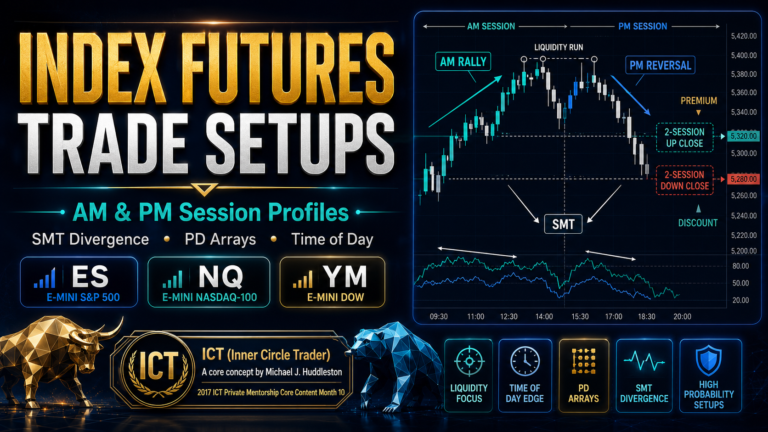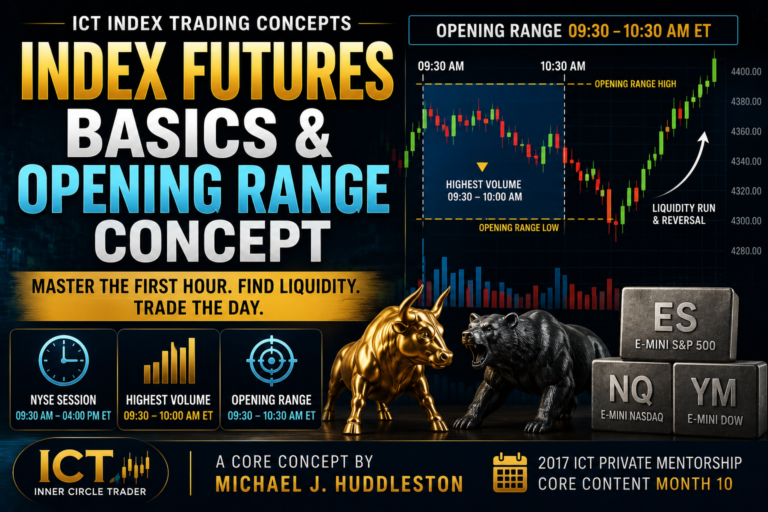
Premium Vs. Carrying Charge Market is an ICT commodity analysis concept used to understand whether current demand is strong enough to support an aggressive price expansion.
This concept was taught by Michael J. Huddleston, the founder of ICT (Inner Circle Trader), in the 2017 ICT Private Mentorship Core Content Month 10.
The method compares the price of the nearest futures contract with later delivery contracts. This comparison can reveal whether a commodity is trading under normal market conditions or whether commercial demand is creating an unusual premium.
Michael J. Huddleston describes the value of this analysis as:
“This is going to provide you an X-ray view of institutional order flow.”
By studying the relationship between futures delivery months, traders can identify markets that may be preparing for explosive bullish moves.
What Is a Futures Delivery Month?
Commodity futures contracts are available in different delivery months.
For example, soybean futures may have contracts for:
- July
- August
- November
- January
Each contract represents the price of the commodity for delivery during that particular month.
The contract closest to the current date is called the nearby contract.
The contract immediately following it is called the next month out.
ICT compares the nearby contract with the next month out to determine whether the market is showing a premium or a carrying charge.
What Is a Carrying Charge Market?
A carrying charge market occurs when later futures contracts are priced higher than the nearby contract.
For example:
- July contract: 940
- August contract: 943
- November contract: 945
- January contract: 952
In this situation, the price gradually increases as the delivery date moves further into the future.
This is considered a normal futures market structure because storing, financing, insuring and transporting a physical commodity involves costs.
The additional price in later contracts reflects these carrying expenses.
A carrying charge market generally suggests:
- Supply is currently adequate.
- There is no urgent demand for immediate delivery.
- Commercial users are not aggressively competing for the commodity.
- A rapid parabolic rally is less likely.
- Price may still rise, but the expansion may be slower.
A carrying charge market does not mean that bullish opportunities are impossible.
It only means that the market does not currently show the same urgency that is present in a premium market.
What Is a Premium Market?
A premium market occurs when the nearby futures contract is priced higher than later delivery contracts.
For example:
- August contract: 154.80
- September contract: 154.12
- October contract: 152.77
- November contract: 151.27
- January contract: 145.00
The nearby contract is trading at a higher price than the contracts that follow it.
This means commercial users are willing to pay more for the commodity now than they are for delivery later.
Michael J. Huddleston explains:
“If the price today’s nearby contract is higher than the contract delivery months that are after it, that is a premium market.”
This structure suggests that current demand is strong while available supply may be limited.
Why Does a Premium Develop?
Commodity markets represent tangible goods.
These may include:
- Grains
- Livestock
- Metals
- Energy products
- Fibres
- Food commodities
Commercial users may need the physical commodity for production, processing or consumption.
When current supply becomes limited, commercial participants may be willing to pay a higher price for immediate delivery.
This creates a premium in the nearby contract.
A premium may develop because:
- Supply is unusually low.
- Immediate commercial demand is high.
- Buyers require physical delivery now.
- Future supply is expected to improve.
- Commercial participants are competing for available inventory.
This creates the conditions for what ICT calls a commercial bull market.
What Is a Commercial Bull Market?
A commercial bull market occurs when strong physical demand and limited current supply support higher commodity prices.
There are two broad types of bullish price movement.
The first type is a gradual bull market.
Price moves higher in a controlled stair-step pattern with normal corrections.
The second type is a premium-driven bull market.
Price expands rapidly and may become parabolic.
According to Michael J. Huddleston:
“The commodities that have a premium built in have a tendency to move really quick and a lot of distance in a short amount of time.”
This speed and magnitude are important characteristics of a premium-based rally.
Premium in Commodities vs Premium PD Arrays
The word premium can have two different meanings within ICT analysis.
A premium commodity market refers to the relationship between futures delivery months.
It means the nearby contract is priced higher than later contracts.
A premium PD Array refers to the upper portion of a dealing range where price may be considered expensive.
These concepts should not be confused.
A commodity may have a premium across its delivery months while its current price is trading inside a discount PD Array.
This can create an attractive bullish condition.
The broader commodity structure indicates strong demand, while the chart location offers a discounted entry.
How to Identify a Premium Market
The process is straightforward.
First, locate the nearby futures contract.
Then identify the next month out.
Compare their prices.
The market is showing a premium when:
Nearby contract price > Next month-out contract price
For stronger confirmation, compare several later delivery months.
A clear premium becomes more significant when the nearby contract is priced above multiple future contracts.
For example:
- Nearby: 130
- Next month: 125
- Following month: 121
- Later month: 118
This declining price structure suggests strong immediate demand.
The larger the difference, the stronger the premium may be.
How to Identify a Carrying Charge Market
A carrying charge market is identified when the futures prices rise as the delivery months move further into the future.
The structure may look like this:
- Nearby: 100
- Next month: 102
- Following month: 104
- Later month: 106
This suggests there is no major shortage in the nearby supply.
Commercial users are not paying an unusual amount to receive the commodity immediately.
The market is pricing the normal cost of carrying the commodity over time.
What Is a Commodity Spread Chart?
A spread chart displays the price difference between two futures contracts.
For ICT premium analysis, the spread commonly compares:
- The nearby contract
- The next month-out contract
The calculation is:
Nearby contract price − Next month-out contract price
When the result is above zero, the nearby contract is trading at a premium.
When the result is below zero, the later contract is trading above the nearby contract, indicating a carrying charge structure.
The zero line is therefore an important reference point.
A rising spread above zero indicates that the premium is strengthening.
A falling spread may indicate that the premium is weakening.
Why the Spread Is Important
The spread helps traders monitor changes in commercial demand.
The outright price chart may show price declining, consolidating or rising. However, the spread may reveal whether institutional and commercial demand is strengthening underneath the visible price action.
A widening premium can suggest that commercial users are becoming increasingly aggressive.
This may occur before the nearby contract begins a major rally.
The spread is not a random technical indicator. It is created entirely from the prices of two related futures contracts.
As Michael J. Huddleston explains:
“Price will tell you everything about price.”
Bullish Spread Divergence
Bullish spread divergence occurs when the nearby futures price makes lower lows while the premium spread makes higher lows or rises.
This means the visible market price is declining, but the nearby contract is becoming more valuable relative to the next month out.
That disagreement can indicate underlying institutional accumulation.
The condition may appear as follows:
- Nearby price makes a lower low.
- The nearby-to-next-month spread rises.
- The market already has a premium.
- Price trades into a discount PD Array.
- A bullish order block supports price.
- Sell-side liquidity is taken.
- Institutional order flow remains bullish.
This can produce a strong buying opportunity.
Michael J. Huddleston states:
“We want to look for bullish divergence between price action of the nearby contract and the spread.”
The spread may be strengthening because commercial participants are buying the nearby contract aggressively.
Bearish Spread Divergence
Bearish spread divergence occurs when price makes a higher high but the spread fails to make a corresponding higher high.
The nearby contract may still be trading at a premium, but the premium is no longer strengthening with price.
This may suggest that the rally is losing commercial support.
The condition may appear as follows:
- Price forms a higher high.
- The spread forms a lower high.
- The premium begins to weaken.
- Price enters a premium PD Array.
- Institutional buying is no longer confirmed.
- A bearish reversal or retracement becomes more likely.
This does not automatically create a short setup.
However, it may be a reason to:
- Tighten a trailing stop
- Secure partial profits
- Avoid opening new long positions
- Wait for a fresh bullish signal
- Monitor the market for distribution
A healthy premium-driven rally should normally be accompanied by an expanding spread.
Combining Premium Analysis With ICT PD Arrays
Premium analysis becomes more useful when combined with standard ICT price-action concepts.
A high-probability bullish framework may include:
- A premium in the nearby futures contract
- A rising nearby-to-next-month spread
- Bullish spread divergence
- A higher-timeframe bullish bias
- Price trading in discount
- A bullish order block
- A fair value gap
- A liquidity void
- A run on sell-side liquidity
- Bullish displacement
The futures premium provides the fundamental and commercial context.
The PD Array provides the technical entry location.
Bullish Order Block Confirmation
A bullish order block may become especially important when it forms inside a premium commodity market.
Suppose price declines into a previous down-close candle.
At the same time:
- The market remains at a premium.
- The spread continues to rise.
- Price takes equal lows.
- The order block is located in discount.
- Commercial demand appears to be increasing.
The lower price may be attracting additional institutional buying rather than signalling genuine weakness.
A bullish reaction from the order block may lead to a fast repricing of the commodity.
Liquidity and Premium Markets
Liquidity concepts remain important when trading commodity futures.
A premium market does not mean the trader should buy at any price.
The trader should still wait for price to move into a favourable location.
A common bullish sequence may include:
- The nearby contract is trading above later contracts.
- The premium spread is rising.
- Price trades below an old low.
- Sell stops are triggered.
- Price enters a bullish order block or fair value gap.
- The spread shows bullish divergence.
- Bullish displacement confirms institutional sponsorship.
- Price expands rapidly higher.
The liquidity event gives institutional participants an opportunity to accumulate positions at more favourable prices.
How Often Should Traders Check for Premiums?
Commodity traders do not necessarily need to check every futures market every day.
Michael J. Huddleston suggests periodically scanning markets for developing premiums.
A practical routine may involve reviewing commodity contract structures every two or three weeks.
The purpose is to identify markets where the nearby contract is beginning to trade above later delivery months.
Once a premium develops, the trader can add that commodity to a focused watchlist.
The trader can then monitor:
- The nearby contract
- The next month-out contract
- The spread chart
- Seasonal tendencies
- Relative strength
- Higher-timeframe PD Arrays
- Liquidity levels
- Institutional order flow
Premium Market Trading Checklist
Before considering a bullish setup, confirm the following:
- The nearby contract is priced above the next month out.
- The premium remains visible across additional delivery months.
- The spread is above the zero line.
- The spread is increasing.
- The commodity has a bullish higher-timeframe narrative.
- Price is trading in discount.
- A bullish PD Array is present.
- Sell-side liquidity has been taken.
- The spread shows bullish divergence.
- Bullish displacement confirms the setup.
- There is a clear upside liquidity objective.
The more conditions that align, the stronger the bullish narrative may become.
Carrying Charge Market Checklist
A market is more likely to be in a normal carrying charge structure when:
- Later delivery contracts are priced above the nearby contract.
- The futures curve rises gradually over time.
- There is no urgency for immediate delivery.
- Current supply appears adequate.
- The spread remains at or below zero.
- No meaningful commercial premium is developing.
- Price action lacks explosive expansion.
- Bullish moves are gradual rather than parabolic.
Bullish setups may still occur, but the trader should not expect every rally to behave like a premium-driven commercial bull market.
Common Mistakes Traders Make
Confusing Futures Premium With PD Array Premium
A futures premium compares delivery months.
A premium PD Array refers to the upper half of a dealing range.
They are separate concepts.
Looking at Only One Contract
The nearby contract alone does not reveal whether the market has a premium.
The trader must compare it with at least the next month out.
Ignoring the Size of the Premium
A small premium may be less meaningful than a premium that continues across several delivery months.
A larger and expanding spread can indicate stronger commercial demand.
Buying Only Because a Premium Exists
A premium provides a bullish context, not an automatic entry.
The trader should still wait for liquidity, discount and a valid ICT setup.
Ignoring Spread Divergence
The outright futures chart may appear weak while the spread is strengthening.
Failing to examine the spread can cause the trader to miss institutional accumulation.
Chasing a Parabolic Rally
Premium markets can move quickly.
However, entering after a large vertical expansion can expose the trader to poor risk-to-reward.
The better opportunity often develops during a retracement into a discount PD Array.
Premium Vs. Carrying Charge Market Example
Suppose the nearby cotton contract is trading at 77.00 while the next month-out contract is trading lower.
This confirms that cotton is trading at a premium.
Price then declines and makes successive lower lows.
However, the spread between the nearby and next month-out contracts continues to rise.
At the same time:
- Price trades into a bullish order block.
- The order block is located in discount.
- Equal lows are taken.
- The higher-timeframe structure remains bullish.
- The premium indicates strong commercial demand.
The lower lows in price combined with a rising spread create bullish spread divergence.
This suggests that institutions may be buying aggressively during the decline.
When price displaces higher, the market can begin a rapid premium-driven expansion.
Why Premium Markets Can Move Explosively
A premium market contains a supply-and-demand imbalance in the physical commodity.
Commercial users may need the commodity immediately.
Speculators can wait, but businesses that depend on the physical product may not have that option.
As commercial participants compete for limited supply, they bid up the nearby contract.
When technical accumulation aligns with this fundamental urgency, price can reprice rapidly.
This is why premium markets may produce:
- Large daily ranges
- Strong directional candles
- Shallow retracements
- Fast breaks of short-term highs
- Parabolic rallies
- Significant movement in a short period
The premium acts as evidence that the bullish move is supported by real commercial demand.
Final Thoughts
Premium Vs. Carrying Charge Market analysis gives ICT traders a deeper understanding of commodity futures and institutional order flow.
A carrying charge market reflects a more normal pricing structure in which later contracts include storage and financing costs.
A premium market reflects urgent demand for immediate delivery, with the nearby contract trading above future delivery months.
The strongest opportunities may appear when:
- The commodity has a clear premium.
- The nearby-to-next-month spread is strengthening.
- Price trades into discount.
- Sell-side liquidity is taken.
- A bullish PD Array supports price.
- Bullish spread divergence appears.
- Institutional displacement confirms the move.
By combining futures contract structure with ICT concepts such as liquidity, order blocks, fair value gaps and premium-discount analysis, traders can identify commodities with the potential for rapid commercial bull-market expansion.
The central idea is simple: when commercial participants are willing to pay more for a commodity now than for delivery later, the futures curve may be revealing strong institutional demand before the full price expansion becomes visible.