The Importance of Multi-Asset Analysis lies in understanding how bonds, currencies, commodities and stocks interact as one connected financial system. Michael J. Huddleston, the founder of ICT (Inner Circle Trader) concepts, teaches that traders should not analyse one market in isolation if they want to identify the strongest directional moves and understand the broader institutional narrative.
This concept is taught in the 2017 ICT Private Mentorship Core Content Month 10.
A trader may specialise in forex, stock indices, commodities or bonds, but specialization does not remove the need to understand the other asset classes. Each market provides information about risk appetite, interest rates, inflation expectations, capital flows and institutional participation.
As Michael J. Huddleston explains:
“To be a specialist, you still have to understand what the general market is going to do most likely.”
Multi-asset analysis helps traders determine whether markets are moving in harmony, beginning to decouple or remaining trapped in uncertainty.
What Is Multi-Asset Analysis?
Multi-asset analysis is the study of several major asset classes together rather than analysing a single instrument independently.
The four primary asset classes used in this ICT framework are:
- Bonds
- Currencies
- Commodities
- Stocks
Each asset class responds to changes in:
- Interest rates
- Economic growth
- Inflation
- Monetary policy
- Institutional risk appetite
- Global uncertainty
- Capital allocation
When these markets behave in a coordinated way, the broader financial environment becomes easier to interpret.
When they stop confirming one another, the market may be entering a period of uncertainty, transition or reduced institutional conviction.
Why Single-Market Analysis Is Incomplete
A forex trader may believe that only currency charts matter.
A stock trader may focus exclusively on the S&P 500.
A commodity trader may study only gold or crude oil.
However, a chart does not exist in isolation.
A large move in EURUSD may be influenced by:
- US Treasury yields
- Dollar Index direction
- Commodity-market strength
- Stock-market risk appetite
A major stock-index move may be influenced by:
- Bond prices
- Interest-rate expectations
- Currency flows
- Economic growth expectations
A trader may occasionally make money by studying one market alone, but it becomes harder to understand:
- Why a move is occurring
- Whether the move has institutional sponsorship
- How far the move may continue
- Whether the trade should be held
- Whether conditions support explosive expansion
Huddleston explains:
“Can you make money doing it? Yes, you can. Will you understand when the large moves are going to take place and how long to hold on to them based on those conditions? Just looking at the euro, no.”
The Four Main Asset Classes
Bonds
The bond market provides information about:
- Interest rates
- Monetary-policy expectations
- Safety demand
- Institutional risk appetite
- Economic uncertainty
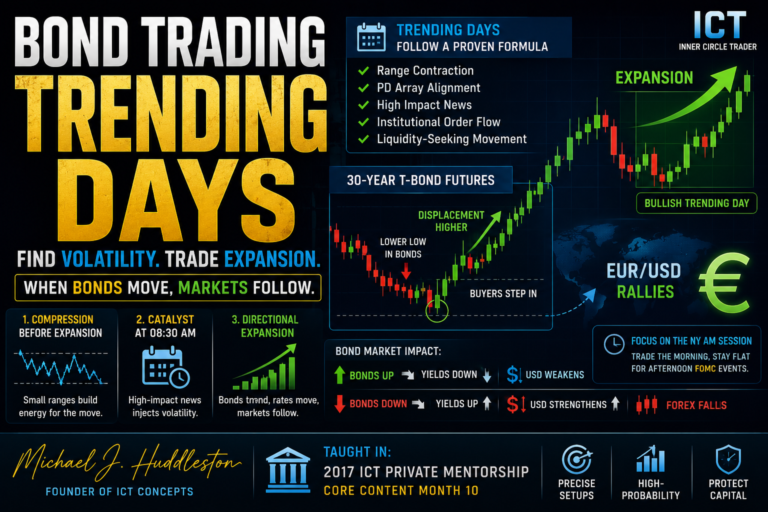
Rising bond prices generally imply declining yields.
Falling bond prices generally imply rising yields.
Because currencies respond strongly to interest-rate differentials, bond-market analysis is especially important for forex traders.
Currencies
Currencies reveal how capital is moving between economies.
Important currency-market information includes:
- US dollar strength or weakness
- Foreign-currency demand
- Yield-seeking behaviour
- Risk-on and risk-off flows
- Relative economic expectations
The Dollar Index frequently acts as an important reference point for commodities and foreign currencies.
Commodities
Commodities can provide information about:
- Inflation expectations
- Global demand
- Economic activity
- Currency strength
- Supply conditions
Dollar-denominated commodities frequently react inversely to the US dollar, although this relationship is not always perfectly maintained.
Stocks
Stocks reflect:
- Corporate growth expectations
- Investor risk appetite
- Economic optimism
- Institutional capital allocation
- Liquidity conditions
Strong equity markets often appear during risk-on conditions.
Falling equity markets can reflect risk aversion, tightening liquidity or economic uncertainty.
Understanding Risk-On Conditions
A risk-on environment develops when investors are willing to move capital into assets that offer greater potential return.
Typical risk-on behaviour may include:
- Stocks rising
- Foreign currencies strengthening
- US dollar weakening
- Commodity prices rising
- Safe-haven demand falling
- Bond prices weakening as capital leaves safety
- Treasury yields rising
In a clean risk-on environment, multiple asset classes should broadly support the same narrative.
For example:
- S&P 500 rallies
- NASDAQ rallies
- AUDUSD strengthens
- EURUSD strengthens
- Dollar Index declines
- Treasury bonds weaken
- Commodities find support
This alignment suggests that institutional capital is actively accepting risk.
Understanding Risk-Off Conditions
A risk-off environment develops when investors prioritise capital protection and liquidity.
Typical risk-off behaviour may include:
- Stocks declining
- Foreign currencies weakening
- US dollar strengthening
- Safe-haven assets gaining demand
- Bond prices rising
- Treasury yields declining
- Growth-sensitive commodities weakening
A clean risk-off environment may show:
- S&P 500 falling
- NASDAQ falling
- AUDUSD declining
- EURUSD weakening
- Dollar Index rallying
- Treasury bonds strengthening
- Industrial commodities losing support
This alignment reveals that institutions are reducing risk exposure.
Markets Should Move in Symmetry
The strongest market environments occur when the major asset classes move in a coordinated way.
Huddleston describes this as symmetry or harmony between the markets.
Symmetrical conditions may provide:
- Stronger directional bias
- Larger price ranges
- Cleaner market structure
- More reliable liquidity objectives
- Greater institutional sponsorship
- Better trade-holding confidence
When all four asset classes support the same general narrative, the probability of sustained expansion may increase.
Huddleston explains:
“When the markets are working well together, when all the asset classes are doing as they should, risk-on environments, everything should rally.”
This does not mean every instrument will move in exactly the same way. It means their broader behaviour should make sense within the same macro narrative.
What Is Multi-Asset Decoupling?
Decoupling occurs when one or more asset classes stop behaving as expected relative to the others.
Examples may include:
- Stocks rising while bonds also rise aggressively
- Dollar Index rallying while commodities also rally
- Foreign currencies weakening while risk assets remain strong
- Treasury yields rising without corresponding dollar strength
- Equity indices making highs while market leadership weakens
These conditions create conflicting information.
A decoupled market may indicate:
- Institutional uncertainty
- Transition between risk regimes
- Event risk
- Low conviction
- Position reduction
- Waiting for new information
- Temporary market inefficiency
When the asset classes are not aligned, one-sided moves may become harder to sustain.
Why Decoupling Makes Trading Difficult
During decoupling, markets may appear technically attractive but lack broader sponsorship.
A forex pair may begin rallying, but the bond market may not support the move.
Stocks may trade higher, but commodity markets and currencies may reflect risk aversion.
The result may be:
- Short-lived breakouts
- Choppy price action
- Repeated reversals
- Reduced follow-through
- Smaller daily ranges
- More difficult trade management
Huddleston explains:
“If there isn’t this beautiful dovetail with all four of the asset classes, then you’re going to have a very hard time finding opportunities where moves can be explosive.”
The absence of alignment does not mean no trade can occur.
It means traders should reduce expectations and avoid assuming that every setup will produce a large expansion.
Institutional Conviction and Market Alignment
Large institutions include:
- Banks
- Pension funds
- Insurance companies
- Hedge funds
- Asset managers
- Corporations
- Sovereign institutions
These participants control significantly more capital than retail traders.
When they have conviction, their activity becomes visible across several asset classes.
For example, strong institutional confidence in a risk-on environment may appear through:
- Bond selling
- Stock accumulation
- Foreign-currency buying
- Commodity strength
- Dollar weakness
If only one or two asset classes reflect this activity, institutions may not yet be fully committed.
When a third and fourth asset class begin confirming, the market may be transitioning from uncertainty into a more directional environment.
Two Asset Classes Versus Four
Suppose two asset classes support a risk-on narrative, but the other two do not.
This is not yet a fully symmetrical market.
For example:
- Stocks rise
- Commodities rise
- Bonds also rise
- Dollar remains strong
The information is mixed.
If a third asset class begins behaving as expected, the picture becomes more interesting.
For example:
- Stocks rise
- Commodities rise
- Foreign currencies strengthen
- Dollar begins weakening
Now institutional capital may be moving with greater conviction.
The more asset classes that confirm the same narrative, the stronger the market alignment becomes.
Why Explosive Moves Require Sponsorship
Large directional moves usually require institutional capital.
Retail traders alone cannot create sustained expansion across major financial markets.
Explosive moves tend to appear when:
- Several asset classes align
- Interest-rate markets confirm
- Liquidity is available
- Smart Money commits capital
- Seasonal tendencies support the move
- Higher-time-frame objectives remain open
Huddleston states:
“You want explosive moves, you want big directional one-sided markets. That’s going to come by way of understanding the four asset classes.”
The purpose of multi-asset analysis is to identify where large institutions are placing capital before the move becomes obvious to everyone.
Interest Rates Connect the Markets
Interest rates are one of the most important links between bonds, currencies, commodities and stocks.
Changes in yields can affect:
- Currency valuation
- Corporate borrowing costs
- Stock valuations
- Commodity financing
- Investor risk appetite
- International capital flows
When bond prices rise and yields fall:
- The dollar may weaken
- Foreign currencies may strengthen
- Stocks may benefit from lower borrowing costs
- Certain commodities may gain support
When bond prices fall and yields rise:
- The dollar may strengthen
- Foreign currencies may weaken
- Stock valuations may come under pressure
- Financial conditions may tighten
The exact response depends on the wider economic environment, but the bond market remains a vital source of information.
The Dollar and Commodities
Many commodities are priced in US dollars.
This creates an important relationship between:
- Dollar Index
- Gold
- Silver
- Crude oil
- Agricultural commodities
- Industrial metals
A stronger dollar can make commodities more expensive for buyers using other currencies.
This may pressure commodity prices.
A weaker dollar can support commodity prices by making them relatively less expensive internationally.
However, supply shocks, geopolitical events or strong global demand can temporarily override this relationship.
When commodities and the dollar move in the same direction unexpectedly, the trader should investigate whether a decoupling is developing.
Stocks and Risk Appetite
Stock indices are major indicators of investor risk appetite.
Strong equity markets may suggest:
- Institutional confidence
- Economic optimism
- Increased speculative demand
- Greater willingness to hold risk
Weak equity markets may suggest:
- Capital preservation
- Economic concern
- Reduced liquidity
- Institutional distribution
However, the trader should not rely on the index alone.
It is important to compare:
- S&P 500
- NASDAQ
- Dow Jones
- Major stock leadership
- Bond-market behaviour
- Currency-market behaviour
If stocks rise while fewer companies participate, the apparent strength may be misleading.
Commodities and Economic Expectations
Commodity markets can reveal information about the real economy.
Industrial commodities such as copper and crude oil can reflect:
- Manufacturing demand
- Transportation demand
- Economic growth
- Global consumption
Agricultural commodities may be influenced by:
- Weather
- Crop conditions
- Supply shortages
- Seasonal demand
Precious metals may respond to:
- Dollar direction
- Inflation concerns
- Safe-haven demand
- Interest rates
When commodities support the same narrative as bonds, currencies and stocks, the general market picture becomes clearer.
Multi-Asset Analysis for Forex Traders
A forex trader can use multi-asset analysis without trading bonds, stocks or commodities directly.
Before trading a currency pair, review:
- Dollar Index
- Treasury bond prices
- Treasury yields
- S&P 500
- NASDAQ
- Gold
- Crude oil where relevant
- Commodity currencies
For example, before buying AUDUSD, the trader may look for:
- Dollar weakness
- Bond-market behaviour supporting lower US yields
- Equity-market strength
- Commodity strength
- Bullish AUD institutional order flow
If these factors align, the trade may have stronger sponsorship.
Multi-Asset Analysis for Index Traders
An index trader can improve analysis by reviewing:
- Treasury bonds
- Treasury yields
- Dollar Index
- Major currencies
- Commodity-market direction
- Sector and stock leadership
A bullish stock-index setup becomes stronger when:
- Bond and yield behaviour supports risk-taking
- Dollar behaviour is consistent with the narrative
- Commodity markets show economic confidence
- Major indices confirm one another
If these conditions conflict, the trader may expect consolidation or reduced follow-through.
Multi-Asset Analysis for Commodity Traders
Commodity traders should consider:
- Dollar direction
- Interest rates
- Commercial positioning
- Equity-market risk appetite
- Related commodities
- Seasonal tendencies
For example, a bullish gold setup may become stronger when:
- Dollar Index is bearish
- Real yields are falling
- Bonds are strengthening
- Gold is at a Discount Array
- Commercial activity supports accumulation
The commodity chart provides the setup, but the other markets provide the context.
Multi-Asset Analysis for Stock Traders
A stock trader can use multi-asset analysis to determine whether the broader environment supports ownership or short selling.
Before buying stocks, review:
- Equity-index trend
- Bond-market direction
- Interest-rate expectations
- Dollar strength
- Commodity-market health
- Market breadth
Before shorting stocks, review:
- Risk-off behaviour
- Yield stress
- Dollar strength
- Commodity weakness
- Index distribution
- Weak stock leadership
This prevents the trader from selecting an individual stock without considering the larger environment.
Multi-Asset Analysis and Trade Management
Multi-asset analysis does more than identify entries.
It also helps with trade management.
A trader may hold a position longer when:
- All asset classes remain aligned
- The higher-time-frame objective is unfulfilled
- Institutional sponsorship remains visible
- Correlated markets continue confirming
A trader may reduce exposure when:
- Asset classes begin decoupling
- Bonds stop confirming currencies
- Stocks lose leadership
- Commodities reverse against the narrative
- The higher-time-frame target has been reached
Without this wider view, traders may exit good trades too early or hold weak trades too long.
Knowing When Not to Trade
One of the greatest benefits of multi-asset analysis is recognising when no trade should be taken.
If the four asset classes are sending conflicting messages, the correct decision may be to remain flat.
Huddleston explains:
“If I can’t find them, if they’re not leaving clear tracks, I’m keeping my hands in my pocket.”
This discipline protects the trader during periods of:
- Holiday trading
- Event uncertainty
- Low institutional participation
- Mixed economic signals
- Completed weekly objectives
- Z-day consolidation
Avoiding a poor market condition is part of professional analysis.
Completed Objectives and Consolidation
A market may stop offering quality opportunities after reaching its higher-time-frame objective.
Suppose a currency pair has already reached the weekly sell-side target.
This does not automatically mean it must reverse higher.
It may simply consolidate.
Multi-asset analysis can help determine whether:
- Further downside is supported
- Reversal conditions exist
- Related markets confirm continuation
- Institutional participation has weakened
When the objective is complete and the asset classes are mixed, forcing another trade is unnecessary.
Holiday and Weekend Conditions
Markets often become less directional ahead of:
- Major holidays
- Long weekends
- Important political events
- Central-bank decisions
- Widely followed economic releases
During these periods, institutions may reduce exposure and wait for more information.
Multi-asset analysis may reveal this through:
- Narrower bond ranges
- Stock-market consolidation
- Mixed currency behaviour
- Weak commodity follow-through
- Lack of clear risk-on or risk-off alignment
The trader should adjust expectations rather than forcing a normal trading model onto an abnormal environment.
A Practical Multi-Asset Routine
Traders do not need to stare at every asset class throughout the entire day.
A practical routine can be completed periodically.
Review Bonds
Determine:
- Are Treasury bond prices rising or falling?
- Are yields rising or falling?
- Is the bond market trending or consolidating?
Review the Dollar
Determine:
- Is the Dollar Index bullish or bearish?
- Are foreign currencies confirming?
- Is dollar movement supported by yields?
Review Commodities
Determine:
- Are commodities generally rising or falling?
- Is gold confirming dollar and yield behaviour?
- Are growth-sensitive commodities showing strength?
Review Stocks
Determine:
- Are major indices rising or falling?
- Are they confirming one another?
- Is market leadership expanding or narrowing?
Classify the Environment
Decide whether the market is:
- Risk-on
- Risk-off
- Transitioning
- Decoupled
- Consolidating
Adjust Trading Expectations
Based on the classification:
- Trade normally
- Reduce risk
- Shorten targets
- Wait for greater confirmation
- Remain flat
Risk-On Multi-Asset Checklist
A clean risk-on environment may include:
- Stocks rising
- Major indices confirming
- Foreign currencies strengthening
- Dollar Index weakening
- Commodities finding support
- Bonds weakening
- Treasury yields rising
- Institutional order flow aligned
The exact relationships may vary, but the broad narrative should be internally consistent.
Risk-Off Multi-Asset Checklist
A clean risk-off environment may include:
- Stocks declining
- Major indices confirming weakness
- Foreign currencies weakening
- Dollar Index strengthening
- Growth-sensitive commodities declining
- Bonds strengthening
- Treasury yields falling
- Institutional order flow aligned
When these relationships appear together, bearish or defensive moves may have greater magnitude.
Decoupled-Market Checklist
A decoupled or uncertain market may include:
- Stocks and bonds rising together without a clear macro reason
- Dollar and commodities moving in the same direction
- Foreign currencies failing to confirm dollar weakness
- Major indices diverging
- Interest rates moving without currency confirmation
- Repeated consolidation
- Completed higher-time-frame objectives
- Lack of displacement
During these conditions, trade frequency and position size should generally be reduced.
Common Multi-Asset Analysis Mistakes
Watching Only One Instrument
A single chart cannot adequately explain the broader market environment.
Assuming Relationships Are Fixed
Intermarket relationships can temporarily change or decouple.
Forcing Risk-On or Risk-Off Labels
The market may be neutral or transitioning.
Ignoring Bonds
Interest rates influence currencies, stocks and commodities.
Looking for Trades Instead of Information
The purpose of analysis is first to understand the market, not force an entry.
Expecting Perfect Alignment Every Day
Clean symmetry only appears during certain periods.
Trading Aggressively During Decoupling
Mixed signals usually call for reduced expectations.
Overcomplicating the Process
The trader only needs to periodically identify the broad direction and relationship of the four asset classes.
Importance of Multi-Asset Analysis Checklist
Before entering a trade, ask:
- What are Treasury bonds doing?
- Are yields rising or falling?
- Is the Dollar Index bullish or bearish?
- Are foreign currencies confirming the dollar move?
- Are commodities rising or falling?
- Are commodities behaving consistently with the dollar?
- Are stock indices confirming one another?
- Is the environment risk-on or risk-off?
- Are all four asset classes aligned?
- Is one asset class beginning to decouple?
- Has the higher-time-frame objective already been reached?
- Is Smart Money showing clear directional commitment?
- Does the market support a large move or only a small trade?
- Should risk be reduced?
- Is remaining flat the better decision?
Final Thoughts
The Importance of Multi-Asset Analysis comes from recognising that bonds, currencies, commodities and stocks are parts of one connected financial system.
Each asset class provides a different piece of the broader institutional narrative.
Bonds reveal interest-rate and safety demand.
Currencies reveal international capital flow.
Commodities reflect supply, demand, inflation and dollar sensitivity.
Stocks reveal economic expectations and risk appetite.
When these markets move in harmony, traders may find:
- Cleaner setups
- Greater volatility
- Larger price objectives
- Stronger directional conviction
- Better trade-management decisions
When they decouple, traders should expect uncertainty, consolidation and reduced institutional sponsorship.
As Michael J. Huddleston explains:
“You have to know what the market’s going to do as a whole.”
A trader does not need to trade every asset class. However, understanding what each one is communicating can help identify where institutions are placing capital, when a major move is likely to occur and when the safest decision is to avoid trading altogether.
All concepts discussed here are for educational purposes. Forex, futures, stocks, bonds, commodities and options involve substantial risk, and multi-asset analysis cannot guarantee future market results.