Growing Small Accounts is an important trading and risk-management concept taught by Michael J. Huddleston, the creator of ICT (Inner Circle Trader). This approach is taught in the ICT Mentorship Core Content – Month 2 and focuses on growing trading equity through controlled risk, selective setups, favorable reward-to-risk and compounding.
The main idea is not to turn a small account into a large account overnight.
Instead, the trader should protect trading equity and allow consistent returns to compound over time.
As Michael J. Huddleston explains:
“You can actually define your trades with very, very low risk in terms of total equity and then watch it compound over time. That’s how you grow an account.”
For ICT traders, Growing Small Accounts is mainly about survival, consistency and giving compound growth enough time to work.
Do Not Rush to Make Massive Gains
One of the biggest mistakes of a new trader is trying to make large profits too quickly.
After seeing how quickly a profitable trade can move, trading may start to feel like a lottery.
The trader begins chasing:
- Massive pip targets
- High percentage returns
- Oversized positions
- Fast account growth
- High-risk trades
This usually creates poor risk decisions.
Michael J. Huddleston states:
“Do not try to rush to make massive gains in either pips or percent returns.”
The goal should not be to prove how many pips you can make.
The trader should focus on consistent percentage growth of account equity.
A small percentage return compounded consistently can become more important than one large profitable trade.
Small Account Does Not Mean Large Risk
Many traders believe a small trading account requires aggressive risk.
The thought process is simple:
Small Capital → Need Large Position → Need Large Profit
ICT teaches the opposite approach.
A trader does not need to expose a large percentage of account equity to generate account growth.
Taking large risk only because the account is small can quickly destroy the account.
The better model is:
Small Risk → Defined Setup → Favorable Reward → Compound Growth
Michael J. Huddleston explains:
“It’s not necessary for you to have very much risk on your trades to make a lot of money.”
The problem is normally not the size of the starting account.
The problem is the trader’s desire to make money too quickly.
Respect Risk Before Reward
New traders usually enter a trade thinking about profit.
They calculate how much money can be made.
They imagine the target being reached.
But they often give very little attention to the possibility of losing.
ICT teaches traders to reverse this thinking.
Risk should be studied before reward.
Before entering a trade, ask:
- Where is the stop loss?
- How much account equity is at risk?
- What invalidates the trade?
- Where is the logical profit objective?
- Is the potential reward worth the risk?
Michael J. Huddleston explains:
“You need to learn to respect the risk side before you take that trade and execute on it.”
Every trade can lose.
The purpose of risk management is to make sure one losing trade or even a series of losses does not remove the trader from the market.
Risk 2% or Less
In the Growing Small Accounts framework, risk should remain controlled.
For a new trader, ICT discusses 2% risk as an upper guideline, while the account-growth example later uses 1.5% risk per trade.
The trader does not need more risk to build account equity.
For example:
$1,000 Account
1.5% risk = $15 risk per trade
A $15 loss will not destroy a $1,000 account.
The trader can accept the loss, review the trade and wait for another setup.
Compare this with risking 10% or 20% of the account.
A few consecutive losses can create severe account drawdown and emotional pressure.
The goal is to make losing trades have little impact on total equity.
Growing Small Accounts Through Reward-to-Risk
The reward-to-risk ratio is an important part of Growing Small Accounts.
ICT encourages traders to identify setups with favorable payout potential.
A 3:1 reward-to-risk ratio means:
Risk $1 → Potentially Make $3
The importance of this becomes clear when win rate is considered.
A trader does not need to win every trade.
According to the framework discussed by ICT, even a trader with a relatively low accuracy can remain profitable when the reward-to-risk structure is favorable.
For example, at approximately 25% accuracy, a 3:1 reward-to-risk model becomes particularly important.
The trader may lose several trades.
But the winning trades have the potential to compensate for multiple losses.
Michael J. Huddleston states:
“You don’t even need high accuracy to build wealth.”
The key elements are:
Controlled Risk + Favorable Reward-to-Risk + Time
Time is the Missing Element
Many new traders understand risk.
They understand compounding.
But they do not want to wait.
This is where the account-growth process normally breaks.
A trader tries to force several months or years of potential growth into a few weeks.
Position size increases.
Trade frequency increases.
Trade quality decreases.
Michael J. Huddleston explains:
“Time is the missing element and that’s the secret. That’s the holy grail to allow compound interest to do its magic.”
Compounding requires time.
The trader must allow percentage growth to build on previous account growth.
This is why Growing Small Accounts is not a quick-money trading model.
It is a long-term equity-building framework.
The 6% Monthly Growth Model
One of the main examples in the ICT Growing Small Accounts lesson is a 6% monthly compounding objective.
The example uses:
- 1.5% risk
- One profitable trade per week
- Approximately 20 pips
- A simple 1:1 payout example
The purpose is not to encourage traders to trade every day.
It demonstrates how relatively small weekly returns can create meaningful account growth.
The basic model is:
1.5% Weekly Return × Approximately 4 Weeks = Around 6% Monthly Growth
ICT explains that approximately 6% monthly compounding can potentially double the trading equity over about one year.
The important focus is:
Double Account Over Time
Not:
Double Account This Week
This changes the trader’s mindset completely.
One Good Trade Can Be Enough
A trader does not need to trade every day.
In the ICT model, a trader can focus on highly selective conditions.
One quality setup may provide the required weekly objective.
Michael J. Huddleston explains:
“One trade. That’s all you need.”
This does not mean a trader will always find one winning trade every week.
It means the trader should stop believing that constant trading is necessary for account growth.
A selective trader waits for conditions that offer:
- Logical institutional price level
- Defined risk
- Clear liquidity objective
- Favorable price structure
- Good reward-to-risk potential
When these conditions are absent, there is no requirement to trade.
Use the Daily Chart to Find Quality Setups
For the 6% account-growth model, ICT discusses looking at the daily chart for higher-quality setups.
The daily timeframe can provide important institutional price levels.
One example used in the framework is a daily bullish order block.
Price moves aggressively higher from a bearish candle.
The down candle before the upward expansion can be studied as a bullish order block.
When price later returns to the daily order block, the trader begins looking for confirmation.
The daily level provides the higher timeframe context.
The trader can then move to a lower timeframe and study price action more closely.
The process can look like:
Daily Order Block → Price Returns to Level → Lower Timeframe Liquidity Run → Bullish Confirmation → Entry
This gives the trade a clear structural framework.
Liquidity Should Define the Profit Objective
Before entering a trade, the ICT trader should already know where price may be drawn.
Liquidity can help define the profit objective.
For a bullish setup, look for buy-side liquidity above:
- Old highs
- Equal highs
- Short-term highs
- Liquidity pools
For a bearish setup, look for sell-side liquidity below:
- Old lows
- Equal lows
- Short-term lows
- Liquidity pools
In the lesson example, price trades below an old low and takes sell-side liquidity.
The move occurs into a daily institutional price level.
After bullish confirmation, buy-side liquidity above equal highs and previous highs becomes the objective.
The trade is therefore planned before entry.
The trader knows:
Where to Buy → Where Risk is Invalidated → Where Price May Be Drawn
This is much different from entering a trade and hoping price continues.
A Simple ICT Small Account Setup Model
A bullish Growing Small Accounts model may look like this:
1. Identify a Daily Institutional Level
Find a daily order block or another important higher timeframe price level.
2. Wait for Price to Return
Do not chase price.
Allow the market to trade back into the level.
3. Look for Sell-Side Liquidity
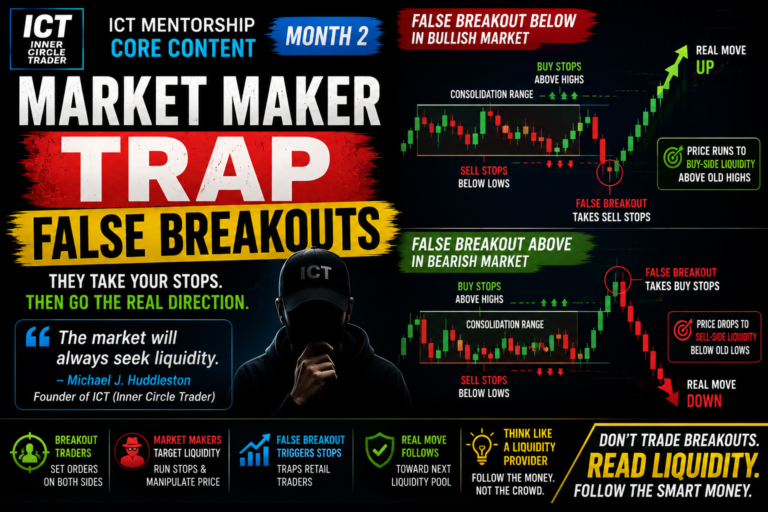
Identify old lows or equal lows below the market.
Price may trade below these lows and run sell stops.
4. Wait for Bullish Confirmation
The trader should not automatically buy when price touches the daily level.
Wait for evidence that price wants to move higher.
5. Define the Entry and Stop Loss
Risk should be calculated before entry.
In the example model, ICT discusses a 20-pip risk with 1.5% account equity risk.
6. Mark Buy-Side Liquidity
Identify logical highs above price.
These levels can become profit objectives.
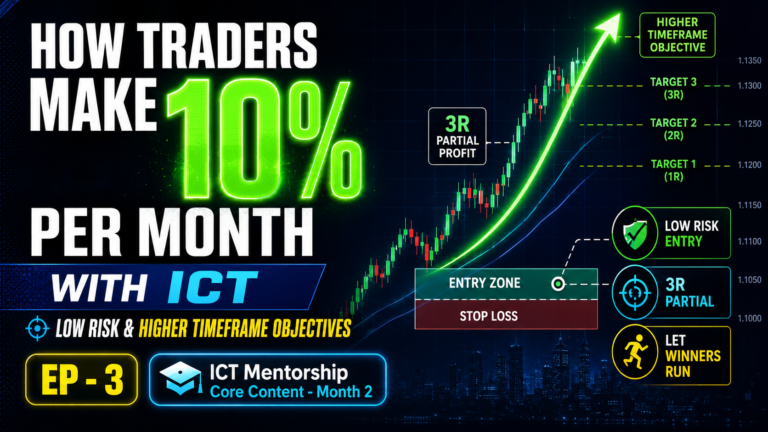
7. Manage the Trade at Reward Multiples
As price reaches 1R, 2R, 3R or higher, the trader can manage risk and scale the position.
This creates an organized trade plan.
Scaling Profits at Logical Levels
ICT also discusses graduating exits instead of always closing the complete trade at one target.
Suppose a trader reaches 1R.
Part of the position can be closed.
The remaining position can continue toward the next liquidity objective.
For example:
1R Reached → Take Partial Profit
2R Reached → Reduce Risk or Move Stop to Breakeven
3R Reached → Take Another Partial
Remaining Position → Allow Price to Reach Higher Liquidity
The exact scaling method can vary.
The important idea is to pay yourself at logical price levels while allowing part of a good trade to continue.
Michael J. Huddleston explains:
“You can graduate your position profits and scale them out at logical levels.”
This is especially useful when a setup provides 3:1, 4:1 or 5:1 reward-to-risk potential.
Avoid Large Drawdown
Growing Small Accounts is not only about making profits.
It is equally about avoiding large drawdown.
Large drawdown creates two problems.
Monetary damage – A large part of trading equity is lost.
Psychological damage – Fear, revenge trading and hesitation can develop.
The ICT approach aims to keep drawdown relatively small through controlled risk and selective trading.
As Michael J. Huddleston explains:
“The drawdown is what will hurt you. It’ll hurt you psychologically and it will hurt you monetarily.”
Account protection should therefore remain a priority.
The trader is trying to stay in the business for years, not survive only a few aggressive trades.
Growing Small Accounts is Not About Trading Every Day
A dangerous mindset is believing a trader must make 20 or 40 pips every trading day.
This can create forced trades.
A market may initially appear attractive and then quickly become unfavorable.
ICT encourages traders to trade in highly selective conditions.
The objective is not:
Trade Every Day
The objective is:
Trade When the Setup Supports Defined Risk and Logical Reward
A trader who waits may take fewer trades.
But those trades can be organized around better market conditions.
Common Mistakes When Growing a Small Trading Account
The first mistake is trying to get rich quickly.
This normally leads to oversized positions.
The second mistake is risking large percentages because the account is small.
Small account size does not justify poor risk management.
The third mistake is focusing only on profit.
Risk must be understood before the trade is opened.
The fourth mistake is chasing a high win rate.
A favorable reward-to-risk structure can reduce the requirement for extremely high accuracy.
The fifth mistake is overtrading.
One selective setup can be more useful than several random trades.
The sixth mistake is ignoring time and compounding.
Growing Small Accounts requires patience.
Final Thoughts on Growing Small Accounts With ICT
The Growing Small Accounts concept taught by ICT (Inner Circle Trader) is based on controlled risk, selective trading and compound account growth.
Michael J. Huddleston emphasizes that traders do not need large risk or massive monthly gains to build trading equity.
The core idea is simple:
Protect Equity → Risk Small → Find Favorable Setups → Target Logical Liquidity → Compound Returns
A new trader can focus on approximately 1.5% risk models, highly selective higher timeframe setups and favorable reward-to-risk opportunities.
Daily institutional levels such as order blocks can provide the context.
Lower timeframe price action can provide confirmation.
Liquidity can provide the profit objective.
Most importantly, the trader must give the account time to grow.
Growing a small trading account is not about finding one lottery trade.
It is about building a repeatable process where losing trades have limited impact and profitable trades have enough reward potential to gradually increase account equity.