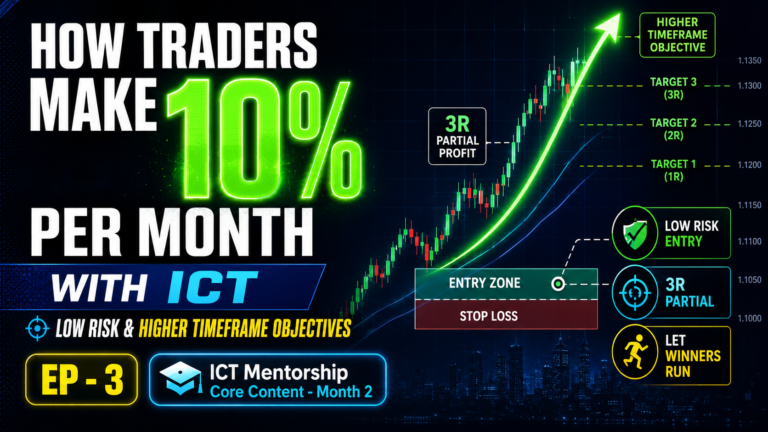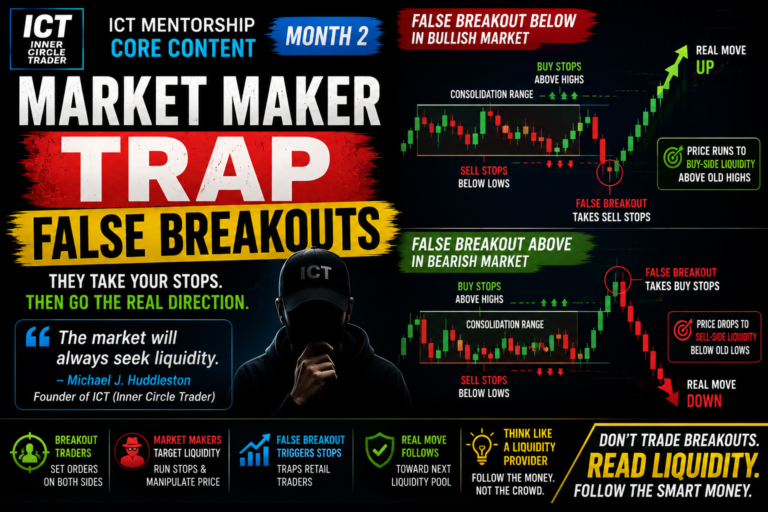
The Secrets To Selecting High Reward Setups is an important decision-making framework taught by Michael J. Huddleston, the creator of ICT (Inner Circle Trader). This concept is taught in the ICT Mentorship Core Content – Month 2 and explains how traders can build a directional opinion by combining big-picture, intermediate and short-term market perspectives.
The real secret is not finding another entry pattern.
It is not simply identifying an order block and entering a trade.
ICT teaches traders to develop a process-oriented way of thinking that helps determine whether to buy, sell or remain on the sidelines.
As Michael J. Huddleston explains:
“Efficiency in trading comes by way of process oriented thinking.”
High reward setups can develop when different market perspectives support the same directional idea.
The complete framework is based on alignment.
Big Picture Perspective + Intermediate Perspective + Short-Term Perspective = High Reward Trading Scenario
High Reward Setups Begin With a Process
Many new traders focus almost completely on trade signals.
They want to know:
- Where to enter
- Where to buy
- Where to sell
- Which order block to use
- Where to place the stop
But these are not the first decisions in the ICT framework.
Before looking for an entry, the trader should understand why a trading opportunity should exist.
Michael J. Huddleston states:
“You have to know what it is specifically you’re looking for and where to find that information.”
The process should help answer:
Should I be bullish or bearish?
Is the current environment suitable for trading?
Which market or currency pair should I focus on?
What would make me change my directional opinion?
What conditions must occur before I execute?
Without a defined process, emotional and impulsive trading can easily enter the trader’s decision-making.
Make Trading Decisions Binary
The ICT trading process should be clearly defined.
A trader should not make decisions based only on feelings such as:
“I think price may go higher.”
Or:
“This chart looks bearish.”
The trading model should have specific conditions.
The decision should gradually become binary:
Conditions Support Buying = Look for Buy Setup
Conditions Support Selling = Look for Sell Setup
Conditions Do Not Agree = Stay on the Sidelines
Michael J. Huddleston explains that the decision process should be:
“Very black or white.”
A structured trading model reduces the influence of:
- Fear
- Greed
- Social media opinions
- Other traders
- Impulsive market reactions
The trader follows their own process.
The Three Perspectives Behind High Reward Setups
The Secrets To Selecting High Reward Setups framework divides market analysis into three perspectives.
These are:
- Big Picture Perspective
- Intermediate Perspective
- Short-Term Perspective
A high reward trading setup develops when all three perspectives support the same directional expectation.
For example:
Big Picture = Bullish
Intermediate = Bullish
Short-Term = Bullish
The trader can focus on buying opportunities.
The opposite applies to bearish conditions.
Big Picture = Bearish
Intermediate = Bearish
Short-Term = Bearish
The trader can focus on selling opportunities.
If the perspectives conflict, the trader may need to wait.
Big Picture Perspective
The big picture perspective provides the broader market direction.
ICT separates this analysis into four areas:
- Macro market analysis
- Interest rate analysis
- Intermarket analysis
- Seasonal influences
The trader does not necessarily need all four components to agree.
According to the lesson, at least two of the four areas should come into agreement.
The model is:
2 of 4 Big Picture Factors Agree = Big Picture Perspective
Macro Market Analysis
Macro market analysis studies whether the broader market environment is inflationary or deflationary.
These conditions can influence:
- Currencies
- Commodities
- Equities
The trader studies the broader economic environment and how it may affect the asset being analyzed.
Interest Rate Analysis
Interest rates can provide important directional information.
The trader studies:
- Rising interest rates
- Falling interest rates
- Unexpected rate hikes
- Unexpected rate cuts
- Interest rate differentials
When one currency has a higher interest rate and another has a lower rate, the difference can help create a directional framework.
The trader studies where capital may be seeking yield.
Intermarket Analysis
Intermarket analysis studies relationships between different markets.
ICT specifically discusses the relationship between commodities and the U.S. Dollar Index.
Commodity prices and the dollar can often show an inverse relationship.
For example:
Commodity Strength → Potential Dollar Weakness
Dollar Strength → Potential Commodity Weakness
The trader uses these relationships as another source of directional information.
Seasonal Influences
Some markets show seasonal tendencies.
A market may historically show a tendency to perform stronger or weaker during certain periods.
Seasonal analysis is not used alone.
It can support another big-picture factor.
For example:
Bullish Seasonal Tendency + Supportive Interest Rate Analysis = Bullish Big Picture Perspective
Two big-picture components are now aligned.
Intermediate Perspective
After establishing the big picture, the ICT trader moves to the intermediate perspective.
The intermediate perspective contains three main areas:
- Top-down analysis
- Commitment of Traders data
- Market sentiment
According to the framework, at least two of these three areas should agree.
The model becomes:
2 of 3 Intermediate Factors Agree = Intermediate Perspective
Top-Down Analysis
Top-down analysis begins with higher timeframe charts.
The trader studies:
- Monthly chart
- Weekly chart
- Daily chart
Important areas include:
- Long-term highs and lows
- Intermediate-term highs and lows
- Order blocks
- Important price levels
- Levels that previously repelled price
Higher timeframe analysis is important because the larger market participants commonly focus on monthly, weekly and daily price data.
The higher timeframe chart can help frame the larger directional expectation.
Commitment of Traders Data
ICT also discusses Commitment of Traders or COT data.
The trader studies the positioning and hedging activity of large market participants.
Special attention can be given to extreme commercial readings.
The lesson discusses studying extremes relative to:
- The previous 12 months
- The previous four years
Extreme positioning can sometimes provide insight into changes in commercial hedging activity.
COT data can then support an intermediate bullish or bearish perspective.
Market Sentiment
Market sentiment studies whether market participants are extremely bullish or bearish.
Sentiment can be collected from different market resources.
The trader studies the general consensus.
Extreme bullishness or extreme bearishness may provide useful information.
Within the framework, market sentiment is considered less significant than strong top-down analysis, but it can still support the intermediate perspective.
For example:
Weekly Chart Bullish + COT Bullish = Bullish Intermediate Perspective
The trader now waits for the short-term perspective to align with buying.
Short-Term Perspective
The short-term perspective is where the ICT trader becomes more focused on current price delivery.
It contains three areas:
- Correlation analysis
- Time and price theory
- Interbank Price Delivery Algorithm
For a high reward setup, the lesson calls for one component from each of these three areas to support the directional idea.
Therefore:
Correlation + Time and Price + IPDA = Short-Term Perspective
Correlation Analysis
Correlation analysis can include:
- U.S. Dollar Index SMT analysis
- Correlated pair SMT analysis
The trader studies relationships between markets.
For example, suppose the U.S. Dollar Index creates a higher high.
A foreign currency pair expected to move inversely may fail to create a corresponding lower low.
This difference can indicate a cracking correlation.
ICT traders can also compare correlated pairs.
For example:
- EUR/USD
- GBP/USD
These markets often show a general relationship.
When correlated markets fail to move together, SMT analysis may provide insight into relative strength or weakness.
Time and Price Theory
Time and price theory provides the timing framework.
ICT discusses several time-based perspectives:
- Quarterly effect
- Monthly effect
- Weekly range
- Daily range
- Time of day
The quarterly effect studies possible price shifts over approximately three to four months.
The monthly effect studies monthly price ranges and important monthly reference points.
The weekly range is important for identifying the expected weekly price expansion.
The daily range studies how the daily candle may form through open, high, low and close price delivery.
Time of day helps determine whether current market conditions are suitable for a particular setup.
The trader is not only asking:
Where is price?
The trader also asks:
When is price trading at this level?
Interbank Price Delivery Algorithm
The third short-term component is IPDA or Interbank Price Delivery Algorithm.
The trader studies:
- Institutional order flow
- Liquidity
- Market efficiency paradigm
Liquidity analysis focuses on where existing orders may be resting.
For example:
Buy Stops Above Old Highs
Sell Stops Below Old Lows
According to the ICT framework, price may seek these liquidity areas to find counterparties for institutional execution.
The trader studies:
Where are the orders?
Why would price seek those orders?
Does institutional order flow support the move?
When liquidity, order flow and the other short-term factors align, the trader has a clearer short-term directional expectation.
The Seven Factors Behind a High Reward Setup
One of the most important parts of The Secrets To Selecting High Reward Setups is the seven-point alignment model.
The framework requires:
Big Picture Perspective = 2 Factors
Intermediate Perspective = 2 Factors
Short-Term Perspective = 3 Factors
Total:
2 + 2 + 3 = 7 Areas of Agreement
These seven supporting factors create the framework for a high reward trading scenario.
For example:
Big Picture
Interest Rates = Bullish
Seasonal Tendency = Bullish
Intermediate
Weekly Chart = Bullish
COT Data = Bullish
Short-Term
SMT Analysis = Bullish
Weekly Range / Time of Day = Bullish
Institutional Order Flow and Liquidity = Bullish
All three market perspectives support higher prices.
The trader now has a reason to look for a long setup.
This does not mean the trader enters immediately.
The framework only defines the high reward trading environment.
An actual entry model is still required.
High Reward Setup Is Not the Same as an Entry Signal
A common mistake is confusing directional alignment with an entry.
Suppose all seven conditions support higher prices.
This does not mean:
Buy Immediately
The trader still needs an executable setup.
The high reward framework answers:
Which direction should I be trading?
The entry model answers:
Where and when should I execute?
The trader may later use:
- Order block
- Liquidity run
- Judas Swing
- Institutional order flow
- Another defined ICT entry model
The important point is that the entry occurs after the broader decision process.
This prevents the trader from chasing random order blocks.
Why Process-Oriented Thinking Matters
Reactionary traders respond to every market movement.
Price moves higher.
They become bullish.
Price moves lower.
They become bearish.
Another trader posts a chart.
Their opinion changes again.
ICT teaches process-oriented thinking.
The trader follows a repeatable sequence.
Big Picture Analysis
↓
Intermediate Analysis
↓
Short-Term Analysis
↓
Directional Decision
↓
Wait for Entry Criteria
↓
Execute or Stay on Sidelines
Michael J. Huddleston explains:
“Professional traders are not in a rush to put money at work.”
The professional trader waits for a scenario that makes sense.
High reward setups are selected.
They are not forced.
Know Why the Trade Should Work
An ICT trader should understand why the anticipated price move may occur.
It is not enough to say:
“I found an order block.”
The trader should understand the surrounding market narrative.
For example:
Interest Rate Analysis Supports USD Strength
↓
Higher Timeframe Analysis Supports Lower Foreign Currency Prices
↓
COT Supports the Bearish Perspective
↓
SMT Shows Weakness
↓
Weekly Range Suggests Lower Price Delivery
↓
Institutional Order Flow is Bearish
↓
Sell-Side Liquidity is Below Price
The trader now understands why lower prices may develop.
The entry setup becomes part of a larger narrative.
This is what separates a random pattern from a process-based trading decision.
Experience Must Be Logged
Process-oriented thinking develops through experience.
ICT encourages developing traders to practice in a demo environment.
But random demo trading is not enough.
The trader should record:
- Market perspective
- Directional expectation
- Reason for the bias
- Setup used
- Outcome
- What worked
- What failed
Winning trades should not simply be labelled as good trades.
Losing trades should not be ignored.
Both provide information.
The trader builds a reference library from repeated market experience.
Over time, the decision process becomes faster.
What initially requires written analysis can gradually become a familiar trading routine.
High Reward Trading Should Become Boring
Trading should not constantly feel exciting.
The trader should not be chasing the emotional feeling of correctly predicting a market move.
A structured process creates routine.
Michael J. Huddleston explains that trading should become:
“Boring… monotonous… mundane and routine.”
This is important.
When the trader has predefined decision points, there is less room for emotional interpretation.
The process becomes:
Condition Exists = Continue Analysis
Condition Does Not Exist = Wait
The trader does not need to force anything.
High reward setups become easier to recognize because the trader already knows exactly what conditions are required.
A Simple ICT High Reward Setup Selection Model
The Secrets To Selecting High Reward Setups can be simplified into the following process.
1. Practice Patience
Do not begin by searching for an entry signal.
2. Evaluate the Trading Environment
Determine whether current conditions are suitable for trading.
3. Build the Big Picture Perspective
Study macro conditions, interest rates, intermarket relationships and seasonal influences.
Require at least two areas of agreement.
4. Build the Intermediate Perspective
Study top-down analysis, COT data and market sentiment.
Require at least two areas of agreement.
5. Build the Short-Term Perspective
Study correlation, time and price theory, and IPDA.
Require support from all three areas.
6. Check Directional Alignment
Big picture, intermediate and short-term perspectives should support the same direction.
7. Define the Trading Side
Decide whether to look for buys, sells or remain on the sidelines.
8. Wait for Executable Criteria
Use a defined ICT entry model.
9. Understand Why the Trade Should Work
Know the liquidity objective and price narrative.
10. Record the Experience
Document the setup and use it to refine the trading process.
Final Thoughts on The Secrets To Selecting High Reward Setups
The Secrets To Selecting High Reward Setups with ICT (Inner Circle Trader) is not based on finding a magical entry signal.
Michael J. Huddleston teaches a structured decision-making process.
The trader begins with the big picture.
Then the intermediate perspective is analyzed.
Finally, short-term price delivery is studied.
The complete model is:
2 Big Picture Factors + 2 Intermediate Factors + 3 Short-Term Factors = High Reward Trading Framework
When the three perspectives support the same directional expectation, the trader is better prepared to wait for a specific entry model.
The main lesson is simple:
Do not react to price. Build a process that tells you what to expect from price.
As Michael J. Huddleston explains:
“The real secret to trading [is] understanding what makes the process arrive at a decision.”
For ICT traders, high reward setups become clearer when market decisions are organized, directional perspectives are aligned and execution occurs only after the complete trading process supports the idea.