Money Management is one of the most important parts of ICT trading because even a trader with good market analysis can damage an account through excessive risk, overleveraging, and poor position management.
In the ICT Mentorship Core Content – Month 5, Michael J. Huddleston, founder of ICT (Inner Circle Trader), explains Money Management from a higher time frame and position trading perspective.
The main objective is not to maximize every possible return.
The objective is to:
Control drawdown → Limit risk exposure → Preserve equity → Focus on high-quality setups → Build a consistent equity curve
As Michael J. Huddleston explains:
“It’s not important you have a big account.”
What matters more is learning how to control money consistently over a long period of time.
What Is Money Management in ICT Trading?
Money Management refers to the rules used to control how much trading capital is exposed to risk.
It includes:
- Capital allocation
- Risk per trade
- Maximum exposure
- Drawdown control
- Reward-to-risk selection
- Stop-loss placement
- Position management
- Profit-taking
- Re-entry decisions
ICT Money Management is built around capital preservation and consistency.
The trader should not ask:
How much can I make from this trade?
The better question is:
How much risk can I manage if the trade is wrong?
The primary objective is to remain financially and psychologically stable enough to participate in future opportunities.
Control Drawdown Before Focusing on Profit
One of the major ideas taught by ICT is the importance of controlling account drawdown.
Michael J. Huddleston discusses approximately 15% annual maximum drawdown as a strong objective, while suggesting that drawdown around the 20% area may still be tolerable depending on overall performance.
The important principle is not the exact percentage.
The principle is:
Keep drawdown manageable and controlled.
Large drawdowns create several problems.
They reduce available trading equity.
They increase emotional pressure.
They encourage revenge trading.
They make traders increase risk in an attempt to recover losses.
A steady equity curve with limited drawdown is generally more sustainable than an account showing extreme gains followed by large collapses.
In ICT Money Management:
Capital protection comes before aggressive account growth.
ICT’s 30% Equity Allocation Concept
One of the most interesting Money Management ideas discussed by ICT is limiting active trading allocation to approximately 30% of total account equity.
Suppose a trader has:
Total Account Equity = $100,000
Instead of calculating trading risk using the full $100,000, the trader may allocate:
30% Trading Allocation = $30,000
Risk calculations are then based on the allocated $30,000.
The remaining capital acts as a reserve.
The idea is:
Total Equity
→ Allocate 30% for trading calculations
→ Calculate percentage risk from the 30% allocation
Michael J. Huddleston explains:
“I limit my allocation to only 30% of my total equity.”
This conservative model reduces the probability of excessive leverage and helps preserve available capital.
Example of the 30% Allocation Model
Assume the account balance is:
$10,000
The trader uses 30% of the equity as the trading allocation.
$10,000 × 30% = $3,000
The Money Management calculations are based on the $3,000 allocation.
If maximum risk per trade is 1%:
$3,000 × 1% = $30
Maximum trade risk becomes:
$30
The structure is:
$10,000 total equity
→ $3,000 trading allocation
→ 1% risk
→ $30 maximum trade risk
This is extremely conservative compared with risking 1% or 2% of the full account balance.
The objective is not rapid account growth.
The objective is to develop the ability to manage risk consistently.
Why Keep a Large Equity Reserve?
Using only part of the total equity provides several advantages.
First, it reduces overleveraging.
The trader is less likely to use excessive margin.
Second, it limits large equity fluctuations.
Third, the trader maintains available capital for future opportunities.
Suppose a high-quality setup appears while the trader already has a long-term position open.
A trader who has committed nearly all available equity may not be able to participate.
A trader with cash reserves has greater flexibility.
The Money Management logic becomes:
Low capital allocation
→ Lower leverage
→ Smaller drawdown
→ More available equity
→ Greater flexibility for future setups
ICT’s philosophy is based on staying financially prepared rather than constantly maximizing exposure.
Risk 1% or Less Per Trade
For the conservative higher time frame model, ICT discusses 1% as an ideal maximum risk per trade.
Remember, in the 30% allocation model, this is not necessarily 1% of the entire account.
It is:
1% of the allocated trading equity
The reason is simple.
A trader cannot completely control whether an individual setup wins or loses.
The trader can control the amount of money exposed to the outcome.
Small risk allows the trader to survive a sequence of losing trades.
It also reduces the emotional importance of an individual position.
When one trade does not have the power to seriously damage the account, the trader can remain more objective.
Focus on 3:1 Reward-to-Risk or Higher
ICT recommends focusing on setups offering approximately 3:1 reward-to-risk or better for higher time frame trading.
Example:
Risk = 100 pips
Potential Reward = 300 pips
Reward-to-risk:
300 ÷ 100 = 3:1
The advantage of a high reward-to-risk model is that the trader does not need an extremely high win rate.
Michael J. Huddleston explains that:
“Having low risk, high reward permits very, very low accuracy.”
For example, assume a trader risks 1 unit per trade.
Trade 1 → -1R
Trade 2 → -1R
Trade 3 → +3R
Net result:
+1R
The trader lost two trades and won only one trade.
The account can still remain profitable because the winning trade was larger than the losses.
Higher Time Frame Stops Must Match the Time Frame
A common mistake is trying to use intraday stop-loss expectations on higher time frame trades.
Some traders believe that using a 10-pip stop means they are more skilled.
ICT strongly rejects this mindset for position trading.
Michael J. Huddleston states:
“Stop-loss orders are not a measure of ability.”
The stop loss should be based on the structure and time frame being traded.
A Daily chart setup may require significantly more space than a five-minute chart setup.
For example:
Stop Loss = 200 pips
This initially sounds like excessive risk.
However, suppose the trade targets:
600 pips
The reward-to-risk remains:
600 pips reward ÷ 200 pips risk = 3:1
The important point is that pip risk and monetary risk are not the same thing.
A wider stop should be compensated through smaller position size.
The logic is:
Wider structural stop
→ Smaller position size
→ Same fixed monetary risk
Never increase account risk simply because the higher time frame stop is larger.
Do Not Rush to Move the Stop to Break Even
In lower time frame trading, traders may move a stop loss to break even relatively quickly.
Position trading is different.
Higher time frame price movements naturally contain larger retracements.
A long-term trade may move into profit and then retrace for several days or even weeks before continuing in the original direction.
Moving the stop to break even too quickly can remove the trader from a valid long-term position.
ICT teaches traders to resist the impulse to immediately reduce risk on higher time frame trades.
The market should first make a meaningful move before stop-loss management is considered.
The principle is:
Give the higher time frame trade enough room to develop.
This requires patience.
Learn to Accept Drawdown in Open Profit
Position traders must understand the difference between realized profit and open profit.
Suppose a long-term position is showing a significant unrealized gain.
Price then retraces.
Part of the open profit disappears.
This can be emotionally difficult.
However, higher time frame trades naturally experience periods of expansion and retracement.
A trader may need to sit through:
Expansion
→ Open profit increases
→ Retracement
→ Open profit decreases
→ Trend resumes
→ New expansion
The trader should not automatically assume the trade is invalid because some open profit has been given back.
The higher time frame narrative and trade invalidation level should guide the decision.
Use Logical Profit Targets and Partial Positions
ICT also discusses taking profits at logical areas of resistance or support.
Suppose a trader is holding a long-term bullish position.
Price approaches a higher time frame resistance level where a retracement is expected.
The trader may:
- Close one-quarter of the position.
- Close one-third.
- Close one-half.
- Close three-quarters.
The trader then allows the remaining position to continue.
If price retraces into another logical buying area, the trader may consider re-entering the removed portion.
The process can look like:
Enter long-term trade
→ Price reaches logical target
→ Take partial profit
→ Price retraces
→ Wait for logical re-entry
→ Add position back
→ Participate in next expansion
This is more active than simply holding the original position from beginning to end.
However, every adjustment should be based on logical market structure.
Low Risk Leaves Equity for More Opportunities
Another advantage of conservative Money Management is that the trader does not place all capital into one idea.
Suppose a trader has a strong long-term position.
A second high-probability setup appears in another market.
If the trader is already overleveraged, the second setup cannot be taken safely.
Low risk preserves flexibility.
Lower exposure per trade
→ More available equity
→ Ability to participate in other qualified setups
The goal is not to trade more frequently.
The goal is to remain prepared when a genuine opportunity appears.
Higher Time Frame Trading Requires Low Frequency
Long-term ICT setups do not appear every trading day.
According to Michael J. Huddleston’s perspective, a trader may find only two or three high-quality position trading opportunities during a year.
This requires a completely different mindset from day trading.
The trader must stop believing:
More trades = More profit
More trades also mean:
More risk exposure
Every time money is placed into the market, the account is exposed to a potential loss.
Therefore:
Low frequency + High-quality setup + Controlled risk
can be more attractive than constant trading.
ICT Money Management favors what Michael describes as the “easy low hanging fruit” rather than trying to force returns from every market condition.
The Goal Is a Consistent Equity Curve
A trader who wants to manage significant capital should focus on consistency.
ICT discusses approximately 18% to 25% annual returns as an example of a respectable objective in the managed funds context.
This should not be viewed as a guaranteed trading return.
The more important lesson is that professional capital management is generally focused on:
Controlled drawdown
→ Consistent performance
→ Limited risk exposure
→ Sustainable account growth
An account that increases steadily while maintaining limited drawdown may be more attractive than an account that produces an extreme return followed by a major loss.
The goal is to become a steady trader, not a trader constantly swinging for the fences.
Money Management Must Match Your Trading Personality
Position trading requires patience.
Trades may take weeks or months to fully develop.
Open profits may fluctuate significantly.
Setups may appear infrequently.
Some traders naturally adapt to this style.
Others become impatient and begin forcing trades.
Money Management becomes more difficult when the trading model conflicts with the trader’s personality.
Before becoming a position trader, ask:
Can I wait several weeks for a trade?
Can I sit through normal higher time frame retracements?
Can I accept only a few quality setups per year?
Can I keep risk small even when I strongly believe in a trade?
Can I follow the same risk rules after a losing trade?
The trading model and Money Management framework must fit the trader’s psychology.
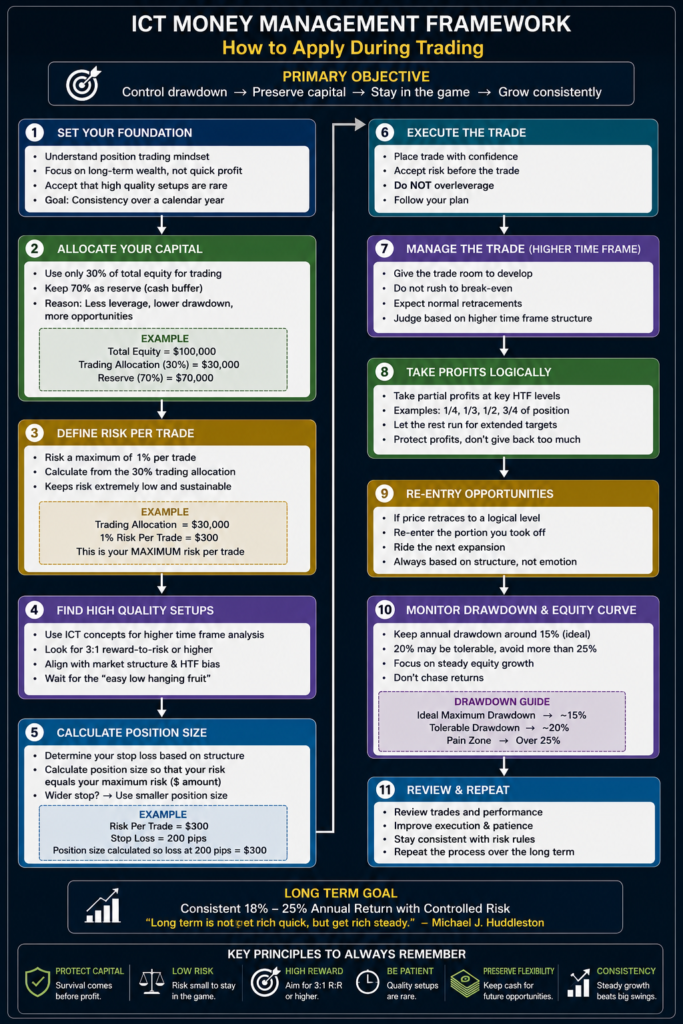
ICT Money Management Framework
A simple way to apply the concept is:
Determine total account equity
→ Allocate a conservative portion of capital
→ Define maximum risk per trade
→ Look for 3:1 or higher reward-to-risk
→ Calculate position size from the structural stop
→ Execute only high-quality setups
→ Allow higher time frame trades room to develop
→ Take profit at logical targets
→ Re-enter only when price provides a logical opportunity
→ Monitor total drawdown and equity curve
The trader’s first responsibility is not making money quickly.
The first responsibility is protecting the ability to continue trading.
Final Thoughts
Money Management in ICT trading is built around conservative risk, controlled drawdown, and steady long-term account growth.
The trader does not need a large account to learn proper capital management.
A small account managed correctly can teach the same core disciplines:
Control risk.
Avoid excessive leverage.
Preserve available equity.
Focus on high reward-to-risk setups.
Allow higher time frame trades enough room.
Reduce unnecessary trading frequency.
As Michael J. Huddleston explains:
“Long term is not get rich quick, but get rich steady.”
That statement summarizes the ICT Money Management philosophy.
The objective is not to make the maximum amount of money from every available trade.
The objective is to manage risk well enough that capital survives, the equity curve grows consistently, and the trader remains ready for the next high-probability opportunity.