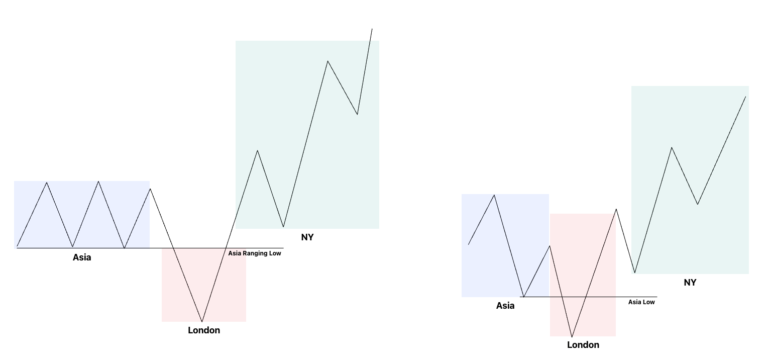
The Weekly Bias – Excellence In Short Term Trading is an ICT (Inner Circle Trader) concept that helps traders anticipate where the weekly high or weekly low may form and position themselves before the major weekly expansion.
This concept was taught by Michael J. Huddleston, the founder of ICT (Inner Circle Trader), in the ICT Forex – Market Maker Primer Course. Instead of reacting to every intraday price movement, the model encourages traders to study the weekly range, determine higher-timeframe direction, and use the weekly opening price as a key reference point.
The basic idea is simple:
Bullish Weekly Bias → Look for the weekly low → Buy below or near the weekly open → Hold for expansion higher
Bearish Weekly Bias → Look for the weekly high → Sell above or near the weekly open → Hold for expansion lower
Understanding this framework can greatly improve short-term and swing trading because it gives the trader a clear expectation for how the week may develop.
What Is The Weekly Bias in ICT Trading?
The Weekly Bias is the trader’s directional expectation for the current trading week.
A trader may expect:
- Higher prices during the week — Bullish Weekly Bias
- Lower prices during the week — Bearish Weekly Bias
The weekly bias should not be determined simply because price moved up or down on Monday. ICT teaches traders to first study the higher timeframe directional premise, particularly the monthly and weekly charts.
When higher timeframe analysis suggests higher prices, the trader should look for a bullish weekly profile.
When higher timeframe analysis suggests lower prices, the trader should anticipate a bearish weekly profile.
The goal is to align short-term trades with the expected direction of the weekly expansion.
The Weekly Opening Price Is a Key Reference Point
One of the most important elements of The Weekly Bias – Excellence In Short Term Trading is the Sunday opening price or weekly opening price.
ICT suggests marking the opening price and extending the level across the entire trading week until Friday.
The weekly opening price acts as a reference for value.
In a bullish environment:
Below Weekly Open = Relatively Discounted or Oversold
In a bearish environment:
Above Weekly Open = Relatively Premium or Overbought
This does not require a traditional overbought or oversold indicator. The condition is interpreted through price action and the higher timeframe directional bias.
For example, when the monthly and weekly charts suggest higher prices, a decline below the weekly opening price may represent an opportunity to look for buying setups.
Similarly, when the higher timeframe bias is bearish, movement above the weekly opening price may offer an area to search for short positions.
ICT Weekly Power of Three Concept
The Weekly Bias model can be viewed through the ICT Power of Three concept:
Accumulation → Manipulation → Distribution
On a bullish week, price may initially move below the weekly opening price. This decline can function as the Judas Swing or manipulation phase.
The downward movement may:
- Stop out existing buyers
- Trigger breakout sell orders
- Encourage retail traders to become bearish
- Move price into a discounted area
Smart money traders operating with a bullish higher timeframe premise may view this same decline differently.
Instead of seeing bearish momentum, they may see an opportunity to position before weekly expansion.
As Michael J. Huddleston explains:
“You’re buying below that weekly open trying to do Power of Three in one week.”
Once the manipulation is complete, price may expand higher during the remaining portion of the week.
The bearish model is simply the inverse.
Weekly Open → Judas Swing Above Open → Weekly High Forms → Bearish Expansion
Bullish Weekly Bias Profile
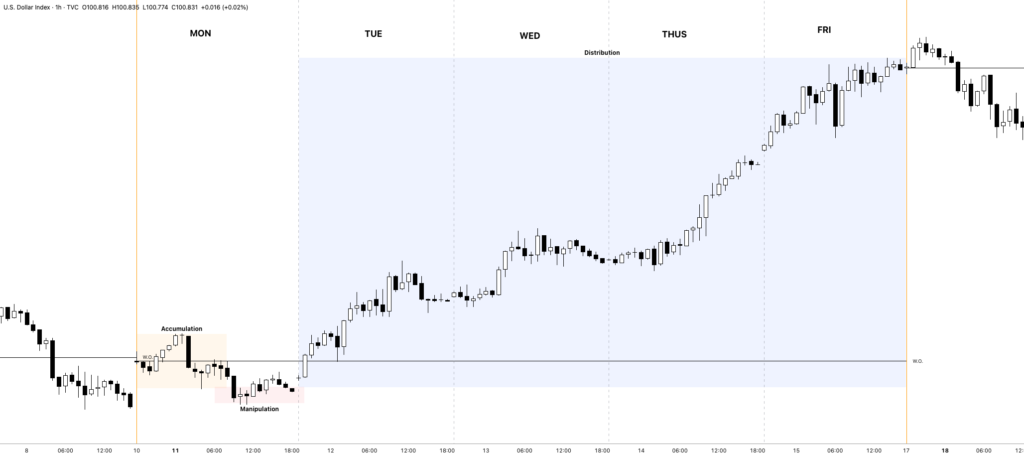
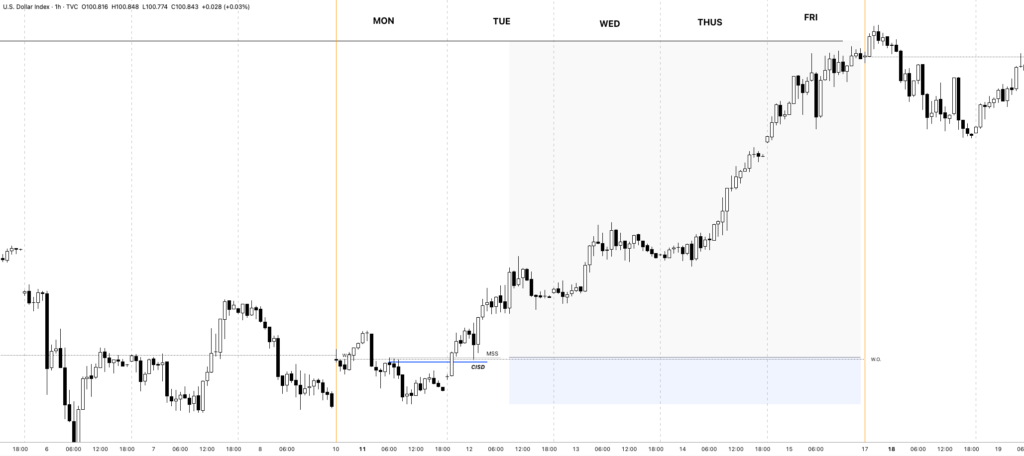
When the higher timeframe directional bias is bullish, ICT teaches traders to anticipate the weekly low forming between Sunday’s open and Wednesday’s New York open at 07:00 New York time.
However, the probability of the weekly low forming may increase during the period from:
Tuesday London Open → Wednesday New York Open
Tuesday and Wednesday are therefore important days for identifying a potential weekly low.
The bullish model generally looks like this:
Bullish HTF Bias → Mark Weekly Open → Price Trades Below Weekly Open → New Weekly Low Forms Tuesday or Wednesday → Bullish Confirmation → Expansion Higher
ICT specifically highlights Tuesday’s London session as an important period to monitor.
If the weekly low does not form Tuesday and price moves lower Wednesday, Wednesday may create the weekly low.
The trader should therefore avoid immediately interpreting every decline as bearish momentum. In a bullish higher timeframe environment, the decline may be establishing the low of the weekly range.
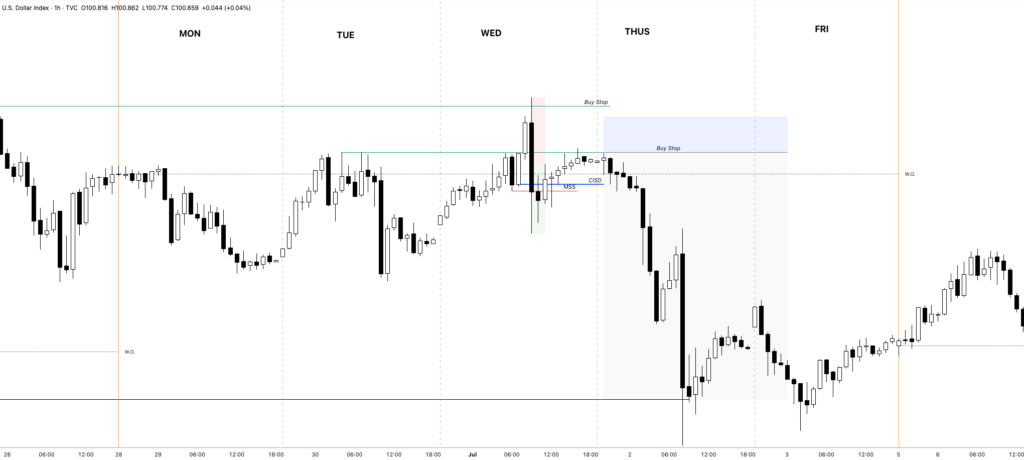
How to Identify a Bullish Weekly Reversal
Assume the trader has already established a bullish weekly bias.
Price moves below the weekly opening price and creates a new weekly low during the Tuesday–Wednesday window.
The trader can then study short-term market structure.
The process is:
New Weekly Low → Identify Short-Term High Before the Low → Price Breaks Above Short-Term High → Wait for Retracement → Look for Long Entry
The break above the short-term high suggests that price may be shifting away from the weekly low.
Traders who prefer confirmation can then use an ICT Optimal Trade Entry (OTE) or another ICT entry model during the retracement.
This approach is particularly useful for traders uncomfortable buying directly as price creates a new weekly low.
Michael J. Huddleston emphasizes that different entry styles may suit different trader personalities. Some traders are comfortable buying near new lows, while others require market structure confirmation and a retracement.
The weekly bias provides the directional framework. The exact entry model can be adapted to the trader.
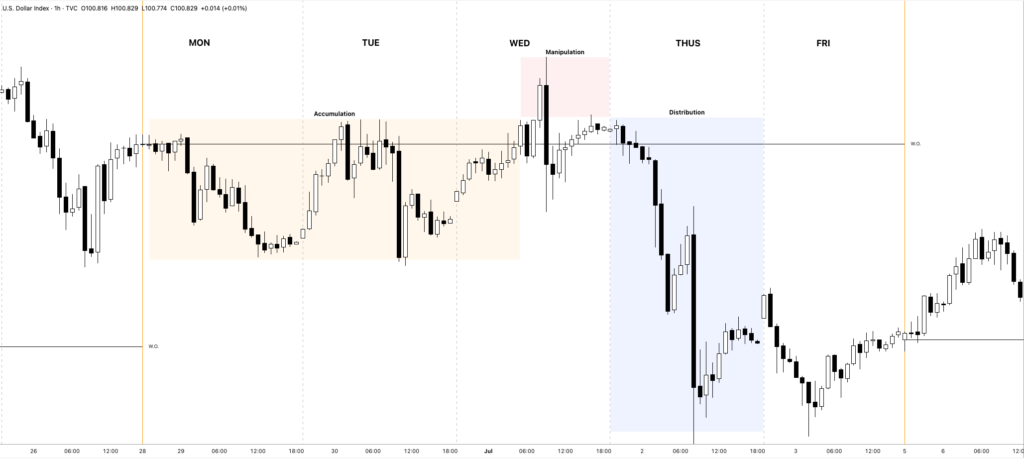
Bearish Weekly Bias Profile
The bearish model is the opposite of the bullish weekly profile.
When higher timeframe analysis suggests lower prices, traders should anticipate the weekly high forming between Sunday’s opening and Wednesday’s New York open at 07:00 New York time.
Again, particular attention should be placed on:
Tuesday London Open → Wednesday New York Open
The bearish weekly profile generally looks like this:
Bearish HTF Bias → Mark Weekly Open → Price Trades Above Weekly Open → Weekly High Forms Tuesday or Wednesday → Bearish Confirmation → Expansion Lower
Price movement above the weekly opening price is interpreted as a relatively overbought condition when the higher timeframe premise is bearish.
The rally may also act as a Judas Swing.
Retail traders may see strong upward momentum and begin buying. At the same time, price may be trading into liquidity, equal highs, or another ICT reference point where a short opportunity can form.
The objective is to position near the weekly high before the expected bearish expansion below the weekly opening price.
Tuesday and Wednesday Are Critical for Weekly Bias
One of the most important ideas in this ICT model is the timing of the weekly turning point.
For bullish conditions:
Weekly Low → Frequently Tuesday or Wednesday
For bearish conditions:
Weekly High → Frequently Tuesday or Wednesday
Monday can establish the weekly high or low, but ICT explains that waiting for Tuesday may provide more information about the week’s developing range.
Monday’s range can help traders understand how price is being positioned around the weekly opening price.
ICT’s preferred focus is particularly around Tuesday London Open.
If the expected turning point does not appear Tuesday, Wednesday becomes extremely important.
This is why Wednesday acts as a critical point in the Weekly Bias model.
Wednesday Is the Line in the Sand
Michael J. Huddleston describes Wednesday very clearly:
“Wednesday is the line in the sand.”
In a bullish scenario, price may form the weekly low Tuesday, move above the weekly opening price, and retrace toward the open again Wednesday.
However, once price decisively expands above the weekly open after the Wednesday turning point, the trader ideally wants to see price continue moving away from the opening price.
For bullish conditions:
Wednesday Expansion Above Weekly Open → Price Should Move Away From the Open
For bearish conditions:
Wednesday Expansion Below Weekly Open → Price Should Move Away From the Open
If price continuously gravitates back toward the weekly opening price after Wednesday, it may indicate:
- A mixed weekly profile
- Consolidation
- A possible reversal
- Weak weekly expansion
These conditions are generally less attractive for the Weekly Bias short-term trading model.
When the Weekly Bias Setup Is Invalid
Having a bullish or bearish bias does not mean the trader must remain committed to that idea regardless of price action.
Suppose a trader expects the weekly low to form Tuesday or Wednesday.
Price forms a potential low and produces a bullish setup. However, after Wednesday’s New York open, price aggressively trades below the anticipated weekly low.
ICT teaches traders to accept that the expectation may be wrong and move to the sidelines.
The same principle applies to bearish conditions.
A trader should not repeatedly enter simply because the original higher timeframe bias was bearish.
Trading contains imperfections. Price may eventually move in the expected direction Thursday or Friday after the trader has already been stopped out.
The important lesson is to follow the model instead of emotionally chasing the eventual move.
As Huddleston explains:
“You’re not worrying about the end result. You just trust the process of what you’re doing.”
Consistency comes from repeatedly applying a defined process across a large sample of trades.
Using Weekly Bias for Short-Term and Swing Trading
The Weekly Bias concept is not limited to day traders.
A short-term or swing trader can use the weekly opening price and weekly directional bias without constantly monitoring very low timeframes.
The simplified bullish framework is:
Bullish Weekly Bias → Wait for Price Below Weekly Open → Search for Long Setup → Hold for Weekly Range Expansion
The simplified bearish framework is:
Bearish Weekly Bias → Wait for Price Above Weekly Open → Search for Short Setup → Hold for Weekly Range Expansion
Instead of constantly trying to capture 10 or 20 pips, the trader is attempting to position before the larger portion of the weekly move develops.
The weekly bias provides context for where the trader ideally wants to enter.
Bullish → Prefer buying below the weekly opening price
Bearish → Prefer selling above the weekly opening price
The trader can then combine this framework with ICT concepts such as liquidity, market structure, Optimal Trade Entry, equal highs, equal lows, or other PD Arrays.
Targeting Liquidity During Weekly Expansion
A trader should have a predetermined target before the weekly expansion occurs.
In bullish conditions, the trader can study liquidity above the market.
Potential objectives may include:
- Old highs
- Equal highs
- Buy-side liquidity
In bearish conditions, traders can study:
- Old lows
- Equal lows
- Sell-side liquidity
For example, if relatively equal lows are visible during a bearish weekly profile, price may expand below those lows.
The objective is not to hold blindly until Friday. Traders should identify a logical liquidity objective inside the expected weekly expansion.
Why Partial Profits Are Important
Trade management is another important part of The Weekly Bias – Excellence In Short Term Trading.
A trader may expect a weekly movement of 150–300 pips, but the market is not obligated to produce the full projected range.
Price may expand 100 pips and then reverse sharply.
ICT strongly emphasizes paying yourself when the market provides a meaningful move.
Huddleston states:
“If it gives you a hundred pips, pay yourself on those hundred pips.”
For a short-term trader, taking partial profits can protect gains if the weekly profile suddenly changes.
After taking partial profits, the trader may manage the remaining position according to the structure and objective of the trade.
The essential lesson is simple: an initial risk does not guarantee the market will deliver the full expected profit target.
Common Mistakes When Trading the Weekly Bias
Ignoring Higher Timeframe Direction
The Weekly Bias model starts with higher timeframe analysis. Buying below the weekly open without a bullish premise is not the complete concept.
Chasing Price Above the Weekly Open in a Bullish Week
The preferred opportunity is generally created when price trades below the weekly opening price before expanding higher.
Chasing after expansion may result in poor entry positioning.
Selling Below the Weekly Open in a Bearish Week
In a bearish scenario, the ideal short opportunity may form above the opening price during the Judas Swing.
Ignoring Tuesday and Wednesday
These are important days for anticipating the weekly high or weekly low.
Forcing the Bias After Invalidation
When price clearly violates the expected weekly turning point, traders should be willing to accept that their analysis may be incorrect.
Holding Full Positions Without Taking Profits
The weekly profile can change. Partial profit-taking can protect a successful short-term trade.
A Simple ICT Weekly Bias Trading Process
The Weekly Bias model can be simplified into the following process:
Step 1: Determine Higher Timeframe Bias
Study the monthly and weekly charts.
Step 2: Mark the Weekly Opening Price
Preferably use the Sunday opening price for the Forex weekly range.
Step 3: Observe Monday’s Price Action
Use Monday to understand how price is developing around the weekly open.
Step 4: Focus on Tuesday and Wednesday
Look for the weekly low in bullish conditions or the weekly high in bearish conditions.
Step 5: Look for the Judas Swing
Bullish → Manipulation below the weekly open.
Bearish → Manipulation above the weekly open.
Step 6: Wait for an ICT Entry Model
Use market structure, OTE, liquidity, or another suitable ICT entry technique.
Step 7: Expect Expansion Away From the Weekly Open
After Wednesday, strong price delivery should ideally move away from the weekly opening price.
Step 8: Target Liquidity and Manage Profits
Use logical liquidity objectives and consider partial profit-taking during significant expansion.
Final Thoughts
The Weekly Bias – Excellence In Short Term Trading provides ICT traders with a framework for understanding the entire weekly range rather than reacting to isolated intraday candles.
The concept begins with higher timeframe directional bias and uses the weekly opening price as the central reference point.
In bullish conditions, traders anticipate the weekly low and search for buying opportunities below or near the weekly open.
In bearish conditions, traders anticipate the weekly high and search for short opportunities above or near the weekly open.
The most important timing window is generally Tuesday London Open through Wednesday New York Open at 07:00 New York time, when the weekly high or weekly low may form.
Once the turning point is established, the trader looks for price to expand away from the weekly opening price and move toward a predetermined liquidity objective.
For ICT (Inner Circle Trader) students, this model shifts the focus from chasing small random price movements to understanding where the weekly range may form, when the turning point may occur, and how to position before the major expansion of the week.