
Mastering High Probability Scalping Vol. 2 focuses on combining daily market bias with previous-day liquidity targets to frame short-term trading opportunities. This approach was taught by Michael J. Huddleston, founder of the ICT (Inner Circle Trader) concepts, in the ICT Forex – Market Maker Primer Course.
The central idea is simple: scalpers should not randomly search for small moves on lower timeframes. Instead, they can establish a directional expectation from the daily chart, identify where price is likely to reach for liquidity, and then use lower-timeframe price action to find a calculated entry.
In this lesson, the primary liquidity objective is the previous day’s high or previous day’s low.
As Michael J. Huddleston explains:
“The setups are plenty, but you have to allow them to be presented in price action from the daily chart and then not forcing it.”
This principle is essential to high-probability scalping. The trader waits for specific daily conditions before looking for a scalp.
The Foundation of Mastering High Probability Scalping Vol. 2
The model begins on the daily chart.
Before studying a 15-minute chart or searching for a killzone entry, the trader first determines whether the daily market condition supports bullish or bearish price delivery.
The basic process is:
Daily market structure → Daily retracement → Directional bias → Previous-day liquidity target → Killzone entry
The daily chart provides context.
The lower timeframe provides execution.
The previous day’s high or low provides the objective.
This prevents a trader from entering a lower-timeframe setup without understanding where price may be attempting to move.
Bullish Daily Bias for High Probability Scalping
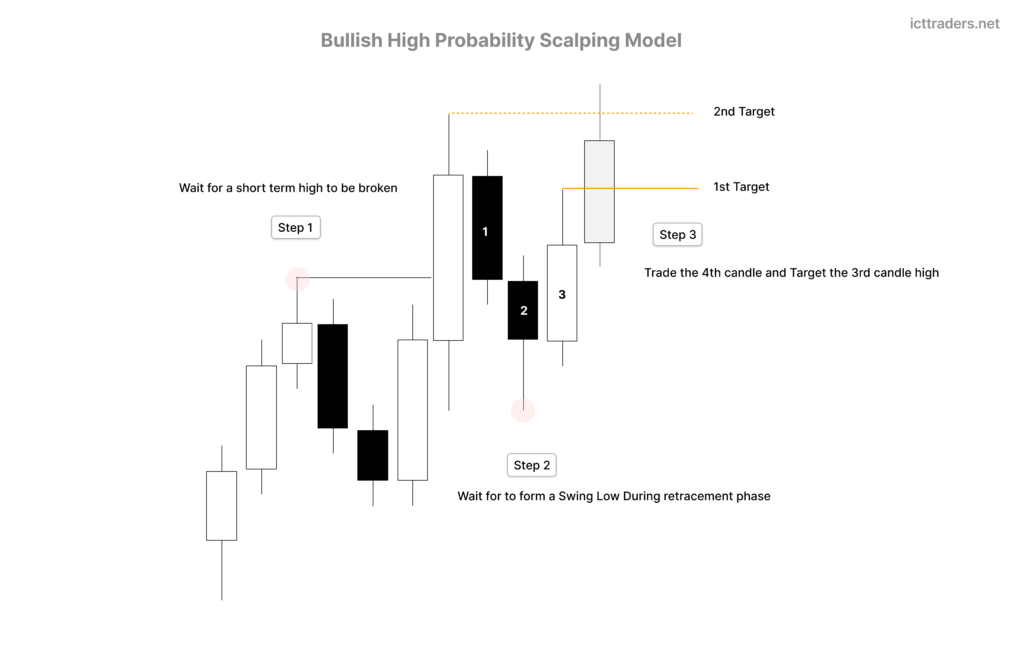
A bullish condition begins when price trades through a daily swing high.
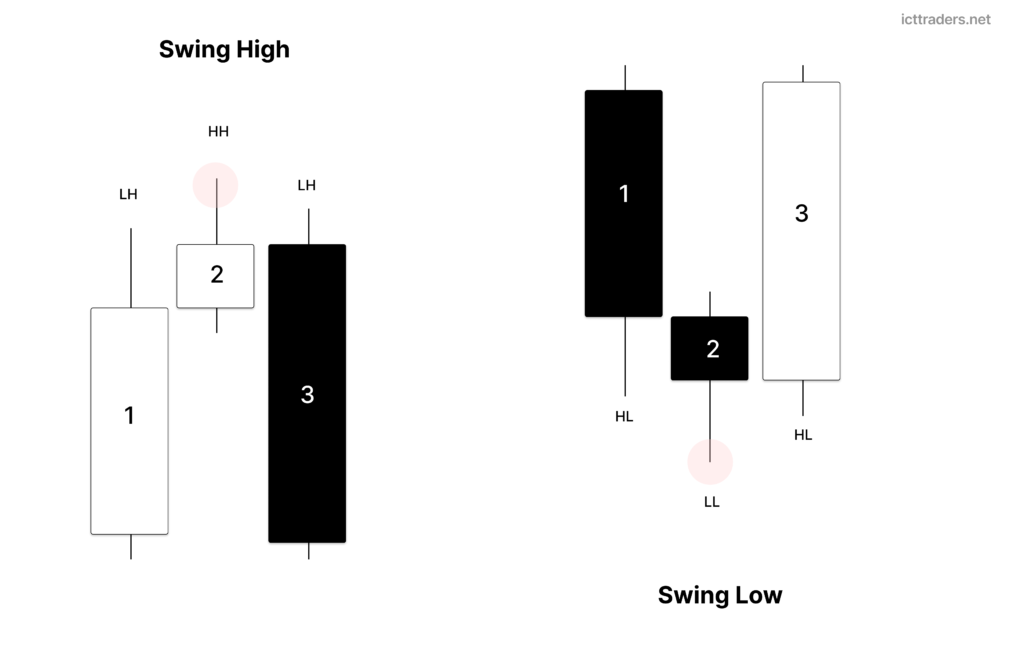
A swing high is a daily candle with:
- A lower high to its left.
- A lower high to its right.
- The highest high in the three-candle formation.
When price subsequently trades above this swing high, ICT treats it as a bullish shift in market conditions.
However, the trader does not immediately buy the breakout.
The break simply places the trader on alert for a future buying opportunity.
Michael explains this distinction clearly:
“Doesn’t mean to buy it right there. Just means we are now on an alert to wait for a specific criteria.”
After the swing high is broken, the trader waits for price to retrace and form a daily swing low.
A daily swing low has:
- A higher low to its left.
- A higher low to its right.
- The lowest low in the three-candle formation.
The important condition is that this new swing low should not trade below a recent significant swing low.
The sequence is:
Daily swing high broken → Price retraces → Higher swing low forms → Bullish continuation is anticipated
The market has broken a short-term high, retraced without significantly damaging the bullish structure, and may now be positioned for another move higher.
The Third Candle of the Daily Swing Low
The three-candle swing formation plays an important role in this model.
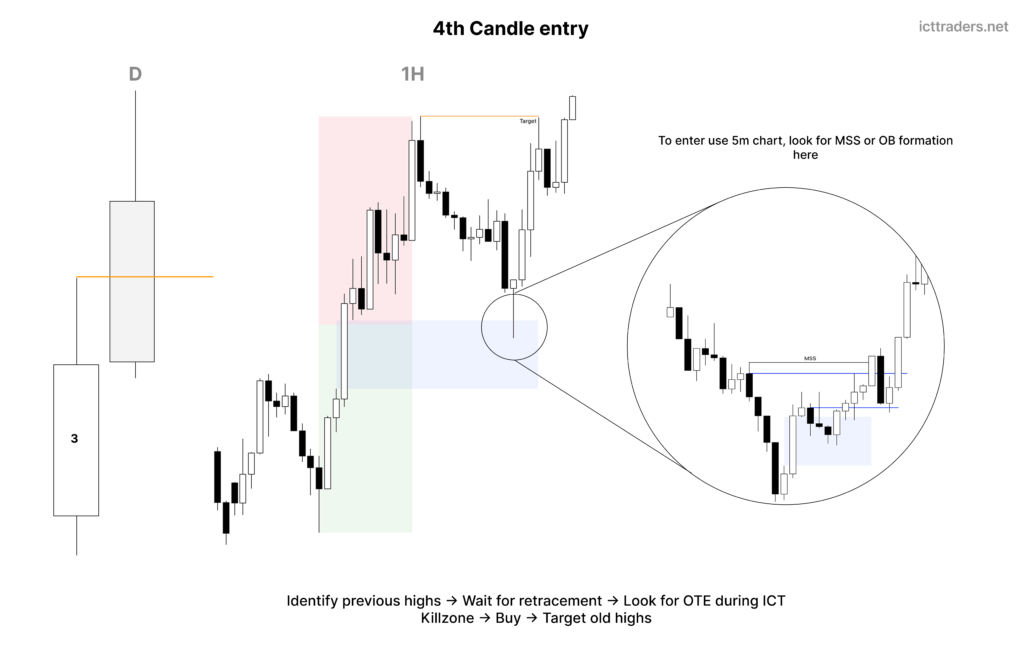
After the daily swing low forms, focus on the third candle of the swing formation.
The trader watches the high of this candle.
Ideally, the next daily candle opens below the third candle’s high and subsequently trades through it.
This provides evidence that bullish price delivery may be returning.
The bullish logic becomes:
Swing high broken → Higher swing low forms → Third swing candle identified → Following day trades above its high
Once this condition occurs, the trader can begin looking for bullish intraday scalping opportunities.
The primary objective is usually the previous day’s high.
Previous Day High as a Liquidity Target
In a bullish market condition, ICT considers the previous day’s high a potential liquidity pool.
Buy stops may rest above the high.
Short sellers may also place protective stop losses above the previous day’s range.
As price expands higher, the previous day’s high becomes a logical draw on liquidity.
Therefore, the trader is not simply saying:
“Price looks bullish.”
The actual idea is more specific:
Daily structure is bullish → Intraday price retraces → Buy during a favorable time window → Target previous-day high liquidity
This gives the scalp a defined objective.
When the previous day’s high is taken, the trader can study whether price has reached another important resistance level or whether bullish conditions remain intact.
ICT teaches traders to continue looking for previous-day highs to be raided until:
- A daily swing high forms.
- A significant resistance area is reached.
- Another important higher-timeframe objective is reached.
The market condition, therefore, controls how long the bullish outlook remains valid.
Bearish Daily Bias for High Probability Scalping
The bearish model is the inverse of the bullish condition.
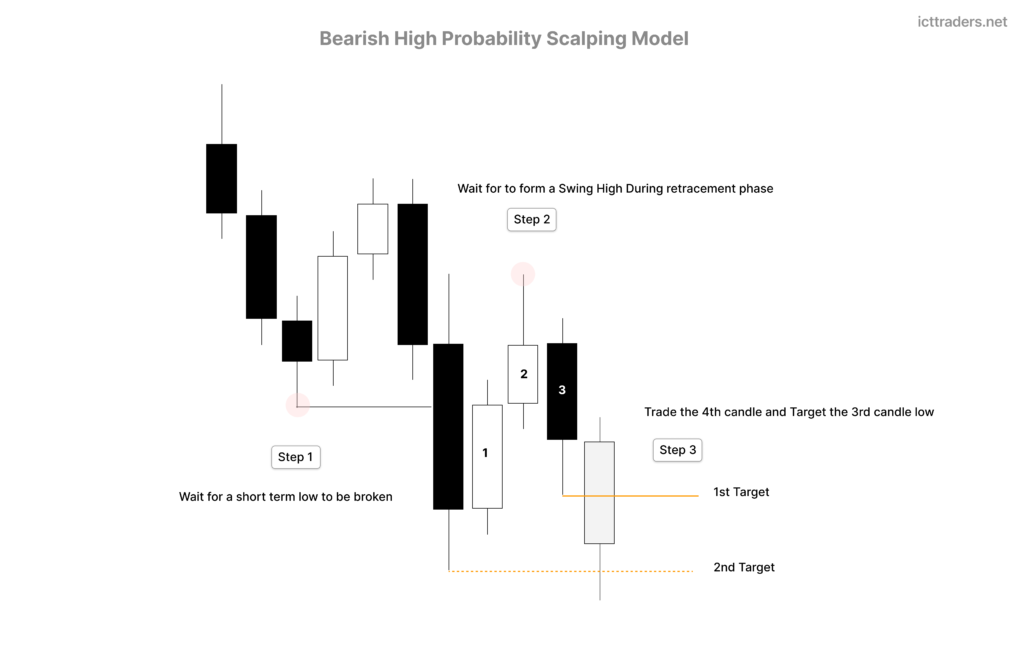
First, the trader waits for a daily swing low to be broken.
A daily swing low contains:
- A higher low to the left.
- A higher low to the right.
- The lowest low in the middle.
When price trades below this swing low, the trader becomes alert to a possible bearish market condition.
Again, this does not mean selling immediately.
The trader waits for a retracement.
Price should rally and form a daily swing high without breaking a recent significant swing high.
The sequence becomes:
Daily swing low broken → Price retraces higher → Lower swing high forms → Bearish continuation is anticipated
This structure suggests price has expanded lower and retraced without invalidating the bearish market condition.
The Third Candle of the Daily Swing High
Once a three-candle daily swing high forms, traders focus on the third candle of the formation.
The low of this candle becomes important.
The following trading day is watched for price to trade below that low.
When price begins trading through the candle’s low, the trader may start looking for bearish intraday setups.
The bearish logic is:
Swing low broken → Lower swing high forms → Third swing candle identified → Following day trades below its low
The primary liquidity objective becomes the previous day’s low.
ICT traders may continue anticipating previous-day low raids until:
- A new daily swing low forms.
- Price reaches important support.
- A significant higher-timeframe liquidity objective is reached.
Previous Day Low as a Bearish Liquidity Target
During bearish price delivery, the previous day’s low may contain sell-side liquidity.
Stops from traders holding long positions may rest below the low.
Price may be drawn toward this liquidity before creating a significant reversal or continuing into another downside objective.
The bearish scalp model becomes:
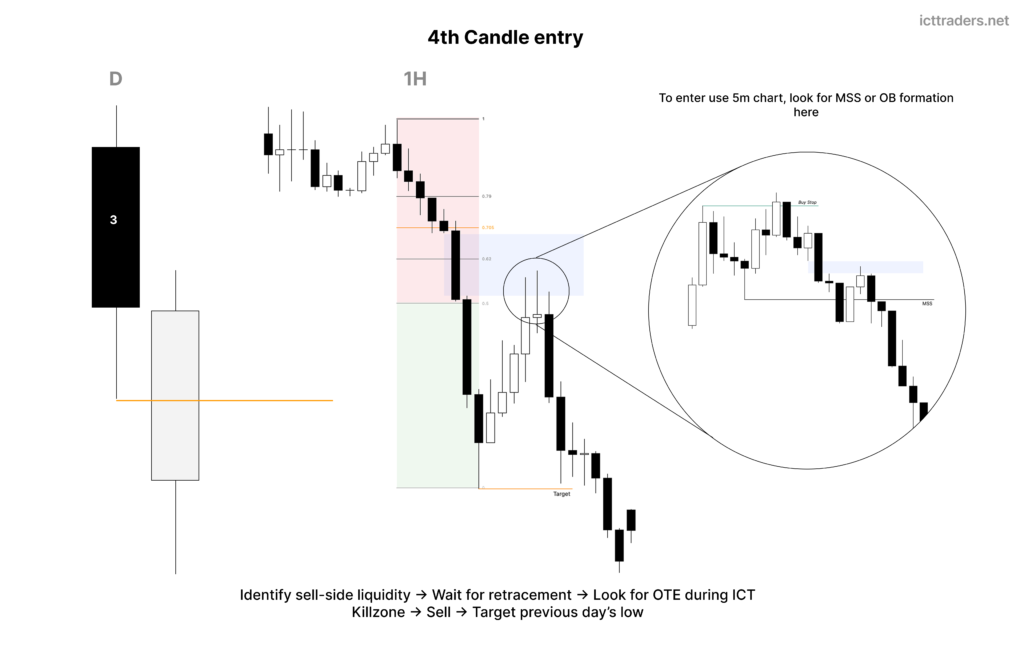
Daily structure is bearish → Wait for intraday retracement → Find a sell setup during a killzone → Target previous-day low
The trader now has three important elements:
Direction + Entry framework + Liquidity target
Without these three elements, scalping can quickly become random.
Using ICT Killzones for Scalping Entries
Once the daily bias and previous-day liquidity target are identified, the trader moves to a lower timeframe.
Michael J. Huddleston demonstrates the concept using the 15-minute chart.
He primarily looks for setups during:
- London session opportunities.
- New York session opportunities.
These active trading periods can provide the movement needed for price to expand toward previous-day liquidity.
Suppose the daily condition is bullish and the previous day’s high is the objective.
The trader may:
- Mark the previous day’s high.
- Identify the London or New York trading window.
- Wait for price to retrace.
- Study the dealing range.
- Look for an ICT Optimal Trade Entry.
- Enter with bullish daily bias.
- Target the previous day’s high.
The same process can be inverted for bearish conditions.
Combining Optimal Trade Entry With Previous Day Liquidity
The ICT Optimal Trade Entry, or OTE, can strengthen the scalping framework.
For a bullish setup, price may retrace into the OTE region of a defined dealing range before expanding higher.
Michael refers to retracement levels around:
- 62%.
- 70.5%.
- 79%.
These levels can help traders identify a favorable price area for a potential entry.
However, an important distinction must be understood.
The daily swing model itself does not always require a perfect 62% to 79% retracement.
The daily structure provides directional bias.
The OTE can then provide additional entry refinement on the lower timeframe.
A bullish example would be:
Bullish daily bias → Previous-day high is the target → London retracement → OTE reached → Price expands toward buy-side liquidity
The market narrative and entry technique are working together.
You Do Not Need a Setup Every Trading Day
One of the most important lessons in Mastering High Probability Scalping Vol. 2 is patience.
Many developing traders believe scalping requires constant activity.
ICT teaches the opposite.
Michael J. Huddleston states:
“There’s going to be a lot of missed opportunities admittedly with this, but it gives you a specific criteria to work within.”
Missing trades is not necessarily a problem.
Forcing trades outside the model is the greater problem.
The daily chart may not provide a valid bullish or bearish condition every day on one currency pair.
However, traders studying several major currency pairs may find a small number of quality setups during the trading week.
The goal is not:
Trade every day.
The goal is:
Wait for the daily conditions that support a high-probability intraday move.
Why ICT Focuses on Small, Realistic Pip Objectives
Michael emphasizes the idea of aiming for realistic scalping objectives.
He states:
“You only need about 25 pips or so per week.”
The lesson is not that every trader must use a fixed 25-pip target.
The deeper principle is to stop believing that successful trading requires capturing enormous weekly price ranges.
A trader studying this scalping model may focus on setups capable of producing approximately 20 to 25 pips.
Two quality opportunities may potentially provide a 50-pip weekly objective.
Michael explains that when traders begin expecting 250 to 500 pips every week, the task becomes considerably more difficult.
A smaller objective encourages selectivity.
Instead of asking:
“Where can I trade today?”
The trader asks:
“Where is the highest-quality setup that can reasonably provide my objective?”
That change in thinking is important.
Why Tuesday and Wednesday Are Important
Michael J. Huddleston also explains his personal preference for focusing on Tuesday and Wednesday.
The logic connects intraday scalping with weekly price delivery.
When anticipating a bullish weekly candle, the trader may look for the weekly low to develop around Tuesday or Wednesday.
When anticipating a bearish weekly candle, the trader may look for the weekly high to form around Tuesday or Wednesday.
The general idea is:
Bullish weekly expectation → Look for weekly low formation → Seek bullish scalp
Bearish weekly expectation → Look for weekly high formation → Seek bearish scalp
This can add additional conviction to the daily bias model.
However, the trader should still require the appropriate price conditions.
The day of the week alone is not an entry signal.
One Good Trading Day Can Be Enough
Another important principle from this ICT scalping model is that a trader does not need to participate in every market move.
A favorable daily setup may sustain momentum for several days.
The developing trader may only need to capture part of one day’s price expansion.
Michael explains his own approach:
“I’m content with doing one thing well.”
This is the mindset behind high-probability scalping.
The trader identifies:
- A clear daily bias.
- A logical liquidity objective.
- A favorable trading session.
- A calculated retracement.
- A reasonable price target.
Once the objective is achieved, additional trading may be unnecessary.
More trades do not automatically create better results.
Step-by-Step ICT High Probability Scalping Model
The complete model can be simplified into the following process.
For Bullish Scalps
Daily swing high is broken → Wait for retracement → Higher daily swing low forms → Watch third candle’s high → Following day trades above it → Mark previous-day high → Wait for London or New York retracement → Look for OTE or valid ICT entry → Target previous-day high liquidity
For Bearish Scalps
Daily swing low is broken → Wait for retracement → Lower daily swing high forms → Watch third candle’s low → Following day trades below it → Mark previous-day low → Wait for London or New York retracement → Look for OTE or valid ICT entry → Target previous-day low liquidity
The simplicity of this model is intentional.
It gives developing ICT traders defined criteria rather than encouraging constant prediction.
Common Mistakes When Using This Scalping Model
Trading Immediately After a Swing Break
A broken swing high or low creates an alert condition.
It is not automatically an entry.
Wait for the retracement and corresponding daily swing structure.
Ignoring the Daily Chart
A lower-timeframe setup may appear attractive but lack higher-timeframe support.
The daily bias should frame the scalp.
Forcing a Setup Every Day
Not every pair provides the required price condition every trading day.
Allow the setup to form naturally.
Trading Without a Liquidity Objective
The previous day’s high or low gives the scalp a logical destination.
Entering without understanding the price objective can make trade management difficult.
Expecting Extremely Large Weekly Returns
The purpose of this model is consistency and selectivity.
ICT emphasizes realistic objectives rather than attempting to capture every market fluctuation.
Final Thoughts on Mastering High Probability Scalping Vol. 2
Mastering High Probability Scalping Vol. 2 teaches traders to connect daily market structure with previous-day liquidity runs.
Michael J. Huddleston’s ICT framework begins by identifying whether a daily swing high or swing low has been broken. The trader then waits for a controlled retracement and a new daily swing formation before anticipating continuation.
Once the daily bias is established, the previous day’s high or low becomes a potential liquidity objective.
The trader can then move to the 15-minute chart, focus on the London or New York killzone, and use tools such as the ICT Optimal Trade Entry to refine execution.
The complete philosophy is based on patience and selectivity.
Establish daily bias → Identify previous-day liquidity → Wait for the correct session → Enter on a favorable retracement → Take a realistic scalp
A trader does not need a setup every day. One or two well-framed opportunities can be more valuable than repeatedly forcing trades without a clear daily narrative or liquidity objective.