How Traders Make 10% Per Month is a trading framework taught by Michael J. Huddleston, the creator of ICT (Inner Circle Trader). This concept is taught in the ICT Mentorship Core Content – Month 2 and explains how traders can use low-risk trade setups, favorable reward-to-risk and higher timeframe liquidity objectives to pursue meaningful percentage returns.
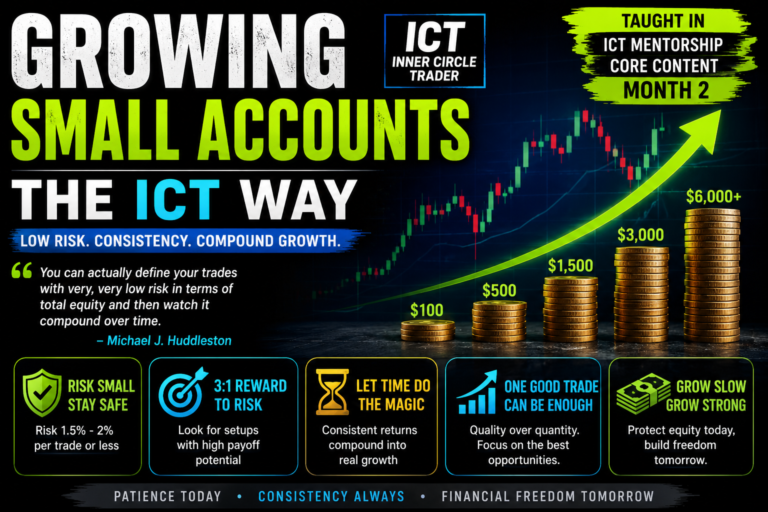
The idea is not to take massive risk or force large profits from every trade.
Instead, ICT teaches traders to refine their risk, take partial profits at a logical reward multiple and allow the remaining position to reach for larger liquidity objectives.
As Michael J. Huddleston explains:
“It’s not having big risk that makes the money. It’s having this small risk that makes the money.”
This is the foundation behind the How Traders Make 10% Per Month framework.
The 10% figure is presented as an illustrative trading model, not a guaranteed monthly return. The focus is on how low-risk entries and larger price objectives can create favorable reward multiples when a setup develops correctly.
Start With a Higher Timeframe Trade Premise
The ICT model begins with the higher timeframe.
The trader first identifies an important level on the:
- Monthly chart
- Weekly chart
- Daily chart
These higher timeframe levels provide the main trading premise.
For example, the market may trade into a daily bullish order block.
Price previously showed strong bullish movement from this level.
When the market returns to the same price area, the ICT trader can study whether buying may enter again.
The daily chart provides the reason for expecting price to move higher.
The lower timeframe is then used to refine the trade.
The basic model is:
Daily Institutional Level → Lower Timeframe Entry → Higher Timeframe Liquidity Objective
This combination is important.
A trader is not simply looking for a random 5-minute setup.
The 5-minute entry should be supported by a higher timeframe price level.
Identify Liquidity Above or Below Price
Before entering a trade, the ICT trader identifies where price may be drawn.
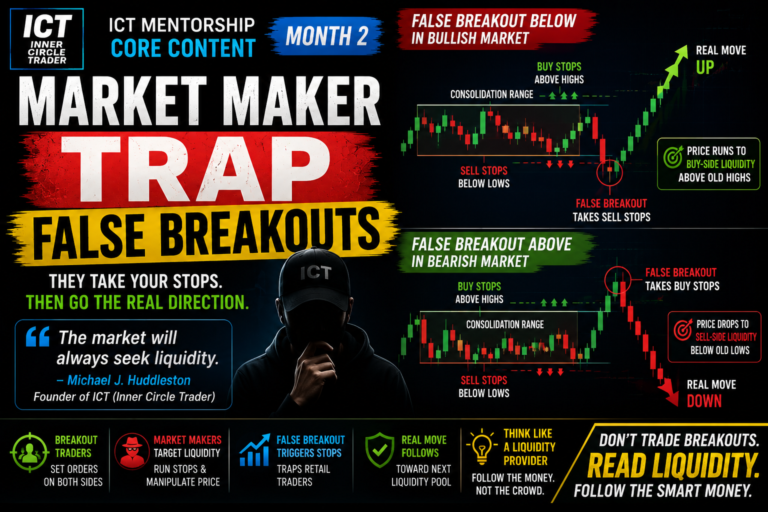
In a bullish setup, look for buy-side liquidity above the market.
This may rest above:
- Old highs
- Equal highs
- Short-term highs
- 5-minute liquidity pools
- 15-minute liquidity pools
- Hourly highs
In a bearish setup, the trader studies sell-side liquidity below old lows.
The liquidity levels become possible profit objectives.
Suppose a daily bullish order block supports higher prices.
There are several old highs above the market.
Buy stops may rest above these highs.
The trader now has a potential price range.
For example:
Daily Bullish Order Block → Current Price → Buy Stops 100 Pips Higher
The trader does not need to capture the complete 100-pip range.
But knowing the larger objective can help frame a trade with significant reward potential.
Refine the Entry to Reduce Risk
The next step in How Traders Make 10% Per Month is reducing the stop-loss distance.
Suppose an hourly entry requires a 20-pip stop.
The trader can study the same setup on the 15-minute chart.
The 15-minute chart may provide a more precise entry.
The trader can then move to the 5-minute chart.
A small bullish order block may form close to the higher timeframe level.
The setup may now require less than 10 pips of risk.
The process can look like:
Daily Level → Hourly Framework → 15-Minute Refinement → 5-Minute Entry
The trade direction remains the same.
The liquidity objective remains the same.
Only the entry becomes more precise.
This changes the potential reward-to-risk significantly.
Why Small Risk Creates Larger R Multiples
Suppose a trader uses a 10-pip stop.
Price moves 30 pips in the anticipated direction.
The trade has reached 3R.
The calculation is:
10 Pip Risk × 3 = 30 Pip Reward
Now compare this with a 30-pip stop.
The same 30-pip movement only provides 1R.
This is why ICT focuses on refining risk.
Michael J. Huddleston states:
“If you frame your trades with really small risk, it’s easy to get multiples of three to one or more for your reward.”
The trader is not increasing account risk.
The trader is reducing the distance between entry and logical invalidation.
A properly framed low-risk entry can allow price to reach 3R before the market even attacks the larger higher timeframe liquidity objective.
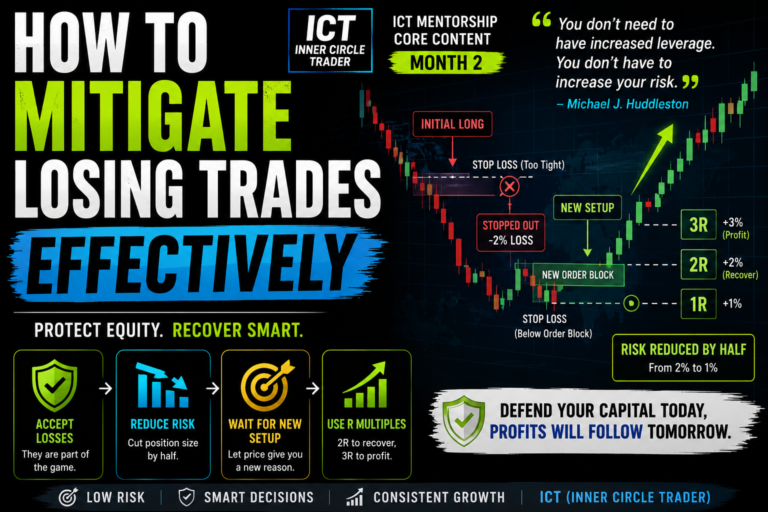
The 2% Risk and 3R Partial Profit Example
The lesson provides an example using 2% total trade risk.
Suppose the trader enters a bullish setup.
The complete position represents 2% account risk.
Price moves higher and reaches 3R.
At 3R, the trader closes half of the original position.
Half of the 2% position represents 1% risk allocation.
That first 1% portion earns 3R.
Therefore:
1% × 3R = 3% Account Return
The trader has now banked 3% from the first portion of the trade.
The second half remains open.
This remaining position can continue toward higher timeframe liquidity.
The trade-management model becomes:
2% Original Position
↓
Price Reaches 3R
↓
Close Half
↓
Bank 3%
↓
Leave 1% Portion Running
↓
Target Higher Timeframe Liquidity
This is a central part of the ICT model.
Pay Yourself at 3R
ICT emphasizes taking partial profits when the market provides a logical reward.
The trader does not know with certainty that price will reach the final objective.
The market may:
- Consolidate
- Retrace
- Reverse
- Fail to reach higher liquidity
Therefore, the trader can pay themselves when a favorable reward multiple has already developed.
Michael J. Huddleston explains:
“You have to pay yourself because you don’t know if your trade’s gonna pay now.”
Taking a partial profit is not viewed as weakness.
The trader has already received compensation from the trade.
The remaining position can now be used to pursue the larger market objective.
This can also reduce psychological pressure.
The trader is no longer watching a completely unrealized profitable position.
Part of the profit has already been secured.
Let the Remaining Position Target Liquidity
After taking the first partial at 3R, the second portion of the trade remains open.
The trader then focuses on higher liquidity pools.
For example:
5-Minute Buy Stops
↓
15-Minute Buy Stops
↓
Hourly Buy Stops
Price may continuously move through higher levels of buy-side liquidity.
The remaining position can be held toward these objectives.
In the example discussed by ICT, the refined risk model allowed price to reach a 9R reward multiple around a 15-minute liquidity pool.
Further price expansion could provide an even larger R multiple near the hourly objective.
The important concept is:
Take Profit on One Portion → Allow the Remaining Portion to Seek Larger Liquidity
The second portion has the potential to generate more profit because it remains exposed to the larger price range.
You Do Not Need the Entire Price Range
Many traders make the mistake of trying to capture the absolute low and absolute high.
Suppose the trader identifies a potential 100-pip range.
They believe they must capture all 100 pips.
ICT teaches a more practical approach.
What happens if the trader captures only 50 pips?
That is still half of the identified range.
Michael J. Huddleston asks:
“Do you think you’ll get every pip of every potential range you identify as potential profit?”
Demanding every pip can create frustration and greed.
The trader does not need the perfect entry and perfect exit to produce a favorable return.
A low-risk setup with a 50-pip expansion can still create significant R multiples.
For example:
10 Pip Risk → 50 Pip Move = 5R
The trader captured only half of a 100-pip potential range.
But the reward-to-risk remains strong.
The How Traders Make 10% Per Month Model
The basic ICT model can be understood through a simple example.
Assume the trader identifies one valid higher timeframe bullish setup.
The setup is refined to a 10-pip stop.
Total trade risk is 2%.
Price moves 30 pips higher and reaches 3R.
The trader closes half the position.
This can bank approximately 3% under the lesson’s risk example.
The remaining position continues higher.
If similar well-framed opportunities develop across the month, the initial 3R partial profits alone illustrate how percentage returns can accumulate.
The model is not:
Take Huge Risk → Find One Massive Winner
The model is:
Find Higher Timeframe Setup
↓
Refine Risk
↓
Reach 3R
↓
Take Partial Profit
↓
Let Remaining Position Run
↓
Repeat Only When Quality Conditions Form
This is how the lesson frames the idea of traders pursuing 10% in a month.
Again, this is a model of trade structuring and not a promise that every trader or every month will generate 10%.
Higher Timeframe Objectives Make the Difference
Small risk by itself is not enough.
The trader also needs a logical reason to expect price expansion.
This is why monthly, weekly and daily levels are important in ICT.
The trader looks for a level where price may receive institutional sponsorship.
Then lower timeframe risk is framed around that higher timeframe idea.
Michael J. Huddleston explains that the trade should be based on:
“Levels that should see institutional sponsorship.”
Suppose price is reacting from a daily bullish order block.
There are hourly liquidity pools 100 pips above the entry area.
The trader can use a 5-minute chart to refine the entry.
The 5-minute chart provides the risk.
The hourly chart provides the larger objective.
This creates an asymmetrical trading opportunity.
Small Lower Timeframe Risk → Large Higher Timeframe Objective
That asymmetry is the real focus of the model.
Why Partial Profit is Important
Some traders believe the complete position should remain open until the final target.
This creates an all-or-nothing approach.
The trade either reaches the ultimate objective or the trader makes nothing.
ICT teaches a different approach.
The trader can take partial profit when price reaches a logical reward multiple.
Then the remaining position continues.
Michael J. Huddleston states:
“You pay yourself something and then let the partial run.”
Suppose price reaches 3R.
Half the position is closed.
Price then reverses before reaching the higher timeframe liquidity pool.
The trader has still banked profit.
If price continues higher, the remaining position participates in the larger move.
This creates two separate objectives:
First Portion = Pay the Trader
Second Portion = Seek Higher Timeframe Expansion
This can provide a more flexible trade-management structure.
Do Not Force a 100-Pip Trade Every Week
The ICT framework does not mean traders should force themselves to capture 100 pips every week.
Some weeks may provide a large price range.
Other weeks may not.
A trader may also experience losses.
The purpose is not to create a fixed pip demand.
The purpose is to study setups where the potential higher timeframe range is large compared with the refined risk.
For example:
8 Pip Risk → 80 Pip Objective
10 Pip Risk → 100 Pip Objective
20 Pip Risk → 50 Pip Objective
Each trade has a different reward profile.
The trader should work with the price action provided by the market.
Trying to force a specific number of pips can lead to unnecessary trades.
A Simple ICT Model for 10% Monthly Growth
The How Traders Make 10% Per Month concept can be simplified into the following process.
1. Find a Higher Timeframe Institutional Level
Study the monthly, weekly or daily chart.
Look for a level that may support price expansion.
2. Determine the Directional Premise
Decide whether the trade idea is bullish or bearish.
3. Mark Higher Timeframe Liquidity
Identify old highs or lows where stops may be resting.
4. Measure the Potential Price Range
Determine the approximate distance between the entry area and liquidity objective.
5. Refine the Trade on Lower Timeframes
Move from the hourly chart to the 15-minute and 5-minute chart.
6. Frame a Small Logical Stop
The stop should be based on price invalidation, not randomly tightened.
7. Calculate 3R
Measure the price level that provides three dollars of potential reward for every one dollar risked.
8. Take Partial Profit at a Logical Reward Multiple
In the lesson’s example, half of a 2% position is taken off at 3R.
9. Let the Remaining Position Run
Target 15-minute, hourly or other higher timeframe liquidity pools.
10. Do Not Demand the Entire Range
Accept a logical portion of the move when market conditions require it.
Common Mistakes Traders Make
The first mistake is using big risk to make big money.
ICT teaches that small, refined risk can create larger R multiples.
The second mistake is trading without a higher timeframe premise.
A tight 5-minute stop is not enough.
The third mistake is ignoring liquidity objectives.
The trader should know where price may be reaching before entering.
The fourth mistake is holding the entire position for one final target.
Taking partials can allow the trader to secure profit while keeping exposure to the larger move.
The fifth mistake is trying to capture every pip.
Perfect entries and exits are not required.
The sixth mistake is forcing a fixed weekly pip objective.
Trading opportunities depend on market conditions.
The seventh mistake is allowing greed to control profit taking.
A 50-pip portion of a 100-pip range can still provide a strong return when risk is small.
Final Thoughts on How Traders Make 10% Per Month With ICT
The How Traders Make 10% Per Month framework taught by ICT (Inner Circle Trader) is not based on taking extreme risk.
Michael J. Huddleston focuses on finding a higher timeframe institutional price level, identifying larger liquidity objectives and refining the entry on a lower timeframe.
The complete model is:
Higher Timeframe Premise → Low-Risk Entry → 3R Partial Profit → Remaining Position Runs → Higher Timeframe Liquidity
The trader first frames a trade with small and logical risk.
When price reaches a favorable reward multiple, part of the position can be closed.
The remaining balance is allowed to target larger liquidity pools.
Most importantly, the trader does not need to capture every pip of the move.
The real advantage comes from combining small risk with a larger potential price range.
As Michael J. Huddleston summarizes:
“It’s not about how many perfect exits and entries you get.”
For ICT traders, the lesson is simple: refine the risk, pay yourself when profit is available and allow a portion of a correctly framed trade to seek the larger market objective.