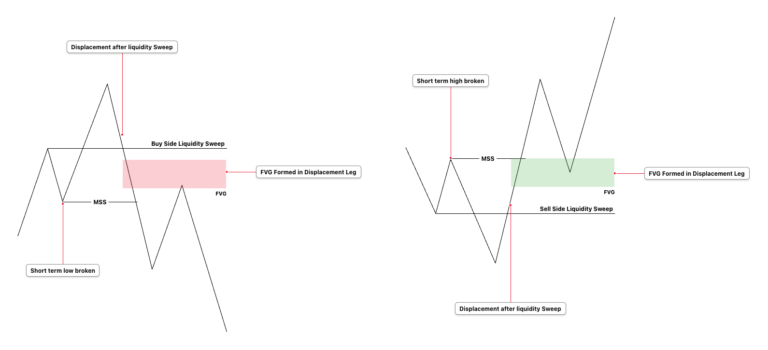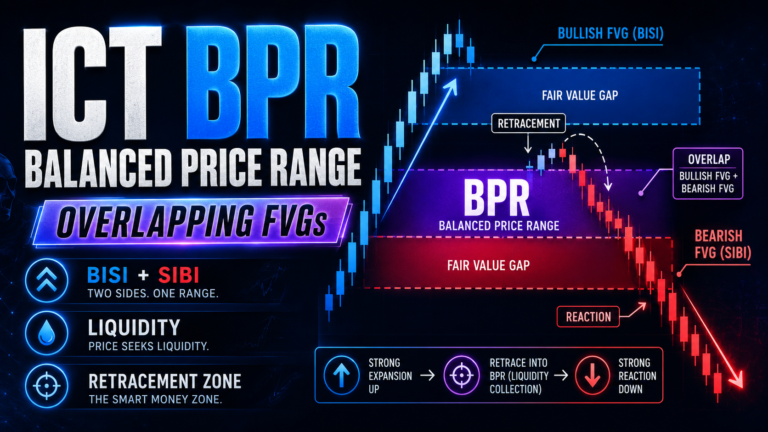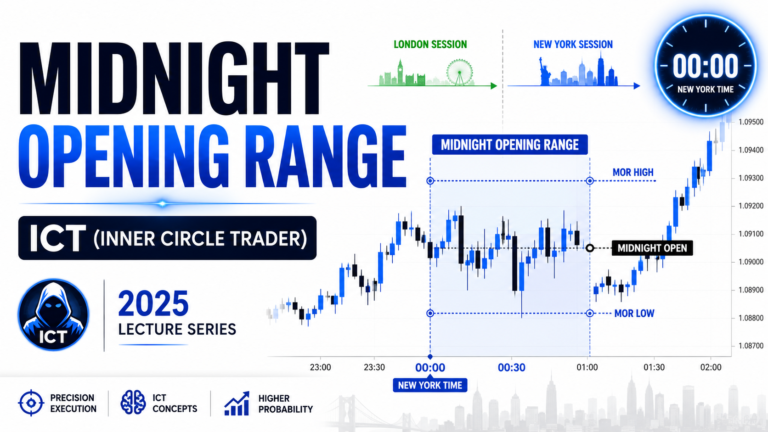
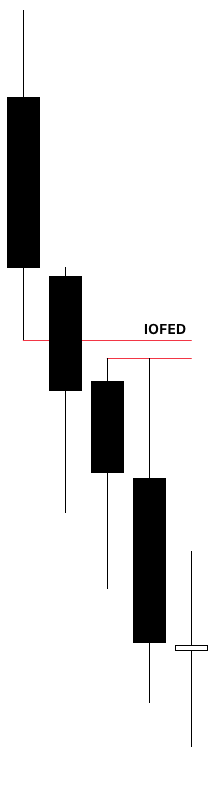
The ICT Institutional Order Flow Entry Drill, commonly called IOFED, is an entry technique taught by Michael J. Huddleston, the founder of ICT (Inner Circle Trader). It describes a situation where price retraces only slightly into a fair value gap before continuing strongly in the expected direction.
Instead of waiting for price to reach the midpoint or fully fill the fair value gap, the trader enters near the opening boundary of the gap.
Michael J. Huddleston explains the idea clearly:
“Institutional Order Flow Entry Drill is where the market just trades a little bit inside the fair value gap and then drops.”
The same principle applies to bullish and bearish price delivery.
What Is an ICT Institutional Order Flow Entry Drill?
An Institutional Order Flow Entry Drill occurs when price enters only a small portion of a fair value gap and then quickly continues in the direction of the prevailing order flow.
In a bullish market, price retraces slightly into a bullish fair value gap and then moves higher.
In a bearish market, price rallies slightly into a bearish fair value gap and then moves lower.
The main characteristic of an IOFED is the shallow retracement.
Price does not need to reach the midpoint of the fair value gap. It may only touch the gap or trade a few points inside it before continuing.
Why Does IOFED Form?
IOFED forms when institutional order flow is strong.
When price is being delivered aggressively in one direction, the market may not offer a deep retracement. It only needs to trade slightly into the imbalance before continuing toward its objective.
In a bearish market, short-term rallies generally occur for one of two reasons:
- To take buy-side liquidity above a short-term high
- To return to an inefficiency above price
Once price reaches that objective, bearish delivery may resume.
In a bullish market, short-term declines generally occur to:
- Take sell-side liquidity below a short-term low
- Return to an inefficiency below price
Once the purpose of the retracement has been completed, price may continue higher.
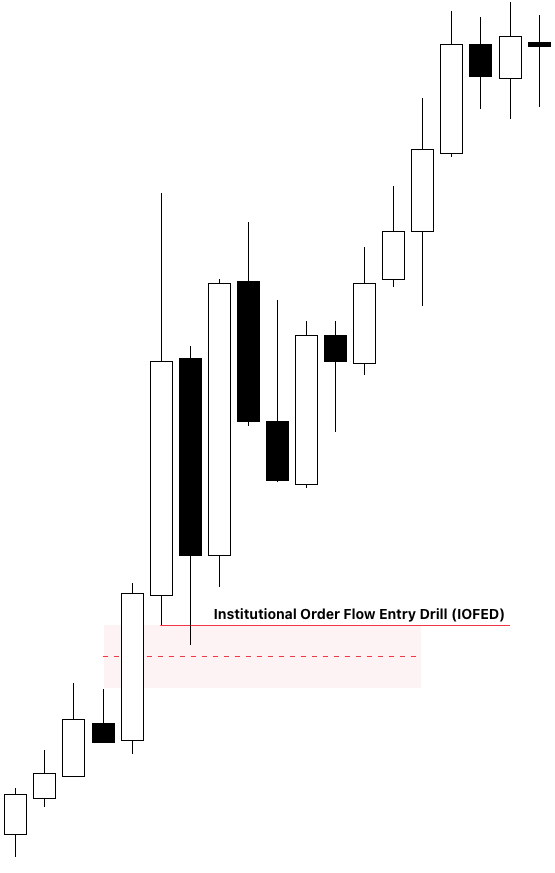
Bullish IOFED
A bullish IOFED forms inside a bullish fair value gap.
The usual sequence is:
- Price produces bullish displacement.
- A bullish fair value gap forms.
- Price begins retracing toward the gap.
- The retracement enters only a small portion of the FVG.
- Price fails to make a deeper retracement.
- Bullish delivery resumes.
The shallow retracement shows that sellers are unable to push price deeper into the imbalance.
The bullish fair value gap may therefore provide an entry for continuation toward buy-side liquidity.
Bearish IOFED
A bearish IOFED forms inside a bearish fair value gap.
The usual sequence is:
- Price produces bearish displacement.
- A bearish fair value gap forms.
- Price rallies back toward the gap.
- The rally enters only a small portion of the FVG.
- Price fails to retrace deeper.
- Bearish delivery resumes.
The shallow rally indicates that buyers are unable to force price deeply into the imbalance.
The bearish fair value gap may therefore provide an entry for continuation toward sell-side liquidity.
How Deep Does Price Enter the Fair Value Gap?
There is no fixed percentage that price must enter for the setup to qualify as an IOFED.
Price may:
- Touch the boundary of the fair value gap
- Trade a few ticks or points inside it
- Enter the first portion of the gap
- Reverse before reaching the midpoint
The important feature is that most of the fair value gap remains open.
This is different from waiting for Consequent Encroachment, which is the 50% level of the FVG.
An IOFED accepts a shallower entry because strong order flow may not allow price to reach the midpoint.
IOFED and Consequent Encroachment
Consequent Encroachment is often considered an ideal fair value gap entry because it represents the midpoint of the imbalance.
However, waiting only for CE can cause a trader to miss strong moves.
During powerful bullish delivery, price may touch the upper boundary of a bullish FVG and immediately rally.
During powerful bearish delivery, price may touch the lower boundary of a bearish FVG and immediately decline.
The IOFED allows the trader to participate without demanding a perfect midpoint retracement.
This does not mean Consequent Encroachment is unimportant. It simply means that the market is not required to reach it.
How to Identify an IOFED
The first step is to determine the expected direction of price.
If the market is bullish, focus only on bullish fair value gaps.
If the market is bearish, focus only on bearish fair value gaps.
Next, look for clear displacement.
The price movement should be strong enough to show directional commitment. It should ideally create a clean fair value gap and break a meaningful short-term swing.
After the FVG forms, watch the retracement.
A potential IOFED is present when price trades slightly into the gap but shows no willingness to reach its midpoint or opposite boundary.
The setup becomes stronger when price quickly rejects the opening portion of the FVG and resumes displacement.
How to Enter an IOFED Trade
There are two simple entry methods.
Entry at the FVG boundary
The trader enters when price first reaches the opening boundary of the fair value gap.
For a bullish FVG, this is the upper boundary.
For a bearish FVG, this is the lower boundary.
This is the more aggressive approach because it assumes the retracement will remain shallow.
Entry slightly inside the FVG
The trader places the entry a small distance inside the fair value gap.
This allows price to penetrate the imbalance slightly before the position is opened.
The exact distance depends on the instrument, timeframe and volatility.
The trader should not place the entry so deep that it becomes a Consequent Encroachment trade rather than an IOFED.
Using Partial Entries
Michael J. Huddleston explains that he may use the opening portion of the fair value gap as part of a pyramiding approach rather than waiting only for the midpoint.
A trader may enter part of the position near the beginning of the gap.
If price moves deeper into the FVG while the setup remains valid, another portion may be added.
For example:
- First entry near the FVG boundary
- Second entry deeper inside the FVG
- Final entry near Consequent Encroachment
This approach reduces the chance of missing the trade if price performs only a shallow retracement.
However, the entire planned risk must be calculated before entering. Adding to the position should not increase total risk beyond the trader’s original limit.
Stop-Loss Placement
The stop loss should not be placed only a few points beyond the IOFED entry.
Price can trade deeper into the fair value gap without invalidating the entire setup.
For a bullish IOFED, the stop can be placed below the low that supports the bullish move.
For a bearish IOFED, the stop can be placed above the high that supports the bearish move.
The stop should be based on market structure and invalidation, not simply on the boundary of the fair value gap.
When IOFED Fails
An IOFED may fail when price trades through the fair value gap and continues against the expected direction.
Possible signs of failure include:
- Price closes completely through the FVG
- The displacement swing is broken
- Price shows no rejection from the gap
- The expected liquidity target changes
- The directional bias was incorrect
A shallow entry does not guarantee that the market will continue immediately.
Price may still reach Consequent Encroachment, fully fill the gap or invalidate the setup.
This is why IOFED must be used with proper risk management.
Best Timeframes for IOFED
The Institutional Order Flow Entry Drill is fractal and can appear on any timeframe.
Higher timeframes provide the narrative, while lower timeframes provide the execution.
A practical combination may include:
- Weekly chart for the broader directional objective
- Daily chart for institutional order flow
- Four-hour chart for premium and discount arrays
- One-hour chart for significant liquidity
- 15-minute chart for displacement
- Five-minute or one-minute chart for IOFED execution
Very low-timeframe FVGs should not be traded without higher-timeframe alignment. Small gaps occur frequently and may have no meaningful institutional significance.
Time of Day
An IOFED becomes more meaningful when it forms during an active trading window.
Important periods include:
- London Open Kill Zone
- New York Open Kill Zone
- London Close
- ICT Macro windows
- Major economic news releases
- Session transitions
A fair value gap formed during active delivery may attract a shallow retracement before the next expansion.
An FVG formed during inactive or low-volume conditions may produce less reliable continuation.
Time should support the price narrative.
Common IOFED Mistakes
Trading every shallow FVG touch
A small interaction with an FVG is not automatically an IOFED.
The setup needs higher-timeframe direction, liquidity and displacement.
Ignoring the weekly and daily bias
An IOFED is a continuation entry.
Trading it against the higher-timeframe objective increases the chance of failure.
Entering before liquidity is taken
A fair value gap becomes more meaningful when its displacement follows a liquidity event.
Without that context, the move may lack a clear purpose.
Using weak fair value gaps
An FVG created inside consolidation or overlapping candles may not represent strong institutional delivery.
Prioritise gaps created by displacement.
Placing the entire position at the boundary
Price can trade deeper into the fair value gap.
Using the full intended risk at the first touch may create unnecessary pressure.
Assuming CE will never be reached
An IOFED anticipates shallow delivery, but it does not guarantee it.
Price may still reach consequent encroachment or fully rebalance the gap.
Chasing after price leaves the FVG
Once price has displaced far from the entry area, the original opportunity has passed.
Do not chase a move simply because the IOFED worked.
Ignoring the target
A setup without a clear draw on liquidity lacks a complete narrative.
Know where price is expected to deliver before entering.
Treating IOFED as a mechanical pattern
The concept should not be reduced to “touch FVG and enter.”
The FVG is only one part of the setup.
ICT IOFED Checklist
Before using an Institutional Order Flow Entry Drill, check:
- Is the market direction clear?
- Did price create strong displacement?
- Did a clean fair value gap form?
- Is the FVG aligned with the expected direction?
- Is price retracing into the opening portion of the gap?
- Has price failed to reach Consequent Encroachment?
- Is there a clear target in the direction of the trade?
- Is the invalidation level clear?
- Can the trade be taken without chasing price?
- Is the risk properly controlled?
Final Thoughts
The ICT Institutional Order Flow Entry Drill is a simple entry technique based on a shallow retracement into a fair value gap.
The trader does not wait for price to reach the midpoint or fully rebalance the imbalance. Instead, the entry is taken near the opening portion of the FVG because strong institutional order flow may offer only a limited retracement.
The main idea is straightforward:
Price enters slightly into the fair value gap and then continues in the expected direction.
IOFED is useful for traders who regularly miss trades while waiting for a perfect Consequent Encroachment entry. However, it should only be used when the directional bias, displacement and fair value gap already support continuation.