The ICT Turtle Soup concept is one of the most important liquidity-based trading setups taught by Michael J. Huddleston through ICT (Inner Circle Trader). It focuses on false breakouts above old highs or below old lows where price runs a pool of stop orders and then quickly moves in the opposite direction.
At first, Turtle Soup looks very simple.
Price trades above an old high and reverses lower.
Or price trades below an old low and reverses higher.
But this is only the visible pattern.
The real ICT Turtle Soup concept is based on understanding why price needs to run that high or low, what liquidity is resting there, what the higher timeframe expects, and where price may deliver after the stop run.
Michael J. Huddleston explains the setup simply:
“Turtle Soup’s a false breakout pattern.”
However, every false breakout is not a high-probability Turtle Soup.
The most important part is the context behind the liquidity run.
What is the ICT Turtle Soup Concept?
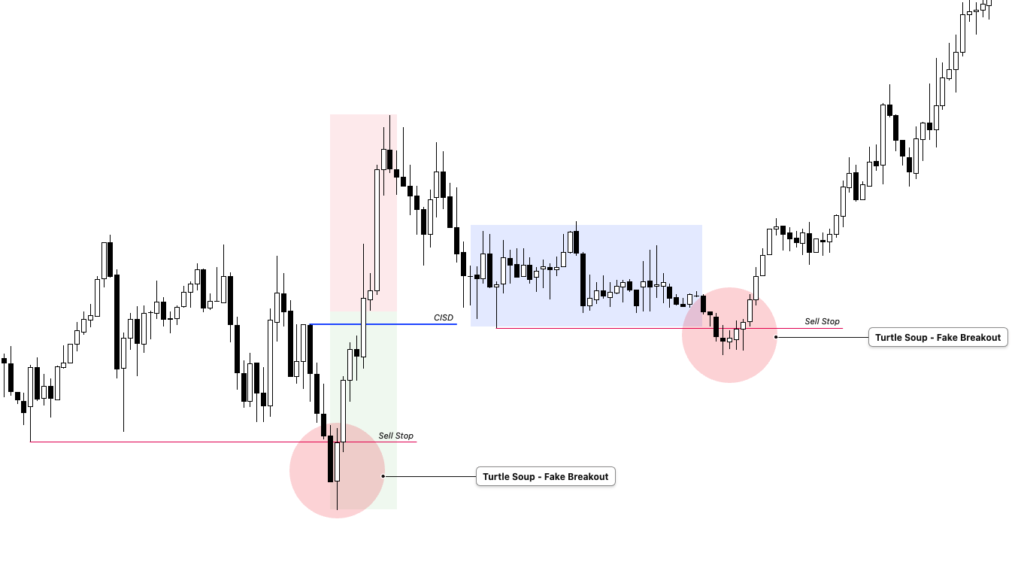
The ICT Turtle Soup concept is a false breakout setup where price trades beyond a previous high or low, triggers stop orders resting around that level, and then rejects the breakout.
A bearish Turtle Soup normally forms above an old high.
Price trades above the high.
Buy-side liquidity is taken.
Price rejects the higher price.
The market then moves lower.
A bullish Turtle Soup normally forms below an old low.
Price trades below the low.
Sell-side liquidity is taken.
Price rejects the lower price.
The market then moves higher.
The basic structure is:
Old High
Price trades above the high.
Buy stops are triggered.
Price fails to continue higher.
Bearish repricing develops.
This is a Turtle Soup Sell.
The opposite structure is:
Old Low
Price trades below the low.
Sell stops are triggered.
Price fails to continue lower.
Bullish repricing develops.
This is a Turtle Soup Long.
ICT also commonly describes these setups as stop runs, liquidity runs, false breaks, or false breakouts.
Why Does a Turtle Soup Form?
To understand why Turtle Soup forms, first understand where stop orders normally rest.
Suppose a trader is short.
The trader wants protection if price moves higher.
The stop loss is generally a buy stop.
Where is the buy stop commonly placed?
Above a previous high.
Now suppose a trader is long.
The trader wants protection if price moves lower.
The stop loss is generally a sell stop.
Where is the sell stop commonly placed?
Below a previous low.
When many market participants use similar highs and lows for protection, orders begin to pool around these levels.
Above old highs there can be buy-side liquidity.
Below old lows there can be sell-side liquidity.
The Turtle Soup forms when price reaches beyond one of these levels, activates the available stop orders, and then reprices in the opposite direction.
The stop run provides liquidity.
In ICT logic, large market participants need counterparties.
If there is institutional selling interest, willing buyers above an old high can provide counterparties.
If there is institutional buying interest, willing sellers below an old low can provide counterparties.
This is why a previous high or low can become important.
The high or low itself is not magical.
The orders expected around the level are the real focus.
Turtle Soup Sell Setup
An ICT Turtle Soup Sell is a bearish false breakout above an old high.
Suppose the higher timeframe is bearish.
Price is expected to seek lower liquidity.
However, before moving lower, a short-term high is present above the marketplace.
Buy stops are resting above that high.
Price rallies.
The old high is violated.
The buy stops are triggered.
Breakout traders may also enter long positions.
Price then rejects the higher level and aggressively reprices lower.
The setup can be simplified as:
Bearish higher timeframe expectation
Then:
Old high identified
Then:
Buy-side liquidity above the high
Then:
Price trades above the old high
Then:
Buy stops are taken
Then:
Price rejects the breakout
Then:
Bearish displacement develops
Then:
Price seeks sell-side liquidity
Michael J. Huddleston describes these opportunities as:
“False breaks above an old high with the idea on a higher time frame chart that indicates that price may go lower.”
The higher timeframe bearish expectation is what gives the stop run meaning.
Turtle Soup Long Setup
An ICT Turtle Soup Long is the bullish opposite.
Suppose the higher timeframe suggests higher prices.
An old low is present below the marketplace.
Long traders may have protective sell stops below the low.
Breakdown traders may also use sell-stop orders below the level.
Price trades below the old low.
Sell-side liquidity is taken.
The market fails to continue lower.
Bullish repricing begins.
The setup becomes:
Bullish higher timeframe expectation
Then:
Old low identified
Then:
Sell-side liquidity below the low
Then:
Price trades below the old low
Then:
Sell stops are taken
Then:
Price rejects the lower price
Then:
Bullish displacement develops
Then:
Price seeks buy-side liquidity
A Turtle Soup Long is therefore not simply buying because a previous low was broken.
The trader should already have a reason to expect higher prices.
The run below the low provides the liquidity event that supports the anticipated bullish move.
The Most Important Turtle Soup Rule: Higher Timeframe Context
One of the biggest mistakes traders make is searching for Turtle Soup setups around every old high and old low.
That is not the complete ICT model.
Huddleston explains:
“You first have to know why the stop run would be necessary.”
This is extremely important.
Suppose price trades above an old high.
This does not automatically mean sell.
Price may simply be moving higher because the actual higher timeframe objective is another liquidity pool far above the market.
Similarly, price trading below an old low does not automatically mean buy.
The market may be bearish and continue moving toward a larger sell-side liquidity objective.
Before trading Turtle Soup, ask:
What does the Monthly, Weekly, or Daily Chart suggest?
Where is Institutional Order Flow directing price?
Has price reached an important higher timeframe level?
What is the next likely liquidity objective?
A high-probability Turtle Soup normally forms when the liquidity run agrees with the higher timeframe narrative.
For example:
The Daily Chart is bearish.
Price is expected to move toward sell-side liquidity.
A Daily or 4-hour short-term high is violated.
That violation can become a high-probability Turtle Soup Sell.
The market is simply collecting buy-side liquidity before continuing in the already expected bearish direction.
Why Price Often Moves Only Slightly Above a High or Below a Low
A Turtle Soup does not always require a large breakout.
Price may trade only slightly above an old high.
It may violate the high by a few pips and then reverse.
The same can occur below an old low.
Why?
The objective may only be to reach the liquidity resting beyond the level.
Once the orders are triggered, there may be no institutional reason to continue delivering price in the breakout direction.
This is why ICT traders pay attention to a small violation followed by rapid displacement.
Suppose there are equal highs.
Price trades slightly above them.
Immediately after the sweep, strong bearish candles appear.
The market accelerates lower.
That is very different from price trading above the highs and holding there for a long period.
The first condition suggests rejection.
The second condition may suggest acceptance of the higher price.
Dynamic Response After the Liquidity Run
The response after the stop run is a major part of the setup.
Michael J. Huddleston explains:
“You need to see immediate dynamic response.”
If a Turtle Soup Sell is valid, price should show willingness to move lower.
If a Turtle Soup Long is valid, price should show willingness to move higher.
The response does not need to produce the entire price objective in one candle.
But the market should show some form of urgency.
Look for:
- Strong displacement
- Quick rejection of the swept level
- Large price expansion away from the liquidity pool
- A break of a nearby short-term high or low
- Formation of an imbalance or Fair Value Gap
- Protection of the new institutional price swing
Be careful when price runs the liquidity and then becomes completely lethargic.
Suppose an old high is violated.
You expect a Turtle Soup Sell.
But price stays above the high.
The market consolidates.
There is no bearish displacement.
The setup may not have institutional sponsorship.
In another ICT lesson, Huddleston explains that if a Turtle Soup should send price lower, it should do so quickly. A failure to reject can warn that the market may still be interested in higher prices.
Where Can ICT Turtle Soup Form?
The Turtle Soup pattern is fractal.
It can form on Monthly, Weekly, Daily, 4-hour, 1-hour, 15-minute, 5-minute, and lower timeframe charts.
The pattern remains conceptually similar.
However, the timeframe changes the magnitude and duration of the setup.
A Weekly Turtle Soup may begin a large swing lasting weeks or months.
A Daily Turtle Soup may produce a multi-day move.
A 4-hour or 1-hour Turtle Soup may provide a short-term setup.
A 15-minute or 5-minute Turtle Soup may provide intraday execution.
The best timeframe depends on the trading model.
Huddleston gives an example of a 4-hour Turtle Soup Sell into a Daily bearish order block.
This shows how multiple timeframes can work together.
The Daily Chart provides the institutional location.
The 4-hour chart provides the Turtle Soup setup.
A trader can then refine the entry further on a lower timeframe.
Turtle Soup at Old Highs and Old Lows
The most basic place to look for Turtle Soup is around an obvious old high or old low.
For a Turtle Soup Sell, look above:
- Previous short-term high
- Intermediate-term high
- Equal highs
- Previous session high
- Previous day high
- Previous week high
- Previous month high
For a Turtle Soup Long, look below:
- Previous short-term low
- Intermediate-term low
- Equal lows
- Previous session low
- Previous day low
- Previous week low
- Previous month low
The higher timeframe should determine which level deserves your attention.
Do not mark every high and low on the chart.
Ask which liquidity pool is logical relative to the expected price direction.
Turtle Soup at Equal Highs and Equal Lows
Equal highs and equal lows are particularly important because they create visually obvious liquidity.
Equal highs may encourage traders to see resistance.
Short traders can position below the highs and place protective buy stops above them.
Breakout traders may also place buy orders above the highs.
This creates buy-side liquidity.
In a bearish higher timeframe environment, price may run above the equal highs and form a Turtle Soup Sell.
Equal lows create the opposite condition.
Long traders may place sell stops below them.
Breakdown traders may enter short below the lows.
In a bullish higher timeframe environment, price may trade below the equal lows and form a Turtle Soup Long.
The cleaner the highs or lows appear, the easier it may be to anticipate where orders are likely clustered.
Turtle Soup in Premium and Discount
Premium and discount can improve Turtle Soup context.
Suppose a defined price range has a high and a low.
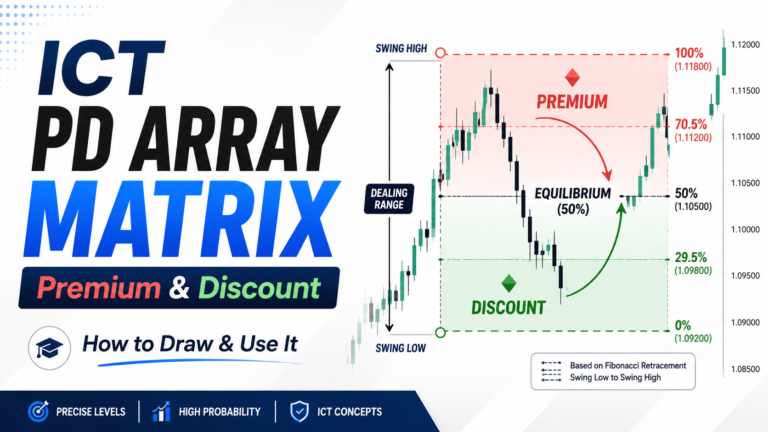
The midpoint is equilibrium.
Above equilibrium is premium.
Below equilibrium is discount.
In a bearish setup, ICT prefers selling at a premium.
If price is already above equilibrium and then runs an old high, the conditions can become more attractive for a Turtle Soup Sell.
The market is at a premium.
Buy-side liquidity is taken.
The higher timeframe is bearish.
These factors align.
The model becomes:
Bearish bias
Price at premium
Old high violated
Buy stops taken
Turtle Soup Sell
The opposite applies to a Turtle Soup Long.
A bullish market trades into discount.
Price moves below an old low.
Sell-side liquidity is taken.
The market aggressively reprices higher.
The model becomes:
Bullish bias
Price at discount
Old low violated
Sell stops taken
Turtle Soup Long
The liquidity run becomes more meaningful because it occurs at a logical valuation area.
Turtle Soup and Fair Value Gaps
Fair Value Gaps can help explain where price may move after a Turtle Soup.
Suppose price is trading inside a range.
A Fair Value Gap remains above the market.
Equal highs and buy-side liquidity are also present above.
Price trades below an old low and takes sell-side liquidity.
The higher timeframe supports higher prices.
The Turtle Soup Long now has a logical objective.
Price may reprice toward:
Equal highs
and
The Fair Value Gap above price
The stop run below the old low removes sell-side liquidity.
The imbalance above gives price another area to seek.
In the ICT Fair Value Gap teaching, a run below an old low was used to anticipate a Turtle Soup Long before price moved higher and closed the Fair Value Gap.
The opposite condition can also form.
A Fair Value Gap exists below price.
Price runs an old high.
Buy-side liquidity is taken.
A Turtle Soup Sell forms.
Price may then deliver lower into the imbalance.
This is why Turtle Soup should not be studied as an isolated candlestick pattern.
The liquidity objective after the stop run is equally important.
Turtle Soup and Order Blocks
Order blocks can define the institutional location for a Turtle Soup.
Suppose the Daily Chart has a bullish order block.
Price retraces into the Daily bullish order block.
On the hourly chart, an old low is present.
Price trades below the old low while simultaneously reaching the higher timeframe bullish order block.
This is much more meaningful than a random old-low violation.
The setup now has:
Higher timeframe bullish order block
Sell-side liquidity below an old low
Price runs the old low
Turtle Soup Long
The trader can then look for bullish displacement.
The bearish model works in reverse.
Price reaches a Daily bearish order block.
A 4-hour or hourly old high is present.
Price trades above the high and into the Daily bearish order block.
The market rejects.
A Turtle Soup Sell can form.
This is why Huddleston repeatedly combines stop runs with higher timeframe institutional reference points.
Using Lower Timeframes to Refine a Turtle Soup Entry
A higher timeframe Turtle Soup does not always require a blind entry at the liquidity level.
The setup can be refined.
Suppose the hourly chart shows an old low.
The Daily Chart has a bullish order block below price.
Price trades below the hourly low and into the Daily order block.
Instead of immediately buying, move to a 15-minute or 5-minute chart.
Now look for:
- A lower timeframe old low being violated
- Bullish displacement
- A bullish order block
- A Fair Value Gap
- A short-term high being broken
The higher timeframe says:
Look for a long.
The lower timeframe helps define:
Where to enter the long.
One ICT example refines a Daily bullish order block and old-low liquidity run from the hourly chart into the 15-minute and then 5-minute chart. The same Turtle Soup idea remains present, but the lower timeframe order block allows a tighter entry and smaller stop.
This is the fractal nature of price.
How to Identify a Turtle Soup on the Chart
A practical Turtle Soup identification process can be used.
Step 1. Define the Higher Timeframe Bias
Start with Monthly, Weekly, or Daily analysis.
Determine whether price is more likely to seek higher or lower liquidity.
Step 2. Identify the Higher Timeframe Institutional Level
Look for:
- Order block
- Breaker
- Fair Value Gap
- Liquidity void
- Premium or discount
- Institutional Order Flow reference point
Step 3. Mark Logical Liquidity
In a bearish model, mark old highs and equal highs.
In a bullish model, mark old lows and equal lows.
Step 4. Wait for Price to Violate the Level
A Turtle Soup needs the liquidity to be attacked.
For a Sell, price should trade above the high.
For a Long, price should trade below the low.
Step 5. Study the Response
Does price reject?
Does displacement appear?
Does the market quickly move back through the swept level?
Step 6. Identify the Opposing Liquidity Objective
For a Turtle Soup Sell, locate sell-side liquidity below.
For a Turtle Soup Long, locate buy-side liquidity above.
Step 7. Refine the Entry
Use a lower timeframe order block, breaker, displacement, or Fair Value Gap when greater precision is needed.
The important sequence is:
Bias first
Liquidity second
Stop run third
Confirmation and execution after
How to Anticipate Turtle Soup Before It Forms
The advanced skill is not seeing Turtle Soup after the reversal.
The advanced skill is expecting the liquidity run before price reaches the high or low.
Several ICT concepts can help.
Higher Timeframe Direction
Suppose the Monthly and Weekly Charts are bearish.
You already expect lower prices.
On the Daily Chart, a short-term high is present above price.
Instead of viewing a rally above the high as bullish, you can anticipate that price may run the buy stops and then continue lower.
The higher timeframe tells you which stop run to stalk.
Known Liquidity Pools
Mark obvious highs and lows before price reaches them.
Do not wait until the sweep happens.
Ask:
Where are the buy stops?
Where are the sell stops?
Which pool is useful relative to the higher timeframe direction?
Premium and Discount
In a bearish market, anticipate Turtle Soup Sell setups around old highs in premium.
In a bullish market, anticipate Turtle Soup Long setups around old lows in discount.
Institutional Reference Points
If an old high is located inside a Daily bearish order block, the potential Turtle Soup Sell can be anticipated before the high is taken.
If an old low is located inside a Daily bullish order block, the potential Turtle Soup Long can be anticipated before the low is taken.
Opposing Liquidity Objective
You should know where price may go after the sweep.
A bearish Turtle Soup is easier to trust when clear sell-side liquidity is present below.
A bullish Turtle Soup is easier to trust when clear buy-side liquidity is present above.
This is anticipatory skill development.
You are not waiting for a random false breakout.
You have already defined the level, direction, and likely target.
Using SMT Divergence to Anticipate Turtle Soup
ICT Institutional Market Structure provides another way to anticipate Turtle Soup.
In Forex, the U.S. Dollar Index can be compared with foreign currency pairs.
Suppose DXY makes a lower low.
A foreign currency makes a higher high.
The markets are symmetrical.
The underlying price direction is confirmed.
If the foreign currency later moves below a short-term low, the movement may simply collect sell stops before the foreign currency continues higher.
A Turtle Soup Long can be anticipated.
In another example, a foreign currency trades above an old high.
The move looks bullish.
But DXY fails to make the corresponding lower low.
The foreign currency breakout is not confirmed.
The currency pair may only be running buy stops.
This can warn of a Turtle Soup Sell.
Huddleston directly explains that market symmetry and SMT analysis can help him:
“Anticipate a Turtle Soup before it actually happens.”
SMT does not replace the Turtle Soup.
It gives additional information about whether the breakout is supported or failing to receive confirmation.
Symmetry and Continuation Turtle Soups
Turtle Soup is often misunderstood as a pure market reversal setup.
It can also appear as a continuation setup in the higher timeframe direction.
Suppose a foreign currency is bullish.
DXY weakness confirms the bullish condition.
The foreign currency temporarily moves below a short-term low.
Retail traders may think the trend is reversing.
But the movement below the low simply gathers sell stops.
A Turtle Soup Long forms.
Price then continues in the original bullish direction.
The setup is a lower timeframe reversal that supports a higher timeframe continuation.
Similarly, in a bearish environment, price may temporarily run above a short-term high.
A Turtle Soup Sell forms.
The market then continues lower.
This is why the higher timeframe narrative is so important.
Turtle Soup and Market Maker Trendline Traps
Trendline Phantoms can create predictable liquidity for Turtle Soup setups.
Suppose price forms higher highs and higher lows.
Retail traders draw an ascending support trendline.
The higher timeframe is bearish.
As price approaches the third trendline touch, retail traders expect support and buy.
ICT may instead focus on the high formed between the second and third trendline touches.
Buy-side liquidity may exist above that high.
Price can briefly trade above the high.
The liquidity is taken.
A Turtle Soup Sell forms.
Price then collapses through the apparent trendline support.
The retail trendline creates the trap.
The Turtle Soup provides the liquidity event.
The higher timeframe bearish narrative provides the direction.
The opposite can happen with descending trendline resistance.
If the higher timeframe is bullish, ICT may study the low between the second and third trendline highs.
Price can trade below that low, take sell stops, and form a Turtle Soup Long.
Turtle Soup and Head and Shoulders Traps
Classical Head and Shoulders patterns can also create Turtle Soup opportunities.
Suppose the Daily Chart is bullish.
On the hourly chart, a classical Head and Shoulders pattern forms.
Retail traders identify the neckline.
The neckline is formed by clean or equal lows.
When price breaks below the neckline, retail traders sell.
But those lows also contain sell-side liquidity.
Because the higher timeframe is bullish, ICT may view the neckline break as a Turtle Soup Long.
Price runs the sell stops below the neckline.
The trader looks for a bullish reversal.
The highest point or head of the pattern may later provide buy-side liquidity as a price objective.
The opposite occurs with an Inverted Head and Shoulders.
Suppose the higher timeframe is bearish.
Retail traders see a bullish Inverted Head and Shoulders.
Price breaks above the neckline.
Buy stops and breakout orders are triggered.
ICT may interpret this movement as a Turtle Soup Sell.
Price takes buy-side liquidity above the neckline and then moves lower.
The lowest point or head may become the sell-side liquidity objective.
Turtle Soup in Range-Bound Markets
Turtle Soup can be particularly useful when the market is trading inside a broader consolidation.
In a range, price frequently moves between liquidity on both sides.
The market may trade above a previous high and reject.
Later, price may move below a previous low and reject.
In this type of market profile, ICT emphasizes studying:
- Stops
- Premium and discount
- Fair Value Gaps
- Range extremes
Suppose price is in the premium portion of a range.
An old high is violated.
A Turtle Soup Sell may develop.
The first lower swing low can provide an initial profit objective.
Suppose price is in discount.
An old low is violated.
A Turtle Soup Long may develop.
The first higher swing high can become an objective.
Turtle Soup is therefore useful for trading liquidity from one side of a range toward the other.
Turtle Soup at Major Highs and Lows
Turtle Soup can also form around important intermediate-term or major highs and lows.
A major old high can hold a large pool of buy-side liquidity.
When price trades above the level and strongly rejects, a significant bearish price swing may begin.
A major old low can hold substantial sell-side liquidity.
When price trades below the level and aggressively reprices higher, a significant bullish swing may develop.
However, ICT also teaches that price does not always need to trade beyond the absolute wick high or wick low.
The candle bodies can provide information about institutional accumulation and distribution.
In some conditions, price may trade beyond the highest candle body inside a swing high and reject without creating a completely new wick high.
This is closer to the ICT Rejection Block concept.
It is related to the same underlying principle of liquidity being taken around a price extreme, but it is not always a textbook Turtle Soup failure swing beyond the absolute old high or low.
Turtle Soup vs Rejection Block
Turtle Soup and Rejection Blocks are closely related, but they should not always be treated as exactly the same pattern.
A classic Turtle Soup normally involves:
A previous high being violated and rejected
or
A previous low being violated and rejected
A Rejection Block studies the range between the wick extreme and the highest or lowest candle body at a swing.
Price may take liquidity beyond the bodies of the candles without necessarily breaking the absolute wick high or low.
Therefore:
Turtle Soup focuses on the failure swing beyond an old high or low.
Rejection Block expands the idea by studying distribution or accumulation inside the wick range of a major swing.
Both concepts are based on liquidity around price extremes.
How to Confirm a Turtle Soup
There is no need to use an indicator to confirm Turtle Soup.
Price itself should provide evidence.
Possible confirmation characteristics include:
Immediate Rejection
Price cannot hold above the swept high or below the swept low.
Displacement
The market moves aggressively away from the liquidity pool.
Short-Term Structure Shift
After a Turtle Soup Sell, a nearby short-term low may be violated.
After a Turtle Soup Long, a nearby short-term high may be violated.
Fair Value Gap
Strong displacement may leave an imbalance that supports the new price delivery.
Order Block Formation
The candle before the displacement may provide a lower timeframe institutional entry area.
SMT Confirmation
A correlated or inversely correlated market may fail to confirm the breakout.
No single confirmation is required in every setup.
The higher timeframe narrative and price response should work together.
How to Enter an ICT Turtle Soup Setup
There are different ways to execute a Turtle Soup.
An aggressive trader may enter close to the liquidity run.
For example, price trades above an old high in a bearish higher timeframe condition.
The trader sells after seeing rejection.
A more conservative trader may wait for bearish displacement.
After displacement, the trader can look for a retracement into:
- Bearish order block
- Breaker
- Fair Value Gap
For a Turtle Soup Long, the same process is reversed.
Price trades below an old low.
Bullish displacement appears.
The trader waits for price to retrace into a bullish order block or Fair Value Gap.
The best execution method depends on the trader’s model.
The Turtle Soup defines the liquidity event.
The lower timeframe entry model defines the execution.
Where to Place the Stop Loss
Stop placement should be based on the specific setup and timeframe.
For a Turtle Soup Sell, the stop is generally protected above the price extreme that should not be violated if the bearish idea is correct.
For a Turtle Soup Long, the stop is generally protected below the low that should hold if the bullish expectation is correct.
Lower timeframe refinement can reduce the stop size.
For example:
The hourly chart identifies a Turtle Soup Long.
The trader moves to a 5-minute chart.
A bullish order block forms after the liquidity run.
The entry can be refined around the lower timeframe order block.
The stop can then be based on the lower timeframe setup rather than the entire hourly swing.
However, reducing the stop should not destroy the logic of the trade.
A very tight stop placed inside normal price fluctuation can be taken before the expected move begins.
How to Set Turtle Soup Profit Targets
Profit targets should be based on liquidity.
For a Turtle Soup Long, possible objectives include:
- Short-term high
- Equal highs
- Previous day high
- Buy-side liquidity
- Fair Value Gap above price
- Bearish order block
- Higher timeframe terminus
For a Turtle Soup Sell, possible objectives include:
- Short-term low
- Equal lows
- Previous day low
- Sell-side liquidity
- Fair Value Gap below price
- Bullish order block
- Higher timeframe terminus
The first logical opposing liquidity pool can provide a partial profit objective.
A larger higher timeframe liquidity target may be used for the remaining position.
This is one of the most important differences between liquidity-based trading and arbitrary risk-to-reward targeting.
The trader should understand where price has a reason to go.
When a Turtle Soup Setup is Weak
Not every liquidity sweep should be traded.
A Turtle Soup setup may be weaker when:
- There is no higher timeframe directional bias
- Price is sweeping liquidity in the direction of strong higher timeframe Institutional Order Flow
- There is no logical opposing liquidity target
- The sweep occurs in the middle of an unclear range
- Price shows no immediate dynamic response
- The market holds above the swept high or below the swept low
- Correlated markets confirm the breakout strongly
- The trader is fading a genuine continuation move
Suppose DXY makes a higher high.
A foreign currency makes a lower low.
The markets are symmetrically confirming dollar strength.
In this environment, aggressively stalking a bullish reversal in the foreign currency may be lower probability.
You must understand whether the liquidity sweep is likely to reverse price or simply support continuation.
Common Turtle Soup Trading Mistakes
The first mistake is trading every old high and old low.
A liquidity level alone is not enough.
The second mistake is ignoring higher timeframe Institutional Order Flow.
The stop run should make sense inside the larger price narrative.
The third mistake is entering before liquidity is taken.
If your model requires a Turtle Soup, wait for the high or low to be violated.
The fourth mistake is assuming every wick is a Turtle Soup.
The old high or old low should be clearly defined.
The fifth mistake is ignoring the reaction after the sweep.
A valid reversal should show willingness to reprice.
The sixth mistake is having no target.
Know which opposing liquidity pool price may seek.
The seventh mistake is confusing a genuine breakout with a false breakout.
Higher timeframe direction, SMT, premium and discount, and institutional reference points help distinguish them.
A Complete ICT Turtle Soup Trading Model
A complete Turtle Soup model can be built with the following process.
Step 1. Start With the Higher Timeframe
Use the Monthly, Weekly, or Daily Chart.
Determine the likely directional delivery of price.
Step 2. Identify the Higher Timeframe Draw on Liquidity
Where is price expected to go?
Above old highs?
Below old lows?
Into a Fair Value Gap?
Toward an order block?
Step 3. Define Premium or Discount
For bearish setups, prefer liquidity runs at premium.
For bullish setups, prefer liquidity runs at discount.
Step 4. Mark the Opposite-Side Liquidity
If bearish, mark old highs and equal highs.
If bullish, mark old lows and equal lows.
Step 5. Anticipate the Stop Run
Do not wait for hindsight.
Know which liquidity level may be taken before the real price move begins.
Step 6. Watch for the Sweep
Price must violate the old high or old low.
Step 7. Study the Reaction
Look for rejection and displacement.
The market should show willingness to leave the liquidity area.
Step 8. Refine on a Lower Timeframe
Look for an order block, breaker, Fair Value Gap, or smaller Turtle Soup.
Step 9. Enter in the Higher Timeframe Direction
The lower timeframe setup should align with the original directional narrative.
Step 10. Target Opposing Liquidity
Use known highs, lows, gaps, or institutional reference points as objectives.
The model can be summarized as:
Higher timeframe bias
Then:
Known liquidity
Then:
Stop run
Then:
Dynamic rejection
Then:
Lower timeframe execution
Then:
Opposing liquidity objective
Final Thoughts
The ICT Turtle Soup concept is much more than a false breakout pattern.
Yes, the visible setup is a previous high or low being violated and rejected.
But the real skill is understanding why that particular high or low should be taken.
A Turtle Soup Sell forms when price runs buy-side liquidity above an old high and then reprices lower.
A Turtle Soup Long forms when price runs sell-side liquidity below an old low and then reprices higher.
However, the best setups are supported by higher timeframe Institutional Order Flow.
A bearish Turtle Soup may occur at premium, inside a higher timeframe bearish order block, with sell-side liquidity below price.
A bullish Turtle Soup may occur at discount, inside a bullish order block, with buy-side liquidity above price.
SMT divergence can help anticipate the false breakout before it forms.
Fair Value Gaps can provide the next price objective.
Trendline Phantoms and Head and Shoulders patterns can create retail liquidity around the exact highs and lows Turtle Soup attacks.
Lower timeframes can refine the liquidity run into a more precise entry.
Most importantly, price should show a meaningful response after the stop run.
Michael J. Huddleston explains the central lesson clearly:
“You first have to know why the stop run would be necessary or why it would be influential in terms of price action.”
That is the difference between seeing a random false breakout and understanding the ICT Turtle Soup concept.
Do not begin with the breakout.
Begin with the higher timeframe.
Find the institutional price narrative.
Identify the liquidity.
Anticipate which high or low may be attacked.
Then wait for the stop run and watch how price responds.
That is how Turtle Soup becomes a defined ICT trading setup instead of a random reversal pattern.