Liquidity Pools are one of the most important price concepts taught within the ICT (Inner Circle Trader) methodology created by Michael J. Huddleston. The concept focuses on understanding where clusters of buy and sell orders may be resting around specific price levels and how price may move towards these orders.
Some traders enter immediately at the current market price.
Others leave pending orders.
Long traders may protect their positions with sell stops below price.
Short traders may protect their positions with buy stops above price.
Breakout traders may place buy stop orders above old highs or sell stop orders below old lows.
When many orders collect around the same price area, a pool of liquidity is formed.
These areas are known as Liquidity Pools.
Michael J. Huddleston explains in the mentorship lesson:
“Our liquidity is the open interest of buyers and sellers in the market.”
ICT traders study old highs and old lows because these visible price levels can help identify where stop orders and pending market interest may reside.
What Are Liquidity Pools?
Liquidity Pools are areas around specific price levels where a collection of pending buy or sell orders is expected to exist.
These orders may include:
- Protective stop-loss orders
- Buy stop orders
- Sell stop orders
- Breakout entry orders
- Orders from traders closing existing positions
Suppose price forms an old high.
Some traders may hold short positions.
Their protective stop losses can be placed above the old high.
A stop loss on a short position is a buy stop.
Breakout traders may also place buy stop orders above the same high because they expect price to continue higher after a breakout.
The result is a collection of buy orders above the old high.
This creates a buy-side Liquidity Pool.
Now suppose price forms an old low.
Long traders may place protective sell stops below the low.
Bearish breakout traders may also enter short using sell stops below the same price level.
These orders collect below the old low.
This creates a sell-side Liquidity Pool.
The ICT trader studies these areas to determine where price may seek liquidity.
The Main Idea Behind Liquidity Pools
The main idea behind Liquidity Pools is that orders tend to collect around obvious price levels.
Old highs are visible.
Old lows are visible.
Equal highs and equal lows are also easy for traders to identify.
Many retail traders use the same chart references when placing entries and stop losses.
This can create clusters of orders.
The ICT methodology studies where these orders are likely to rest.
The trader does not need to know exactly why every market participant has placed an order.
The important question is:
Where is the interest likely to exist?
Michael J. Huddleston explains:
“We are interested in knowing where their interest may reside in new pending orders.”
By studying price action, a trader can estimate where buy stops and sell stops are likely to be located.
These areas become potential draws on price.
Buy-Side and Sell-Side Liquidity Pools
There are two basic types of Liquidity Pools:
- Buy-side Liquidity Pools
- Sell-side Liquidity Pools
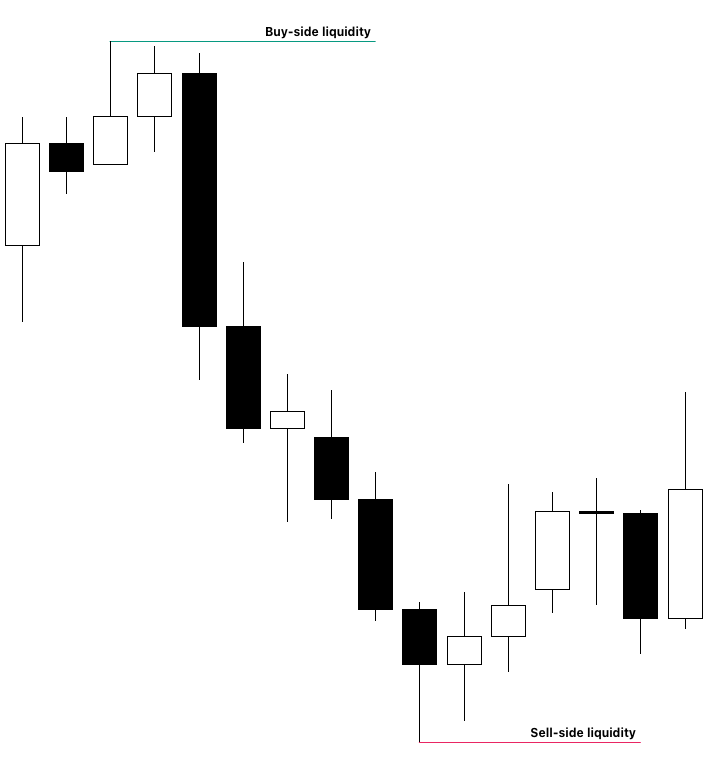
A buy-side Liquidity Pool normally exists above market price.
A sell-side Liquidity Pool normally exists below market price.
The names are based on the type of orders expected to enter the market when price reaches the level.
Above an old high, buy stops may become market buy orders.
This injects buy-side liquidity into the market.
Below an old low, sell stops may become market sell orders.
This injects sell-side liquidity.
ICT traders use the broader market direction to determine whether they want to buy from sell-side liquidity or sell into buy-side liquidity.
What is Buy-Side Liquidity?
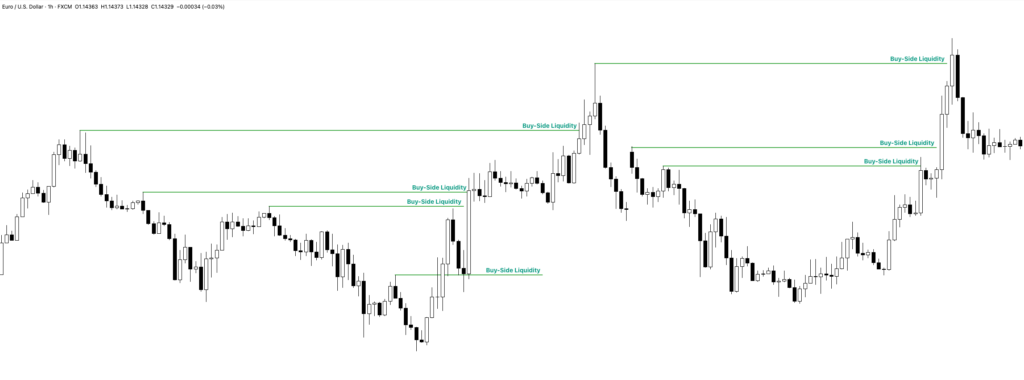
Buy-side liquidity is a collection of buy orders expected above the current market price.
These orders commonly rest above:
- Old highs
- Short-term highs
- Swing highs
- Equal highs
- Relative equal highs
There are generally two important sources of buy stops above a high.
The first source is protective stop losses from short traders.
Suppose a trader sells the market.
The trader expects price to move lower.
A protective stop may be placed above a recent high.
If price trades above this level, the buy stop is activated.
The short position is closed through a market buy order.
The second source is breakout traders.
These traders see resistance or an old high.
They expect a movement above the level to confirm bullish continuation.
They place buy stop orders above the high.
When price trades higher, these orders become active.
Both groups create buying interest above the old high.
This collection of orders creates a buy-side Liquidity Pool.
What is Sell-Side Liquidity?
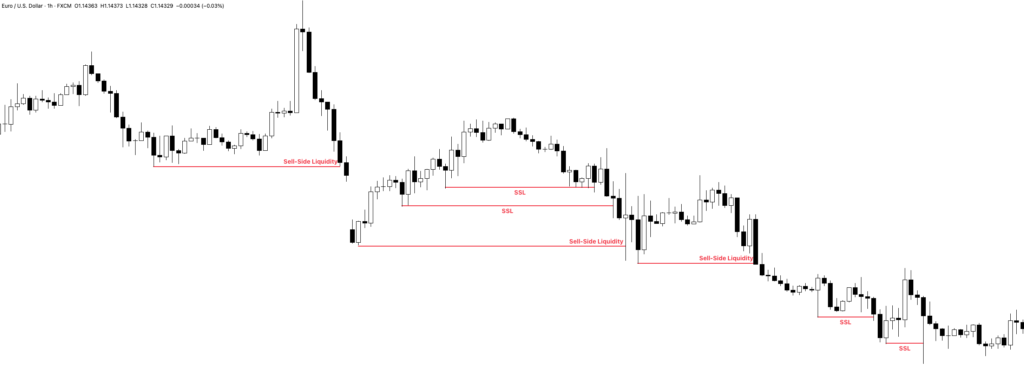
Sell-side liquidity is a collection of sell orders expected below the current market price.
These orders commonly rest below:
- Old lows
- Short-term lows
- Swing lows
- Equal lows
- Relative equal lows
Long traders may place protective sell stops below a recent low.
If price violates the low, the stop becomes a market order to sell.
Breakout traders may also place sell stop orders below the low.
They expect price to continue lower after the breakdown.
When price trades below the old low, these orders are activated.
The result is a rush of sell orders entering the marketplace.
This creates sell-side liquidity.
In a bullish market, the ICT methodology studies these sell orders as possible liquidity that can be paired with buying interest.
Where Do Liquidity Pools Form?
Liquidity Pools commonly form around obvious price references.
Old highs and old lows are important because traders can easily see them.
Equal highs and equal lows can create even clearer liquidity references.
A trader may look at equal highs and think:
“Price has tested resistance several times. If it breaks out, I will buy.”
Another trader may already be short and place a protective buy stop above the same equal highs.
Buy orders therefore collect above the level.
The opposite occurs below equal lows.
Long traders place stops below the lows.
Breakout traders look to sell below the lows.
Sell orders collect beneath the price level.
This is why ICT traders pay close attention to obvious swing points.
The chart itself provides visual clues about where orders may be resting.
Old Highs as Liquidity Pools
An old high can provide a clear reference for buy-side liquidity.
Suppose price trades lower after forming a high.
The old high remains visible on the chart.
Short sellers may use this high as a protective stop reference.
Their buy stops rest above the old high.
Bullish breakout traders may also watch the same level.
They believe price moving above the high shows bullish strength.
They place buy stop orders above it.
If price trades above the old high, the buy stops are activated.
A surge of market buy orders can enter.
The area above the high therefore represents a pool of buy-side liquidity.
In a bearish market narrative, ICT traders may look for price to trade above the old high before moving lower.
Old Lows as Liquidity Pools
An old low can provide a reference for sell-side liquidity.
Suppose price rallies after creating a low.
Long traders may use the low as a protective stop level.
Their stop-loss orders rest below the low.
Bearish breakout traders may also place sell stop orders below the same level.
They expect a breakdown to create lower prices.
If price trades below the old low, these sell stops become market sell orders.
A rush of selling interest is injected into the market.
In a bullish market narrative, ICT traders may look for this sell-side liquidity to be taken before price expands higher.
Equal Highs and Liquidity Pools
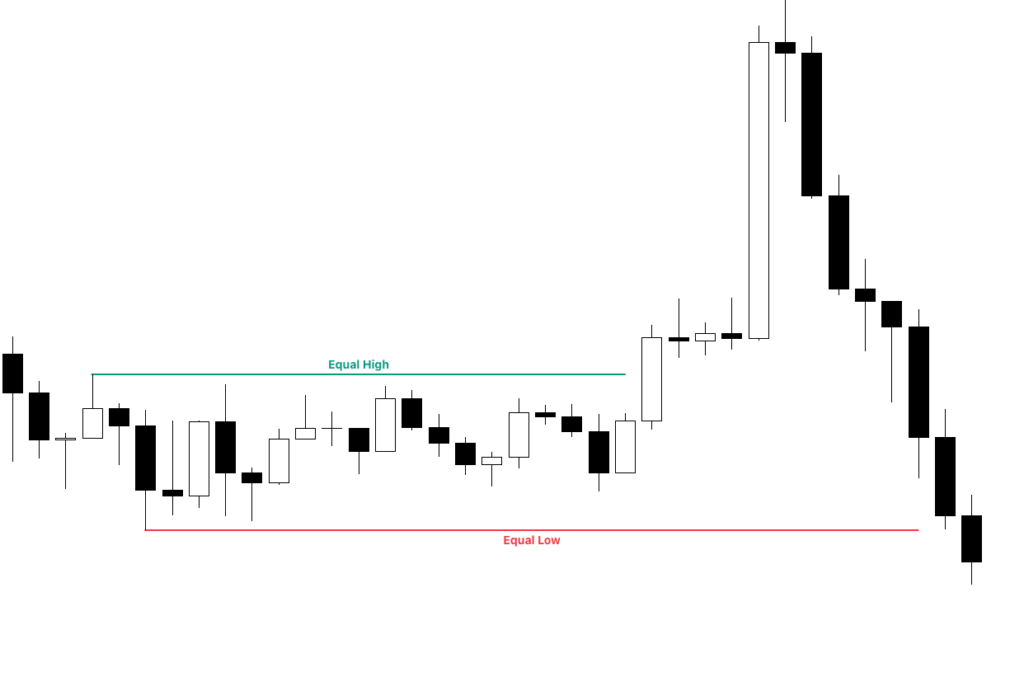
Equal highs are important Liquidity Pools because the price structure is easy to see.
Two or more highs form around a similar price level.
Traditional technical analysis may describe the area as resistance.
Breakout traders can expect price to move higher if the resistance breaks.
Buy stop orders may collect above the equal highs.
Short traders may also place protective stops above the same area.
The collection of buy orders creates buy-side liquidity.
If the underlying market direction is bearish, ICT traders may wait for price to move through the equal highs.
The buy stops become active.
Buy-side liquidity enters the market.
A bearish trader may then look for a selling opportunity after the liquidity raid.
Equal Lows and Liquidity Pools
Equal lows create a similar condition below price.
Two or more lows form around the same level.
Retail traders may identify the area as support.
Long traders can place stop losses below the support.
Breakout sellers may place sell stop orders below the equal lows.
Sell orders accumulate under the price level.
This creates a sell-side Liquidity Pool.
In a bullish market context, the market may trade below these equal lows.
Sell stops are activated.
The selling liquidity enters the marketplace.
ICT traders may look for a potential buying opportunity after this liquidity has been taken.
Liquidity Pools and Market Direction
Market direction is one of the most important parts of using Liquidity Pools.
A trader should not automatically sell every old high.
A trader should not automatically buy every old low.
The underlying market narrative must first be established.
Michael J. Huddleston explains:
“The trick is knowing what the underlying paintings of the market is.”
In practical terms, the trader should determine whether the market is predisposed to move higher or lower.
Higher-time-frame analysis is used to establish bullish or bearish conditions.
If the market is bullish, ICT traders generally focus on sell-side liquidity below price.
The market may move below an old low.
Sell stops are activated.
The trader looks to buy from the rush of selling liquidity.
If the market is bearish, attention shifts towards buy-side liquidity above price.
Price may move above an old high.
Buy stops enter the market.
The trader looks for an opportunity to sell into the buying liquidity.
Buying Below Market Price in ICT
The ICT methodology teaches traders to think in terms of buying at a discount.
If the broader market context is bullish, the trader does not need to chase price higher.
Instead, the trader can wait.
Price may correct lower.
An old low exists below the market.
Sell stops rest below the low.
When price trades below the old low, those sell orders become active.
The market now has willing participants selling at lower prices.
A bullish ICT trader may look to buy from these sellers.
Michael J. Huddleston explains:
“We want to buy below the market price from sellers that are willing to sell below the market price.”
The trader is attempting to pair buy orders with the rush of sell-side liquidity.
This allows the long position to be established at a discount.
Selling Above Market Price in ICT
The bearish concept works in reverse.
If the higher-time-frame market narrative is bearish, the trader may wait for price to rally.
An old high exists above the current market.
Buy stops are expected above the high.
When price trades above the old high, short sellers may be stopped out.
Breakout buyers may also enter.
A rush of buying liquidity enters the marketplace.
The bearish ICT trader looks to sell into these buyers.
This allows the short position to be established at a premium.
Michael J. Huddleston summarizes the idea:
“We want to sell to the buyers above us.”
The trader is not chasing price lower.
The goal is to sell after the market trades into a higher price level where buying interest is available.
Liquidity Pools and Premium and Discount
Liquidity Pool trading is closely connected with premium and discount.
A bullish trader wants to buy at a discount.
The trader waits for price to move below market price and reach sell-side liquidity.
A bearish trader wants to sell at a premium.
The trader waits for price to move above the market and reach buy-side liquidity.
This is different from the common retail approach of buying after price has already moved higher or selling after price has already collapsed.
ICT traders attempt to identify where other market participants will provide liquidity.
The trading idea is then aligned with the broader market direction.
In a bullish market:
Sell-side liquidity below → Potential buying opportunity
In a bearish market:
Buy-side liquidity above → Potential selling opportunity
What is a Liquidity Raid?
A liquidity raid occurs when price trades into a Liquidity Pool and activates the orders resting around the level.
Suppose an old low exists.
Sell stops are located below the low.
Price moves lower.
The old low is violated.
The sell stops become market sell orders.
Sell-side liquidity is injected into the market.
This is a run on a sell-side Liquidity Pool.
Now consider an old high.
Buy stops rest above the level.
Price moves higher and violates the high.
The buy stops become market buy orders.
Buy-side liquidity is injected.
This is a run on a buy-side Liquidity Pool.
The liquidity raid itself should be studied within the larger market context.
Bullish Run on a Liquidity Pool
A bullish Liquidity Pool setup occurs when the broader market is predisposed to move higher.
The trader identifies a recent low below current price.
Long traders may have protective sell stops below the low.
Breakout sellers may also have sell stop orders below the same level.
The low creates a sell-side Liquidity Pool.
Price trades below the low.
The sell stops are activated.
They become market orders to sell.
This injects sell-side liquidity.
A bullish ICT trader may pair buying interest with the rush of sell orders.
The trader then looks for price to reprice higher.
The complete model is:
Bullish Market Context → Old Low Forms → Sell Stops Collect Below → Price Trades Below Low → Sell-Side Liquidity Taken → Long Position Accumulated → Price Reprices Higher
Bearish Run on a Liquidity Pool
A bearish Liquidity Pool setup is the opposite.
The broader market should be predisposed to move lower.
The trader identifies an old high above current price.
Buy stops are expected above the high.
Price rallies.
The old high is violated.
Short traders are stopped out.
Breakout buyers enter.
A rush of market buy orders is created.
This injects buy-side liquidity.
The bearish ICT trader may look to sell into the buying interest.
The market can then reprice lower.
The model is:
Bearish Market Context → Old High Forms → Buy Stops Collect Above → Price Trades Above High → Buy-Side Liquidity Taken → Short Position Established → Price Reprices Lower
How to Identify Liquidity Pools on a Chart
First, open the higher-time-frame chart.
Determine whether the market is bullish or bearish.
Now identify the current market price.
Look above price.
Mark old highs.
Mark equal highs.
Mark obvious swing highs.
These levels can contain buy-side Liquidity Pools.
Now look below price.
Mark old lows.
Mark equal lows.
Mark clear swing lows.
These areas can contain sell-side Liquidity Pools.
The next step is to role-play the positions of other traders.
Ask:
If I were short, where would I place my protective buy stop?
Then ask:
If I were long, where would I place my protective sell stop?
Michael J. Huddleston explains this process in the lesson:
“If I were short right now, where would my protective buy stop would be? If I was long right now, where would my protective sell stop be?”
This simple chart exercise helps identify potential Liquidity Pools.
How to Anticipate a Liquidity Raid
A liquidity raid becomes more meaningful when it aligns with higher-time-frame market direction.
Suppose the market is bullish.
Price is expected to move higher.
A recent low exists below the market.
Sell stops are expected below this low.
Instead of buying immediately at the current price, the trader waits.
Price corrects lower.
The market approaches the old low.
A sweep below the low may provide the desired sell-side liquidity.
The trader anticipates a raid because the broader market direction remains bullish.
The same logic applies to a bearish market.
If the market is predisposed lower, the trader studies old highs.
Price may rally above a high and take buy-side liquidity before declining.
The higher-time-frame bias gives the raid context.
Liquidity Pools and Market Efficiency Paradigm
The mentorship lesson connects Liquidity Pools with the ICT Market Efficiency Paradigm.
The trader studies the market as a mechanism for matching buyers and sellers.
A buyer requires someone willing to sell.
A seller requires someone willing to buy.
Liquidity Pools provide areas where large collections of opposing orders may become available.
Below an old low, sell orders enter the marketplace.
A buyer can accumulate from this selling interest.
Above an old high, buy orders enter.
A seller can distribute into the buying interest.
ICT traders therefore study where price can find opposing orders.
This allows the chart to be viewed as a map of potential liquidity.
Do You Need an Order Book to Find Liquidity Pools?
According to the ICT lesson, a trader does not need an order book, ladder or Depth of Market display to study these Liquidity Pools.
Old highs and old lows provide visible price references.
The trader can use common sense to estimate where protective stops and breakout orders may be located.
Michael J. Huddleston states:
“You don’t need to see an order book.”
The ICT approach uses price action.
Find the obvious high.
Find the obvious low.
Consider how traders may have positioned around these levels.
Then combine this information with the higher-time-frame market direction.
The chart itself becomes the main reference.
Liquidity Pool Entry in a Bullish Market
The mentorship lesson describes an aggressive entry approach for a bullish Liquidity Pool setup.
First, establish that the market is bullish.
Identify a recent low.
Sell stops are expected below this low.
The trader anticipates price moving under the low.
A buy limit order may be considered around or below the low.
The goal is to buy the sell-side liquidity.
However, the lesson emphasizes that entering too early above the low may result from fear of missing the trade.
A more refined approach is to wait for price to move below the low.
The market takes the sell stops.
The trader then enters from a discounted price.
The trade is based on the expectation that the move below the low is a liquidity raid rather than the beginning of a larger decline.
The 10 to 20 Pip Sweep Concept
In the ICT lecture video , Michael J. Huddleston discusses a 10 to 20 pip sweep below an old low on lower-time-frame charts such as the 15-minute or 30-minute chart.
This was presented within the specific forex examples and mentorship context.
The trader identifies the old low.
Price trades below the level.
A movement 10 to 20 pips under the low may provide a possible entry area in the bullish setup described.
The idea is to enter below the obvious liquidity level rather than buying above the low.
However, this should not be treated as a universal fixed measurement for every asset class.
The ICT lecture video ‘s examples are based on forex price action.
The broader concept is that price should meaningfully trade into the Liquidity Pool before the trader considers the entry.
Risk Management Around Liquidity Pools
Risk management is important because not every movement below a low or above a high is only a stop run.
Sometimes price is beginning a larger directional move.
In the bullish forex example, the mentorship lesson discusses a 30 to 50 pip stop when the entry is already significantly below the old low.
Michael J. Huddleston also explains that if price continues moving substantially below the low, the move may not simply be a liquidity raid.
He states:
“It’s probably not just a stop run.”
This is an important point.
The market should show a willingness to reject the liquidity area.
If price continues aggressively moving through the level, the trader should question the original market narrative.
Liquidity Pool trading requires both an anticipated raid and a correct directional bias.
Pairing Sell-Side Liquidity With Buy-Side Liquidity
One of the most important Liquidity Pool concepts is pairing one side of liquidity with the opposite side.
Suppose the market is bullish.
Price trades below an old low.
Sell stops are taken.
The trader accumulates a long position from the sell-side liquidity.
Now price moves higher.
Above the market, equal highs exist.
Buy stops rest above these highs.
When price reaches the buy-side Liquidity Pool, the long position can be reduced or closed.
The model is:
Accumulate from Sell-Side Liquidity → Price Moves Higher → Distribute Into Buy-Side Liquidity
Michael J. Huddleston describes the idea:
“You’re accumulating the sell side liquidity for longs and you’re distributing your longs to the buy side liquidity.”
The bearish model works in reverse.
A short position may be established around buy-side liquidity and covered around sell-side liquidity.
Liquidity Pools as Profit Targets
Liquidity Pools can provide logical profit objectives.
Suppose a trader enters long after price raids an old low.
The sell-side Liquidity Pool has been taken.
Now the trader looks above the market.
An old high exists.
Equal highs may also be visible.
Buy stops are expected above these price levels.
The buy-side Liquidity Pool becomes a potential target.
The trader can reduce the position as price reaches different buy-stop areas.
The same principle applies to bearish trades.
A short position established after a buy-side raid may target sell stops below old lows.
This creates a complete liquidity-based trade model.
Layered Liquidity Pools
More than one Liquidity Pool can exist above or below the market.
Suppose price is moving higher.
A short-term high exists nearby.
Another older high exists above it.
A third high is located even higher.
Each level may contain buy stops.
The trader can identify these as layered buy-side Liquidity Pools.
A long position may take partial profits at the first liquidity pool.
More profits can be taken at the next level.
The final part of the position can target the higher pool.
The same logic applies to layered sell-side liquidity below price.
ICT traders can use multiple old lows as staged downside objectives.
Liquidity Pools and False Breakouts
A liquidity raid may appear as a false breakout.
Suppose the market is bearish.
Price moves above an old high.
Retail breakout traders see a bullish breakout.
They buy.
Short traders are stopped out.
Buy orders flood into the market.
However, the higher-time-frame market remains bearish.
ICT traders may interpret the move above the old high as a run on buy-side liquidity.
Price can then reject the level and move lower.
The same occurs below an old low in a bullish market.
Retail traders may see a bearish breakout.
They sell.
Long traders are stopped out.
Sell-side liquidity enters.
The bullish market then reprices higher.
The false breakout is therefore connected with the liquidity raid.
Liquidity Pools and Retail Breakout Trading
The ICT Liquidity Pool concept is very different from normal retail breakout trading.
A breakout trader sees price moving above an old high and buys.
An ICT trader with a bearish bias may see the same movement as buy-side liquidity being injected into the market.
A breakout trader sees price moving below an old low and sells.
An ICT trader with a bullish bias may view the move as sell-side liquidity becoming available.
The difference is the higher-time-frame market narrative.
ICT traders are not automatically fading every breakout.
They first determine whether the market is predisposed higher or lower.
The Liquidity Pool raid is then studied within that directional context.
Common Mistakes When Trading Liquidity Pools
One common mistake is buying every move below an old low.
The market must first have a bullish price narrative.
Another mistake is selling every move above an old high.
The broader market should support bearish price delivery.
Traders also confuse any high or low with an important Liquidity Pool.
More obvious swing points, equal highs and equal lows generally provide clearer areas where orders may collect.
Another mistake is entering before the liquidity is taken.
Fear of missing the trade can cause a trader to buy above the old low or sell below the old high.
The mentorship lesson encourages patience.
Traders may also ignore the opposing Liquidity Pool.
A bullish trade should have a logical area of buy-side liquidity above price.
A bearish trade should have a possible sell-side objective below.
Another mistake is assuming every price violation is only a stop run.
If price aggressively continues beyond the level, the market narrative may be wrong.
Simple Liquidity Pools Checklist
Before using Liquidity Pools in an ICT setup, check the following:
Market Bias: Is the higher-time-frame market bullish or bearish?
Current Price: Where is price currently trading?
Old Highs: Are there visible highs above the market?
Old Lows: Are there visible lows below the market?
Equal Highs or Lows: Are obvious liquidity clusters present?
Buy Stops: Where may short stops and bullish breakout orders rest?
Sell Stops: Where may long stops and bearish breakout orders rest?
Liquidity Raid: Has price traded through the expected liquidity level?
Entry Location: Are you buying from sell-side liquidity or selling into buy-side liquidity?
Opposing Pool: Is there a logical Liquidity Pool available as the next price objective?
These questions help traders study liquidity as a complete price-delivery model.
Final Understanding of Liquidity Pools
Liquidity Pools are areas where a collection of buy or sell orders may be resting around specific price levels.
The concept is an important part of the methodology taught by Michael J. Huddleston, founder of ICT (Inner Circle Trader).
Buy-side Liquidity Pools normally form above old highs, equal highs and swing highs.
Protective buy stops from short traders may rest above these levels.
Breakout buyers may also place buy stop orders above the highs.
Sell-side Liquidity Pools normally form below old lows, equal lows and swing lows.
Protective sell stops from long traders may rest below these levels.
Breakout sellers may also place sell stop orders below the lows.
The higher-time-frame market direction determines how ICT traders interpret these Liquidity Pools.
When the market is bullish, traders may wait for price to raid sell-side liquidity below an old low.
The rush of selling interest can provide liquidity for buying.
Price can then reprice higher towards a buy-side Liquidity Pool.
When the market is bearish, traders may wait for a rally above an old high.
Buy-side liquidity enters the market.
The trader can look to sell into this buying interest and target sell-side liquidity below price.
The important lesson is not to chase price.
Study where traders may have placed their orders.
Find the old highs.
Find the old lows.
Identify where buy stops and sell stops may reside.
Establish the higher-time-frame market direction.
Then wait for price to reach the Liquidity Pool that supports the expected market narrative.
This is the core logic behind Liquidity Pools within Michael J. Huddleston’s ICT trading methodology.