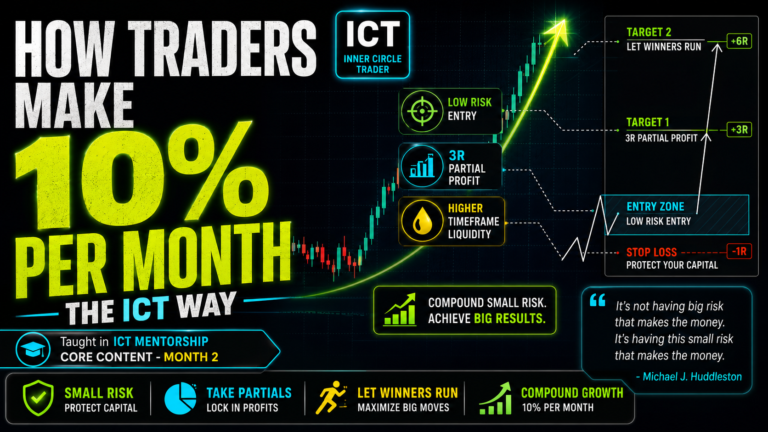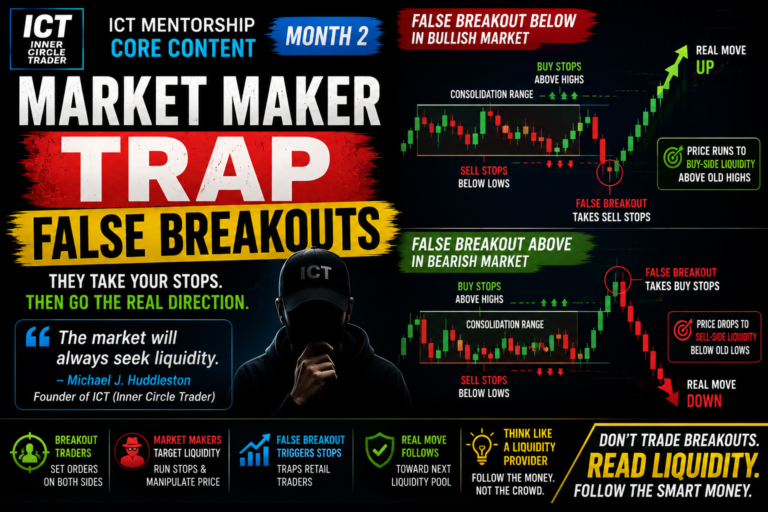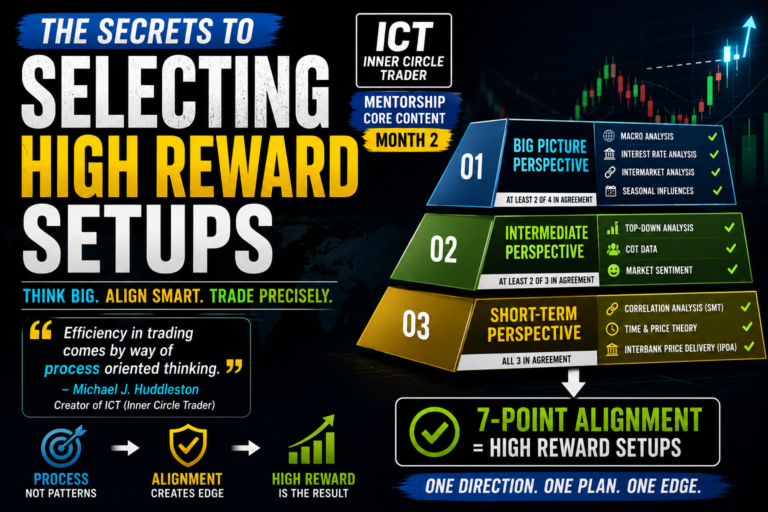
No Fear Of Losing is an important trading psychology and risk management concept taught by Michael J. Huddleston, the creator of ICT (Inner Circle Trader). This concept is taught in the ICT Mentorship Core Content – Month 2 and explains why losing trades do not automatically prevent a trader from becoming profitable.
Many new traders believe profitability requires a very high win rate.
They want to win 80%, 90% or even 100% of their trades.
Because of this expectation, every losing trade feels like failure.
ICT teaches a different approach.
A trader can take many losses and still remain profitable when risk is controlled and winning trades are framed around favorable reward-to-risk multiples.
As Michael J. Huddleston states:
“Losing is inevitable.”
The goal is not to remove losing trades.
The goal is to make losses small enough that they do not destroy the profitability provided by larger winning trades.
What Does No Fear Of Losing Mean in ICT?
No Fear Of Losing does not mean a trader should become careless about losing money.
It does not mean ignoring risk.
The concept means accepting that losses are a normal part of trading.
A professional equity manager understands that every trade can lose.
Therefore, the trader defines risk before entering.
Once the trade is placed, a losing outcome should already be financially manageable.
The basic framework is:
Defined Risk → Accept Possible Loss → Execute Setup → Allow Reward-to-Risk Model to Work
Fear develops when the trader risks more than they are mentally or financially prepared to lose.
With controlled risk, one losing trade should not become a major event.
Fear of Losing Creates Poor Trading Decisions
A trader who cannot accept losses will normally begin making fear-based decisions.
The trader may constantly think:
- What if this trade loses?
- What if price hits my stop?
- Should I close now?
- Should I move my stop?
- Should I skip this setup?
- Should I enter later?
The focus moves away from the actual trading model.
Instead, the trader becomes focused only on the adverse outcome.
This can damage execution.
A valid setup appears, but the trader is afraid to enter.
Price moves exactly as anticipated.
The trader then chases the market.
Another setup appears.
Fear prevents execution again.
This can develop into trade paralysis.
The trader understands the setup but becomes unable to execute efficiently.
Traders Who Cannot Take a Loss Struggle Long Term
Trading equity cannot be managed effectively when the trader believes every trade must win.
Sooner or later, a loss will occur.
The trader may respond by:
- Increasing position size
- Revenge trading
- Removing the stop loss
- Moving the stop farther away
- Closing good trades too early
- Avoiding valid setups
The real problem is not the losing trade.
The problem is the emotional reaction to the loss.
ICT teaches traders to think like professional equity managers.
A professional does not expect every transaction to become profitable.
Losses are included in the business model.
Michael J. Huddleston describes them as:
“Losses are costs of doing business.”
When losses are controlled and expected, they become part of the statistical trading process.
You Do Not Need a High Win Rate
One of the central ideas behind No Fear Of Losing is that high accuracy is not necessary for profitability.
The relationship between:
- Win rate
- Average loss
- Average win
- Reward-to-risk
determines the outcome.
A trader can have a low win rate but large average winning trades.
Another trader may have a high win rate but take very large losses.
The second trader can still lose money.
This is why accuracy alone does not define trading performance.
ICT focuses on framing setups that can provide 3:1 or 5:1 reward-to-risk.
With a favorable reward multiple, winning trades can cover several losses.
The 30% Accuracy and 3:1 Reward-to-Risk Example
Consider a hypothetical $5,000 trading account.
The trader risks 1% on every trade.
Account Size = $5,000
1% Risk = $50
The trader takes 10 trades.
Accuracy is only 30%.
This means:
3 Winning Trades
7 Losing Trades
The trader looks for 3:1 reward-to-risk setups.
Each winning trade produces approximately $150.
Each losing trade costs $50.
The three winning trades produce:
3 × $150 = $450
The seven losses cost:
7 × $50 = $350
The result is:
$450 Profit − $350 Loss = $100 Net Profit
The trader lost 70% of the trades.
But the account still finished net positive.
The important reason is the reward-to-risk structure.
This example demonstrates why a losing trade should not automatically create fear.
The individual trade is only one event inside a larger sample of trades.
Why 5:1 Reward-to-Risk Changes the Outcome
Now consider the same $5,000 account.
The trader still risks only 1%.
The win rate remains 30%.
There are still:
3 Wins
7 Losses
But the trader now frames trades around 5:1 reward-to-risk.
Each loss remains $50.
Each winning trade can produce $250.
Three winning trades produce:
3 × $250 = $750
Seven losing trades cost:
7 × $50 = $350
The net result becomes:
$750 − $350 = $400 Profit
The trader was wrong 70% of the time.
Yet the hypothetical return is positive because the average winner is much larger than the average loser.
This is the power of favorable reward-to-risk.
The trader does not need every trade to work.
Low Risk Makes Losses Easier to Accept
Fear of losing becomes stronger when too much equity is exposed.
Imagine risking 20% of an account on one trade.
A loss can have a major financial and psychological impact.
The trader will naturally become emotionally attached to the position.
Now compare this with 1% risk.
On a $5,000 account:
1% = $50
The maximum defined trade loss is approximately $50 under the example.
The trader knows the possible financial outcome before entering.
If the trade loses, the account still has approximately 99% of its starting equity before considering other costs or previous trades.
The loss is not desirable.
But it is manageable.
This is why low risk can reduce fear.
The trader is not trying to predict every market movement perfectly.
The trader is managing exposure.
1% Risk and 5R Trading Model
ICT gives significant attention to the relationship between low risk and higher reward multiples.
Consider 10 trades with a 50% win rate.
The hypothetical account remains $5,000.
Risk per trade is 1%.
Therefore:
Average Loss = $50
The trader frames setups around 5:1 reward-to-risk.
Therefore:
Average Win = $250
With five winning trades:
5 × $250 = $1,250
With five losing trades:
5 × $50 = $250 Loss
The difference is:
$1,250 − $250 = $1,000
The trader was wrong half the time.
But the reward-to-risk structure allows the winners to significantly exceed the losses in this simplified hypothetical example.
Michael J. Huddleston emphasizes:
“One percent makes millionaires.”
The lesson is not that 1% risk guarantees wealth.
The important point is that a trader does not need extreme risk to pursue meaningful account growth.
Think in Terms of a Sample of Trades
New traders often judge themselves after one trade.
One loss means:
“My strategy doesn’t work.”
Two losses mean:
“I can’t trade.”
Three losses mean:
“I need a new strategy.”
This creates constant model switching.
ICT encourages traders to think in terms of a sample of trades.
For example:
10 Trade Sample
Inside those ten trades, there may be:
- Winning trades
- Losing trades
- Breakeven trades
- Large winners
- Small losses
The outcome of one trade does not define the entire model.
Suppose a trader is looking for 5R opportunities.
Several 1R losses may occur before a successful 5R winner develops.
The trader needs the emotional and financial ability to remain consistent through the losing trades.
Fear can prevent this.
The trader may abandon the model immediately before the winning setup appears.
A Bullish Order Block Example
ICT uses a bullish order block to explain how a favorable reward multiple can be framed.
Suppose price returns to a previous institutional area of buying.
A down candle before the previous bullish expansion is identified as a bullish order block.
The trader studies the relevant portion of the candle.
A mean threshold may also be used as part of the setup framework.
The expectation is that price should not violate the important level on a closing basis if the bullish premise is correct.
A hypothetical long position is framed.
Suppose the stop loss is 20 pips.
The trader then identifies an old high above price.
Liquidity may rest above the high.
The objective can provide:
- 3R
- 5R
- Or a larger reward multiple
The trade is not entered because the trader believes it cannot lose.
The trade is entered because:
Risk is defined and the potential reward is favorable.
That is a completely different mindset.
A Losing Trade Does Not Mean the Analysis Was Worthless
A high-probability trading setup can still lose.
The phrase high probability does not mean certainty.
Price may invalidate the setup.
A trader can correctly identify:
- Higher timeframe bias
- Institutional level
- Order block
- Liquidity
- Logical stop
- Reward objective
and still lose the trade.
This is part of trading.
The trader should not immediately assume the complete model is useless.
Instead, the trader asks:
Did I follow my trading parameters?
Was the risk properly defined?
Did the setup fit my model?
Did I accept the stop before entering?
If the trader followed the plan, the loss may simply be a normal business expense.
No Fear Of Losing Does Not Mean Increasing Risk
Some traders misunderstand confidence.
They believe a confident trader should use large position sizes.
This is not the ICT idea.
Confidence should come from understanding the trading model and accepting the predefined risk.
A trader who risks 1% and follows the plan may be more professionally confident than someone risking 20% and hoping the market moves in their direction.
The goal is:
Low Risk + Favorable Reward Multiple + Repeatable Execution
Not:
High Confidence = High Risk
Risk should remain controlled even when the trader strongly believes in a setup.
No trade is guaranteed.
Reward-to-Risk Can Cover Multiple Losses
A 5R winning trade can theoretically offset several 1R losses.
For example:
Loss = -1R
Loss = -1R
Loss = -1R
Loss = -1R
Total loss:
-4R
Then one trade reaches:
+5R
The combined result is:
+1R
The trader lost four trades and won only one.
Yet the sample remains net positive before trading costs and other execution factors.
This helps explain the No Fear Of Losing concept.
The trader does not need to emotionally avoid every loss.
The trader needs to keep losses inside the planned risk model and seek setups with sufficient reward potential.
Why Traders Become Afraid to Execute
Fear normally develops from previous painful trading experiences.
A trader may have:
- Risked too much
- Blown an account
- Moved a stop
- Revenge traded
- Entered without a plan
- Experienced several consecutive losses
The mind starts associating trade execution with financial pain.
The trader becomes hesitant.
The solution is not to force confidence.
The trader needs a better risk framework.
When risk is small and defined, the trader can focus on executing the setup.
The thought process becomes:
This trade can lose.
I know the maximum planned risk.
The loss is manageable.
The potential reward fits my model.
I can execute without demanding certainty.
This is a healthier trading framework.
Trade Paralysis and Missed Opportunities
Trade paralysis occurs when fear prevents the trader from executing.
The setup develops.
Everything fits the trading model.
But the trader waits.
Price starts moving.
Now the trader feels fear of missing out.
The original low-risk entry is gone.
The trader chases price.
The stop becomes larger.
The reward-to-risk becomes worse.
Ironically, fear of losing can push the trader into a lower-quality trade.
The solution is not to enter every setup blindly.
The solution is to have predefined trading parameters.
When the setup meets the rules, the trader executes according to the plan.
When it does not meet the rules, the trader remains on the sidelines.
Improve Accuracy With Time, Not Pressure
ICT does not require a new trader to immediately achieve extremely high accuracy.
The trader develops through:
- Studying price action
- Learning the trading model
- Building patience
- Following risk parameters
- Reviewing trades
- Refining execution
Accuracy may improve as the trader becomes more proficient.
But the initial profitability model should not depend on being right 90% of the time.
A trader who believes 90% accuracy is necessary will place enormous psychological pressure on every position.
A more realistic framework is:
Expect Losses → Keep Risk Small → Seek Favorable Reward → Improve Through Experience
This reduces the need to force performance.
A Simple ICT No Fear Of Losing Framework
The No Fear Of Losing concept can be simplified into the following trading process.
1. Accept That Every Trade Can Lose
Never enter a position believing a loss is impossible.
2. Define the Risk Before Entry
Calculate how much account equity is exposed.
3. Keep Risk Small
ICT uses examples based around 1% and, in some cases, 2% risk.
4. Identify a High-Probability Setup
Use a valid price-action framework such as an institutional level or order block.
5. Frame the Reward-to-Risk
Look for trading scenarios that can potentially provide 3R or 5R.
6. Execute According to the Plan
Do not allow fear to create trade paralysis when a valid setup develops.
7. Accept the Stop if the Setup Fails
The predefined loss is part of the trading process.
8. Evaluate a Sample of Trades
Do not judge the complete trading model from one isolated outcome.
Common Mistakes Caused by Fear of Losing
The first mistake is moving the stop loss farther away.
The trader refuses to accept the predefined loss.
The second mistake is closing profitable trades too early.
The trader becomes afraid that open profit will disappear.
The third mistake is skipping valid setups.
Previous losses create hesitation.
The fourth mistake is chasing price after missing the entry.
Trade paralysis turns into fear of missing out.
The fifth mistake is demanding very high accuracy.
The trader believes every loss represents failure.
The sixth mistake is risking too much.
Large risk naturally creates stronger emotional pressure.
The seventh mistake is changing the trading model after a few losses.
The trader never allows a statistically meaningful sample of trades to develop.
Final Thoughts on No Fear Of Losing
The No Fear Of Losing concept taught by ICT (Inner Circle Trader) is based on accepting losses as part of professional equity management.
Michael J. Huddleston teaches that traders do not need perfect accuracy to become profitable.
The important relationship is:
Defined Risk + Favorable Reward-to-Risk + Consistent Execution
A trader may lose 50% or even more of a hypothetical sample of trades and still produce a positive result when winning trades are significantly larger than losing trades.
This is why the trader should not focus on eliminating losses.
The focus should be on controlling them.
Keep risk small.
Frame trades around logical price levels.
Look for favorable 3R or 5R opportunities.
Accept that some setups will fail.
Then allow the statistical trading model to work over a larger sample of trades.
For an ICT trader, having No Fear Of Losing means understanding one simple fact:
A controlled loss is not the end of profitability. It is part of the cost of participating in the trading business.