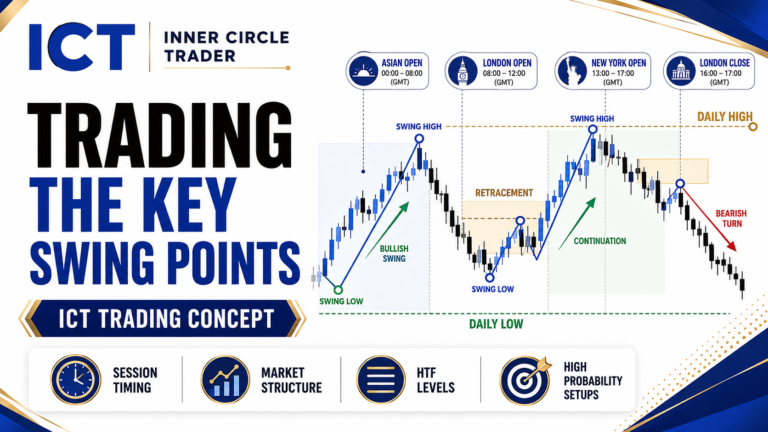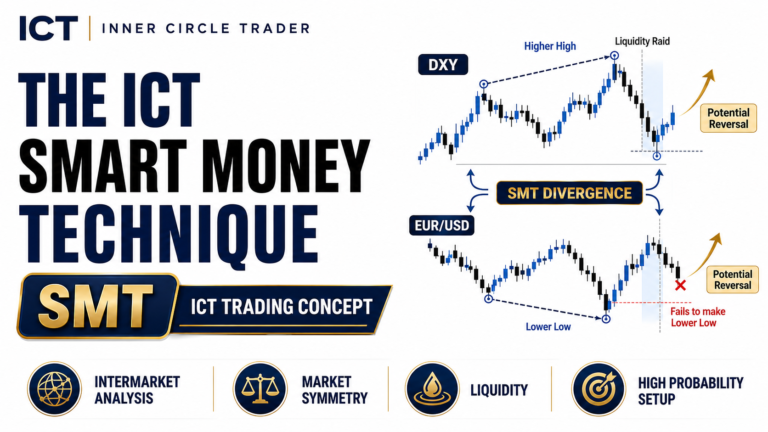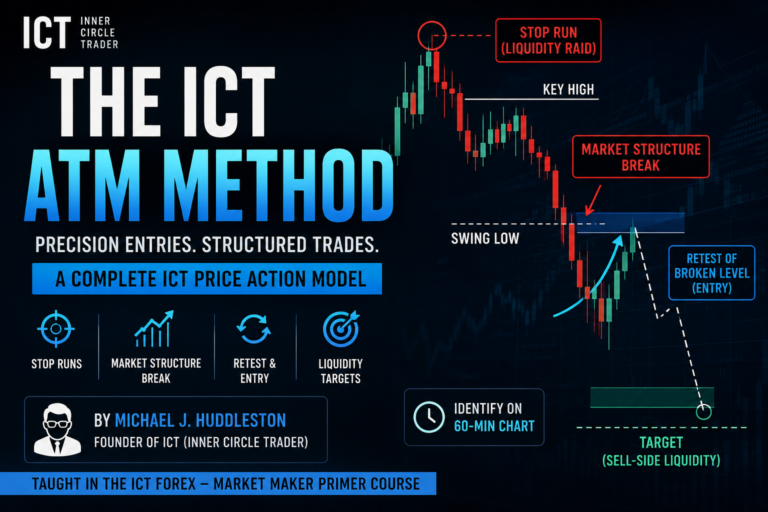
Understanding the Essentials To ICT Market Structure requires more than simply identifying bullish or bearish price swings. Traders must also understand when price is most likely to offer a specific type of opportunity. In the ICT Forex – Market Maker Primer Course, Michael J. Huddleston, founder of the ICT (Inner Circle Trader) concepts, explains The ICT Asian Killzone as a specific time window where certain currencies and Forex crosses can provide structured trading opportunities.
The Asian Killzone is generally less active than London or New York for many major currency pairs. However, this does not make the session unimportant.
For the correct currencies, the Asian session can offer:
- Optimal Trade Entry setups
- Short-term scalp opportunities
- Liquidity raids
- Previous-day range targets
- Strong versus weak currency opportunities
- Important consolidation ranges
As Michael J. Huddleston explains:
“This is the first of several specific times of the day where I like to look for setups.”
The key is knowing which markets to study and what price behavior to expect during this time.
What Is The ICT Asian Killzone?
The ICT Asian Killzone is a specific period associated with the opening phase of Asian market activity.
ICT focuses on the price action developing from the Asian open toward midnight New York time.
This period can produce active movement in currencies connected to markets that are operating during Asian hours.
The primary currencies to focus on are:
- Australian Dollar
- New Zealand Dollar
- Japanese Yen
These currencies are associated with markets that are active during this part of the global financial day.
Therefore, pairs containing AUD, NZD, and JPY may offer more meaningful price movement than currencies whose primary financial centers are inactive.
ICT Asian Killzone Time Window
The ICT Asian Killzone is based on New York time and focuses on the period immediately following the Asian Open.
Michael J. Huddleston explains that the exact opening reference can fluctuate because of daylight-saving time alignment. Depending on the time of year, the Asian Open may appear around 19:00 or 20:00 New York time.
Rather than relying on one exact clock minute, ICT uses an approximate two-hour window around the Asian Open.
Therefore, traders may generally study:
19:00–21:00 New York time
or, after the relevant time shift:
20:00–22:00 New York time
As Huddleston explains:
“For the most part I’m looking at a window of about two hours.”
It is important not to confuse the Asian Killzone entry window with the broader Asian Session study range.
For his analysis, Huddleston focuses on price action developing from the Asian Open until 00:00 New York time, even though actual Asian market activity continues beyond midnight.
The structure is:
Asian Open → Approximate two-hour setup window
↓
Asian session price development
↓
00:00 New York time → Key daily reference point
The Asian Open window is where traders can look for a move beginning or forming, including an ICT Optimal Trade Entry. The broader period from the Asian Open to midnight can also form a meaningful consolidation that provides clues about the remaining 24-hour trading day.
Why Time and Price Matter in the Asian Killzone
ICT does not teach traders to search for setups at random times.
The Asian Killzone combines:
Specific time of day
Specific currencies
Price structure
A valid trading setup
The fact that an Optimal Trade Entry appears on the chart does not automatically make it an Asian Killzone trade.
The trader should consider whether the currency itself is likely to be active during this period.
For example, an AUD, NZD, or JPY pair may naturally have greater potential for movement during Asian market hours.
This is an application of time and price theory.
The trader is looking for a price pattern at a time when the underlying market has a logical reason to become active.
Best Currencies for The ICT Asian Killzone
ICT specifically highlights three major currencies during the Asian trading period:
Australian Dollar
AUD pairs can become active because Australian financial markets are operating during this part of the trading cycle.
Examples include:
- AUD/USD
- AUD/JPY
- AUD/NZD
New Zealand Dollar
NZD pairs may also offer opportunities during Asian hours.
Examples include:
- NZD/USD
- NZD/JPY
- AUD/NZD
Japanese Yen
JPY pairs are particularly important because Japanese financial activity is associated with the Asian session.
Examples include:
- USD/JPY
- AUD/JPY
- NZD/JPY
- GBP/JPY
The currency pair should still be studied within the context of market structure and directional expectation.
The session alone is not a reason to enter.
The Asian Open Can Form an Optimal Trade Entry
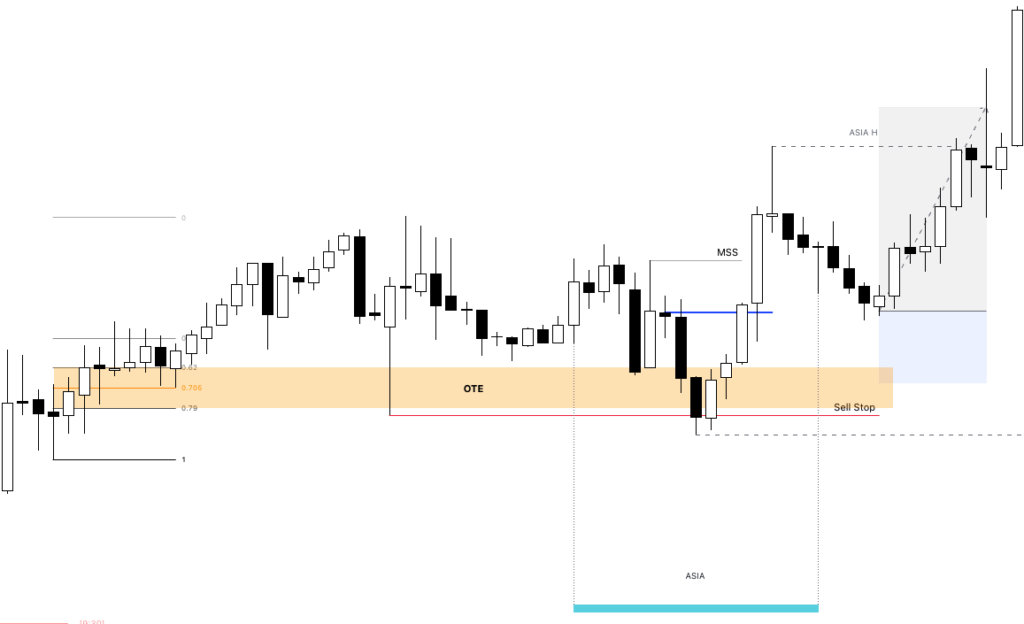
One setup discussed within The ICT Asian Killzone is the ICT Optimal Trade Entry or OTE.
The Asian open may occasionally produce a retracement into an OTE level before price expands toward a liquidity target.
Huddleston explains:
“The Asian open can sometimes set up an optimal trade entry pattern that can offer 15 to 20 pips for a scalp.”
A simple framework may look like:
Directional expectation identified
↓
Asian Killzone begins
↓
Price retraces
↓
ICT OTE develops
↓
Entry is considered
↓
Target liquidity or previous range levels
For a short-term scalp, approximately 15 to 20 pips may sometimes be available.
This is not a guaranteed range.
It represents the type of opportunity ICT studies during the Asian open.
Higher Timeframe Bias Is Helpful, but Not Always Required for the Entire Session Move
Higher timeframe direction can provide useful context.
For example:
Higher timeframe bullish → Prefer bullish Asian OTE
Higher timeframe bearish → Prefer bearish Asian OTE
However, ICT also explains that short-term retracements can provide setups during both bullish and bearish market conditions.
A broader bullish market may still experience a temporary bearish retracement.
A bearish market may experience a short-term rally.
The key is matching your trade objective to the structure you are trading.
A 15-to-20-pip Asian scalp does not necessarily need to capture the entire higher timeframe price movement.
This connects directly with the Essentials To ICT Market Structure.
You must understand which timeframe and price swing your trade is targeting.
Previous Day Highs and Lows Can Become Targets
Asian session price movement may reach into liquidity associated with the previous trading day.
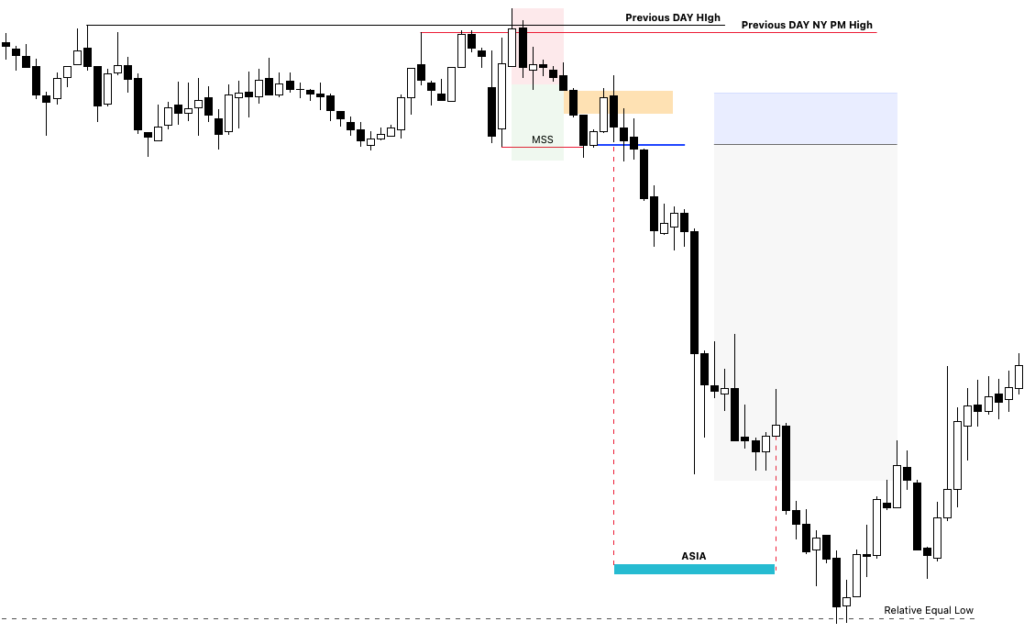
Important reference levels can include:
- Previous Day High
- Previous Day Low
- Equal Highs
- Equal Lows
- Previous session highs
- Previous session lows
For example, a bullish Asian session setup may target equal highs or the Previous Day High.
The process may be:
Bullish setup forms
↓
Price enters OTE
↓
Price expands higher
↓
Equal highs are reached
↓
Previous Day High becomes an extended target
Similarly, a bearish setup can reach below old lows or previous session lows.
The trader should understand where liquidity is resting before entering the trade.
What Happens When the Asian Session Does Not Move?
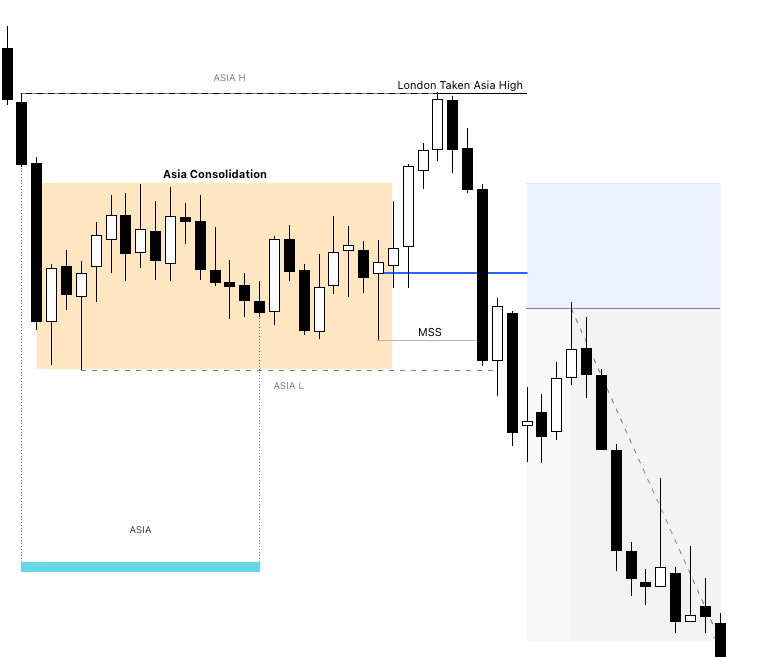
Not every Asian session provides an active trading setup.
This is extremely important.
Huddleston explains that when price is not willing to run during the Asian session, it may consolidate until midnight New York time.
In this situation:
Asian open
↓
No meaningful OTE expansion
↓
Price remains contained
↓
Asian consolidation forms
The trader should not force a trade simply because the market is inside an ICT Killzone.
The consolidation itself can provide valuable information.
Huddleston explains:
“The importance of the consolidation holds many clues to how the daily range will develop.”
Therefore, no Asian trade does not mean no useful information.
Sometimes the Asian range is more valuable as an analytical reference for later sessions.
EUR/USD During the Asian Session
EUR/USD is generally less active during Asian trading hours compared with the London or New York sessions.
There are exceptions.
Sometimes EUR/USD may create:
- A significant daily high
- A significant daily low
- The beginning of a large directional move
However, this is not its typical behavior during the Asian session.
When EUR/USD is not actively expanding, ICT expects it to potentially form a consolidation.
The trader can study:
Asian High
Asian Low
Asian Range
These levels may become significant as later sessions introduce more volatility.
GBP/USD During the Asian Session
GBP/USD behaves similarly.
The British Pound is primarily associated with London trading activity.
Therefore, GBP/USD may remain relatively quiet before European markets become active.
When GBP/USD is not making a meaningful high or low during Asian hours, the session may form a consolidation.
The sequence can be:
Asian Session → Consolidation
↓
Frankfurt activity
↓
London volatility
The trader should avoid forcing a trending expectation when the current session is clearly producing containment.
Why Forex Crosses Are Important During The ICT Asian Killzone
One of the most important lessons about The ICT Asian Killzone is the role of currency crosses.
A currency cross is a pair that does not contain the US Dollar.
Examples include:
- AUD/JPY
- NZD/JPY
- GBP/AUD
- EUR/AUD
Huddleston explains that crosses can be especially active during the Asian session.
Why?
Because the US Dollar may remain relatively quiet before midnight New York time.
This can sometimes create slower movement in USD-based pairs.
Crosses are not directly coupled with the Dollar Index in the same way.
Therefore, active currencies can move against one another with greater volatility.
The US Dollar Often Consolidates Before Midnight
ICT teaches that the US Dollar frequently remains relatively quiet during the Asian session before midnight New York time.
This can affect pairs such as:
- AUD/USD
- NZD/USD
- USD/JPY
These pairs can still move.
However, the behavior of the Dollar Index may sometimes create a drag on price movement.
Huddleston explains that cross pairs can provide more volatility because:
“It’s not being held back or limited by way of the dollar index.”
This is why traders interested specifically in Asian session opportunities should not limit themselves only to USD pairs.
Strong Currency vs Weak Currency in the Asian Session
A useful way to study Asian Killzone opportunities is to compare a relatively strong currency with a relatively weak currency.
Suppose AUD is showing strength.
JPY is showing weakness.
The trader may study AUD/JPY for a bullish setup.
The process becomes:
Identify active Asian currencies
↓
Determine relative strength and weakness
↓
Select the appropriate cross
↓
Study market structure
↓
Wait for an ICT entry model
A strong-versus-weak currency relationship may create a cleaner directional move.
Huddleston states:
“If you look for a strong currency against a weak currency during this time of day and get an optimal trade entry pattern, you’ll get many times a wonderful opportunity to trade.”
The OTE pattern is still important.
Relative strength alone is not an automatic entry signal.
Using Equal Lows During The ICT Asian Killzone
Equal highs and equal lows can help identify liquidity objectives during the Asian session.
Suppose equal lows formed during late New York trading.
Sell stops may be resting below those lows.
During Asian trading hours, price retraces into a bearish Optimal Trade Entry.
A potential sequence is:
Equal lows identified
↓
Sell-side liquidity rests below price
↓
Asian session begins
↓
Bearish OTE develops
↓
Price expands lower
↓
Sell stops below equal lows are raided
ICT may study an additional price movement below the obvious lows.
For example, price may trade approximately 20 pips below a session low or equal lows in certain setups.
The important principle is that the trader has a specific liquidity objective.
Symmetrical Price Movement During Asian Session Trades
ICT may also apply measured price movement or symmetrical price swings.
Suppose the trader identifies a clear price leg.
That range can be used as a projection for another leg.
For example:
First bearish leg = 20 pips
↓
Price retraces
↓
Bearish setup forms
↓
Project another 20-pip move
This projection may align with:
- Equal lows
- Sell-side liquidity
- Previous session lows
- Fibonacci extension levels
When multiple objectives point toward a similar price level, the trade narrative becomes clearer.
Asian Killzone Opportunities for Part-Time Traders
The Asian session may be particularly useful for traders who cannot monitor London or New York.
For someone working during North American daytime hours, the evening can provide a trading window.
Huddleston specifically discusses traders working a traditional job who may only have access to the market before midnight.
The trader could build a model specifically around:
Asian currencies
↓
Asian Killzone
↓
Currency crosses
↓
Strong versus weak selection
↓
OTE entry
This means a trader does not necessarily need to trade London or New York to study the ICT concepts.
A trading model can be built around one specific session.
How Many Pips Can the Asian Session Offer?
For an Asian Open scalp, ICT discusses approximately 15 to 20 pips as a potential opportunity.
Cross pairs may sometimes provide larger movements.
Huddleston explains that certain cross setups can occasionally offer approximately 20 to 50 pips.
However, he also makes it clear that this does not occur every day.
A trader may find these conditions a few times during the week.
The correct approach is:
Do not expect 50 pips every Asian session.
Do not trade simply because the Killzone is active.
Wait for structure.
Wait for the correct currency relationship.
Wait for the entry setup.
When to Avoid Trading The ICT Asian Killzone
Avoid forcing trades when:
- Price remains in tight consolidation
- No valid ICT entry model forms
- The selected currency is not naturally active
- The US Dollar is limiting movement in a USD pair
- There is no clear liquidity objective
- Strong and weak currency relationships are unclear
- Price has already completed the expected move
Remember:
Killzone ≠ Automatic trade
The Killzone tells you when to pay attention.
Market structure and the trading model tell you whether to act.
A Simple ICT Asian Killzone Trading Framework
A trader can use the following process:
Step 1: Identify the Asian trading window
Asian Open → Midnight New York time
↓
Step 2: Focus on active currencies
AUD → NZD → JPY
↓
Step 3: Check market structure
Bullish → Prefer buying opportunities
Bearish → Prefer selling opportunities
↓
Step 4: Compare currency strength
Strong currency vs weak currency
↓
Step 5: Select the appropriate pair or cross
AUD/JPY → NZD/JPY → GBP/AUD → Other relevant crosses
↓
Step 6: Mark liquidity
Equal highs → Equal lows → Previous Day High → Previous Day Low
↓
Step 7: Wait for an ICT entry model
OTE or another contextual setup
↓
Step 8: Define the price objective
15–20-pip scalp or relevant liquidity target
↓
Step 9: Manage the trade
Take profits according to the intended price swing
↓
Step 10: Do nothing when price consolidates
Use the Asian range as information for later analysis
Key Characteristics of The ICT Asian Killzone
The ICT Asian Killzone has several characteristics that make it different from the London and New York trading windows. The Asian session is generally quieter, but specific currencies and cross pairs can provide structured trading opportunities around the Asian Open.
1. AUD, NZD, and JPY Are the Primary Currencies to Study
The Australian Dollar, New Zealand Dollar, and Japanese Yen are particularly important during the Asian trading period.
Common pairs to study include:
- AUD/USD
- NZD/USD
- USD/JPY
- AUD/JPY
- NZD/JPY
- AUD/NZD
These currencies can become more active because their associated financial markets are operating during Asian hours.
Michael J. Huddleston explains that:
“The Australian dollar, the New Zealand dollar, Japanese yen pairs are ideal for this time of day.”
2. The Asian Open Focuses on a Small Two-Hour Opportunity Window
ICT focuses on price movement that originates or begins forming immediately after the Asian Open.
Huddleston uses approximately a two-hour window around the Asian Open because the exact time can shift relative to daylight-saving alignment.
The practical expectation is:
Asian Open
↓
Approximate two-hour setup window
↓
Look for an OTE or directional move
The exact opening reference may appear around 19:00 or 20:00 New York time, depending on the time shift.
3. The Asian Open Can Form ICT Optimal Trade Entry Setups
The Asian Open may create an ICT Optimal Trade Entry or OTE pattern.
Huddleston explains:
“The Asian open can sometimes set up an optimal trade entry pattern that can offer 15 to 20 pips for a scalp.”
A basic model may develop as:
Directional expectation
↓
Asian Open
↓
Price retracement
↓
OTE forms
↓
Entry opportunity
↓
Liquidity target
These setups may offer approximately 15 to 20 pips in certain short-term scalp scenarios.
4. The US Dollar Often Remains Relatively Quiet Before Midnight New York Time
One important characteristic of the Asian session is the behavior of the US Dollar.
Huddleston explains that the Dollar often consolidates until approximately 00:00 New York time.
This can sometimes reduce movement in Dollar-based pairs.
For example:
AUD/USD
NZD/USD
USD/JPY
These pairs can still move, but Dollar consolidation may create a drag on volatility.
This is one reason currency crosses become particularly important during the Asian session.
5. Forex Crosses Can Be More Active During the Asian Session
Pairs that are not directly coupled with the US Dollar may provide stronger price movement during Asian hours.
Examples include:
- AUD/JPY
- NZD/JPY
- AUD/NZD
- EUR/AUD
- GBP/AUD
Huddleston explains that crosses are among the most active pairs during this time of day.
The reason is that their movement may not be limited by a relatively quiet Dollar Index.
The basic idea is:
Active Asian currency
Another strong or weak currency
=
Potential cross-pair opportunity
6. Strong Currency vs Weak Currency Selection Is Important
The Asian Killzone can be studied by comparing relative currency strength.
For example:
AUD strong + JPY weak → Study AUD/JPY bullish setups
NZD weak + JPY strong → Study NZD/JPY bearish setups
Huddleston explains:
“If you look for a strong currency against a weak currency during this time of day and get an optimal trade entry pattern, you’ll get many times a wonderful opportunity to trade.”
Relative strength does not create an automatic entry.
The trader should still wait for an ICT trading setup such as an OTE.
7. Cross Pairs Can Sometimes Offer 20–50 Pip Moves
Although the Asian session is generally considered quieter, cross pairs can occasionally produce meaningful price movement.
Huddleston discusses the possibility of finding approximately 20 to 50 pips in certain cross-pair scenarios.
However, he makes it clear that this does not happen every day.
The trader may identify these opportunities a few times during the week.
Therefore:
Asian Killzone active ≠ Mandatory trade
The correct currency pair and price setup must still be present.
8. Asian Session Consolidation Is an Important Characteristic
When price is not willing to run during the Asian session, the market may consolidate.
This is particularly common in pairs such as:
- EUR/USD
- GBP/USD
These markets are generally less active during Asian trading hours.
The sequence may look like:
Asian Open
↓
No valid OTE expansion
↓
Price remains contained
↓
Asian consolidation forms
Huddleston explains:
“The importance of the consolidation holds many clues to how the daily range will develop.”
Therefore, a quiet Asian session can still provide important information for later trading sessions.
9. The Asian Open-to-Midnight Range Provides Important Price Information
ICT studies the broader period from the Asian Open until 00:00 New York time.
The actual Asian trading session continues beyond midnight, but Huddleston specifically focuses on this earlier range for his analysis.
The framework is:
Asian Open
↓
Potential early setup
↓
Asian price development or consolidation
↓
00:00 New York time
Midnight New York time is treated as an important reference point in the daily trading cycle.
The range formed before midnight may provide clues for the remaining 24-hour trading day.
10. Liquidity and Previous Range Levels Can Become Asian Session Targets
Asian session trades may reach toward obvious liquidity.
Potential targets include:
- Equal Highs
- Equal Lows
- Previous Day High
- Previous Day Low
- Previous session highs
- Previous session lows
For example:
Equal lows identified
↓
Sell-side liquidity rests below price
↓
Bearish OTE forms during Asian hours
↓
Price expands lower
↓
Sell stops are raided
Huddleston also discusses price moving approximately 20 pips beyond previous lows in one of his Asian session examples.
The trader should know the intended liquidity objective before entering.
Overall, the key characteristic of The ICT Asian Killzone is that it focuses on currencies naturally active during Asian market hours. AUD, NZD, and JPY pairs are important, while cross pairs may provide additional volatility when the US Dollar remains relatively quiet.
Traders should study the Asian Open for OTE setups, compare strong currencies with weak currencies, mark liquidity, and observe whether price expands or forms a meaningful consolidation before 00:00 New York time.
Final Thoughts on The ICT Asian Killzone
The Essentials To ICT Market Structure become more practical when traders combine market structure with the correct time of day. The ICT Asian Killzone, taught by Michael J. Huddleston, focuses on opportunities developing during Asian market activity and before midnight New York time.
AUD, NZD, and JPY are important currencies to study because their associated markets are active during this period.
USD pairs can provide setups, including short-term Optimal Trade Entry opportunities of approximately 15 to 20 pips. However, Forex crosses may sometimes offer greater volatility because they are less directly affected by a quiet US Dollar.
The main process is simple:
Know the session
↓
Study the active currencies
↓
Identify strong versus weak
↓
Understand market structure
↓
Mark liquidity
↓
Wait for the entry setup
When price does not move, do not force a trade. The Asian consolidation itself can provide important information about how the remaining daily range may develop.
The purpose of The ICT Asian Killzone is not to trade every evening.
It is to know when specific currencies are naturally active and patiently wait for time, price, market structure, and the ICT entry model to align.