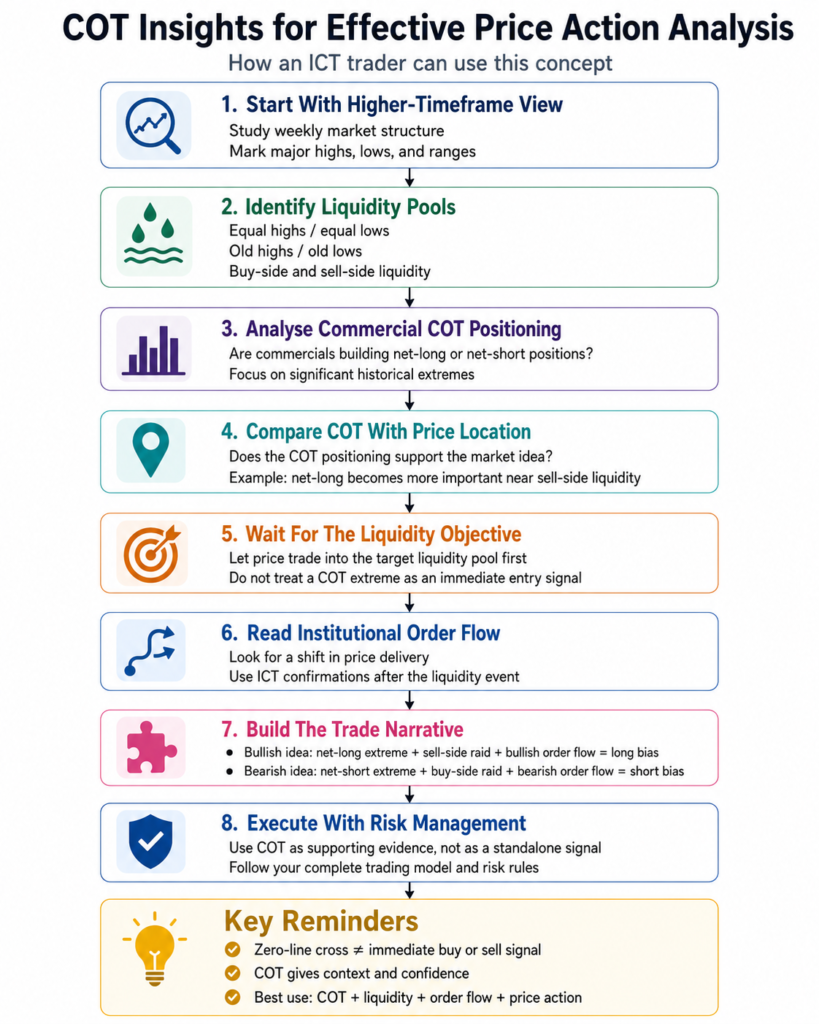
COT Insights For Effective Price Action Analysis is a higher-timeframe analytical approach used to understand how major market participants are positioned before combining that information with price action. Michael J. Huddleston, the founder of the ICT (Inner Circle Trader) concepts, teaches this approach in the ICT Forex – Market Maker Primer Course as a way to gain additional insight into institutional positioning and potential major price moves.
The Commitment of Traders report, commonly called the COT report, can reveal whether major commercial participants are building significant net-long or net-short positions.
However, ICT does not use COT positioning as a simple buy or sell indicator. The real value appears when COT insights are combined with liquidity, institutional order flow, and effective price action analysis.
What Is the Commitment of Traders Report?
The Commitment of Traders report provides information about the positioning of different groups participating in futures markets.
For ICT price action analysis, the major groups can broadly be viewed as:
- Commercials or commercial hedgers
- Large speculators
- Small speculators
Large speculators may include major funds and large private traders.
Small speculators generally represent smaller market participants and retail-style speculative positioning.
Commercials are the group that Michael J. Huddleston gives particular attention to. These participants may include major commercial hedgers and large institutional entities with significant exposure to the underlying market.
The purpose is not to blindly follow every movement in commercial positioning. Traders are looking for significant accumulation, distribution, and extreme net positioning.
Why Commercial Positioning Matters in ICT Analysis
Commercial participants often have considerably deeper capital and market exposure than individual traders.
When commercials build an unusually large position, it can provide insight into where a market may be approaching an important higher-timeframe condition.
Michael J. Huddleston explains:
“What I like to look for is a significant net long position to justify my long entry and or a heavy net short position to justify my short position.”
The key word is justify.
COT data is used to support an existing market idea. It should not replace price action analysis.
For example:
Bullish price narrative + Commercial net-long extreme + Liquidity event + Bullish institutional order flow → Stronger bullish confirmation
Similarly:
Bearish price narrative + Commercial net-short extreme + Liquidity event + Bearish institutional order flow → Stronger bearish confirmation
The COT report adds another layer of confidence to the analysis.
Understanding Net-Long and Net-Short Commercial Positions
When analysing a COT graph, traders can use the zero line as a basic reference point.
Commercial positioning above the zero line generally represents a net-long position.
Commercial positioning below the zero line generally represents a net-short position.
However, the location above or below zero is not enough.
The trader should focus on the magnitude of the positioning.
A small net-long position may carry limited significance.
A historically large net-long buildup may indicate aggressive commercial accumulation.
Likewise, an extreme net-short position may indicate substantial selling or hedging activity.
ICT traders are therefore interested in positioning extremes and maximum saturation of buyers or sellers.
COT Extremes and Major Market Turning Points
One of the most useful COT insights for effective price action analysis is identifying unusually large positioning extremes.
Commercial positioning can sometimes reach extreme net-long levels near major market lows or extreme net-short levels around major market highs.
Michael J. Huddleston states:
“When everything gets to an extreme, whether it be net long or net short, they usually make the high or low of the entire move.”
This does not mean that an extreme COT reading identifies the exact reversal candle.
Price may continue moving against the commercial position for some time.
Instead, the extreme warns the trader that the market may be entering an important higher-timeframe area where a major repricing event could eventually develop.
The trader must still read price.
Do Not Use the Zero-Line Cross as a Directional Signal
A common mistake is assuming that a move across the COT zero line immediately signals a trend reversal.
Suppose commercials previously held a strong net-long position and their positioning moves below zero.
This does not automatically mean price must immediately become bearish.
The change may simply show that commercials are transitioning from a large long position into a net-short position.
During this transition, price can continue rallying.
In fact, commercials may be increasing short exposure as the market moves higher.
Therefore:
Commercials move below zero ≠ Immediate sell signal
And:
Commercials move above zero ≠ Immediate buy signal
The trader must study what price is targeting and whether an important pool of liquidity still needs to be reached.
Combine COT Data With Liquidity
This is where ICT analysis becomes significantly different from simply reading COT extremes.
An extreme commercial position may appear before price completes its liquidity objective.
For example, commercials may become heavily net short while price is still trading beneath equal highs or an old significant high.
A trader who immediately sells because commercials are net short may enter too early.
Price can first continue higher and raid the buy-side liquidity above those highs.
The better sequence may be:
Commercial net-short extreme → Price continues higher → Buy-side liquidity is raided → Institutional bearish order flow develops → Short opportunity
For bullish conditions:
Commercial net-long extreme → Price continues lower → Sell-side liquidity is raided → Institutional bullish order flow develops → Long opportunity
COT positioning provides the background.
Liquidity helps identify where price may need to trade before the directional move begins.
The Importance of Institutional Order Flow
Michael J. Huddleston explains that simply observing net-long and net-short positioning was not enough. The missing element was understanding institutional order flow and where orders needed to be tagged first.
This is extremely important for ICT traders.
Commercials can hold an extreme position before the market reaches its final short-term objective.
Price may still need to:
- Run equal highs
- Run equal lows
- Trade above an old high
- Trade below an old low
- Reach a higher-timeframe PD Array
- Complete a liquidity raid
Once the liquidity objective is met, traders can look for a shift in price delivery that agrees with the larger COT insight.
This is why COT data and effective price action analysis should be blended together rather than studied separately.
Canadian Dollar COT Example
The Canadian dollar example demonstrates how commercial positioning can support a higher-timeframe price narrative.
When the Canadian dollar futures market moved below significant lows, commercial participants developed a substantial net-long position.
The market later delivered a strong move higher and reached above an old significant high.
The important relationship was:
Sell-side liquidity taken → Strong commercial net-long positioning → Bullish Canadian dollar futures expansion
However, Forex traders must understand the relationship between the currency futures contract and certain Forex pairs.
For USD/CAD:
Bullish Canadian dollar futures → Potentially bearish USD/CAD
Bearish Canadian dollar futures → Potentially bullish USD/CAD
This inverse relationship is important when transferring COT insights from Canadian dollar futures to the USD/CAD Forex pair.
Euro COT Example
The Euro example also highlights the importance of combining commercial positioning with liquidity.
When price moved below equal lows, commercials were accumulating net-long positions.
The market subsequently rallied toward and through higher liquidity objectives.
Later, when price reached around major highs and commercials had developed substantial net-short exposure, the market experienced liquidation.
The lesson is not simply:
Net long = Buy
or
Net short = Sell
The correct analysis is:
What are commercials doing?
Then ask:
Where is price relative to liquidity?
Then:
What does institutional order flow suggest?
The combination creates a more complete market narrative.
How to Use COT Insights For Effective Price Action Analysis
ICT traders can use a structured top-down process.
Step 1: Study the Higher-Timeframe Market
Start with weekly price action.
Identify the broader market structure, major highs, major lows, and significant trading ranges.
Step 2: Identify Major Liquidity Pools
Mark obvious:
- Equal highs
- Equal lows
- Old highs
- Old lows
- Major buy-side liquidity
- Major sell-side liquidity
Determine where price may be drawn next.
Step 3: Analyse Commercial COT Positioning
Study whether commercials are:
- Building net-long exposure
- Building net-short exposure
- Reducing an existing position
- Transitioning between positioning extremes
Give additional attention to historically significant extremes.
Step 4: Compare COT Positioning With Price
Ask whether commercial positioning supports the directional idea.
For example, significant commercial net-long positioning becomes more interesting when price is trading around or below major sell-side liquidity.
Step 5: Wait for the Liquidity Objective
Do not assume the COT extreme means an immediate reversal.
Allow price to trade into the anticipated liquidity pool or higher-timeframe area of interest.
Step 6: Read Institutional Order Flow
After the liquidity event, look for price action that supports the expected direction.
This may include a decisive change in price delivery or other ICT confirmation techniques used in the trader’s model.
Step 7: Use COT as Supporting Evidence
The COT report should strengthen the trade narrative.
Michael J. Huddleston describes the benefit as being able to:
“Glean insight and also build confidence behind our trades because we know that we have smart money entities behind us.”
The final trade decision should still be based on a complete trading model and disciplined risk management.
COT Data Is Not Limited to Forex
Although COT analysis is extremely useful for currency futures and related Forex analysis, its application is not restricted to currencies.
The concept can also be studied in:
- Stock index futures
- Bond markets
- Commodity futures
- Currency futures
The same broad principle applies: observe major commercial positioning and compare it with higher-timeframe price action, liquidity, and institutional order flow.
Common Mistakes When Using COT Data
The first mistake is treating every net-long position as bullish and every net-short position as bearish.
The second mistake is expecting an immediate price reversal when commercial positioning reaches an extreme.
Another mistake is ignoring liquidity.
Commercials may already be heavily net short while price still needs to run an important old high.
Similarly, strong net-long positioning can develop while price is still reaching for sell-side liquidity.
Finally, traders should avoid using COT information without understanding the futures contract they are analysing and its relationship with the Forex pair.
Final Thoughts
COT Insights For Effective Price Action Analysis can help ICT traders understand the positioning of major commercial market participants and identify conditions surrounding significant higher-timeframe price moves.
The real advantage does not come from blindly buying when commercials are net long or selling when they are net short.
Instead, ICT traders combine:
Commercial positioning → COT extremes → Higher-timeframe liquidity → Institutional order flow → Effective price action analysis
As Michael J. Huddleston teaches, the greatest benefit appears when COT information is blended with the ability to read price action and understand institutional order flow.
Used correctly, the Commitment of Traders report becomes a context and confirmation tool that can strengthen a trader’s directional narrative and improve confidence in high-quality ICT trade setups.