Implementing The Asian Range is a trading framework used to study the quiet price action that develops before the Frankfurt and London sessions and anticipate how liquidity around that range may influence the intraday move.
In the ICT Forex – Market Maker Primer Course, Michael J. Huddleston, founder of ICT (Inner Circle Trader), teaches his implementation of the Asian Range by combining it with daily bias, liquidity, the midnight opening price, ICT Killzones, and Power of Three.
It is important to understand that Huddleston does not claim to have created the Asian Range concept. He credits trader Chris Laurie for introducing the range to him, while the ICT approach focuses on integrating it into a broader institutional price-delivery framework.
The basic idea is:
Determine Daily Bias → Mark Asian Range → Anticipate Liquidity Raid → Wait for Price to Align With Bias → Trade the Intraday Expansion
As Huddleston explains:
“The range itself doesn’t produce anything magical.”
The real value of the Asian Range appears when the trader already has a logical expectation for where price is likely to move.
What Is the Asian Range?
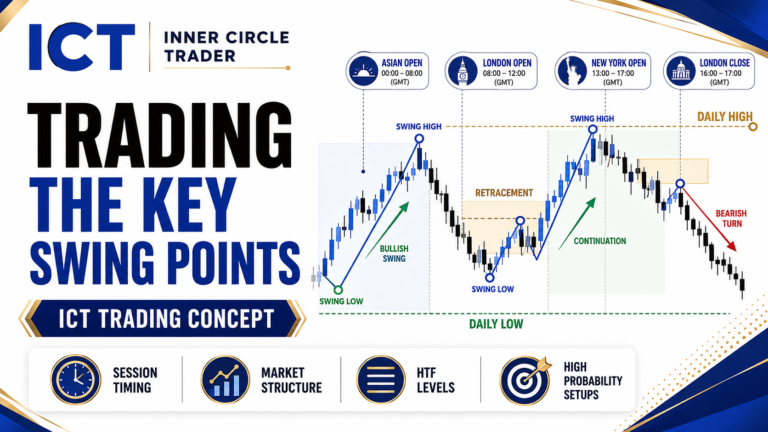
The Asian Range is the highest high and lowest low formed between:
19:00 New York Time → 00:00 New York Time
The range contains five hours of price action.
To mark it on the chart:
- Find 19:00 New York time.
- Find 00:00 New York time.
- Mark the highest high formed during this period.
- Mark the lowest low formed during this period.
- Extend the Asian Range high and low into future price action.
The result is a defined price range.
Asian Range High = Highest price between 19:00 and 00:00
Asian Range Low = Lowest price between 19:00 and 00:00
Huddleston teaches the range ending precisely at midnight New York time in his model.
Why Is the Asian Range Important?
Price action before Frankfurt and London can provide important context for the future intraday move.
The Asian session will often develop a period of relatively quiet or compressed trading.
Huddleston describes this as:
“There is a stillness in price many times right before the intraday directional impulse price swing.”
During this consolidation, liquidity can build on both sides of the range.
Above the Asian Range high, traders may have:
- Buy-stop breakout orders
- Protective buy stops from short positions
Below the Asian Range low, traders may have:
- Sell-stop breakout orders
- Protective sell stops from long positions
The market now has potential liquidity above and below the consolidation.
The important question is:
Which side of the Asian Range is likely to be attacked first, and where is price ultimately expected to expand?
This is why the trader needs a daily directional bias.
A Narrow Asian Range Can Precede Expansion
One of the important characteristics Huddleston highlights is a tight or narrow Asian consolidation.
When price remains compressed between 19:00 and midnight, liquidity may become concentrated above and below the range.
A simplified model is:
Narrow Asian Range → Liquidity Builds Above and Below → One Side Is Attacked → Traders Are Trapped → Price Expands in the Intended Direction
Huddleston explains:
“If we have a very narrow consolidated range between 7:00 p.m. and midnight… that sets up a huge possibility of the algorithm going into a trending model.”
The first breakout should therefore not automatically be treated as the true directional move.
It may be a manipulation designed to attack liquidity before the primary intraday expansion.
Daily Bias Comes Before the Asian Range
The most important rule when Implementing The Asian Range is to establish directional bias first.
The Asian Range is not a standalone buy or sell signal.
Huddleston repeatedly emphasizes the need for a market storyline.
A trader should first ask:
Is price expected to seek higher or lower prices today?
The trader can use higher timeframe analysis, liquidity objectives, market structure, or other ICT concepts to form this expectation.
The model then becomes:
Bullish Bias → Use Asian Range to Frame a Long Setup
Bearish Bias → Use Asian Range to Frame a Short Setup
Without a directional premise, a break above or below the Asian Range can easily be misinterpreted.
As Huddleston states:
“You have to have a bias on the day.”
Bullish Asian Range Model
When the daily bias is bullish, the trader expects price to ultimately seek higher levels.
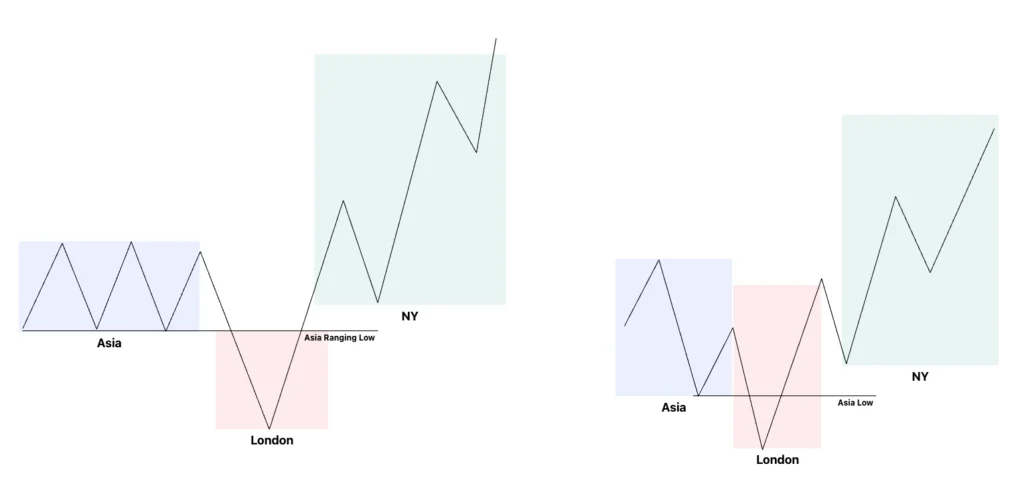
The preferred storyline is:
Bullish Bias → Asian Range Forms → Asian Range Low Is Raided → Sellers Enter → Price Reverses Higher → Bullish Expansion
The move below the Asian Range low can create sell-side liquidity.
Breakout traders may see price breaking the range and enter short.
At the same time, traders who bought earlier may have protective sell stops below the range.
When price breaks the Asian Range low:
- Long positions can be stopped out.
- Breakout sellers can enter short.
- Sell-side liquidity can be taken.
- Price can then reverse toward higher objectives.
The bearish-looking movement below the range may therefore form the manipulation phase of a bullish daily range.
The Bullish Asian Range Entry Model
Huddleston presents an important condition for the bullish setup:
The Asian Range low should be broken first.
After the low has been taken, the trader can watch for bullish price delivery.
One entry approach is:
Asian Range Low Taken → Price Reverses → Buy Stop Around Asian Range High → Bullish Expansion
Huddleston specifically warns against placing the bullish breakout entry before the Asian Range low has been attacked.
The order of events matters.
Wrong Sequence:
Asian Range Forms → Buy Break Above High Without Low Raid
Preferred ICT Sequence:
Bullish Bias → Asian Range Low Taken → Price Reverses → Asian Range High Breaks → Long Opportunity
The raid below the range provides context for the later bullish move.
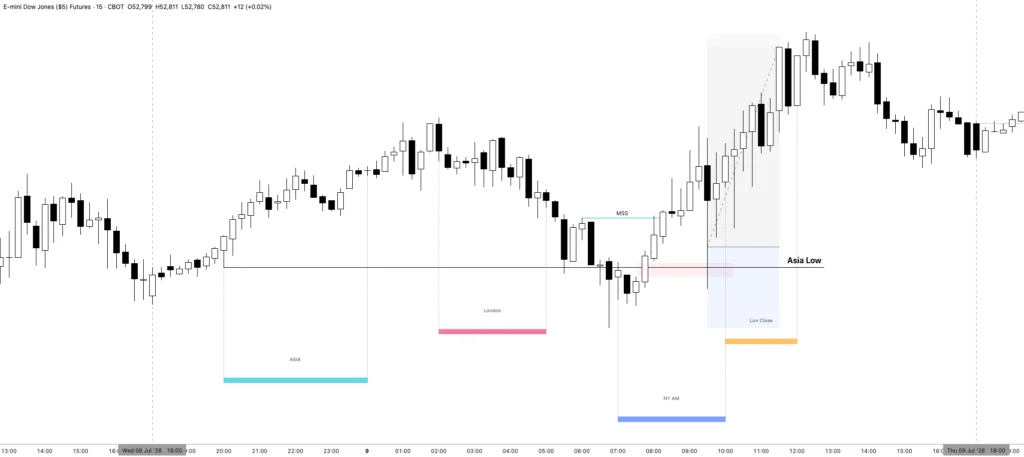
Asian Range High as Bullish Support
After price has attacked the Asian Range low and expanded above the Asian Range high, the range high can become an important reference point.
The trader may extend the Asian Range high forward and wait for price to return to it.
The model becomes:
Asian Low Raid → Bullish Expansion Above Asian High → Retracement to Asian Range High → Look for Buying
Huddleston teaches that, in bullish conditions, a return to the Asian Range high can be studied for institutional buying.
This is particularly interesting when the retracement occurs during the New York Open Killzone and overlaps with another ICT concept, such as an Optimal Trade Entry.
The complete bullish model is:
Bullish HTF Bias → Narrow Asian Range → Sell-Side Raid → Bullish Displacement → Asian High Broken → Retest Asian High → Long Setup → Buy-Side Liquidity
Bearish Asian Range Model
The bearish model is the opposite.
When the trader has a bearish daily bias, price is expected to ultimately seek lower prices.
The preferred storyline is:
Bearish Bias → Asian Range Forms → Asian Range High Is Raided → Buyers Enter → Price Reverses Lower → Bearish Expansion
Price may move above the Asian Range high after midnight.
Breakout traders can interpret this movement as bullish strength and enter long positions.
Short traders may also have protective buy stops above the range.
The move above the Asian Range high can therefore:
- Trigger breakout buying.
- Stop out existing shorts.
- Attack buy-side liquidity.
- Create buying interest at higher prices.
In a bearish market environment, this can create the manipulation required before price expands lower.
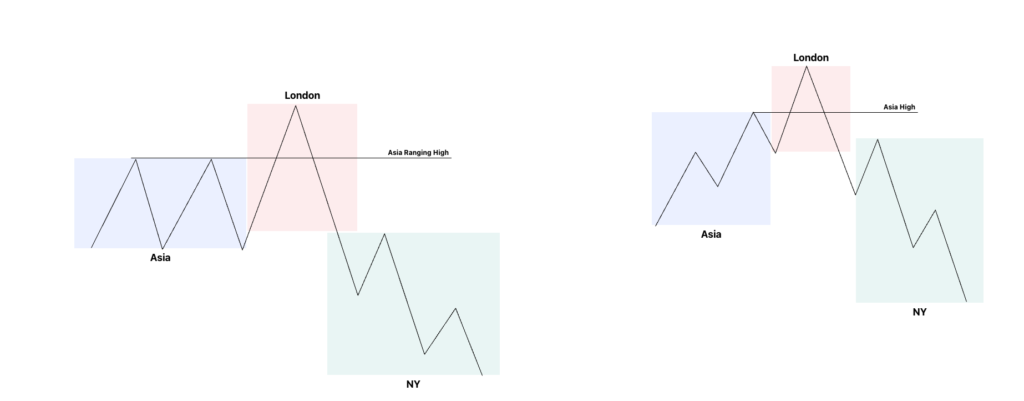
Selling Above the Asian Range High
When the daily bias is bearish, Huddleston focuses primarily on a movement above the Asian Range high.
The model is:
Bearish Bias → Asian Range High Raided → Look for Selling → Bearish Expansion
The key is not to become bullish simply because price temporarily moves above the Asian Range.
The trader should remain focused on the higher timeframe directional premise.
The raid above the high may be the exact movement required to place breakout buyers on the wrong side of the market.
The simplified bearish PO3 relationship is:
Accumulation in Asian Range → Manipulation Above Asian High → Distribution Lower
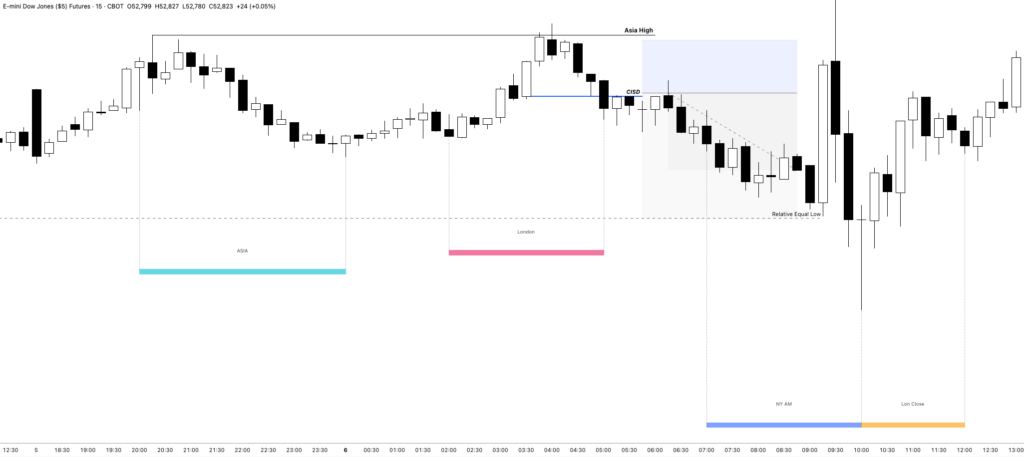
The Bearish Confirmation Entry
A trader who does not want to sell directly during the Asian Range high raid can wait for confirmation.
Huddleston teaches another Asian Range entry model:
Asian Range Low Breaks → Price Retraces to Asian Range Low → Asian Range Low Acts as Resistance → Sell
The sequence is:
Bearish Bias → Asian High Raid → Bearish Move → Asian Low Breaks → Retest Asian Low → Short Entry
Once the Asian Range low has been broken, a return to that level may offer a bearish entry.
This is particularly significant when the retest occurs during an ICT Killzone.
The full bearish framework becomes:
Bearish HTF Bias → Narrow Asian Range → Buy-Side Raid → Bearish Displacement → Asian Low Broken → Retest Asian Low → Short Setup → Sell-Side Liquidity
Asian Range and the Midnight Opening Price
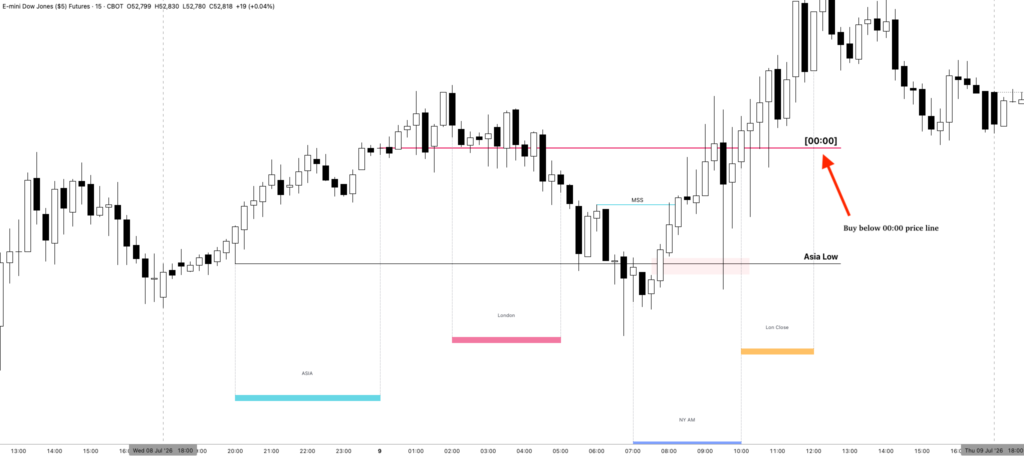
The 00:00 New York opening price is another important reference in this framework.
In bullish conditions, ICT generally wants to see price move below the midnight opening price before expanding higher.
Bullish Bias → Trade Below Midnight Open → Seek Liquidity → Expand Higher
In bearish conditions, price may trade above the midnight opening price before expanding lower.
Bearish Bias → Trade Above Midnight Open → Seek Liquidity → Expand Lower
The midnight opening price and Asian Range can work together to provide intraday context.
For example, in a bullish environment:
Price Below Midnight Open + Asian Range Low Raid = Area to Study for Bullish Opportunity
In a bearish environment:
Price Above Midnight Open + Asian Range High Raid = Area to Study for Bearish Opportunity
Again, these conditions require an existing directional bias.
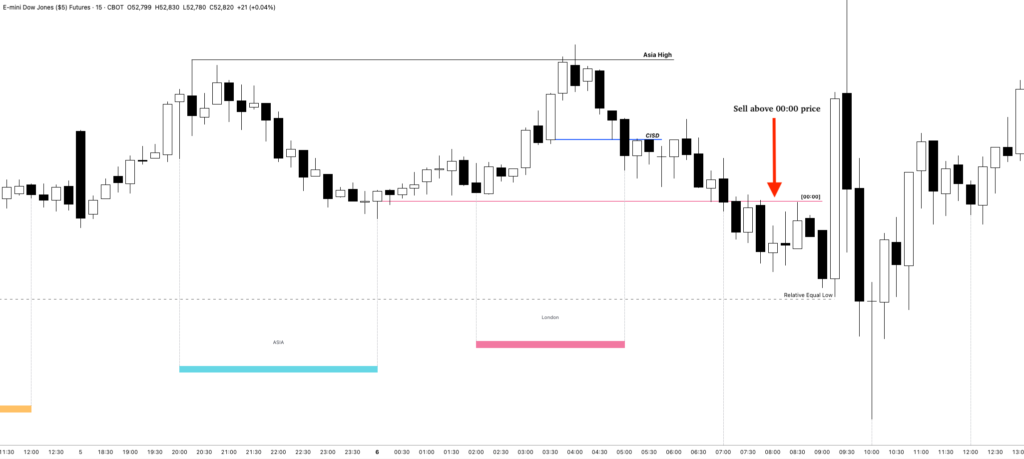
Combining the Asian Range With ICT Killzones
The Asian Range becomes more useful when its price levels interact with important trading periods.
Huddleston specifically discusses the London Open and New York Open Killzones.
For example, a bearish confirmation setup may appear as:
Bearish Bias → Asian High Raid → Asian Low Breaks → London or New York Killzone Retest of Asian Low → Sell
A bullish model may look like:
Bullish Bias → Asian Low Raid → Asian High Breaks → New York Killzone Retest of Asian High → Buy
Time of day provides additional context.
The trader is not simply trading a horizontal line.
The trader is combining:
Daily Bias + Asian Range + Liquidity + Time of Day + ICT Entry Model
This is what creates the complete setup.
Asian Range and ICT Power of Three
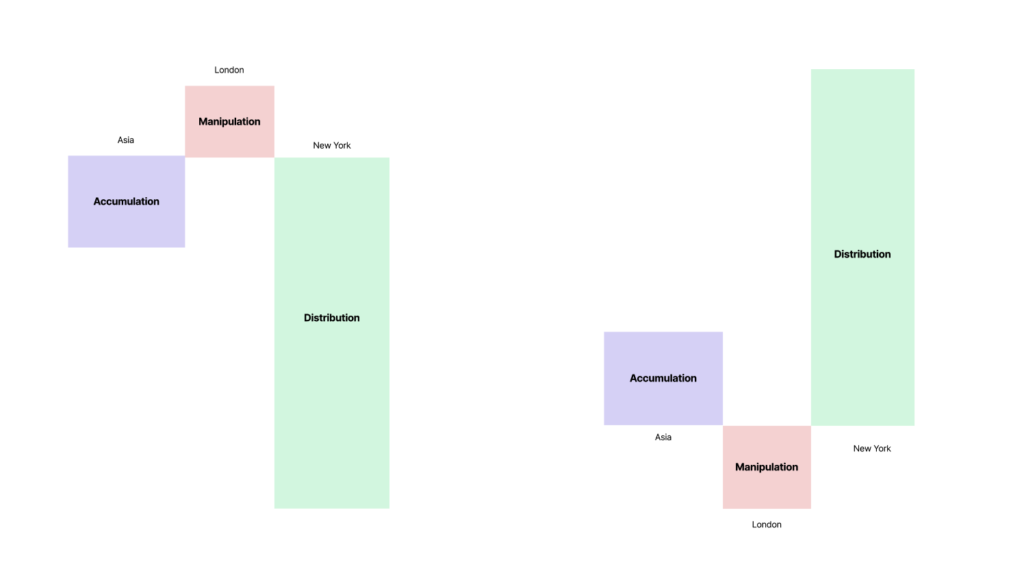
The Asian Range fits naturally into the ICT Power of Three (PO3) framework.
Power of Three consists of:
Accumulation → Manipulation → Distribution
The Asian Range can represent accumulation.
The liquidity raid can represent manipulation.
The directional intraday move can represent distribution.
Bullish PO3 With Asian Range
Asian Consolidation → Raid Below Asian Low → Bullish Expansion
Bearish PO3 With Asian Range
Asian Consolidation → Raid Above Asian High → Bearish Expansion
The trader should therefore be careful about chasing the first move outside a narrow Asian Range.
That first breakout may be the manipulation rather than the true distribution.
How to Implement the Asian Range During Trading
A practical process is:
Step 1: Determine the Daily Bias
Decide whether higher or lower prices are more likely.
Step 2: Mark 19:00 New York Time
This begins the Asian Range used in this ICT model.
Step 3: Mark 00:00 New York Time
The Asian Range ends at midnight.
Step 4: Mark the Asian Range High and Low
Extend both levels forward on the chart.
Step 5: Evaluate the Width of the Range
A tight consolidation may offer a clearer liquidity framework.
Step 6: Wait for the Liquidity Raid
Bullish bias → Focus on the Asian Range low being attacked.
Bearish bias → Focus on the Asian Range high being attacked.
Step 7: Look for Directional Price Delivery
Do not trade simply because a range boundary was touched.
Look for price to begin aligning with the daily bias.
Step 8: Use the Asian Range for Entry Confirmation
Bullish → Asian low raid, high break, and possible Asian high retest.
Bearish → Asian high raid, low break, and possible Asian low retest.
Step 9: Give More Attention to ICT Killzones
London and New York session timing may improve the context of the setup.
Step 10: Target the Expected Liquidity Objective
The daily bias should already provide an idea of where price is likely to seek liquidity.
Common Mistakes When Implementing The Asian Range
Trading the Asian Range Without Daily Bias
This is the biggest mistake.
The same Asian Range can produce a bullish or bearish opportunity depending on the broader market storyline.
Buying Every Asian Range High Break
In a bearish environment, the move above the Asian Range high may be manipulation.
Selling Every Asian Range Low Break
In bullish conditions, the decline below the Asian Range low may create the liquidity raid before expansion higher.
Ignoring the Order of Events
For the bullish breakout model taught by Huddleston, the Asian Range low should be attacked before using the break of the Asian Range high as an entry idea.
Ignoring Killzones
A retest during an important ICT trading period can provide better context than a random retest at any time of day.
Treating the Asian Range as a Magical Indicator
The range itself does not forecast direction.
Daily bias and liquidity context remain essential.
Final Thoughts
Implementing The Asian Range gives ICT (Inner Circle Trader) traders a structured way to study the quiet price action formed before Frankfurt and London and anticipate how liquidity around that consolidation may influence the intraday range.
In Huddleston’s implementation, the Asian Range is defined from:
19:00 → 00:00 New York Time
The trader marks the highest high and lowest low formed during this period and extends both levels forward.
The core framework is:
Daily Bias → Asian Range → Liquidity Raid → Directional Confirmation → Intraday Expansion
For bullish conditions:
Asian Range Low Raid → Bullish Delivery → Asian High Break or Retest → Higher Prices
For bearish conditions:
Asian Range High Raid → Bearish Delivery → Asian Low Break or Retest → Lower Prices
The Asian Range becomes most useful when combined with daily bias, the midnight opening price, ICT Power of Three, liquidity, and ICT Killzones.
Rather than blindly trading every breakout, the goal is to build a storyline and anticipate which side of the Asian Range may be used as manipulation before the true intraday expansion begins.