Essentials To ICT Daytrading is a foundational trading framework taught by Michael J. Huddleston, the founder of ICT (Inner Circle Trader), in the 2017 ICT Private Mentorship Core Content Month 08.
The ICT day trading model focuses on capturing a meaningful portion of the price movement that develops within a single trading day. However, it is not based on entering trades randomly throughout the session.
The model combines:
- Higher-timeframe institutional order flow
- Daily and weekly directional bias
- Premium and discount PD Arrays
- Average Daily Range
- Day-of-week tendencies
- Specific trading-session windows
- Liquidity objectives
The purpose is to identify when price is most likely to expand, in which direction it may move, and where that movement may terminate.
What Is ICT Day Trading?
ICT day trading is the practice of entering and closing a position within the same trading day while attempting to capture a portion of the daily range.
The objective is not to trade every price movement or hold a position from the exact daily low to the exact daily high.
Instead, the trader attempts to capture the most probable portion of the daily expansion.
Michael J. Huddleston explains:
“Day trading does not mean or equate to everyday trading.”
This is one of the most important principles of the model. Not every trading day will offer favourable conditions. Some days may produce clean expansion, while others may remain inside consolidation or create unpredictable volatility.
A disciplined ICT day trader waits for the correct combination of time, price, liquidity and directional bias.
The Daily Range Is the Main Objective
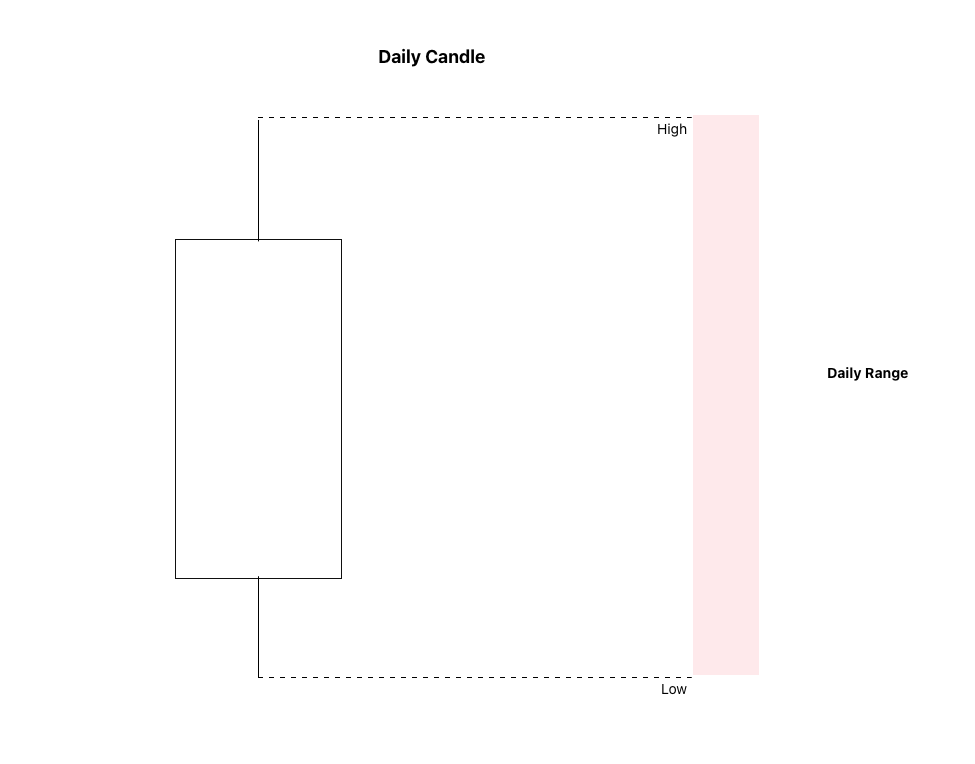
The daily candle contains the complete price range formed during a 24-hour trading period.
ICT day traders attempt to capture approximately 65% to 70% of the daily range when ideal conditions are present.
This does not mean the trader must capture the entire move. Capturing 30 or 40 pips from a 100-pip daily range can still be considered a successful trade.
The trader should not become disappointed simply because price continued moving after the position was closed.
Consistently capturing a reasonable portion of the daily range is more important than attempting to catch the exact high and low.
Using the Average Daily Range
The Average Daily Range, commonly called ADR, helps estimate how far price may move during the current trading day.
In this ICT model, the expected daily range can be estimated by calculating the average range of the previous five trading days.
For example, when the previous five days have produced an average range of 100 pips, the trader may initially expect the current day to produce a similar range.
However, ADR is not a fixed limit.
Certain market conditions, economic events or strong institutional repricing may cause price to deliver:
- A normal daily range
- More than the average daily range
- Twice the average daily range
- An unusually large volatility expansion
ADR should therefore be treated as a reference for expected movement, not as a guaranteed maximum.
Higher-Timeframe Direction Comes First
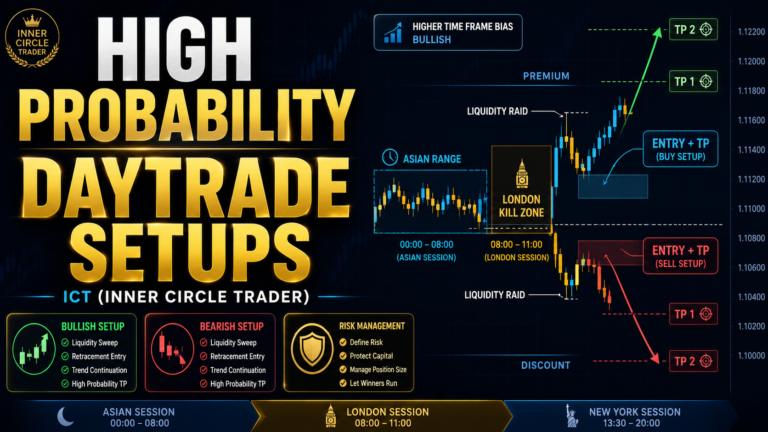
Directional bias frames a large portion of ICT day trading setups.
Before entering an intraday trade, the trader should determine whether institutional order flow is likely to support higher or lower prices.
The ideal condition is to trade in the direction of the expected weekly candle.
A bullish weekly expectation encourages the trader to look for intraday buying opportunities.
A bearish weekly expectation encourages the trader to look for intraday selling opportunities.
The more higher-timeframe factors that support the intraday idea, the stronger the potential setup becomes.
Important higher-timeframe references include:
- Monthly PD Arrays
- Weekly PD Arrays
- Daily PD Arrays
- Previous liquidity pools
- Old highs and lows
- Fair Value Gaps
- Order Blocks
- Rejection Blocks
- Liquidity voids
- Premium and discount zones
For day trading, the daily chart will often provide enough information to locate the most relevant premium or discount PD Array.
Understanding PD Arrays in Day Trading
PD Arrays are essential components of Essentials To ICT Daytrading.
Price is expected to move from one institutional price reference to another. It may move from a premium PD Array toward a discount PD Array or from a discount PD Array toward a premium PD Array.
Examples of premium PD Arrays include:
- Bearish Order Blocks
- Bearish Fair Value Gaps
- Rejection Blocks
- Old highs
- Equal highs
- Buy-side liquidity
Examples of discount PD Arrays include:
- Bullish Order Blocks
- Bullish Fair Value Gaps
- Old lows
- Equal lows
- Sell-side liquidity
- Discount liquidity voids
A trader should study the previous 20, 40 and 60 trading days to identify the most logical higher-timeframe PD Arrays.
These levels help determine:
- Where price may be drawn
- Where price may reverse
- Whether the market is trading in premium or discount
- Whether the current directional bias remains valid
The weekly opening price alone is not enough. It must always be interpreted together with the PD Array Matrix.

The Weekly Opening Price Framework
The opening price of the new trading week can be used as a directional filter.
For brokers that display Sunday trading data, the Sunday opening price is used. When Sunday data is not available, the Monday opening price can be used instead.
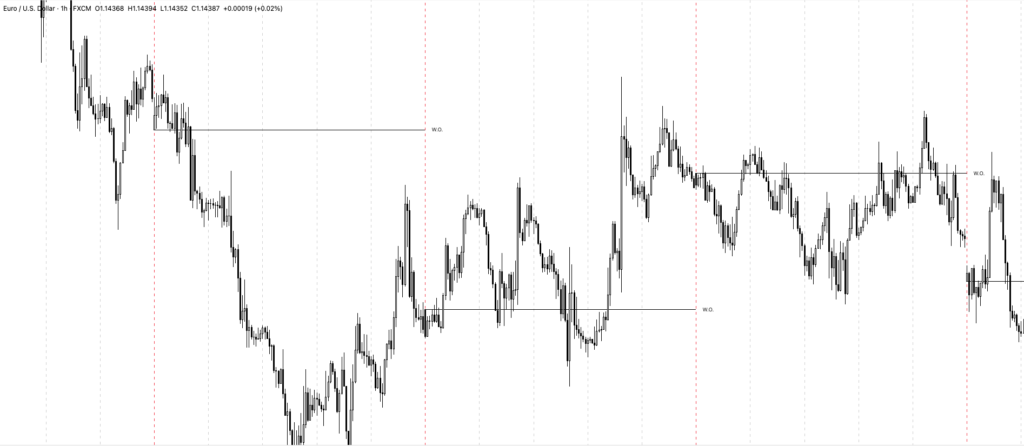
The weekly opening price can be extended across the hourly chart until Thursday.
Bullish weekly conditions
During a bullish weekly expectation, price may initially trade below the weekly opening price and move into a higher-timeframe discount PD Array.
This movement below the opening can act as an early-week manipulation.
Once price returns above the weekly opening price, the trader may look for buying opportunities during London and New York.
As long as price remains above the weekly opening and has not reached a major premium PD Array, the trader can continue favouring bullish day trades.
Bearish weekly conditions
During a bearish weekly expectation, price may initially trade above the weekly opening price and move into a higher-timeframe premium PD Array.
This may create an early-week Judas Swing before price expands lower.
Once price moves below the weekly opening, the trader may look for selling opportunities during London and New York.
As long as price remains below the weekly opening and has not reached a major discount PD Array, bearish day trades may remain favourable.
When the Weekly Opening Filter Becomes Invalid
The weekly opening price should never be used mechanically.
Suppose price is trading below the weekly opening during a bearish week. That does not mean the trader should continue selling after price reaches a major daily discount PD Array.
A bullish Order Block, Fair Value Gap or old low may prevent further downside movement and produce an intraweek reversal.
The same principle applies during bullish conditions. Once price reaches a major daily premium PD Array, the trader should stop automatically looking for long positions.
The higher-timeframe PD Array takes priority over the weekly opening filter.
This is why day trading requires a combination of several concepts rather than one isolated rule.
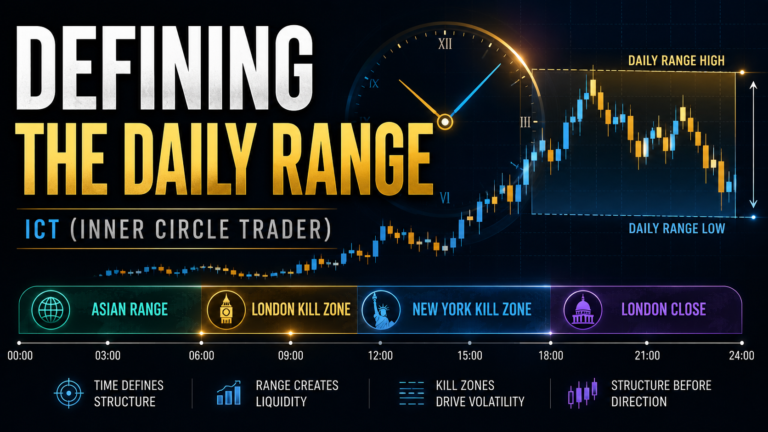
Best Time Windows for ICT Day Trading
Time of day is one of the most important elements of the ICT day trading model.
Michael J. Huddleston states:
“The flexibility resides in time, not price.”
The trader may allow some flexibility regarding when a setup develops within a designated time window. However, the trader should remain strict regarding the price level where the setup is expected to form.
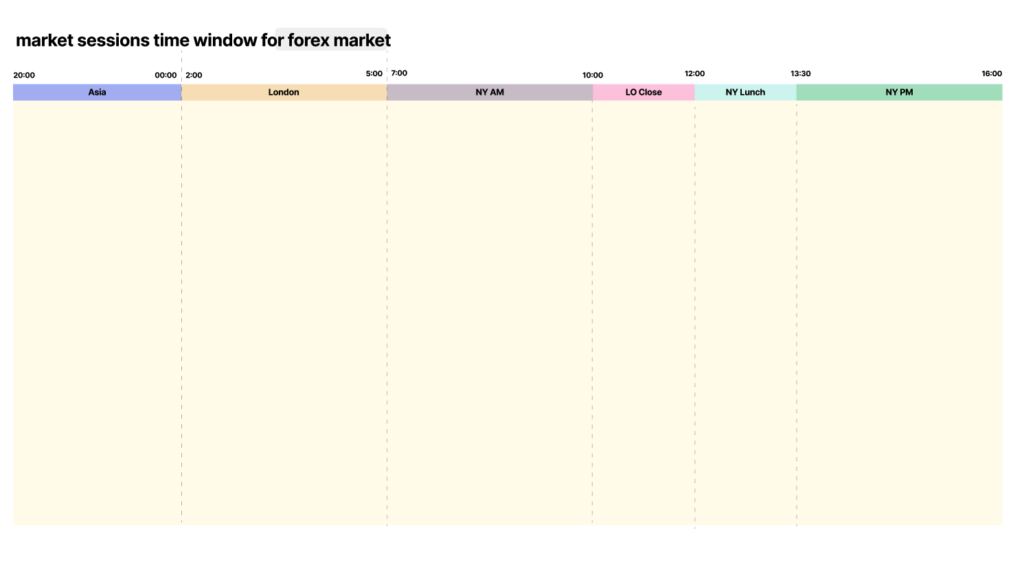
London Open Kill Zone
The London Open Kill Zone generally extends from 01:00 to 05:00 New York time.
The most common period for the daily high or daily low to form is approximately:
- 02:00 to 04:00 New York time
This window may shift slightly because of daylight-saving changes or scheduled economic releases.
The trader looks for manipulation around a relevant PD Array followed by displacement in the expected daily direction.
London Lunch
London lunch generally occurs between:
- 05:00 and 07:00 New York time
During this period, price may:
- Consolidate
- Retrace
- Produce a London lunch reversal
- Prepare for the New York session
- Continue the London move at a slower pace
A trader holding a profitable London position should consider securing partial profits before or around 05:00 New York time.
New York Session
The New York session is often easier for developing day traders because London has already created a visible range.
The trader can study the movement from the London low to the London high and wait for a New York retracement into a lower-timeframe PD Array.
The New York setup may then continue in the direction established by London.
However, the trader should avoid the New York session when London has already completed approximately 80% or more of the five-day Average Daily Range.
When most of the daily range has already been delivered, New York may produce:
- Consolidation
- A deep retracement
- A reversal
- Poor reward-to-risk conditions
Asian Session Open
The Asian session begins around 20:00 New York time.
This session usually creates smaller price movements, but it can occasionally form an important daily high or low in:
- Japanese yen pairs
- Australian dollar pairs
- New Zealand dollar pairs
These markets may form their significant session extreme during Asia rather than London.
London Close and Late New York
London close can be used to manage existing day trades and secure profits.
It may also produce an intraday reversal when price reaches a logical support or resistance PD Array.
In some cases, a London close reversal can provide an entry for a longer-term swing trade, position trade or One Shot One Kill setup.
Most day trading activity should normally be completed by New York noon.
The 15:00 New York time bond market close often confirms that the meaningful daily range has already been delivered.
Day-of-Week Tendencies
The day of the week can significantly influence the probability of an ICT day trading setup.
Sunday
Sunday usually offers a very small range and is generally avoided for day trading.
Its opening price can still be useful for framing the weekly range.
Monday
Monday commonly creates a smaller daily range.
However, when Monday produces a large directional expansion into a major daily PD Array, it can form the high or low of the week.
A large bullish Monday that reaches a premium PD Array may establish the weekly high.
A large bearish Monday that reaches a discount PD Array may establish the weekly low.
Tuesday
Tuesday is generally one of the strongest days for day trading.
During bullish weekly conditions, Tuesday frequently forms the low of the week during London.
During bearish weekly conditions, Tuesday frequently forms the high of the week during London.
This makes Tuesday particularly useful for aligning a day trade with the expected weekly expansion.
Wednesday
Wednesday is often an ideal day because the trader has Monday and Tuesday price action available for analysis.
By Wednesday, the market may provide clearer information about:
- Weekly directional bias
- Early-week manipulation
- Unresolved liquidity
- Premium and discount PD Arrays
- The likely weekly objective
Wednesday can also produce the low or high of the week when price reaches an important daily PD Array.
Thursday
Thursday can provide strong day trading opportunities, but it must be approached carefully.
The weekly range is often completed or capped during Thursday’s New York session.
Thursday can also produce an intraweek reversal.
When price crosses back through the weekly opening on Thursday, it may indicate that the weekly direction is changing.
Friday
Friday often produces a smaller range when the weekly objective has already been reached.
When the expected premium or discount PD Array has not been reached by Thursday, Friday may produce an unexpected expansion toward that objective.
The trader should therefore evaluate what the weekly range has already accomplished before deciding whether to trade Friday.
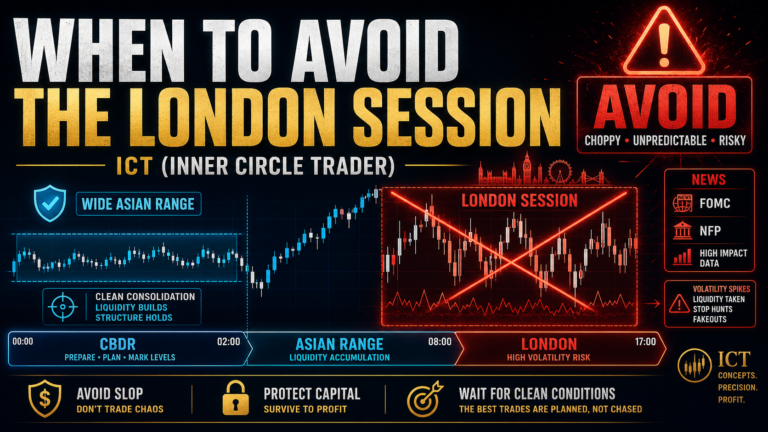
Economic Calendar Restrictions
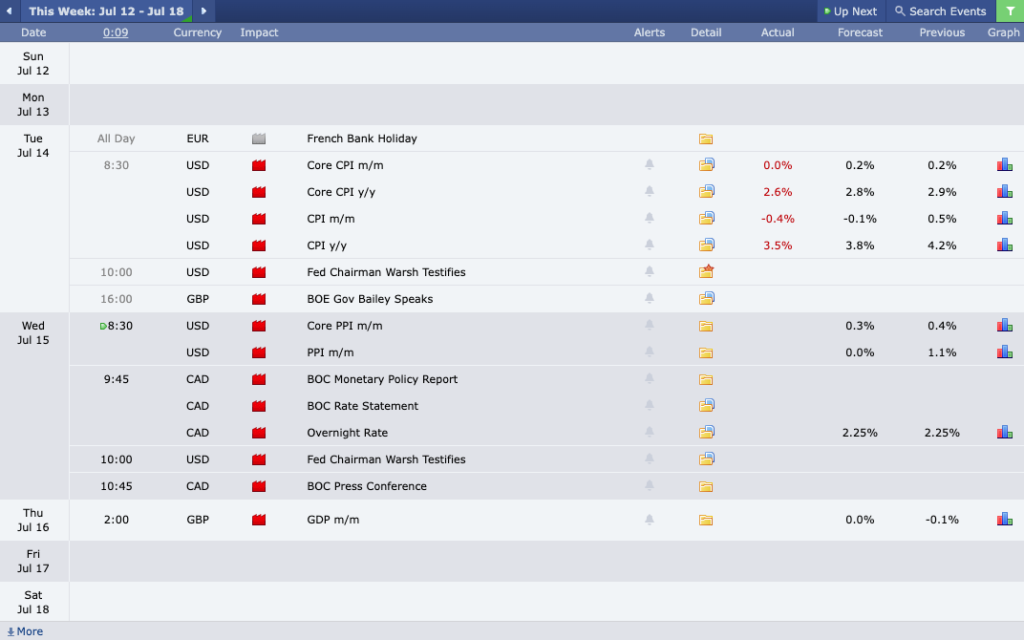
Certain high-impact economic events can make ICT day trading less reliable.
Michael J. Huddleston identifies the following as potential no-trade days:
- FOMC interest-rate announcement days
- Non-Farm Payroll days
Price may still move toward an identifiable liquidity objective, but the volatility surrounding these events can reduce the reliability of normal day trading setups.
These sessions can be studied on a demo account, but remaining on the sidelines can protect the trader from unnecessary risk.
Do Not Overtrade the Daily Range
Day trading does not mean taking many trades during the same 24-hour period.
There may be approximately two primary setup opportunities during a trading day, commonly associated with London and New York.
However, the trader is not required to trade both sessions.
One high-quality setup can be enough.
Michael J. Huddleston explains:
“You only need really one good day of the week.”
A trader who captures 30 to 50 pips from one carefully selected opportunity may not need to trade again during that week.
Taking more trades does not automatically produce more profit. It often increases exposure, emotional pressure and the probability of making an avoidable mistake.
Using Day Trade Entries for Larger Setups
ICT day trading entries are not limited to positions that must be closed on the same day.
The precision of an intraday entry can also be used to enter:
- Swing trades
- Position trades
- One Shot One Kill setups
- Higher-timeframe directional trades
Because lower-timeframe entries can offer smaller stop losses, they may significantly improve the reward-to-risk ratio of a higher-timeframe setup.
A trade that would normally offer a three-to-one or five-to-one reward-to-risk ratio may provide a much larger return when entered through a precise intraday PD Array.
Essentials To ICT Daytrading Checklist
Before entering a day trade, review the following conditions.
Higher-timeframe analysis
- Identify the likely weekly candle direction.
- Mark daily premium and discount PD Arrays.
- Review the previous 20, 40 and 60 trading days.
- Determine the most logical liquidity objective.
Weekly framework
- Mark the Sunday or Monday opening price.
- Determine whether price is above or below the weekly opening.
- Check whether price has reached a contrarian higher-timeframe PD Array.
- Be alert for a possible Thursday reversal.
Daily conditions
- Calculate the five-day Average Daily Range.
- Determine how much of the expected range has already been delivered.
- Review the day-of-week tendency.
- Check the economic calendar.
Entry conditions
- Wait for London or New York.
- Demand that price reaches a specific PD Array.
- Look for manipulation and displacement.
- Enter in the direction of institutional order flow.
- Avoid chasing price after the expansion has already occurred.
Trade management
- Target the next opposing PD Array or liquidity pool.
- Consider taking partial profits before London lunch.
- Avoid expecting the exact daily high or low.
- Do not take multiple unnecessary trades.
- Move to the sidelines when the daily range is mostly complete.
Final Thoughts
Essentials To ICT Daytrading provides a structured method for understanding how the daily range develops inside the weekly range.
The model does not rely on indicators, random chart patterns or continuous trading.
It combines:
- Weekly directional bias
- Daily PD Arrays
- The weekly opening price
- Average Daily Range
- Day-of-week tendencies
- Time-of-day windows
- Institutional liquidity objectives
The weekly opening price can help create directional focus, but it must always be interpreted together with higher-timeframe premium and discount PD Arrays.
The most effective ICT day trader is not the trader who takes the most positions. It is the trader who waits for price to reach the correct location, during the correct time window, in alignment with the expected weekly direction.
When those conditions are present, one carefully selected day trade may provide all the opportunity a trader needs for the week.