Intraday Profiles are structured patterns that help traders anticipate how price may behave during a specific trading day. Instead of reacting to every short-term price movement, traders use these profiles to determine when the market is likely to create manipulation, establish the London session high or low, and begin its directional expansion.
This concept was developed and taught by Michael J. Huddleston, the founder of ICT (Inner Circle Trader), in the 2017 ICT Private Mentorship Core Content Month 08.
The Intraday Profiles framework focuses mainly on four London session conditions:
- London normal protraction sell profile
- London delayed protraction sell profile
- London normal protraction buy profile
- London delayed protraction buy profile
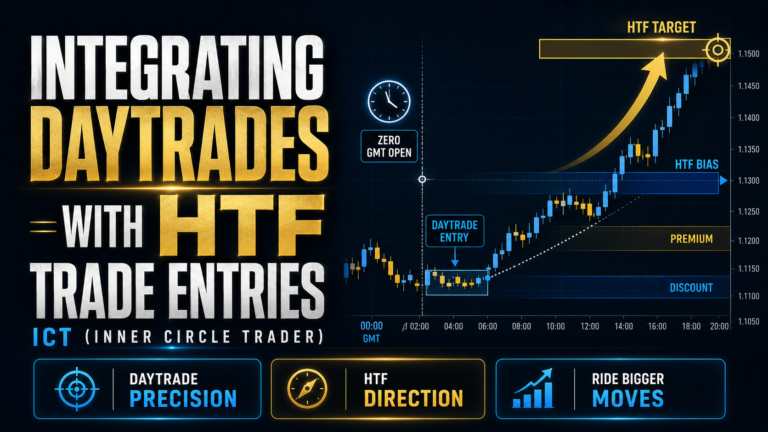
The trader’s higher-timeframe directional bias determines whether the buy or sell profile should be used.
What Are Intraday Profiles?
Intraday Profiles describe the expected sequence of price delivery within a trading day.
A typical profile may include:
- Consolidation before London
- A Judas Swing or protraction
- Formation of the London high or low
- Directional expansion
- Formation of the opposite daily extreme
- Consolidation near the end of the trading day
These profiles are not entry signals by themselves. They provide a framework for understanding when and where a trading opportunity may develop.
The profile must always be combined with:
- Daily directional bias
- Higher-timeframe PD Arrays
- Liquidity objectives
- Central Bank Dealers Range
- Asian session range
- New York time-based confirmation
Establish the Daily Directional Bias First
Before looking for any Intraday Profile, determine whether the market is likely to move higher or lower.
For a bullish profile, price should be:
- Respecting higher-timeframe support
- Trading from a discount area
- Seeking buy-side liquidity
- Showing the potential for a bullish daily close
For a bearish profile, price should be:
- Respecting higher-timeframe resistance
- Trading from a premium area
- Seeking sell-side liquidity
- Showing the potential for a bearish daily close
The profile should never be selected without a clear directional premise.
As Michael J. Huddleston explains:
“I should already have just two conditions set for London. Either I’m going to be bullish or bearish.”
Once the directional bias is established, the trader only needs to identify whether the protraction will occur normally after midnight or be delayed until approximately 02:00 New York time.
Important Time Windows
The Intraday Profiles model is based on New York time.
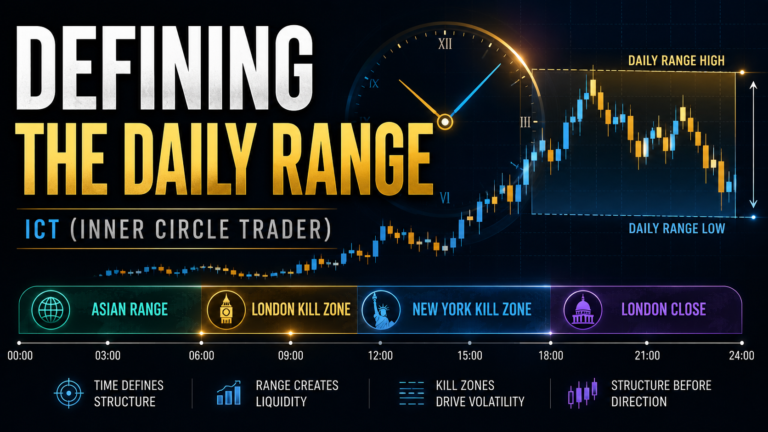
Important periods include:
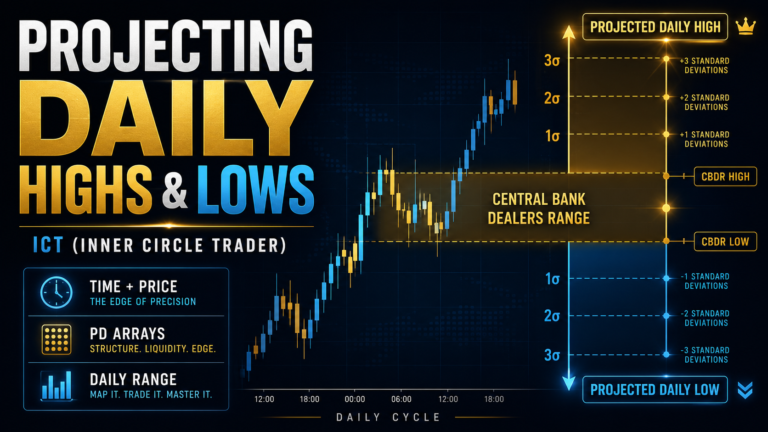
- 14:00 to 20:00: Central Bank Dealers Range
- 20:00 to 00:00: Asian session range
- 00:00 to 02:00: Normal protraction window
- 02:00 to 03:00: Delayed protraction window
- 02:00 to 04:00: Common London high or low formation period
The most important reference points are 00:00 and 02:00 New York time.

Central Bank Dealers Range
The Central Bank Dealers Range is generally measured between 14:00 and 20:00 New York time.
For the highest-probability normal protraction profile, this range should ideally be:
- Less than 40 pips
- Relatively consolidated
- Free from excessive late New York volatility
A narrow Central Bank Dealers Range suggests that price is allowing orders and liquidity to accumulate before the London session.
When the range is significantly greater than 40 pips, the normal protraction profile becomes less reliable.
However, a wider range does not automatically eliminate the trading day. A tightly consolidated Asian range may still create conditions for a valid setup.
Asian Session Range
The Asian range is generally measured between:
- 20:00 and 00:00 New York time
For a classic normal protraction profile, the Asian session should ideally remain within:
- 20 to 30 pips
A narrow Asian range allows liquidity to form above and below the market.
These liquidity pools may later be used during the London Judas Swing before price expands in the expected daily direction.
If both the Central Bank Dealers Range and Asian range are excessively wide, the London session may not offer a clean normal protraction setup.
London Normal Protraction Sell Profile
The London normal protraction sell profile is used when the higher-timeframe directional bias is bearish.
The trader expects price to rally after midnight, form the London high, and then expand lower.
Main Conditions
- Daily directional bias is bearish
- Price is expected to seek sell-side liquidity
- Central Bank Dealers Range is ideally below 40 pips
- Asian range is ideally between 20 and 30 pips
- Price begins moving higher after 00:00
- The rally continues toward 02:00
- Price reaches a premium PD Array
- The London high commonly forms between 02:00 and 04:00
The rally after midnight is the protraction or Judas Swing.
It may sweep:
- Asian session highs
- Short-term buy-side liquidity
- Equal highs
- Previous intraday highs
- Stops resting above the market
The rally should ideally reach approximately one to two standard deviations of the Central Bank Dealers Range.
After reaching a premium area, price may reverse and expand lower toward sell-side liquidity.
London Normal Protraction Buy Profile
The London normal protraction buy profile is the opposite of the sell model.
It is used when the higher-timeframe directional bias is bullish.
The trader expects price to decline after midnight, form the London low, and then expand higher.
Main Conditions
- Daily directional bias is bullish
- Price is expected to seek buy-side liquidity
- Central Bank Dealers Range is ideally below 40 pips
- Asian range is ideally between 20 and 30 pips
- Price begins moving lower after 00:00
- The decline continues toward 02:00
- Price reaches a discount PD Array
- The London low commonly forms near the London open
The move below the Asian range may sweep:
- Asian session lows
- Equal lows
- Short-term sell-side liquidity
- Stops resting below the market
- Previous intraday lows
Once price reaches a discount PD Array, the trader may look for confirmation that the bullish expansion is beginning.
What Is Delayed Protraction?
A delayed protraction occurs when price does not create the expected Judas Swing immediately after midnight.
For example, on a bearish day, price may start moving lower after 00:00 instead of rallying first.
On a bullish day, price may begin moving higher after midnight instead of declining first.
When the normal protraction is absent, the trader should not immediately abandon the daily bias.
Instead, the focus shifts to 02:00 New York time.
Michael J. Huddleston states:
“If that does not happen, then you draw a vertical line at 2 a.m. Then you expect it there.”
The trader waits for a retracement beginning at or shortly after 02:00.
London Delayed Protraction Sell Profile
The London delayed protraction sell profile is used when the daily bias is bearish, but price does not rally immediately after midnight.
Price may instead:
- Drift lower
- Create progressively lower prices
- Fail to establish a clear London sell entry
- Remain below the earlier session high
At or shortly after 02:00, price should retrace higher.
The trader then looks for price to reach an intraday premium PD Array, such as:
- Bearish order block
- Fair value gap
- Liquidity void
- Optimal Trade Entry area
- Previous short-term high
- Premium portion of the intraday range
The retracement should generally remain below the existing daily high.
Once price reaches the premium area and shows bearish confirmation, the trader may look for continuation toward sell-side liquidity.
London Delayed Protraction Buy Profile
The London delayed protraction buy profile is used when the daily bias is bullish, but price does not decline immediately after midnight.
Price may initially:
- Trade higher
- Fail to provide a discount entry
- Move away from the Asian session low
- Appear to begin the bullish expansion without the trader
At or shortly after 02:00, price may retrace lower.
The trader looks for this retracement to reach an intraday discount PD Array, such as:
- Bullish order block
- Fair value gap
- Liquidity void
- Optimal Trade Entry area
- Previous short-term low
- Discount portion of the intraday range
Once price reaches the discount area and shows bullish confirmation, the trader may look for continuation toward buy-side liquidity.
Normal Protraction vs Delayed Protraction
The main difference is the timing of the Judas Swing.
Normal Protraction
- Begins shortly after 00:00
- Continues toward 02:00
- Creates the London manipulation early
- Commonly forms the London high or low
Delayed Protraction
- Normal midnight manipulation does not appear
- Price moves initially in the expected daily direction
- A retracement begins near or shortly after 02:00
- The retracement provides the London entry
The trader should not force both profiles onto the same trading day.
First, look for the normal profile. If it does not appear, shift attention to the delayed profile.
Premium and Discount PD Arrays
Intraday Profiles require price to reach a logical area before an entry is considered.
For bearish setups, focus on premium PD Arrays:
- Bearish order blocks
- Bearish fair value gaps
- Premium Optimal Trade Entry zones
- Liquidity voids above price
- Previous highs
- Buy-side liquidity
For bullish setups, focus on discount PD Arrays:
- Bullish order blocks
- Bullish fair value gaps
- Discount Optimal Trade Entry zones
- Liquidity voids below price
- Previous lows
- Sell-side liquidity
Time identifies when the setup may form. PD Arrays identify where the setup may form.
Practical Sell-Side Process
For a bearish trading day:
- Confirm bearish daily bias.
- Mark the Central Bank Dealers Range.
- Mark the Asian session range.
- Check whether price rallies after 00:00.
- If price rallies, look for the normal sell profile.
- Wait for price to reach premium.
- Look for bearish confirmation.
- Target sell-side liquidity.
- If no midnight rally occurs, mark 02:00.
- Wait for a delayed retracement into premium.
- Look for bearish continuation.
Practical Buy-Side Process
For a bullish trading day:
- Confirm bullish daily bias.
- Mark the Central Bank Dealers Range.
- Mark the Asian session range.
- Check whether price declines after 00:00.
- If price declines, look for the normal buy profile.
- Wait for price to reach discount.
- Look for bullish confirmation.
- Target buy-side liquidity.
- If no midnight decline occurs, mark 02:00.
- Wait for a delayed retracement into discount.
- Look for bullish continuation.
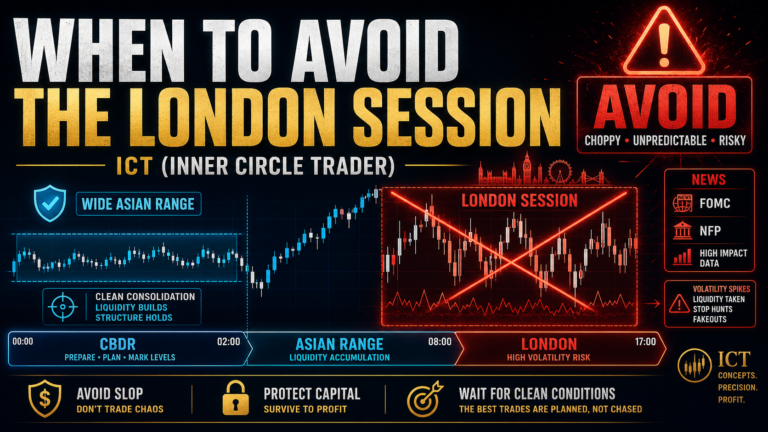
When to Avoid the Setup
Avoid forcing an Intraday Profile when:
- Higher-timeframe bias is unclear
- Price is not moving toward a logical liquidity objective
- Central Bank Dealers Range is excessively volatile
- Asian range is unusually wide
- Price does not create either normal or delayed protraction
- The retracement does not reach a valid PD Array
- Price has already completed most of its expected daily range
- The expected London high or low has already formed without an entry
- The setup appears outside the relevant time window
Some trading days will expand without providing a valid entry.
Missing such a move is better than chasing price outside the profile.
Common Mistakes
Trading Without Daily Bias
The trader sees a London manipulation but does not know whether price should ultimately move higher or lower.
Forcing the Midnight Setup
Price does not create the expected move after 00:00, but the trader enters anyway instead of waiting for delayed protraction.
Ignoring 02:00
The trader assumes the setup is missed when price may still produce a delayed Judas Swing.
Entering Without a PD Array
Time alone is not enough. Price must also reach a meaningful premium or discount location.
Chasing Expansion
The trader enters after the directional move has already started and the logical entry area has been left behind.
Intraday Profiles Checklist
Before trading the London session, confirm:
- Is the daily bias bullish or bearish?
- What liquidity is price expected to seek?
- Is the Central Bank Dealers Range narrow or extended?
- Is the Asian range consolidated?
- Did price begin the expected protraction after 00:00?
- Is price approaching premium or discount?
- Did the Judas Swing form near the expected time?
- If the normal profile failed, is delayed protraction forming near 02:00?
- Is there a valid PD Array for entry?
- Is there a clear liquidity target?
- Has price already completed the expected daily expansion?
Final Thoughts
The ICT Intraday Profiles model reduces the London session to a small number of repeatable conditions.
The trader first determines whether the day is expected to be bullish or bearish. The next step is to observe price after midnight.
If the expected counter-directional move begins between 00:00 and 02:00 New York time, the trader may be observing a normal protraction profile.
If that movement does not appear, attention shifts to 02:00 to 03:00 New York time, where a delayed protraction may provide the entry.
The objective is not to predict every intraday movement. It is to wait for a recognizable time-and-price pattern that aligns with higher-timeframe direction, premium or discount, and a clear liquidity objective.
As Michael J. Huddleston summarizes:
“You’re only looking for two things: a movement after 12 a.m. going into 2 o’clock in the morning, and if that doesn’t happen, then you expect it at 2 a.m.”
By applying these filters, ICT traders can approach the London session with a defined model rather than reacting emotionally to every price fluctuation.