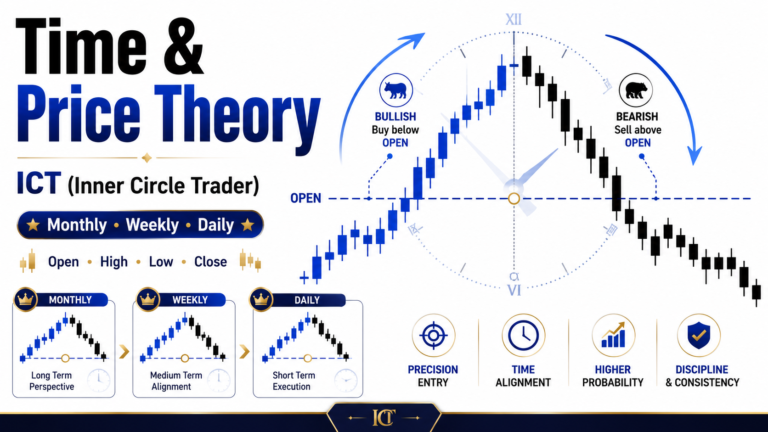
The ICT London Killzone is one of the most important trading windows in the 24-hour Forex market. In the ICT Forex – Market Maker Primer Course, Michael J. Huddleston, founder of The ICT (Inner Circle Trader) concepts, teaches traders to combine time, higher timeframe direction, liquidity, and price delivery during the London Open.
London can produce some of the most significant directional price movement of the trading day. It may also establish the High of the Day or Low of the Day, creating an opportunity for traders to participate in a large portion of the daily range.
As Michael J. Huddleston explains:
“The key times to monitor are 2:00 a.m. to 5:00 a.m. New York time.”
The ICT London Killzone is therefore not simply about trading when London is active. It is a defined time window where traders study price for a specific setup aligned with the expected daily direction.
What Is The ICT London Killzone?
The ICT London Killzone is a specific period around the London Open when Forex markets can experience increased volatility and directional price expansion.
The ideal ICT London Killzone taught in the Market Maker Primer Course is:
02:00–05:00 New York time
This is the primary three-hour window traders should monitor.
The basic concept is:
Higher timeframe bias
↓
London Killzone begins
↓
Price creates a manipulation or retracement
↓
Potential High or Low of the Day forms
↓
Directional range expansion begins
The trader is not trying to trade every price movement during these three hours.
The objective is to identify whether price is forming a high-probability entry that aligns with the expected daily direction.
ICT London Killzone Time Window
The exact London Killzone time window is:
02:00–05:00 New York time
Huddleston specifically advises traders to use New York time as the primary reference.
Do not rely entirely on your broker’s chart time.
Instead:
Check New York time
↓
Wait until 02:00 New York time
↓
Compare it with your broker platform
↓
Mark 02:00–05:00 on your chart
This prevents confusion caused by different broker server times or the trader’s local timezone.
As Huddleston explains:
“The ideal ICT London kill zone for your learning is going to be 2 a.m. to 5 a.m. and it’s relative to New York time.”
The Killzone and the complete London trading session should not be treated as the same thing.
The broader London session continues beyond 05:00.
However, the specific ICT London Killzone discussed in this lesson is 02:00–05:00 New York time.
Why Is the London Killzone Important?
London can produce a major portion of the directional movement seen during the 24-hour trading day.
The session can offer:
- Increased volatility
- Large directional price expansion
- High or Low of the Day formation
- ICT Optimal Trade Entry setups
- Liquidity raids
- 25-to-50-pip scalp opportunities
- Low-risk entry points in trending markets
Huddleston describes the London Open as one of his preferred trading periods because of the magnitude of price movement available.
He explains:
“The most bang for your buck is going to be in the London open.”
However, greater volatility also creates greater risk.
A trader must understand higher timeframe direction before attempting to trade London price movement.
Best Forex Pairs for The ICT London Killzone
Michael J. Huddleston specifically highlights the Euro and British Pound pairs for the London Open.
The primary pairs are:
EUR/USD
GBP/USD
These currencies are closely associated with European and London financial activity.
Therefore, they can become particularly active during the London Killzone.
Other instruments may also exhibit similar time-based price behavior, but for Forex traders learning this model, EUR/USD and GBP/USD are important markets to study.
A beginner should avoid monitoring too many pairs.
Instead:
Select EUR/USD or GBP/USD
↓
Mark 02:00–05:00 New York time
↓
Study several months of historical price action
↓
Observe where the daily high and low form
The objective is to build recognition through repeated chart study.
London Frequently Creates the High or Low of the Day
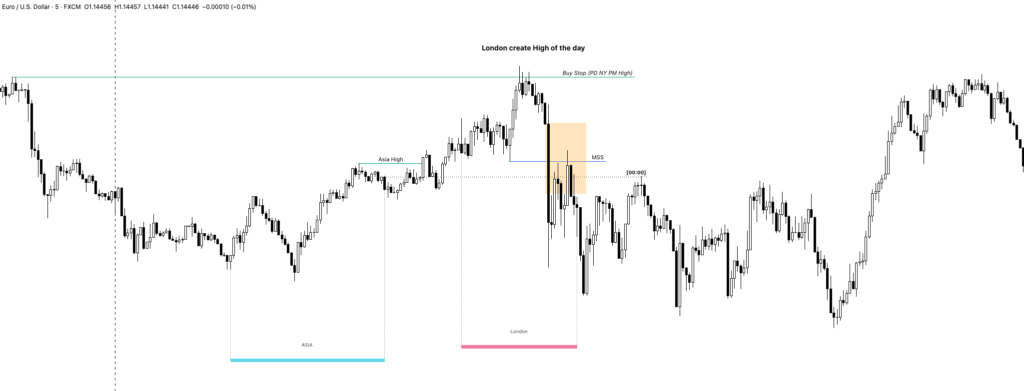
One of the most important characteristics of The ICT London Killzone is its tendency to form an important daily extreme.
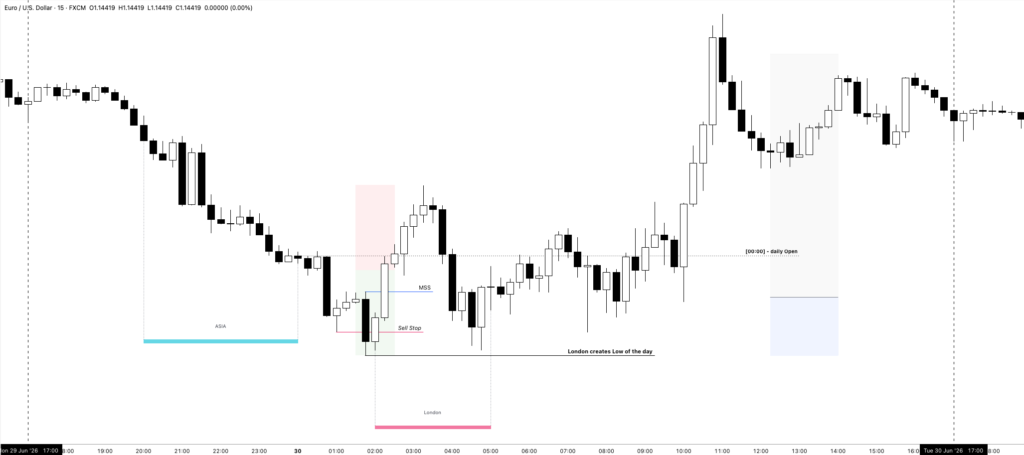
In a bullish market, London may create the Low of the Day.
In a bearish market, London may create the High of the Day.
The concept can be simplified as:
Bullish daily expectation → Look for London to create the Low of the Day
Bearish daily expectation → Look for London to create the High of the Day
Huddleston explains:
“London open generally has the highest probability of creating the high or the low of the day.”
This is not a guarantee that every London session will form the daily high or low.
The concept becomes more useful when supported by higher timeframe analysis.
Bullish ICT London Killzone Setup
Suppose higher timeframe analysis suggests price should move higher.
The trader should not immediately buy when the London Killzone begins.
Instead, watch for price to initially move lower.
The ideal idea is:
Higher timeframe bullish
↓
Price trades after midnight New York time
↓
London Killzone begins at 02:00
↓
Price declines
↓
Potential Low of the Day forms
↓
Bullish entry setup develops
↓
Price expands higher
In this situation, the initial decline may create the low that supports the larger bullish move.
The trader is looking for a low-risk buying opportunity while the market is temporarily trading lower.
Huddleston explains:
“When the market is bullish the tendency is for the market to trade down creating the low of the day in the London open ICT kill zone.”
The trader should combine this expectation with a valid ICT entry model.
Bearish ICT London Killzone Setup
The bearish model works in the opposite direction.
Suppose higher timeframe analysis suggests lower prices.
During the London Killzone, the trader may want to see price initially rally.
The structure becomes:
Higher timeframe bearish
↓
Price trades sideways or consolidates
↓
London Killzone begins
↓
Price rallies above the opening area
↓
Buy-side liquidity is raided
↓
Potential High of the Day forms
↓
Bearish expansion begins
The initial rally may appear bullish to traders who do not understand the larger market profile.
The ICT trader studies the move as a possible opportunity to sell at a premium price.
Huddleston explains the bearish idea clearly:
“We want to see price rally up. That’s where we’ll sell.”
The trader is not selling simply because price rallies.
Higher timeframe context must support the bearish expectation.
Higher Timeframe Bias Is Essential
The London Open can be extremely volatile.
This makes higher timeframe analysis particularly important.
Before the Killzone begins, determine whether the market is primarily:
Bullish
or
Bearish
You may use the Daily or other appropriate higher timeframe to study:
- Higher timeframe support
- Higher timeframe resistance
- Premium and discount
- ICT Optimal Trade Entry
- Existing market direction
- Price rejection
- Expected daily range
The London Killzone should be used as an execution window within a larger directional framework.
For example:
Daily bearish condition
↓
Price trades into a higher timeframe premium area
↓
Daily candle shows rejection
↓
Expect lower prices
↓
Study 02:00–05:00 for the High of the Day
The time window gives the trader when to focus.
Higher timeframe bias gives the trader which direction to favor.
The ICT London Killzone and Optimal Trade Entry
The London Open can frequently create an ICT Optimal Trade Entry or OTE pattern.
Huddleston explains that London OTE setups may sometimes offer approximately 25 to 50 pips for a scalp.
A possible bullish setup is:
Bullish directional bias
↓
London creates a low
↓
Price begins moving higher
↓
Trading range is identified
↓
Price retraces into bullish OTE
↓
Long entry is considered
↓
Price expands toward higher targets
A bearish model is reversed:
Bearish directional bias
↓
London creates a high
↓
Price begins moving lower
↓
Trading range is identified
↓
Price retraces into bearish OTE
↓
Short entry is considered
↓
Price expands toward lower targets
OTE should not be used without market context.
The London time window, daily direction, and price narrative must support the setup.
Using Previous Day Price Action
Previous trading day data can also help frame a London setup.
Huddleston discusses studying the relationship between London lows formed on consecutive trading days.
For example, the trader may identify:
Previous London Low
↓
Highest high between the two London lows
↓
Current London Low
This price range may provide a framework for an Optimal Trade Entry.
The previous day’s price action can therefore be used to structure the current London trade idea.
This demonstrates an important principle of The ICT approach:
Price should be studied as a developing narrative rather than isolated candlesticks.
Previous highs, lows, and ranges may help establish the context for the next setup.
Liquidity Raids During The ICT London Killzone
Liquidity is another important part of London Killzone trading.
Suppose higher timeframe analysis is bearish.
Price forms equal highs before London.
Buy stops may rest above those highs.
The trader may anticipate:
Equal highs form
↓
Buy-side liquidity identified
↓
London Killzone begins
↓
Price rallies
↓
Equal highs are raided
↓
Potential High of the Day forms
↓
Bearish range expansion
In the example explained by Huddleston, price trades above equal highs, collects the buy stops, and then moves aggressively lower.
The trader should understand that the liquidity raid itself is not the complete trading model.
The correct context includes:
Bearish higher timeframe expectation
London Killzone
Buy-side liquidity
Potential High of the Day
Bearish price delivery
This creates the full narrative.
The ICT London Killzone and Power of Three
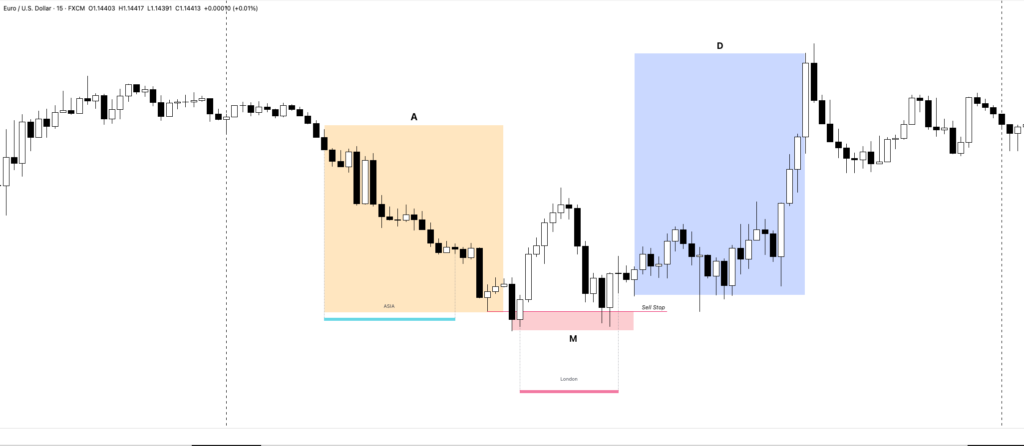
The London session can also show an intraday version of the ICT Power of Three.
Power of Three generally includes:
Accumulation
↓
Manipulation
↓
Distribution
Consider a bearish daily profile.
Price may consolidate before London.
Then price rallies above the opening area during the London Killzone.
This rally creates the manipulation.
After the High of the Day forms, price expands lower.
The sequence becomes:
Accumulation → Pre-London consolidation
↓
Manipulation → London rally and liquidity raid
↓
Distribution → Bearish range expansion
Huddleston describes this as a micro Power of Three formation.
Price is fractal.
A pattern visible on the daily candle can also be observed in intraday price delivery.
Bearish Daily Power of Three During London
Imagine the Daily Candle is expected to close bearish.
The daily profile may develop like this:
Daily Open
↓
Limited movement lower
↓
Price rallies above the Open
↓
London creates the High of the Day
↓
Price expands aggressively lower
↓
Low of the Day forms
↓
Price closes near the lower portion of the range
On the Daily chart, traders only see one bearish candle.
On the intraday chart, that candle may contain an entire London Power of Three formation.
This is why ICT traders study both time and price.
The daily candle does not show when manipulation occurred.
The London Killzone helps identify the time when that manipulation may form.
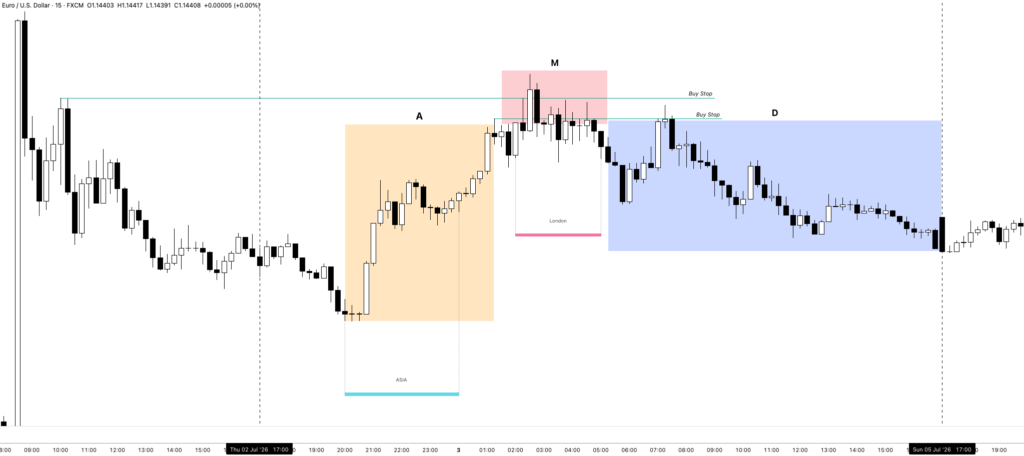
Bullish Daily Power of Three During London
For a bullish daily expectation:
Daily Open
↓
Price moves lower
↓
London creates the Low of the Day
↓
Sell-side liquidity may be targeted
↓
Price begins bullish expansion
↓
High of the Day forms later
↓
Price closes toward the upper portion of the daily range
The London decline may initially appear bearish.
However, within a bullish higher timeframe framework, it may create the low-risk buying opportunity.
The trader should avoid determining directional bias only from the first London price movement.
Why London Can Be Dangerous for New Traders
The same volatility that creates opportunity can quickly damage an undisciplined trader.
London may move aggressively.
Huddleston compares its volatility to a lightning bolt.
During high-impact economic events, price can become extremely one-sided.
A trader caught on the wrong side may experience rapid adverse movement.
Therefore:
Always control risk.
Use stop-loss orders.
Know the economic calendar.
Do not overleverage.
Do not chase an already-expanding move.
Huddleston warns that London may become relentless once the directional move begins.
If the trader misses the setup, it may be better to allow the trade to go without them.
There will be another trading opportunity.
Economic News During the London Session
Economic calendar releases can create significant overnight volatility.
Before trading The ICT London Killzone, traders should know whether important economic events are scheduled.
News affecting EUR or GBP can create large movements.
The presence of high-impact news does not automatically make the session tradable.
It may increase risk.
Before the Killzone:
Check scheduled economic events
↓
Identify affected currency
↓
Determine higher timeframe bias
↓
Mark liquidity and important levels
↓
Wait for the expected London profile
Do not enter solely because volatility increases.
Volatility without a trading model is not an opportunity.
What Happens Between 05:00 and 07:00 New York Time?
The London Killzone ends at approximately 05:00 New York time in this lesson.
Huddleston describes the period between:
05:00–07:00 New York time
as similar to a London lunch period.
Price may:
- Become quiet
- Consolidate
- Create small retracements
- Wait for New York activity
Huddleston states:
“I don’t like to see any type of entry between five o’clock and seven o’clock in the morning New York time.”
This distinction is extremely important.
02:00–05:00 → ICT London Killzone
05:00–07:00 → Potential quieter London lunch-type period
The actual London trading session continues beyond these times.
However, the trader should not confuse the entire session with the specific London Killzone entry window.
What If London Does Not Produce the Expected Move?
Sometimes the London Killzone will reach an important level but fail to produce significant directional expansion.
Suppose higher timeframe analysis is bullish.
Price creates a low after 02:00.
However, price does not begin a strong bullish run during London.
Huddleston explains that the real move may then occur during the next trading session, particularly as New York activity begins.
The sequence may become:
Bullish expectation
↓
London creates significant low
↓
No meaningful London expansion
↓
London remains contained
↓
New York overlap begins
↓
OTE develops
↓
Bullish range expansion
Therefore, traders should not force a London entry when price fails to confirm the expected setup.
The London price action itself can provide information for the New York session.
London and New York Session Relationship
London trading overlaps with New York activity.
This relationship can help traders assess how the daily range may continue developing.
When London has already produced a large trending move, New York may sometimes become quieter.
For example:
London creates High of the Day
↓
Large bearish expansion
↓
Majority of expected range delivered
↓
New York consolidates or produces a smaller reaction
Alternatively, London may establish an important price level without producing the full directional move.
New York may then create the larger range expansion.
This is why traders should study the overall profile rather than assuming every Killzone must produce the same pattern.
A Simple ICT London Killzone Trading Framework
A trader can study The ICT London Killzone using this process:
Step 1: Establish higher timeframe bias
Bullish or bearish
↓
Step 2: Mark important price levels
Support → Resistance → Equal Highs → Equal Lows → OTE
↓
Step 3: Check the economic calendar
Know whether important news is scheduled
↓
Step 4: Mark the London Killzone
02:00–05:00 New York time
↓
Step 5: Study the initial movement
Bullish bias → Look for price to trade lower
Bearish bias → Look for price to trade higher
↓
Step 6: Watch liquidity
Sell-side liquidity for bullish setups
Buy-side liquidity for bearish setups
↓
Step 7: Look for the potential daily extreme
Bullish → Potential Low of the Day
Bearish → Potential High of the Day
↓
Step 8: Apply an ICT entry model
OTE or another contextual entry setup
↓
Step 9: Look for range expansion
Price should begin delivering in the expected direction
↓
Step 10: Avoid forcing entries after 05:00
Be aware of the 05:00–07:00 London lunch-type period
When to Avoid The ICT London Killzone
Avoid forcing a London trade when:
- Higher timeframe direction is unclear
- Price is trapped in a larger consolidation
- No meaningful liquidity objective is visible
- The expected high or low formation does not develop
- The valid entry setup has already passed
- Price has already completed a large directional expansion
- You are chasing a fast-moving candle
- High-impact news creates conditions you do not understand
- The setup appears during the 05:00–07:00 quiet period rather than your planned Killzone
The Killzone is a time filter.
It does not make every setup high probability.
Key Characteristics of The ICT London Killzone
The ICT London Killzone has several important characteristics that make it different from the Asian and New York trading windows. The session is known for increased order flow, strong directional price movement, and the potential formation of the High or Low of the Day between 02:00 and 05:00 New York time.
1. London Frequently Creates the High or Low of the Day
One of the most important characteristics of the London Killzone is its tendency to establish a major daily extreme.
When the Daily Bias is bullish, London may create the Low of the Day.
When the Daily Bias is bearish, London may create the High of the Day.
The basic expectation is:
Bullish Daily Bias → London Low of the Day
Bearish Daily Bias → London High of the Day
Michael J. Huddleston explains that the London session typically creates the daily low when the market is primarily bullish and the daily high when the market is bearish.
2. London Can Produce the Largest Directional Move of the Day
The London session has a high probability of producing a significant directional move within the 24-hour trading cycle.
Price may move aggressively once the expected daily direction becomes established.
This makes London particularly suitable for traders looking to participate in a larger portion of the daily range.
As Huddleston explains:
“The most bang for your buck is going to be in the London open.”
However, this increased movement also means traders must control risk carefully.
3. EUR/USD and GBP/USD Are Ideal Markets to Study
The Euro and British Pound pairs are particularly important during the London Open.
The primary Forex pairs to study include:
- EUR/USD
- GBP/USD
These currencies are naturally associated with European and London financial activity.
Because of this, they may offer greater volatility and clearer directional setups during the London Killzone.
4. The London Open Frequently Forms an ICT Optimal Trade Entry
London price action can create an ICT Optimal Trade Entry or OTE.
Huddleston explains that an OTE formed around the London Open may sometimes provide approximately 25 to 50 pips for a scalp.
A bullish model may develop as:
Bullish Bias → London decline → Low forms → Bullish OTE → Expansion higher
A bearish model may develop as:
Bearish Bias → London rally → High forms → Bearish OTE → Expansion lower
The OTE should always be supported by the higher timeframe narrative.
5. London May Raid Liquidity Before the Daily Expansion
The London Killzone can target obvious liquidity before moving in the expected daily direction.
In a bearish market, price may rally above:
- Equal Highs
- Short-term highs
- Previous liquidity pools
Buy-side liquidity may be taken before price declines.
In a bullish market, price may trade below:
- Equal Lows
- Short-term lows
- Sell-side liquidity
Price may then reverse and expand higher.
The framework is:
Daily Bias
↓
London Killzone
↓
Liquidity raid
↓
Potential High or Low of the Day
↓
Directional expansion
6. London Can Display a Micro Power of Three Formation
Price during the London session can display a fractal Power of Three profile.
A bearish London profile may develop as:
Open → Rally → Session High → Bearish Expansion → Session Low
A bullish London profile may develop as:
Open → Decline → Session Low → Bullish Expansion → Session High
This reflects the same Accumulation, Manipulation, and Distribution concept that can appear on higher timeframes.
Huddleston describes this type of intraday structure as a micro Power of Three formation.
7. London Has High Volume and Can Be Extremely Volatile
The London session can experience significant order execution and strong volatility.
Once a directional move begins, price may become highly one-sided.
This can create excellent opportunities, but it can also be dangerous for inexperienced traders.
A trader caught on the wrong side of the move may experience rapid adverse price movement.
Because of this, traders should:
- Control position size
- Use a stop loss
- Avoid overleveraging
- Check scheduled economic news
- Avoid chasing large price expansions
The higher volatility of London should be treated with respect.
8. High-Impact Economic News Can Influence London Price Action
Many economic calendar releases occur during overnight and European trading hours.
These events can create significant volatility.
News may:
- Accelerate the Daily Bias
- Create a liquidity raid
- Produce a sharp retracement
- Trigger a directional expansion
Traders should check the economic calendar before trading the London Killzone.
News volatility does not replace higher timeframe analysis or a valid ICT trading setup.
9. The 05:00–07:00 New York Time Period Can Become Quieter
The specific London Killzone discussed in this model ends at 05:00 New York time.
Huddleston describes the period from:
05:00–07:00 New York time
as a London lunch-type period.
During this time, price may:
- Consolidate
- Become quieter
- Form minor retracements
- Wait for New York activity
Huddleston explains:
“I don’t like to see any type of entry between five o’clock and seven o’clock in the morning New York time.”
Therefore:
02:00–05:00 → ICT London Killzone
05:00–07:00 → Potential quieter London lunch period
10. London’s Price Delivery Can Provide Clues for New York
The London session can help traders anticipate how the New York session may develop.
If London has already produced a strong directional expansion, New York may sometimes become quieter or consolidate.
If London forms an important high or low but fails to deliver the expected expansion, the stronger move may develop during the London–New York overlap.
Overall, the key characteristic of The ICT London Killzone is its ability to form an important daily extreme and initiate significant range expansion. Traders should establish the Daily Bias first, then study whether London raids liquidity, creates the High or Low of the Day, and delivers an ICT entry model between 02:00 and 05:00 New York time.
Final Thoughts on The ICT London Killzone
The ICT London Killzone is one of the most important time windows taught by Michael J. Huddleston in the ICT Forex – Market Maker Primer Course.
The ideal Killzone covered in this concept is:
02:00–05:00 New York time
During bullish market conditions, traders can study London for the formation of the Low of the Day.
During bearish market conditions, traders can study London for the formation of the High of the Day.
The core framework is:
Higher timeframe bias
↓
02:00–05:00 New York time
↓
Liquidity raid or manipulation
↓
Potential High or Low of the Day
↓
ICT entry model
↓
Directional range expansion
The London Open may provide approximately 25 to 50 pips in certain scalp setups, but the objective is not to trade every London session.
Study the higher timeframe first. Know where liquidity is resting. Understand the expected daily profile. Then wait for time and price to align during the London Killzone.
As Huddleston teaches, the opportunity is not created by time alone. The edge comes from understanding what price should do and when that price behavior is most likely to develop.