
The Elements Of A Trade Setup is an important framework taught by Michael J. Huddleston, the founder of ICT (Inner Circle Trader) concepts, in ICT Mentorship Core Content – Month 1. The lesson explains how a trader can identify the current market condition and then match that condition with the correct ICT price action tool.
A trade setup is not simply created because an indicator gives a signal.
A support level alone is not enough.
A resistance level alone is also not enough.
The trader first needs a context or framework that explains why a trade idea may be favorable.
Michael J. Huddleston explains:
“There has to be something that builds a reason to want to do this trade.”
According to the ICT lesson, price can generally be studied through four market conditions:
Expansion
Retracement
Reversal
Consolidation
Each market condition is connected with a specific ICT concept.
Expansion → Order Blocks
Retracement → Fair Value Gaps and Liquidity Voids
Reversal → Liquidity Pools and Stop Runs
Consolidation → Equilibrium
Understanding these relationships forms the basis of the ICT Elements Of A Trade Setup framework.
What Are the Elements Of A Trade Setup?
The Elements Of A Trade Setup refers to the market context and institutional price reference used to build a trading idea.
ICT divides the setup into two primary concerns.
The first is the context or framework surrounding price.
The trader needs to identify the condition in which the market is currently delivering price.
Is price expanding?
Is price retracing?
Is price reversing?
Or is price consolidating?
The second concern is the institutional order-flow reference point used within that condition.
These references include:
Order Blocks.
Fair Value Gaps.
Liquidity Voids.
Liquidity Pools.
Stop Runs.
Equilibrium.
The basic ICT framework can be understood as:
Identify Market Condition
↓
Select the Correct ICT Tool
↓
Build the Trade Narrative
↓
Wait for Price to Reach the Reference Point
↓
Study the Trade Setup
The trader does not use every ICT concept on every chart.
The tool should match the condition price is currently showing.
The Two Primary Elements of an ICT Trade Setup
Michael J. Huddleston explains that there are two main concerns when studying the elements of a trade setup.
1. Market Context or Framework
The first element is the condition surrounding the trade idea.
The trader asks:
What is price doing now?
Where did price come from?
Where is price likely to move next?
A trader should not simply say:
The indicator says buy.
The moving average says sell.
This is support.
This is resistance.
The setup needs a framework.
The four ICT market conditions provide this framework.
2. Institutional Order-Flow Reference
The second element is the price reference used inside the market condition.
The ICT tools discussed in the lesson are:
Order Blocks
Fair Value Gaps and Liquidity Voids
Liquidity Pools and Stop Runs
Equilibrium
The market condition tells the trader what price is doing.
The ICT tool tells the trader what price reference to study.
This creates a much more structured trading process.

Four Market Conditions in ICT Trading
According to the Elements Of A Trade Setup lesson, price is delivered through four primary conditions.
These are:
Expansion
Retracement
Reversal
Consolidation
The market continually changes from one condition to another.
For example:
Consolidation → Expansion
Then:
Expansion → Retracement
A retracement may lead to:
New Expansion
or:
Consolidation
Price may also move from:
Expansion → Reversal
Then:
Reversal → Retracement
The conditions continuously interchange throughout the market.
The trader’s job is not to predict every candle.
The trader should identify the current condition and study the next logical market behavior.
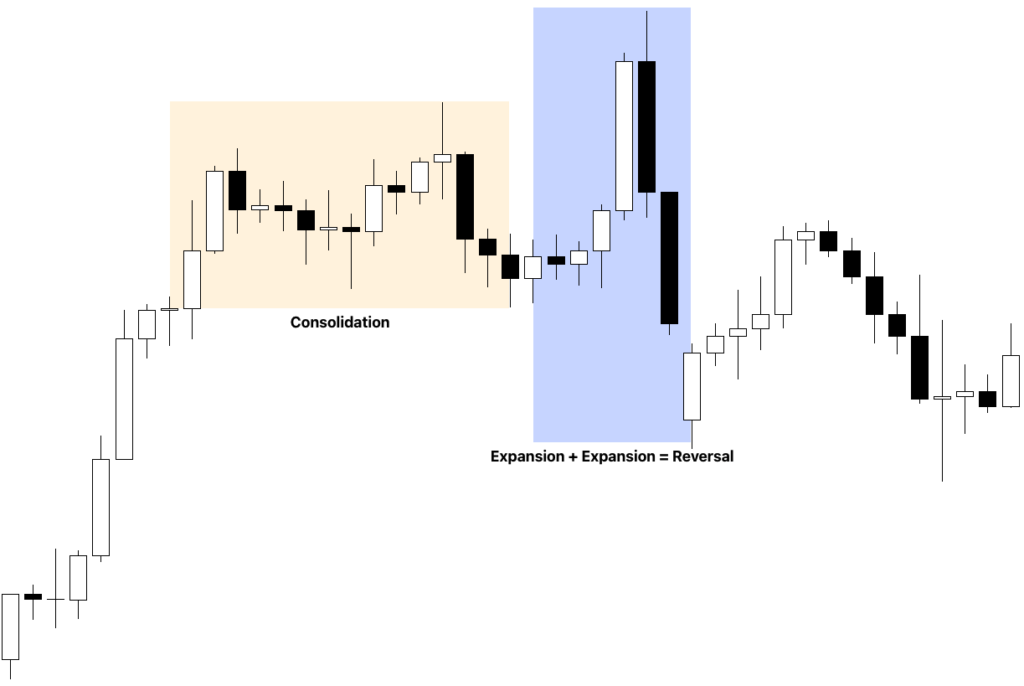
ICT Trade Setup Framework
The complete framework can be simplified as:
| Market Condition | Related ICT Tool |
|---|---|
| Expansion | Order Block |
| Retracement | Fair Value Gap / Liquidity Void |
| Reversal | Liquidity Pool / Stop Run |
| Consolidation | Equilibrium |
This relationship is one of the most important parts of the lesson.
The trader sees expansion.
Look for the Order Block.
The trader sees retracement.
Study Fair Value Gaps and liquidity voids.
The trader is looking for reversal.
Study liquidity pools above highs or below lows.
The market is consolidating.
Study equilibrium and wait for expansion.
The ICT tool changes based on the current price condition.
Expansion in ICT Trading
Expansion is the first market condition discussed in the Elements Of A Trade Setup lesson.
Expansion occurs when price quickly moves away from a level of equilibrium.
Price may aggressively move higher.
Or price may aggressively move lower.
The market is repricing away from the previous balanced range.
The basic structure is:
Equilibrium
↓
Aggressive Price Movement
↓
Expansion
Michael J. Huddleston defines the condition as:
“Expansion is when price moves quickly from a level of equilibrium.”
The speed of the price movement is important.
The market shows willingness to leave the previous price range.
This provides information about possible directional price delivery.
Why Expansion Is Important
Expansion gives the trader a clue regarding the market’s intended repricing direction.
Suppose price has been consolidating.
The range contains a clear high and low.
Price remains around the middle of the range.
Then price suddenly moves aggressively higher.
This bullish expansion tells the trader that price is willing to reprice upward.
The trader should not chase the bullish candle.
Instead, the ICT trader studies the price structure near the previous equilibrium.
The trader looks for a bullish Order Block.
The opposite applies to bearish expansion.
Price aggressively moves lower from equilibrium.
The trader studies the bearish Order Block associated with the displacement.
Expansion reveals the direction.
The Order Block provides the potential price reference.
Expansion and ICT Order Blocks
In the Elements Of A Trade Setup framework:
Expansion is paired with Order Blocks.
Suppose the market is consolidating.
Price suddenly expands upward.
The trader looks for the last down candle before the bullish move.
This candle can become a bullish Order Block.
The basic model is:
Consolidation
↓
Bullish Expansion
↓
Identify Last Down Candle
↓
Bullish Order Block
↓
Wait for Price to Return
↓
Study Long Setup
The bearish concept is reversed.
Price expands lower.
The trader identifies the last up candle before the bearish movement.
This becomes the bearish Order Block.
Bullish Expansion Trade Setup Example
Suppose price is moving inside a consolidation.
A clear high and low define the range.
The midpoint represents equilibrium.
Price then aggressively expands higher.
The market has shown willingness to reprice upward.
The trader identifies the last down candle near the equilibrium price level before the bullish expansion.
This candle becomes the bullish Order Block.
Price later retraces.
The trader waits.
Price trades back into the Order Block.
The long setup can now be studied.
The sequence is:
Equilibrium → Bullish Expansion → Bullish Order Block → Retracement → Return to Order Block → Continuation Higher
In the ICT example, price returns to the bullish Order Block and then expands more than 100 pips higher.
The important lesson is not to chase the initial expansion.
Wait for the price reference.
Bearish Expansion Trade Setup
The bearish model is the opposite.
Price remains inside a consolidation.
The market suddenly moves aggressively lower.
Bearish expansion occurs.
The trader identifies the last up candle before the bearish displacement.
This becomes the bearish Order Block.
Price may later retrace upward.
The market returns to the Order Block.
The trader studies a bearish setup.
The sequence becomes:
Equilibrium → Bearish Expansion → Bearish Order Block → Retracement → Return to Order Block → Continuation Lower
Again, expansion identifies the directional intention.
The Order Block provides the institutional order-flow reference.
Retracement in ICT Trading
The second condition in Elements Of A Trade Setup is retracement.
A retracement occurs when price moves back inside a recently created price range.
Suppose price expands strongly higher.
The expansion creates a new price range.
Price then moves lower into part of that range.
This is a retracement.
The basic structure is:
Expansion
↓
New Price Range Created
↓
Price Moves Back Inside the Range
↓
Retracement
Huddleston explains:
“Retracement is when price moves back inside the recently created price range.”
Retracement does not automatically mean a complete reversal.
Price may simply be returning to an inefficiently delivered range.
Why Retracement Occurs
When price moves very quickly, not every price level receives efficient two-sided delivery.
A strong rally can leave an inefficient price range.
A strong sell-off can also leave inefficient delivery.
Price may later return to these ranges.
The market reprices into levels that were not efficiently traded for fair value.
For this reason, the ICT tools paired with retracement are:
Fair Value Gaps
and
Liquidity Voids
The trader looks for price to return into these inefficient areas.
Retracement and Fair Value Gaps
A Fair Value Gap or FVG represents one-sided price delivery.
Price moves aggressively through a range.
A visible imbalance forms.
Suppose bullish displacement creates a BISI.
Price later retraces downward.
The FVG remains inside the recently created price range.
The trader watches for price to trade back into the imbalance.
The basic bullish model is:
Bullish Expansion
↓
Bullish FVG Created
↓
Price Retraces
↓
FVG Revisited
↓
Study Bullish Continuation
For bearish price delivery:
Bearish Expansion
↓
Bearish FVG Created
↓
Price Retraces Higher
↓
FVG Revisited
↓
Study Bearish Continuation
The FVG provides a price reference inside the retracement.
Retracement and Liquidity Voids
A liquidity void forms when price rapidly moves through a large price range.
The movement may happen through one large candle or multiple aggressive candles.
Very little two-sided trading occurs.
Price effectively skips through portions of the range.
Huddleston explains in the lesson that sudden run-ups and run-downs can create ranges that price may later return to and close.
The trader should not chase the initial move.
Instead, the trader identifies the liquidity void.
Price may later retrace into the void.
The range becomes a potential price delivery objective.
The model is:
Aggressive Price Movement
↓
Liquidity Void Forms
↓
Price Moves Away
↓
Retracement
↓
Void Is Filled
↓
Original Direction May Resume
For example, price aggressively sells off.
A large bearish liquidity void forms.
The trader waits.
Price rallies back into the void.
Once the inefficient range is filled, bearish price delivery may resume.
Reversal in ICT Trading
The third condition is reversal.
A reversal occurs when price changes from the current directional movement and begins moving in the opposite direction.
Suppose price has been moving higher.
The market reaches a specific price area.
Price then begins aggressively moving lower.
A bearish reversal may be developing.
The basic structure is:
Current Direction
↓
Liquidity Event
↓
Direction Changes
↓
Reversal
In the Elements Of A Trade Setup framework, reversal is paired with:
Liquidity Pools
and
Stop Runs
Why Liquidity Is Important for Reversals
ICT does not study reversal only through candlestick patterns.
The trader first asks:
What liquidity has price taken?
Buy stops may rest above an old high.
Sell stops may rest below an old low.
Price can move through these levels.
The stop orders are triggered.
A liquidity pool is attacked.
Then price may aggressively reverse.
Huddleston explains:
“When the price reverses direction, it indicates the market makers have ran a level of stops and a significant move should unfold in the new direction.”
Therefore, the stop run can provide the context for the reversal.
Liquidity Pools Above Old Highs
An old high can contain buy-side liquidity.
Short traders may have stop-loss orders above the high.
Breakout traders may also place buy orders above the level.
Price trades above the old high.
The liquidity pool is taken.
Then price rejects the level.
The market begins moving lower.
This can create a bearish reversal setup.
The model is:
Old High
↓
Buy Stops Above High
↓
Price Trades Above High
↓
Buy-Side Liquidity Taken
↓
Bearish Rejection
↓
Reversal Lower
The trader is not simply selling resistance.
The trade idea is built around a run on liquidity.
Liquidity Pools Below Old Lows
The opposite occurs below an old low.
Sell-side liquidity can rest below the low.
Long traders may place their protective stops below the price level.
Breakout sellers may also enter below the low.
Price trades through the old low.
Sell-side liquidity is taken.
Then the market quickly rejects the lower price.
Price begins moving higher.
This can create a bullish reversal.
The model becomes:
Old Low
↓
Sell Stops Below Low
↓
Price Trades Below Low
↓
Sell-Side Liquidity Taken
↓
Bullish Rejection
↓
Reversal Higher
These stop runs are closely connected with Turtle Soup or false-break concepts.
Reversal Trade Setup Example
Suppose price has been trending lower.
An old low remains below current price.
Sell stops are expected below the low.
Price drops.
The old low is violated.
Sell-side liquidity is taken.
Retail traders may see a bearish breakout.
But price quickly trades back above the old low.
The trader now studies the reversal.
The current bearish direction may be changing.
The liquidity event provides the context.
Price action after the stop run provides confirmation.
The trader is not buying simply because the market looks oversold.
The reversal idea has a reason.
Liquidity has been taken.
Consolidation in ICT Trading
The fourth market condition in Elements Of A Trade Setup is consolidation.
Consolidation occurs when price trades inside a clear range and shows no willingness to move significantly higher or lower.
The market moves sideways.
A clear high and low can be identified.
Retail traders may say the market is doing nothing.
ICT views consolidation differently.
Orders are building on both sides of the range.
Huddleston explains:
“There’s really no such thing as the market doing nothing in consolidation. It’s accumulating orders.”
This is an important idea.
The market may appear inactive.
But liquidity can be forming above and below the consolidation.
Consolidation and Equilibrium
In the ICT framework:
Consolidation is paired with Equilibrium.
Equilibrium is the midpoint or 50% level of the consolidation range.
Suppose the range high is 110.
The range low is 100.
The equilibrium is:
(110 + 100) ÷ 2 = 105
Price may repeatedly move above and below this midpoint.
The market remains inside the defined range.
The trader waits for an impulse move away from equilibrium.
The model is:
Range High
↓
Equilibrium – 50%
↓
Range Low
Price continues consolidating.
Then expansion occurs.
The direction of expansion provides information regarding the next possible price delivery.
Why ICT Traders Wait During Consolidation
A common beginner mistake is forcing trades during consolidation.
The trader becomes impatient.
Price is moving sideways.
The trader buys the low.
Then sells the high.
Then buys again.
The market produces choppy price action.
ICT teaches a different approach.
Wait.
Allow orders to accumulate.
Wait for the impulse move.
Huddleston explains:
“We always wait for the first expansion. That gives us all the insight that we need to make a decision.”
The expansion provides a clue.
Once price moves aggressively away from equilibrium, the trader can begin studying the next condition.
The market may create an Order Block.
Price may retrace.
A new opportunity can form.
There is nothing wrong with missing the first expansion.
The trader does not need to capture every market move.
How the Four Market Conditions Connect
The four conditions should not be viewed as completely separate patterns.
They are stages of price delivery.
One condition can transition into another.
A common price cycle may look like:
Consolidation
↓
Expansion
↓
Retracement
↓
Expansion
↓
Reversal
↓
Retracement
↓
Consolidation
Another sequence may be:
Consolidation → Expansion → Consolidation
Or:
Expansion → Reversal → Retracement
There is no single fixed cycle that must occur every time.
The important point is that the market can only be studied within one of the four broad conditions.
The trader identifies the present condition.
Then the correct ICT tool is applied.
Market Condition and ICT Tool Pairing
The relationship can be remembered using this simple model:
Expansion → Order Block
Price quickly leaves equilibrium.
Look for the Order Block associated with the expansion.
Do not chase the displacement.
Wait for price to return.
Retracement → Fair Value Gap or Liquidity Void
Price moves back inside the recent range.
Identify inefficient price delivery.
Watch for price to fill the FVG or liquidity void.
Reversal → Liquidity Pool or Stop Run
Price takes liquidity above an old high or below an old low.
Study the rejection and possible change in direction.
Consolidation → Equilibrium
Price remains inside a clear range.
Mark the midpoint.
Wait for the impulse move away from equilibrium.
This pairing provides a simple framework for chart study.
How to Identify the Current Market Condition
The first question should be:
What is price doing right now?
Look at the chart.
Do not immediately mark every Order Block and FVG.
First classify price.
Signs of Expansion
Large directional candles.
Rapid movement away from a range.
Price leaving equilibrium.
Strong impulse price swing.
Signs of Retracement
Price moving back into a recently created range.
Return toward a previous FVG.
Return into a liquidity void.
Movement against the most recent expansion.
Signs of Reversal
Old high or low is taken.
Liquidity pool is attacked.
Price rejects the liquidity run.
Market begins moving in the opposite direction.
Signs of Consolidation
Clear range high.
Clear range low.
Sideways price action.
Repeated movement around equilibrium.
No strong willingness to expand higher or lower.
Once the market condition is identified, the trader selects the related ICT tool.
Building an ICT Trade Setup Step by Step
The Elements Of A Trade Setup framework can be used through the following process.
Step 1 – Look at Current Price Action
Determine what price is doing now.
Expansion?
Retracement?
Reversal?
Consolidation?
Do not begin with an entry.
Begin with the condition.
Step 2 – Identify Where Price Came From
Study the previous market condition.
Did price expand from a consolidation?
Is the current movement a retracement of the expansion?
Did price recently take an old high or low?
Understanding the previous condition provides context.
Step 3 – Determine the Likely Next Condition
If price is consolidating, expansion may occur.
If price has expanded, retracement may develop.
If price has taken liquidity and strongly rejected, reversal may be unfolding.
The trader builds an expectation.
Step 4 – Select the Related ICT Tool
Expansion → Order Block.
Retracement → FVG or liquidity void.
Reversal → Liquidity pool.
Consolidation → Equilibrium.
Step 5 – Mark the Price Reference
Identify the exact Order Block.
Mark the FVG.
Shade the liquidity void.
Mark buy-side or sell-side liquidity.
Calculate equilibrium.
Step 6 – Wait for Price
Do not chase the market.
Allow price to reach the reference point.
Step 7 – Study the Reaction
Does price show willingness to continue the expected model?
Does price respect the Order Block?
Does the liquidity run reject?
Is the FVG filled?
Has price expanded away from equilibrium?
The reaction helps refine the trade idea.
Example of Expansion to Order Block Trade Setup
Suppose EUR/USD is consolidating.
The range high is clearly visible.
The range low is clearly visible.
Price repeatedly trades around equilibrium.
Then EUR/USD aggressively expands higher.
The first condition has changed.
Consolidation → Expansion
The trader identifies the last down candle near equilibrium before the bullish impulse.
This is a bullish Order Block.
The trader does not buy the top of the expansion.
Price retraces lower.
Now the market moves into a retracement condition.
Price returns to the Order Block.
The trader studies the long setup.
The full structure is:
Consolidation
↓
Bullish Expansion
↓
Bullish Order Block Identified
↓
Retracement
↓
Return to Order Block
↓
Bullish Continuation
The trader has combined market condition and ICT tool.
Example of Retracement to Liquidity Void
Suppose GBP/USD aggressively moves lower.
The bearish movement creates a large liquidity void.
Price does not efficiently trade through the full range.
The trader identifies the void.
After the sell-off, price begins rallying.
This is a retracement.
The trader studies the liquidity void.
Price trades back upward and fills part or all of the inefficient range.
Once the void is closed, price may resume moving lower.
The structure becomes:
Bearish Expansion
↓
Liquidity Void
↓
Bullish Retracement
↓
Void Filled
↓
Bearish Continuation
The liquidity void is selected because the market is retracing.
Example of Reversal From a Liquidity Pool
Suppose USD/CHF moves higher.
An old high remains above current price.
Buy stops are expected above it.
Price rallies.
The old high is taken.
Then price quickly rejects.
The market begins moving lower.
The current condition may be changing from bullish expansion to bearish reversal.
The trader uses the liquidity pool as the reference point.
The structure is:
Old High
↓
Buy-Side Liquidity
↓
Liquidity Run
↓
Strong Rejection
↓
Bearish Reversal
The liquidity event gives context to the reversal.
Example of Consolidation and Equilibrium
Suppose price is moving sideways.
A range high is visible.
A range low is visible.
The candle bodies repeatedly move around the midpoint.
The trader marks equilibrium.
No trade is forced.
Price continues building orders.
Eventually, a strong impulse move develops.
Price expands higher.
The market condition has changed.
Now the trader can identify the bullish Order Block associated with the expansion.
The structure is:
Consolidation
↓
Equilibrium
↓
Wait
↓
Bullish Expansion
↓
Order Block Identified
↓
Retracement Setup
The trader allows the market to provide information.
Market Efficiency Paradigm and Trade Setups
The Elements Of A Trade Setup lesson also connects these four conditions with what ICT calls the market efficiency paradigm.
The idea is to study price from the perspective of institutional price delivery.
The general speculative public may interpret price using:
Indicators.
Traditional support.
Traditional resistance.
Overbought conditions.
Oversold conditions.
ICT studies how price is being delivered.
Is price leaving equilibrium?
Is it returning to an inefficient range?
Has liquidity been taken?
Are orders building inside consolidation?
The four market conditions help organize this price action.
The trader begins to look for the “fingerprints” or clues left by the market’s movement.
Why One ICT Setup Can Be Enough
A trader does not need to master every ICT concept immediately.
This is an important message from the Month 1 lesson.
Some traders may naturally understand Order Blocks.
Another trader may prefer liquidity runs and reversals.
Some traders may specialize in FVG retracements.
Others may become comfortable studying consolidation and equilibrium.
Huddleston explains:
“It only takes one setup.”
The trader needs one repeatable market condition.
Then pair that condition with the appropriate ICT tool.
For example:
Expansion + Bullish Order Block
A trader can study only this setup.
Or:
Reversal + Sell-Side Liquidity Run
Another trader may focus only on this model.
Consistency does not require trading every possible ICT concept.
It requires understanding the context and repeatedly waiting for the same condition.
Choosing Your Bread-and-Butter Trade Setup
The lesson encourages traders to discover which market condition fits their personality and chart-reading ability.
Your bread-and-butter condition may be:
Expansion Trader
You prefer strong displacement.
You identify Order Blocks.
You wait for retracement into the block.
Retracement Trader
You study Fair Value Gaps.
You identify liquidity voids.
You wait for inefficient ranges to be revisited.
Reversal Trader
You focus on old highs and lows.
You identify liquidity pools.
You trade stop runs and false breaks.
Consolidation Trader
You study defined ranges.
You calculate equilibrium.
You wait for expansion away from the midpoint.
A trader may eventually understand all four conditions.
But this is not required at the beginning.
Start with one.
Study many historical examples.
Build pattern recognition.
How to Practice the Elements Of A Trade Setup
Michael J. Huddleston recommends studying the price action already visible on the left side of the chart.
The trader does not need to begin with live trading.
Open a historical chart.
Find an example of consolidation.
Mark the range.
Identify equilibrium.
Look for the first expansion.
Find the Order Block.
Study the retracement.
Mark the FVG or liquidity void.
Look for old highs and lows.
Identify stop runs.
Classify each price movement.
Write:
Expansion
Retracement
Reversal
or
Consolidation
Then mark the related ICT tool.
The purpose is repetition.
Over time, the trader should become faster at recognizing the market condition.
Eventually, it may only take a few seconds to classify the current price environment.
Common Mistakes When Building an ICT Trade Setup
One common mistake is starting with an entry signal.
The trader asks:
Where should I buy?
Where should I sell?
Instead, first determine the current market condition.
Another mistake is using the wrong ICT tool for the price condition.
For example, a trader may focus on reversal while the market is clearly expanding.
Another trader may trade an Order Block without identifying the expansion that created it.
Do not separate the ICT tool from its context.
Another mistake is chasing price.
Expansion occurs.
The trader buys the large bullish candle.
ICT teaches the trader to wait for the Order Block or later price setup.
Another mistake is trading aggressively inside consolidation.
The market may still be building orders.
Wait for the first expansion.
Another mistake is believing you must master every ICT setup.
You do not.
One clear and repeatable setup can be enough.
Finally, do not expect a trade every day.
The market must create your condition.
Your job is to wait.
Elements Of A Trade Setup Checklist
Before taking a trade, ask:
What condition is the market currently in?
Is price expanding?
Is price retracing?
Is price reversing?
Is price consolidating?
Where did price come from?
Where is price likely to go next?
If price is expanding, where is the Order Block?
If price is retracing, is there an FVG?
Is there a liquidity void?
If price is reversing, has an old high or low been taken?
Where is the liquidity pool?
If price is consolidating, where is equilibrium?
Has the first expansion occurred?
Am I chasing price?
Or am I waiting for the correct price reference?
Does the ICT tool match the market condition?
Is this one of my studied trade setups?
If these questions create a clear framework, the trade idea becomes easier to understand.
Simple ICT Elements Of A Trade Setup Model
The complete concept can be simplified as:
CONSOLIDATION
Price inside defined range.
Use Equilibrium.
Wait for impulse price movement.
↓
EXPANSION
Price quickly leaves equilibrium.
Use Order Block.
Do not chase price.
↓
RETRACEMENT
Price moves back inside the recent range.
Use Fair Value Gap or Liquidity Void.
Study return to efficient price delivery.
↓
REVERSAL
Price takes stops and changes direction.
Use Liquidity Pools and Stop Runs.
Study the new directional move.
↓
NEW CONSOLIDATION OR EXPANSION
Reevaluate price.
Identify the current market condition again.
The process repeats.
Final Thoughts on Elements Of A Trade Setup
The Elements Of A Trade Setup framework gives ICT traders a simple way to organize price action.
The concept, taught by Michael J. Huddleston in ICT Mentorship Core Content – Month 1, begins with identifying the current market condition.
Price can be studied as:
Expansion
Retracement
Reversal
Consolidation
Each condition is paired with a specific ICT (Inner Circle Trader) tool.
Expansion uses Order Blocks.
Retracement uses Fair Value Gaps and Liquidity Voids.
Reversal uses Liquidity Pools and Stop Runs.
Consolidation uses Equilibrium.
The trader should first identify the context.
Then select the appropriate institutional price reference.
Do not chase every move.
Do not force trades inside every market condition.
Wait for the setup that matches your trading model.
The most important lesson from this ICT teaching is simple:
Know the market condition, pair it with the correct ICT tool and wait for price to provide your setup.
A trader does not need every setup.
As Michael J. Huddleston explains:
“It only takes one setup.”
Find one condition you understand.
Study it repeatedly.
Learn the related ICT tool.
Then wait for the market to create the same framework again.