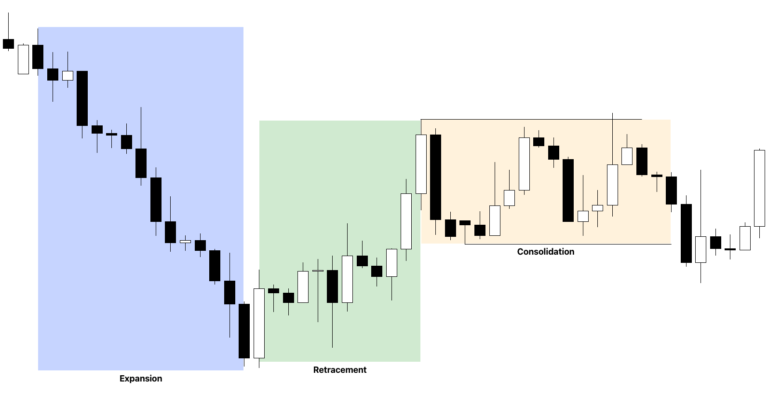
How Market Makers Condition The Market is a concept taught by Michael J. Huddleston, the founder of ICT (Inner Circle Trader) concepts, in ICT Mentorship Core Content – Month 1. The lesson explains how traders are conditioned to interpret price through common retail ideas, while ICT studies market movement through liquidity, consolidation, expansion, retracement and reversal.
Many new traders believe indicators, trend lines or traditional support and resistance are the main forces moving price.
ICT presents a different perspective.
Michael J. Huddleston explains:
“The banks drive price whether you want to accept it or not.”
The main idea is that traders should stop viewing the market only through retail expectations and begin studying the repeated process of price delivery.
What Does How Market Makers Condition The Market Mean?
How Market Makers Condition The Market refers to the way common price movements can create predictable expectations among retail traders.
For example, traders may see:
A trend line touch and expect a reversal.
A moving average crossover and expect continuation.
Support and resistance.
Overbought or oversold indicators.
A breakout from a previous high or low.
Retail traders can become conditioned to react in similar ways around these price patterns.
According to the ICT lesson, the important question is not simply what the pattern looks like.
The trader should ask:
Where is liquidity building?
What stage of price delivery is the market in?
What are traders likely expecting?
Where can price expand next?
ICT calls this change in thinking a paradigm shift.
Smart Money and Uninformed Money
The lesson introduces the Market Efficiency Paradigm.
On one side is uninformed or retail-minded money.
On the other side is smart money and liquidity providers.
Retail traders often believe their collective buying and selling directly drives the market.
Huddleston describes this belief as a facade.
He explains:
“The markets are not efficient for the speculators. They’re efficient for the smart money.”
In the ICT framework, the trader should study how liquidity providers operate instead of following the same expectations as the larger retail trading population.
The objective is not to blindly trade against retail traders.
The objective is to understand how common trader behavior can create liquidity around logical price levels.
Old highs can attract buy stops.
Old lows can attract sell stops.
Consolidations can allow orders to build above and below the range.
Price can then expand toward these areas.
How Retail Traders Are Conditioned
Retail trading education commonly focuses on visual signals.
Indicators tell traders the market is overbought.
Momentum indicators show divergence.
Moving averages cross.
Price reaches resistance.
Price breaks support.
These signals create expectations.
A trader may see a bullish-looking setup and place a stop below an obvious low.
Another trader may sell resistance and place a stop above the previous high.
When many traders use similar reference points, liquidity can build around these areas.
ICT studies the placement of these orders.
Huddleston explains:
“Everyone else is liquidity.”
The important point is not that every retail setup must fail.
Instead, traders should understand that predictable behavior can create predictable pools of orders.
This liquidity becomes important in the price delivery model.
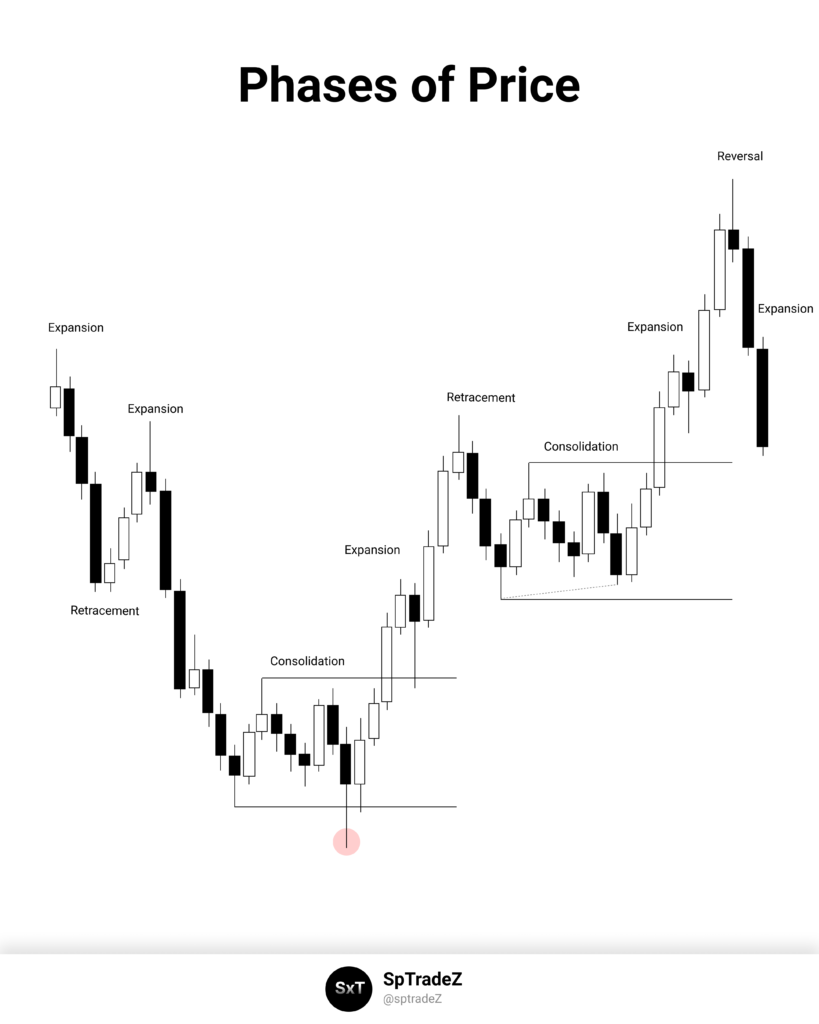
The Four Conditions of Price Delivery
The previous ICT Month 1 lesson introduced four market conditions:
Consolidation
Expansion
Retracement
Reversal
In How Market Makers Condition The Market, Huddleston explains how these four conditions follow a repeated price delivery process.
The market does not randomly move between every condition.
The sequence has structure.
Most importantly:
Consolidation leads to expansion.
Huddleston explains:
“It never goes consolidation retracement. It never does consolidation reversal. It’s always consolidation expansion.”
After expansion, price has two main possibilities.
Price can retrace.
Or price can reverse.
The simplified model is:
Consolidation → Expansion → Retracement
or
Consolidation → Expansion → Reversal
From there, price can expand again and eventually return to another consolidation.

Why Price Starts With Consolidation
According to the ICT price delivery model, market movement begins from consolidation.
A consolidation is a defined range where price moves sideways.
There is a clear high.
There is a clear low.
Price shows little willingness to move significantly in either direction.
Retail traders may believe nothing is happening.
ICT views consolidation as a period where orders are building.
Huddleston explains:
“Consolidation is when the market’s quiet. Why is that important? Because that’s when the orders are building up in the marketplace.”
Liquidity can accumulate above and below the range.
Buy stops can form above the consolidation high.
Sell stops can form below the consolidation low.
The trader should not force a directional idea inside the holding pattern.
Wait for expansion.


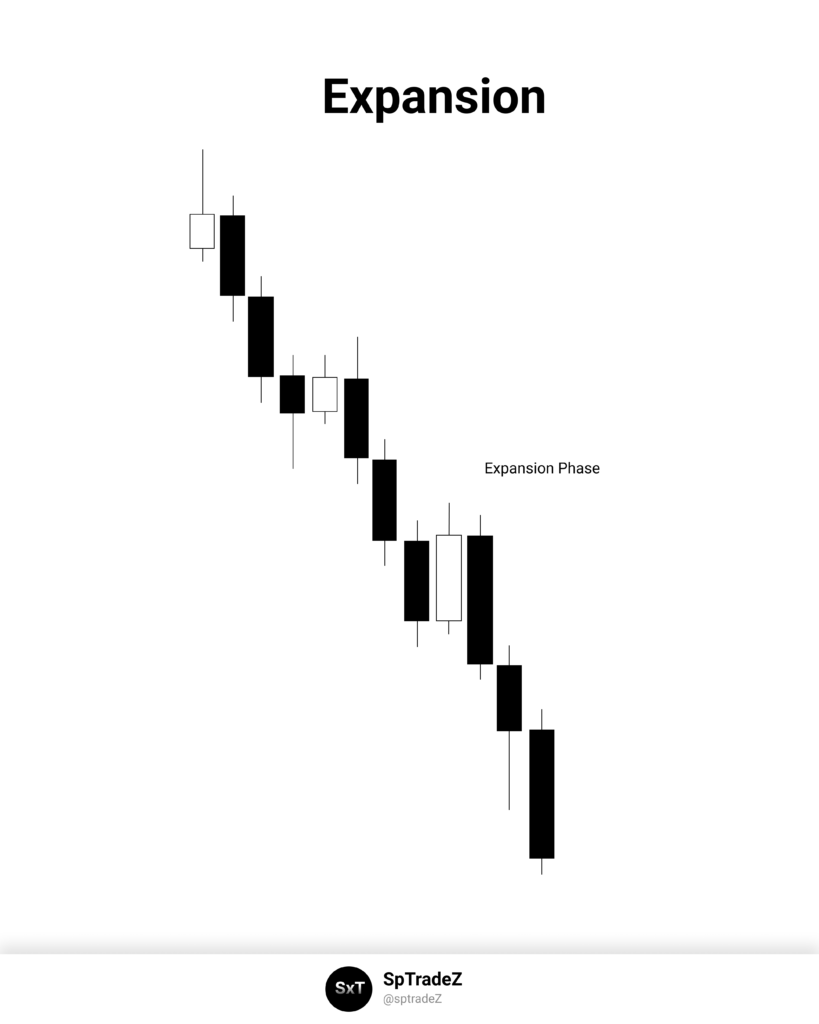
Expansion Reveals Price Direction
After consolidation, price expands.
Expansion is an impulse movement away from the range.
Price may aggressively move higher.
Or price may aggressively move lower.
This is important because the first expansion gives the trader information.
Huddleston states:
“We wait for the expansion. When the expansion occurs, that’s when we get the clue as to what the market is most likely going to be doing.”
Suppose price consolidates and then aggressively expands higher.
The trader now has evidence of bullish price delivery.
Do not chase the move.
Study the price range that created the expansion.
Look for a bullish Order Block.
Watch for a possible retracement.
If price returns to the institutional reference point, another bullish expansion may develop.

What Happens After Expansion?
Once price expands, ICT focuses on two possibilities.
Retracement
Price moves back toward the range it recently left.
For example:
Consolidation → Bullish Expansion → Retracement
Price may return to the bullish Order Block associated with the impulse movement.
The market can recapitalize the price range and then continue higher.
The model becomes:
Expansion → Retracement → New Expansion
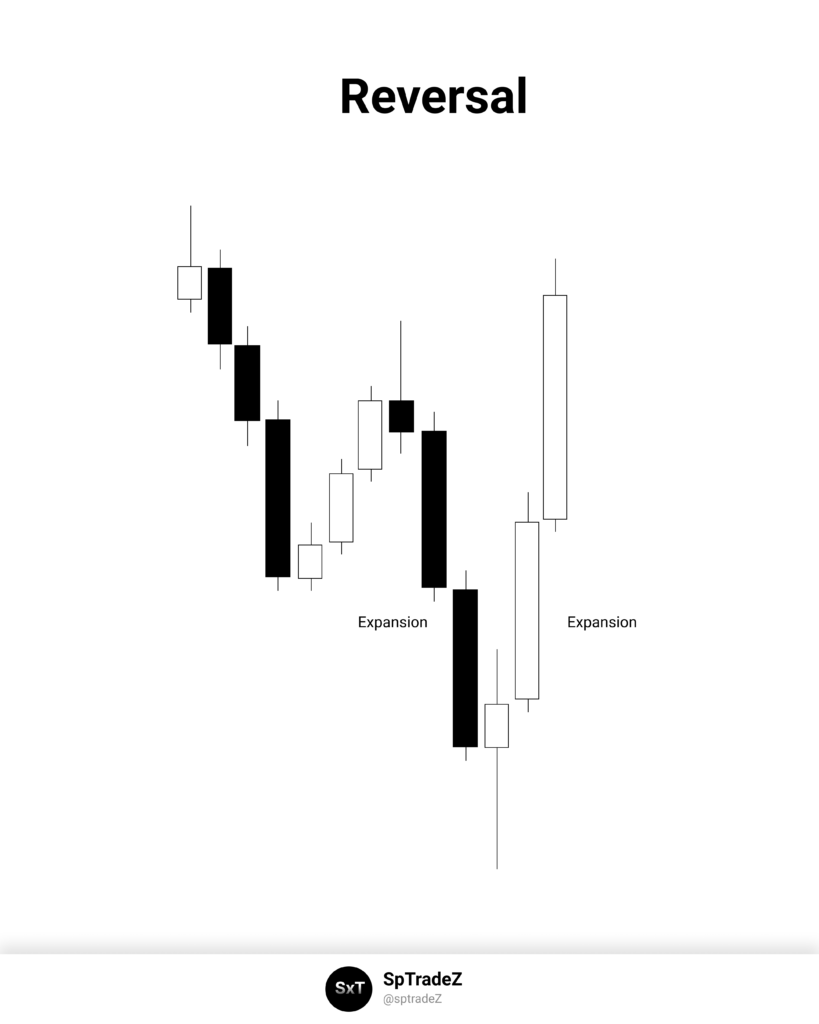
Reversal
Price expands and then changes direction.
The reversal can develop after price reaches liquidity.
For example:
Price expands higher.
Buy-side liquidity is taken.
Price reverses lower.
A new bearish expansion begins.
The model becomes:
Expansion → Reversal → Expansion
The trader studies price and liquidity to determine which condition is developing.

The ICT Daily Price Delivery Model
The ICT applies the four conditions to the daily forex range.
A simplified ICT daily model begins with the Asian session consolidation.
Then price can create manipulation after midnight New York time.
This can form the Judas Swing.
Price then expands into the London session.
Another period of consolidation may develop before New York.
Price can retrace around the New York news window.
Then another expansion or reversal may occur.
Later, London Close can create another reversal condition.
The simplified sequence taught in the lesson is:
Asian Consolidation
↓
Manipulation / Judas Swing
↓
London Expansion
↓
New York Consolidation
↓
Retracement or Reversal
↓
New York Expansion
↓
London Close Reversal
↓
Late-Day Consolidation
This model helps traders understand why expansion, retracement and reversal may occur at repeated times of the trading day.
Example of a Bullish Daily Price Delivery
Suppose the higher timeframe expectation is bullish.
The day begins with the Asian range.
Price consolidates.
After midnight New York time, price trades lower.
This lower movement creates a false move.
Sell-side liquidity may be taken.
The move can form the low of the day during the London setup.
Price then reverses and expands higher.
Later, the market may consolidate before New York.
Price retraces between important New York time windows.
Then another bullish expansion occurs.
The complete model can look like:
Asian Consolidation
↓
Price Drops Below Range
↓
Sell-Side Liquidity Run
↓
London Reversal
↓
Bullish Expansion
↓
New York Retracement
↓
Another Bullish Expansion
↓
London Close Reaction
The early bearish movement conditions traders to expect lower prices.
But the higher timeframe directional premise and liquidity event may support a bullish daily move.
Market Conditioning Through False Expectations
An important part of How Market Makers Condition The Market is the difference between what price appears to be doing and the larger price delivery objective.
A trader may believe price is breaking lower.
The market trades below an old low.
Bearish traders enter.
Long traders are stopped out.
Then price quickly reverses higher.
The trader may feel the market specifically targeted their stop.
ICT teaches the trader to study the liquidity around the level.
The old low was a logical place for sell stops.
The move below it provided liquidity.
The market then delivered price in the opposite direction.
The same can happen above an old high.
Price appears bullish.
Breakout traders buy.
Short traders are stopped out.
Buy-side liquidity is taken.
Price then reverses lower.
The trader should learn to identify the conditions rather than emotionally reacting to the false move.
The Importance of Higher Timeframe Direction
The daily price delivery model becomes more useful when combined with a higher timeframe directional premise.
Huddleston explains that when the trader understands higher timeframe direction and the price delivery model, the next market condition becomes easier to anticipate.
Suppose the weekly and daily analysis supports higher prices.
The trader sees Asian consolidation.
Then price drops below a short-term low.
Instead of automatically becoming bearish, the trader asks:
Is this the manipulation?
Has sell-side liquidity been taken?
Is the market preparing for bullish expansion?
The higher timeframe bias helps the trader interpret the lower timeframe movement.
Without directional context, every expansion can appear equally important.
How ICT Traders Study Price Delivery
A simple process can be used.
Step 1 – Identify Consolidation
Find the current holding pattern.
Mark the range high and low.
Do not force the trade.
Step 2 – Wait for Expansion
Watch how price leaves the consolidation.
The impulse move provides information.
Step 3 – Compare With Higher Timeframe Bias
Does the expansion agree with the higher timeframe price objective?
Or could it be manipulation?
Step 4 – Identify Liquidity
Mark old highs and lows.
Look for buy stops and sell stops.
Determine whether price has run liquidity.
Step 5 – Decide Between Retracement and Reversal
After expansion, ask whether price is returning to the range for continuation.
Or has a liquidity run created a genuine directional reversal?
Step 6 – Apply the Correct ICT Tool
Expansion → Order Block.
Retracement → Fair Value Gap or liquidity void.
Reversal → Liquidity pool or stop run.
Consolidation → Equilibrium.
The trader uses the market condition to choose the correct price reference.
Why Patience Is Important
The lesson also focuses on patience.
A trader does not need to participate in every price movement.
Sometimes the initial expansion moves too far.
There may be no safe entry.
Wait for the retracement.
Or wait for the next consolidation.
Huddleston explains:
“You’re not going to catch every move.”
This is an important part of ICT trading.
The trader should not chase price because they are afraid of missing the move.
The market repeatedly creates consolidation, expansion, retracement and reversal conditions.
Study the process.
Wait for your setup.
Common Mistakes When Studying Market Conditioning
One common mistake is believing indicators control price.
Indicators are derived from previous price movement.
They do not directly tell the trader where liquidity is resting.
Another mistake is treating every breakout as genuine expansion.
The trader should study higher timeframe direction and liquidity.
A move below a low can be a sell-side liquidity run.
A move above a high can be a buy-side liquidity run.
Another mistake is trading inside every consolidation.
ICT teaches traders to wait for the first expansion.
Do not force direction before price provides information.
Another mistake is chasing the impulse move.
After expansion, price may retrace.
Wait for the correct institutional price reference.
Finally, do not ignore time of day.
The daily forex range can show repeating characteristics around Asian consolidation, London expansion, New York price delivery and London Close.
How Market Makers Condition The Market – Simple Model
The complete concept can be simplified as:
CONSOLIDATION
Orders build above and below the range.
↓
EXPANSION
Price aggressively leaves the range.
The market provides a directional clue.
↓
RETRACEMENT OR REVERSAL
Price either returns to the recent range for continuation.
Or price takes liquidity and changes direction.
↓
NEW EXPANSION
Price continues delivering toward another objective.
↓
CONSOLIDATION
The market enters another holding pattern.
↓
THE PROCESS REPEATS
The important point is:
Consolidation always requires expansion before retracement or reversal can be studied.
Final Thoughts on How Market Makers Condition The Market
How Market Makers Condition The Market helps ICT traders understand the repeated process behind price delivery.
The concept, taught by Michael J. Huddleston in ICT Mentorship Core Content – Month 1, challenges the common retail belief that indicators, trend lines or simple support and resistance directly drive price.
ICT (Inner Circle Trader) traders study liquidity and repeated market conditions.
Price begins from consolidation.
Orders build around the range.
Then expansion occurs.
After expansion, price can retrace or reverse.
The trader combines this price delivery sequence with higher timeframe direction, liquidity and institutional reference points.
The core model is:
Consolidation → Expansion → Retracement or Reversal → New Expansion
As Michael J. Huddleston explains:
“There is a certain process the way the price is delivered.”
The goal is to recognize this process.
Do not chase every market move.
Do not react emotionally when a stop is taken.
Study where liquidity is located.
Identify the current market condition.
Then wait for price to provide the next logical stage of delivery.