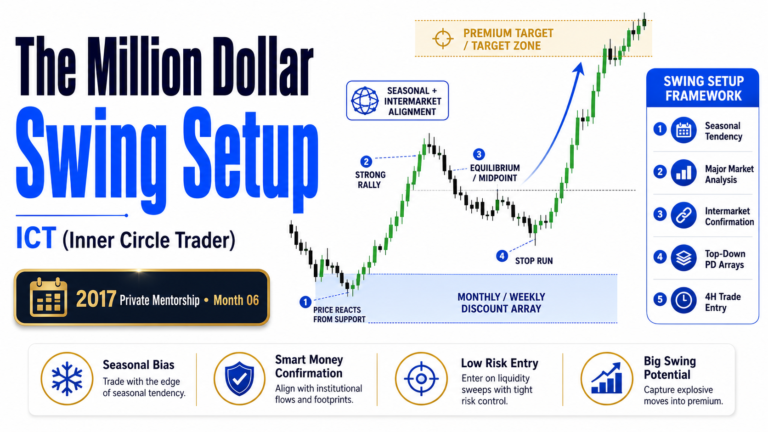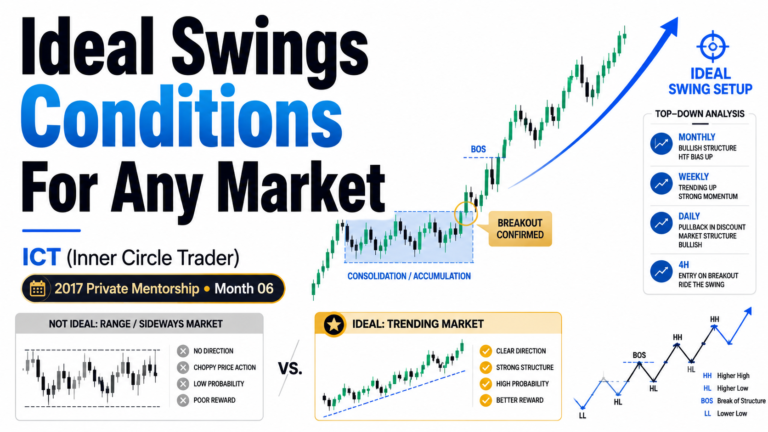
Successful swing trading is not simply about finding a chart pattern and holding a position for several days. It requires multiple forms of evidence supporting the same directional idea.
The Elements To Successful Swing Trading were taught by Michael J. Huddleston, founder of ICT (Inner Circle Trader), in the 2017 ICT Private Mentorship Core Content Month 06. His approach encourages traders to study higher-timeframe direction, institutional order flow, intermarket relationships, premium and discount arrays, risk management, and clear price action before committing capital.
The objective is not to trade frequently. The objective is to identify the cleanest opportunities where several supporting factors align.
As Michael J. Huddleston explains:
“The larger amount of things on this list that I can accumulate to build the idea that my trade is valid, the more likely the trade does pan out.”
Start With an Obvious Higher-Timeframe Trend
The first requirement for successful swing trading is a clear directional tendency on the higher-timeframe chart.
A bullish market should either be:
- Breaking out of consolidation and beginning to move higher
- Producing higher highs and higher lows
- Respecting support during retracements
- Moving toward an obvious premium objective
A bearish market should either be:
- Breaking below consolidation
- Producing lower highs and lower lows
- Respecting resistance during rallies
- Moving toward an obvious discount objective
The direction should not require excessive interpretation. When the trend is unclear, the trader is more likely to force a directional opinion that is not supported by price.
Swing trades generally work best when the monthly, weekly, and daily charts point toward the same broad objective.
Confirm Institutional Order Flow
The next element is clear institutional order flow on the higher timeframes.
Institutional order flow helps determine whether price is being delivered higher or lower.
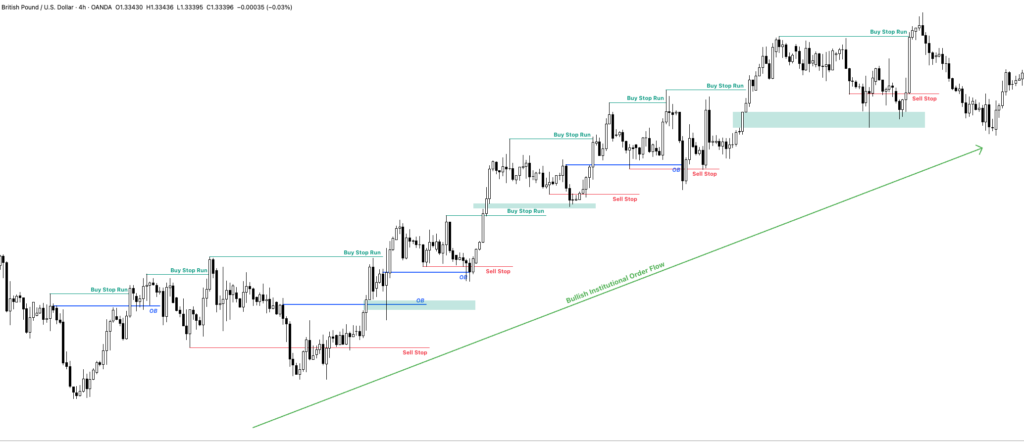
In a bullish environment, traders should look for:
- Down-close candles acting as support
- Retracements being followed by expansion
- Previous swing highs being broken
- Higher prices forming after resistance is removed
- Price respecting bullish order blocks and discount arrays
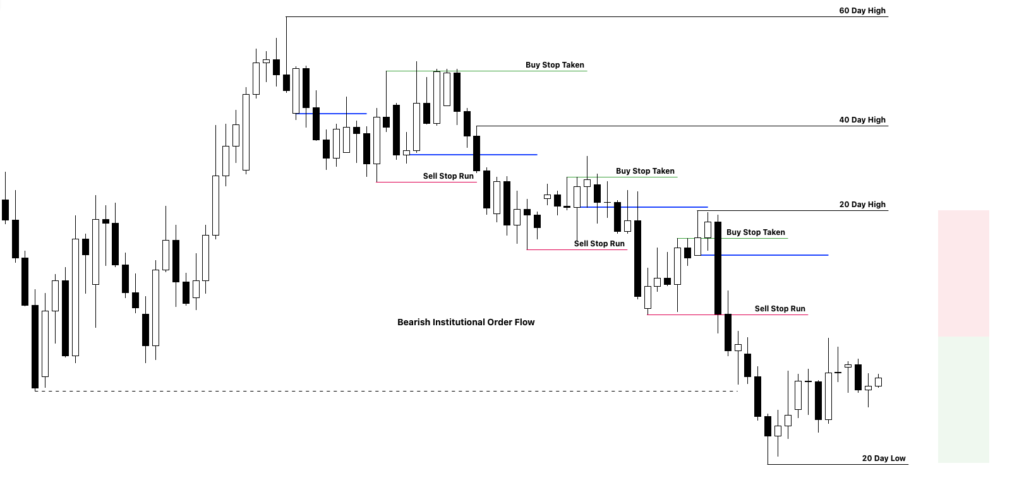
In a bearish environment, traders should look for:
- Up-close candles acting as resistance
- Rallies being followed by bearish expansion
- Previous swing lows being broken
- Lower prices forming after support is removed
- Price respecting bearish order blocks and premium arrays
Institutional accumulation is commonly observed when down-close candles support future buying. Institutional distribution is commonly observed when up-close candles offer resistance for additional selling.
This provides a more meaningful view of trend than simply using moving averages or conventional trendlines.
Look for Institutional Sponsorship
A valid swing-trading idea should show signs that institutional participation supports the expected direction.
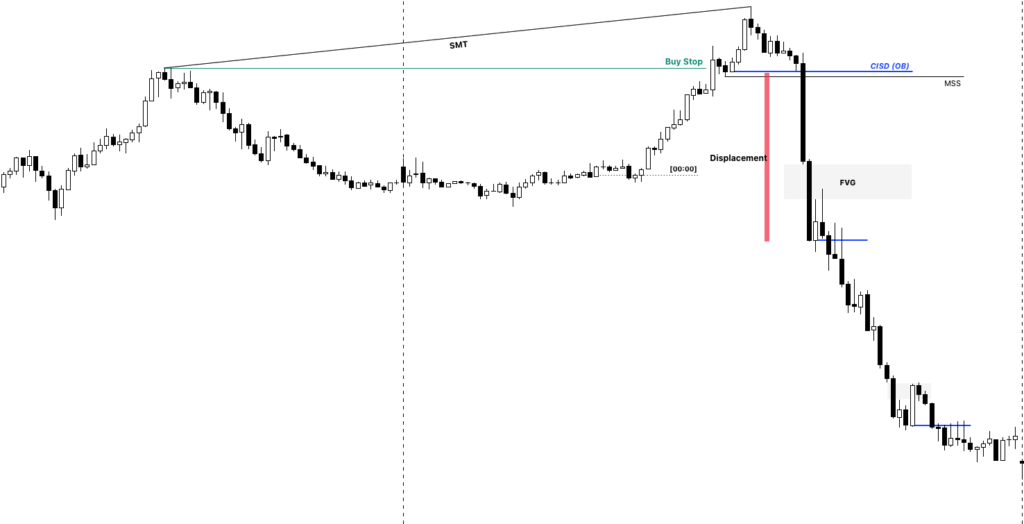
One way ICT traders evaluate this is through relative strength analysis and SMT divergence.
For example, suppose EUR/USD creates a lower low while the U.S. Dollar Index fails to create a corresponding higher high. This may indicate that the dollar is losing strength while EUR/USD is clearing sell-side liquidity before moving higher.
For a bearish example, suppose USD/CHF forms a lower high while the Dollar Index creates a higher high. The relative weakness in USD/CHF may support a bearish idea.
These differences between correlated markets can reveal whether the apparent movement is supported by institutional sponsorship.
However, SMT divergence should support the trade idea rather than serve as the complete strategy by itself.
Identify Clear Premium and Discount Arrays
Successful swing trading requires obvious levels above and below current price.
ICT refers to these levels as Premium and Discount Arrays, or PD Arrays.
Common PD Arrays include:
- Order blocks
- Breaker blocks
- Mitigation blocks
- Fair value gaps
- Liquidity voids
- Rejection blocks
- Old highs and lows
- Imbalanced price ranges
When price is bullish, the trader should identify discount arrays where buying may occur and premium arrays that may act as future targets.
When price is bearish, the trader should identify premium arrays where selling may occur and discount arrays that may provide objectives.
Monthly and weekly imbalances are particularly important because price may be drawn toward areas that have not been traded into for several weeks or months.
When price is positioned near equilibrium, traders can monitor whether it begins delivering toward a premium or discount imbalance.

Demand Clean and Obvious Price Action
One of the most important elements of successful swing trading is selecting markets with clean price action.
The best opportunities usually appear obvious. The directional structure, important levels, and likely objectives can be identified without repeatedly changing the analysis.
Michael J. Huddleston states:
“The cleanest price action are the most favorable markets to trade in.”
When traders must constantly argue with themselves about whether a candle is an order block, whether a level contains liquidity, or whether the market is truly bullish or bearish, the setup may not be strong enough.
He further explains:
“If you’re having to convince yourself, chances are it’s probably not a good trade. Pass on it.”
A high-probability swing trade should almost appear to leap from the chart. The trader should be able to explain the setup clearly and logically.
Clean price action helps remove distractions and reduces the possibility of creating a trade idea that price is not actually supporting.
Use Interest Rates, COT Data and Intermarket Analysis
Price action remains the foundation, but external forms of analysis can improve the probability of a swing-trading idea.
Interest-rate analysis
Interest-rate markets can help confirm the expected direction of currencies and other financial assets.
Traders can study:
- Rising or falling yields
- Divergence between related yields
- Changes in interest-rate expectations
- Relative strength between national debt markets
A divergence in yields may provide early evidence that a shift in currency direction is developing.
Commitment of Traders data
The Commitment of Traders report is not required for every trade, but it can provide additional confirmation.
COT data may help traders understand how commercial participants and large speculators are positioned in a market. It is most useful when combined with seasonal tendencies and higher-timeframe price levels.
Seasonal tendencies
Some markets demonstrate recurring bullish or bearish behavior during particular periods of the year.
Seasonality should not replace price action. It should be treated as an additional factor that may strengthen an already valid setup.
Intermarket analysis
Supporting markets should confirm the trade idea.
For example, a trader analysing a currency may also study:
- The U.S. Dollar Index
- Government bond yields
- Related currency pairs
- Commodities connected to the currency
- Equity-index performance
The more supporting markets agree with the directional idea, the stronger the swing-trading narrative may become.
Build a Rule-Based Filtering Process
Every swing trade should pass through a consistent filtering process.
The rules should remain static. They should not be changed simply because the trader strongly believes that a particular trade will work.
A practical filtering process may ask:
- Is the higher-timeframe direction obvious?
- Is institutional order flow supporting that direction?
- Is price trading from a clear premium or discount array?
- Is there a logical liquidity objective?
- Does relative strength support the trade?
- Are interest rates or intermarket relationships confirming the idea?
- Is the price action clean?
- Does the potential reward justify the risk?
- Does the trade fit within the account’s total risk limits?
When a setup fails the filtering process, the trader should pass on it.
Huddleston emphasises that traders should trust their tested rules rather than abandoning them because another trader, analyst, or mentor has a different opinion.
A trading model becomes reliable only when the same procedure is followed on every opportunity.
Respect Risk and Equity Management
A valid setup does not automatically mean the trade should be executed.
The trader may already have open positions consuming the maximum permitted account risk. Taking another trade could create excessive exposure, particularly when the open positions are correlated.
Before opening a new swing trade, consider:
- Risk allocated to existing positions
- Total account exposure
- Correlation between trades
- Expected duration of each setup
- Potential reward compared with current positions
- Whether the new setup is stronger than an existing trade
A trader may need to close or reduce an existing position before accepting a new opportunity.
Risk rules should never be ignored simply because a setup looks attractive.
Prioritise Reward-to-Risk Potential
Swing trading should focus on opportunities with enough movement potential to justify holding the position.
A minimum objective of approximately three times the initial risk allows a trading model to remain profitable even with a relatively modest win rate.
For example, with a consistent 3:1 reward-to-risk ratio, a trader can theoretically remain profitable while winning only around one-third of trades, before considering costs and execution differences.
Setups offering five times the initial risk provide greater flexibility, but only when the target is supported by realistic market structure and liquidity.
The trader should not invent an unrealistic target merely to improve the reward-to-risk ratio on paper.
The best reward-to-risk opportunities usually occur when:
- Price is leaving consolidation
- A large higher-timeframe imbalance is available
- The entry is near a clear invalidation point
- The liquidity target is far enough from the entry
- Price has strong expansion potential
Create a Complete Swing-Trading Plan
Successful swing trading requires a written plan covering the entire process from analysis to exit.
The plan should define:
- What creates an initial trading opportunity
- What qualifies as a valid swing setup
- Which timeframes will be analysed
- How directional bias will be determined
- Where the trade will be entered
- Where the stop-loss will be placed
- How much capital will be risked
- How profit objectives will be selected
- When the stop-loss may be adjusted
- Whether partial profits will be taken
- What invalidates the setup before entry
- What requires the trade to be closed early
- How total account exposure will be controlled
The purpose of the plan is to make every trading decision explainable.
A trader should know why the trade was entered, why the stop was positioned at a particular level, why the target was selected, and what market development would invalidate the original idea.
This removes much of the emotional decision-making that causes traders to force setups, widen stops, close profitable trades too early, or remain in invalid positions.
Elements To Successful Swing Trading Checklist
Before taking a swing trade, confirm the following:
- The monthly, weekly, or daily trend is clear
- Institutional order flow supports the expected direction
- Price is respecting relevant order blocks or PD Arrays
- A clear premium or discount objective is visible
- Relative strength or SMT supports the setup
- Interest-rate markets do not contradict the trade
- COT data or seasonal tendencies provide additional confirmation
- Intermarket relationships support the directional idea
- Price action is clean and easy to interpret
- The setup passes a fixed rule-based filter
- The trade offers an acceptable reward-to-risk ratio
- Total risk exposure remains within the trading plan
- Entry, stop-loss, target, and invalidation are defined before execution
Not every trade will contain every supporting factor. However, the more valid elements that align, the stronger the probability behind the setup.
Final Thoughts
The Elements To Successful Swing Trading are designed to help traders become selective rather than active.
The ICT approach does not encourage traders to predict every market movement. It encourages them to wait for an obvious higher-timeframe direction, clear institutional order flow, recognisable premium and discount arrays, supporting intermarket evidence, and favourable risk-to-reward potential.
Successful swing trading ultimately depends on preparation, patience, and consistency. Traders must demand clean price action, follow the same filtering process for every setup, and refuse opportunities that do not meet their requirements.
When these principles are organised into a written swing-trading plan, decisions become based on price and predefined rules rather than emotions, opinions, or outside influence.