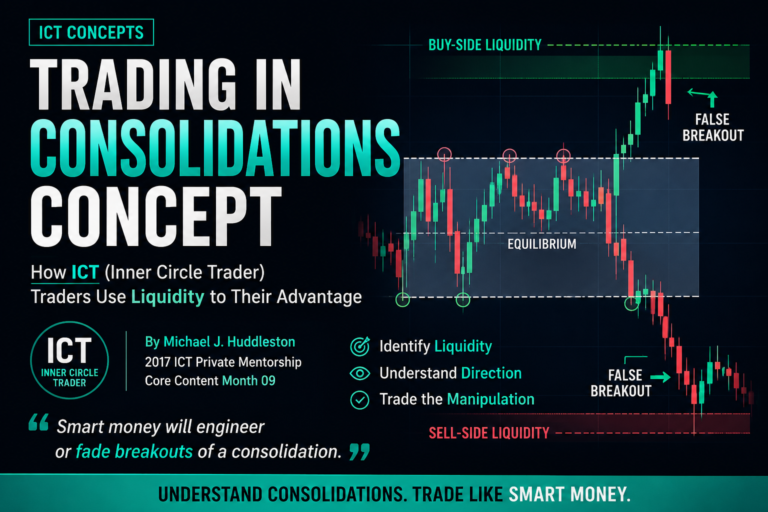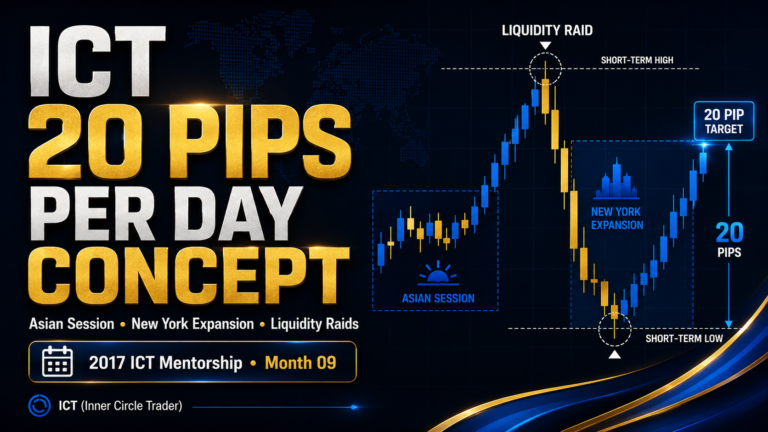
The ICT Bread & Butter Sell Setups are bearish intraday trading models taught by Michael J. Huddleston, the founder of ICT (Inner Circle Trader). This concept is taught in the 2017 ICT Private Mentorship Core Content Month 09 as part of the ICT Amplified Day Trading and Scalping material.
The model focuses on finding small, repeatable bearish price movements during periods when higher-timeframe institutional order flow supports lower prices.
The central idea is to wait for price to retrace into a premium area, generate buy-side liquidity and then continue toward a lower discount objective.
Michael J. Huddleston explains:
“The higher-time-frame PD arrays will draw price. They’re the catalyst that makes price move.”
The ICT Bread & Butter Sell Setups are therefore not simple five-minute reversal patterns. They require higher-timeframe bearish context, correct session timing and a logical lower target.
What Are ICT Bread & Butter Sell Setups?
The ICT Bread & Butter Sell Setups are short-term bearish trading opportunities that form inside a larger institutional sell program.
The trader looks for price to move temporarily higher before selling.
This retracement may:
- Raid buy-side liquidity
- Trigger buy stops
- Squeeze existing short sellers
- Attract breakout buyers
- Return to a premium PD array
- Provide institutional traders with better short-entry pricing
Once sufficient buying liquidity has been created, price may continue lower toward a discount array.
The setup is mainly used during:
- London Open
- New York Open
- London Close
- Asian session open
However, London and New York generally provide the strongest conditions because they contain greater volume and volatility.
Higher-Timeframe Bearish Context
Before searching for a sell setup, the trader must establish that higher-timeframe institutional order flow is bearish.
The trader may study:
- Weekly structure
- Daily structure
- Four-hour market structure
- Premium and discount
- Higher-timeframe PD arrays
- External sell-side liquidity
- The expected daily or weekly objective
A bearish environment may include:
- Price reacting from a weekly premium array
- A daily bearish order block
- A four-hour bearish fair value gap
- A bearish market structure shift
- An unfilled discount objective below price
- Buy-side liquidity already taken
- A lower daily or weekly target
Without this higher-timeframe context, a lower-timeframe sell pattern may only be a temporary retracement in a bullish market.
The Two Main Bearish Price Models
The ICT Bread & Butter Sell Setups are built around two bearish price-engine models:
- Offset Distribution
- Redistribution
Both models create buy-side liquidity before price expands lower.
Offset Distribution
Offset Distribution occurs when price trades above an old high to trigger buy stops.
These buy stops become market orders.
The buying created above the high provides counterparties for institutional short positions.
The model may involve:
- Price trading above an old high
- Existing short sellers being stopped out
- Breakout traders entering long
- Buyers being induced at premium pricing
- Institutional traders selling into that buying
- Price expanding toward a lower discount array
The primary purpose of offset distribution is to:
- Offset existing short positions
- Generate institutional exit liquidity
- Induce new buyers
- Create fresh short-selling opportunities at premium prices
This model appears frequently during bearish market conditions.
Typical Offset Distribution Structure
A common offset distribution sequence may look like this:
- Higher-timeframe order flow is bearish
- Price retraces above a short-term high
- Buy stops are triggered
- Breakout buyers enter the market
- Price reaches a premium PD array
- The move above the high fails
- Bearish displacement begins
- Price targets a short-term discount array
The old high is not automatically a sell level.
The trader still needs premium pricing and a bearish institutional narrative.
Redistribution
Redistribution occurs when price retraces higher into a fair-value or premium area after an earlier bearish move.
This retracement creates temporary pressure on traders already holding short positions.
Weak short sellers may close their positions, while other traders may interpret the retracement as a bullish reversal.
This creates buying liquidity that can be paired with new institutional short entries.
The redistribution model may include:
- An earlier bearish expansion
- A retracement higher
- A return to a bearish fair value gap
- A bearish order block
- A premium dealing-range level
- Short covering
- New retail buying
- Renewed bearish expansion
Its primary purpose is to redistribute additional short positions at premium pricing.
Offset Distribution vs Redistribution
The two models are closely related, but they begin differently.
Offset Distribution
Price usually trades above an old high and triggers visible buy-side liquidity.
Redistribution
Price retraces into a premium PD array after a bearish move, without necessarily requiring a major old high to be raided.
Both models create buyers at higher prices and provide opportunities for institutional selling.
Why Buy-Side Liquidity Is Important
Institutional traders require counterparties to execute large sell orders.
When price trades above an old high, several forms of buying may enter the market:
- Buy stops from short sellers
- Breakout buy orders
- Momentum buying
- Short covering
- Late retail buying
This creates buy-side liquidity.
Institutional traders can sell into this liquidity instead of chasing price lower.
The market may then reprice toward a lower discount array after the buying has been absorbed.
The Bearish Daily Range Profile
On a bearish day, the daily opening price is often near the high of the daily range.
Price may rally slightly above the opening price before declining.
The opening price may be based on:
- 00:00 GMT
- New York midnight
- A nearby early-session consolidation
A common bearish daily profile may include:
- Price opens near the daily high
- A small rally forms above the opening price
- London creates the first bearish expansion
- Price retraces during London lunch
- New York produces a second bearish expansion
- The five-day ADR low or a discount PD array is reached
- Price retraces during London Close
The trader uses this profile to understand where sell setups may form during the day.
London Open Sell Setup
The London Open is one of the most important periods for the ICT Bread & Butter Sell Setups.
When higher-timeframe order flow is bearish, the trader anticipates that London may establish the high of the day.
Price may first move higher in a classic Judas Swing before expanding lower.
London Judas Swing Sell Model
A bearish London Judas Swing may follow this sequence:
- Price opens near the expected daily high
- Price rallies above the opening price
- Buy-side liquidity is taken
- Price enters a premium PD array
- The rally fails
- Bearish displacement begins
- Price expands toward sell-side liquidity
Possible premium arrays include:
- Bearish fair value gap
- Bearish order block
- Rejection block
- Breaker block
- Previous session high
- Asian range high
- Premium portion of the dealing range
The trader looks to sell the temporary bullish movement rather than chasing the initial bearish decline.
London Open Timing
The setup should occur inside the London Kill Zone.
The precise timing may vary according to seasonal time changes, but the trader is looking for the high-volume London opening period.
The setup becomes less attractive when:
- It forms well outside the Kill Zone
- The market has already expanded significantly
- A major discount target has already been reached
- Price is trading in the middle of a range
- No premium PD array is present
Time is an essential part of the setup.
Entering After the Ideal London Entry Is Missed
Sometimes the trader misses the initial Judas Swing entry.
In this situation, a later five-minute retracement may provide another sell opportunity.
The trader may look for:
- A five-minute bearish fair value gap
- A five-minute bearish order block
- A short-term high being raided
- A retracement into premium
- Continuation toward the London objective
This allows the trader to participate in the remaining portion of the London move without entering at a random price.
London Lunch Retracement
A small retracement may occur between approximately 05:00 and 07:00 New York time.
This period is often associated with London lunch and the transition toward New York.
If the market remains bearish, this retracement may form another redistribution setup.
The trader may look for price to return to:
- A bearish order block
- A fair value gap
- A premium dealing-range level
- A short-term high
- The opening price
The target may remain the New York continuation objective below price.
New York Sell Setup
When London confirms bearish institutional sponsorship and establishes the high of the day, New York will often continue lower.
The trader looks for a short-term retracement inside the New York Kill Zone.
A typical New York sell setup includes:
- London establishes the probable daily high
- Price expands lower
- New York retraces higher
- A short-term high is raided
- Price enters a premium PD array
- Bearish displacement resumes
- Price targets the ADR low or another discount array
The 08:20 CME Open
Michael J. Huddleston highlights approximately 08:20 New York time, associated with the CME open, as a useful reference for anticipating a New York Judas Swing.
Price may retrace higher around this time before continuing lower.
The retracement may reach:
- A bearish fair value gap
- A bearish order block
- Buy-side liquidity
- A premium array
- The New York opening price
The trader looks to fade this temporary bullish movement when higher-timeframe order flow remains bearish.
When New York May Not Continue Lower
New York continuation is less likely when:
- A higher-timeframe discount array has already been reached
- The five-day average daily range low has been met
- London has already completed the expected daily move
- Price shows bullish displacement from discount
- The New York session opens directly at a major lower objective
In these conditions, the trader should avoid forcing a continuation short.
The session may instead produce consolidation or reversal.
New York Profit Targets
Possible targets for a bearish New York trade include:
- The five-day ADR low
- London low
- Previous day’s low
- Asian range low
- Equal lows
- A four-hour discount array
- A one-hour fair value gap
- External sell-side liquidity
The target should be identified before the trade is taken.
Taking Profit Near the ADR Low
When the ADR low is reached before approximately 10:00 New York time, one approach is to close most of the position.
A smaller portion may be left open in case price continues expanding.
This approach recognizes that:
- The expected daily range has largely been completed
- Reversal risk may increase
- London Close profit-taking may soon begin
- Price may still exceed the ADR during strong conditions
The trader should not assume the ADR must act as an exact turning point.
Scalping the London Close
The London Close often produces a retracement after a large bearish daily move.
This is not usually another sell setup at the low.
Instead, it may provide an opportunity to scalp a bullish retracement after the bearish objective has been completed.
A London Close reversal becomes more likely when:
- London and New York have both moved lower
- The ADR low has been reached
- It is after approximately 10:30 New York time
- The daily range has expanded strongly
- A five-minute failure swing forms at the low
- A bullish order block appears
The expected retracement may reach approximately 20 to 30 percent of the total daily range.
Important London Close Clarification
The main ICT Bread & Butter Sell Setup is designed to sell premium pricing during bearish conditions.
Once price reaches a major lower objective, selling at the low becomes dangerous.
At London Close, the better opportunity may be to take profits on shorts or study a countertrend retracement.
This prevents the trader from chasing a move after the daily range has already been delivered.
Asian Session Sell Setup
A smaller bearish setup may also form near the Asian session open.
When higher-timeframe order flow is bearish, price may trade at or slightly above the opening price and then expand approximately 15 to 20 pips lower while forming the Asian range.
A basic Asian sell setup may include:
- Bearish higher-timeframe bias
- Entry near or above the 00:00 GMT opening price
- A short-term premium array
- Limited downside objective
- A fixed 15-to-20-pip target
Because the Asian session is often narrow, the trader should not expect a large second leg.
Avoiding Greed During the Asian Session
The Asian range can be limited.
When a 15-to-20-pip move is available, the trader should consider taking the full profit.
Michael J. Huddleston emphasizes:
“If you are fortunate to get 20 pips, be content and exit.”
Holding for a large expansion during a low-volatility period may turn a profitable scalp into a losing trade.
Understanding the Five-Day Average Daily Range
The five-day Average Daily Range, or ADR, estimates the market’s recent average daily movement.
It helps traders identify possible daily objectives.
However, ADR is not an exact promise.
Price may:
- Fail to reach the ADR
- Stop just before it
- Reach it precisely
- Exceed it
- Double it during strong expansion
The ADR should be treated as a general framework rather than a fixed support or resistance level.
Combining ADR With PD Arrays
ADR becomes more useful when it overlaps with other price references.
Possible confluences include:
- Higher-timeframe discount array
- Previous day’s low
- Weekly low
- Asian range projection
- Central Bank Dealers Range level
- Standard deviation projection
- Fair value gap
- Sell-side liquidity
When several references align near the ADR low, the lower objective becomes more meaningful.
Exiting Before the ADR Level
Because broker data and daily highs and lows may differ, Michael J. Huddleston describes taking profit approximately 15 pips before the projected ADR level.
The purpose is to improve exit efficiency.
The trader does not need price to touch the exact ADR low to make the trade successful.
For example:
- Projected ADR low is 1.2500
- The trader may begin taking profit near 1.2515
- The market may or may not continue to 1.2500
- The main portion of the trade is already secured
This reflects a profitability-first mindset.
Michael J. Huddleston explains:
“It’s not about being right. It’s about being profitable.”
When ADR May Be Exceeded
ADR may be exceeded when:
- A strong intermediate-term swing has begun
- High-impact news creates expansion
- Price is moving toward a major weekly objective
- The current ADR is relatively small
- London reaches the ADR before New York opens
- Additional news is scheduled after the equity open
If ADR is reached early and the market remains strongly bearish, further downside may still occur.
The trader should evaluate order flow rather than automatically buying at the ADR low.
When ADR May Double
When the average daily range is relatively small, such as below approximately 60 pips, a strong directional day may deliver close to twice the recent ADR.
This may happen when:
- Long-term trends are active
- An intermediate-term swing is expanding
- Price is completing a major higher-timeframe objective
- High-impact news creates capitulation
- Volatility expands after a period of contraction
This is another reason ADR should not be treated as an absolute boundary.
Five-Minute Execution Model
The ICT Bread & Butter Sell Setups are generally executed on the five-minute chart.
The five-minute chart provides:
- Entry timing
- Short-term swing highs
- Fair value gaps
- Bearish order blocks
- Liquidity raids
- Market structure shifts
- Displacement confirmation
However, the lower timeframe should only be used after the higher-timeframe analysis is complete.
Five-Minute Sell Entry Sequence
A practical bearish entry sequence may include:
- Establish bearish higher-timeframe order flow.
- Identify the lower draw on liquidity.
- Wait for the correct Kill Zone.
- Allow price to retrace higher.
- Mark buy-side liquidity above a short-term high.
- Wait for price to enter a premium PD array.
- Observe a raid or failed bullish expansion.
- Confirm bearish displacement.
- Enter on a retracement into a lower-timeframe bearish array.
- Target the next discount objective.
Premium PD Arrays for Sell Entries
Possible premium entry locations include:
- Bearish order block
- Bearish fair value gap
- Breaker block
- Rejection block
- Mitigation block
- Previous session high
- Previous day’s high
- Equal highs
- Opening price
- Premium half of a dealing range
The quality of the setup improves when multiple relevant elements overlap.
Discount Objectives for Sell Trades
Possible downside objectives include:
- Short-term low
- London low
- Asian range low
- Previous day’s low
- Equal lows
- Sell-side liquidity
- Bullish fair value gap
- Higher-timeframe discount PD array
- ADR low
The objective is where institutional short positions may be reduced or offset.
Using the Setup After Missing the High of the Day
A trader may miss the ideal short entry near the daily high.
The Bread & Butter Sell Setup provides a method for joining a move that has already started.
Instead of chasing price lower, the trader waits for:
- A five-minute retracement
- A bearish fair value gap
- A bearish order block
- A short-term liquidity raid
- Redistribution at premium
This can provide a lower-risk continuation entry during London or New York.
Scalping as a Hedging Tool
Scalping may also be used to offset short-term retracements against a larger position.
For example, a trader may hold a longer-term bullish position but expect a temporary bearish retracement.
A related correlated market may provide an intraday short opportunity.
However, this requires a strong understanding of:
- Correlation
- Position exposure
- Margin use
- Directional risk
- The difference between hedging and overtrading
Scalping should not be used to hide a poorly managed longer-term position.
Risk Management
The small size of the target does not remove risk.
The trader should calculate position size according to:
- Account balance
- Risk percentage
- Stop distance
- Pip value
- Instrument volatility
- Session conditions
A reasonable scalp may use:
- 0.5 percent account risk
- 1 percent account risk
- One-to-one reward-to-risk
- A clearly defined invalidation level
- Partial exits near the objective
The trader should not increase risk simply because the expected move is small.
Scalping Small Accounts
Michael J. Huddleston explains that scalping may help create greater velocity in a small account.
A trader might find one opportunity during London and another during New York.
However, this does not justify aggressive risk.
The idea is to use repeatable setups with controlled exposure, not to risk a large percentage of the account on every scalp.
The Importance of Market Volatility
Small daily ranges do not automatically create good scalping conditions.
Extremely tight markets may contain:
- Poor displacement
- Limited targets
- Frequent whipsaws
- Excessive spread impact
- Weak follow-through
The trader needs enough volatility to support a clean intraday move.
A useful condition may appear after the market contracts and prepares for expansion.
Highest-Probability Trading Days
The most favorable opportunities often appear during the earlier part of the trading week.
Monday, Tuesday and Wednesday may offer stronger conditions when combined with:
- Clear weekly bias
- Higher-timeframe premium
- Scheduled high-impact news
- London or New York Kill Zone timing
- An incomplete lower objective
This does not mean valid setups cannot occur later in the week.
It means the trader should always consider the weekly profile.
When to Avoid ICT Bread & Butter Sell Setups
Avoid or reduce confidence in the setup when:
- Higher-timeframe order flow is bullish
- Price is already in deep discount
- The ADR low has already been exceeded
- The main sell-side objective is complete
- Price is outside a Kill Zone
- No premium PD array is present
- The retracement lacks buy-side liquidity
- Bearish displacement is weak
- Price repeatedly holds above the entry area
- The daily range is too narrow
- The trade is being forced because the earlier entry was missed
Common Mistakes
Common mistakes include:
- Selling every bearish order block
- Entering outside London or New York Kill Zones
- Ignoring higher-timeframe order flow
- Treating ADR as a guaranteed target
- Selling after price has already reached discount
- Chasing the initial bearish move
- Holding Asian scalps for unrealistic targets
- Using excessive risk on short-term trades
- Focusing only on the five-minute chart
- Confusing redistribution with a bullish reversal
- Trading every day without suitable conditions
ICT Bread & Butter Sell Setup Checklist
Higher-Timeframe Context
- Is weekly, daily or four-hour order flow bearish?
- Is price trading from premium?
- Is there an unfilled discount target below?
- Has buy-side liquidity already been identified?
- Does the daily or weekly profile support lower prices?
Session Context
- Is the setup forming in London or New York?
- Has London created the probable daily high?
- Is the market retracing during a Kill Zone?
- Has the ADR low already been reached?
- Is important news supporting volatility?
Entry Context
- Has price raided a short-term high?
- Is price inside a bearish PD array?
- Is the setup offset distribution or redistribution?
- Has bearish displacement appeared?
- Is the entry price still in premium?
Target Context
- Where is the nearest sell-side liquidity?
- Is the ADR low still pending?
- Is there a discount fair value gap below?
- Is sufficient range available?
- Will profit be taken before the exact ADR level?
Risk Context
- Where is the setup invalidated?
- Is the stop beyond logical buy-side liquidity?
- Is the risk percentage controlled?
- Is the expected reward reasonable?
- Is the trade being taken because of a valid setup rather than boredom?
Final Thoughts
The ICT Bread & Butter Sell Setups provide a structured way to trade small bearish price movements inside a larger institutional sell program.
The model is based on two primary ideas:
- Offset distribution, where price raids an old high and generates buyers
- Redistribution, where price retraces into premium and creates new institutional short-entry opportunities
The best setups combine:
- Bearish higher-timeframe institutional order flow
- Premium PD arrays
- Buy-side liquidity
- London or New York Kill Zone timing
- Five-minute execution
- A clear discount objective
- Proper use of the five-day ADR
The trader should not sell simply because price appears high.
The market must provide a reason for institutional traders to sell, a pool of buyers to trade against and sufficient range toward a lower objective.
The five-minute setup is only the final entry mechanism.
The real foundation of the ICT Bread & Butter Sell Setups is higher-timeframe analysis, time-of-day alignment and disciplined patience.