The Trading Market Reversals Concept is a structured price-action framework taught by Michael J. Huddleston, the founder of ICT (Inner Circle Trader). This concept is covered in the 2017 ICT Private Mentorship Core Content Month 09 as part of the ICT Amplified Day Trading and Scalping teachings.
The concept explains how traders can anticipate reversals after price raids buy-side or sell-side liquidity and reaches an important higher-timeframe premium or discount PD array.
A reversal is not identified simply because price moves above an old high or below an old low.
The trader must understand:
- Higher-timeframe institutional order flow
- The current market environment
- The purpose of the liquidity raid
- Premium and discount PD arrays
- Session timing
- Weekly market templates
- The expected draw on liquidity
Michael J. Huddleston explains:
“I don’t know with 100 percent certainty what price is going to do, but I do have a collection of generic scenarios that tend to repeat themselves.”
What Is the Trading Market Reversals Concept?
The Trading Market Reversals Concept focuses on situations where price trades beyond a visible high or low, takes resting liquidity and then moves strongly in the opposite direction.
Above an old high, the market may raid buy stops.
Below an old low, the market may raid sell stops.
However, not every liquidity raid will create a reversal.
Sometimes price will trade through an old high and continue higher. At other times, it will trade below an old low and continue lower.
The reversal becomes more probable when the liquidity raid is supported by:
- A higher-timeframe PD array
- A clear institutional order-flow bias
- A mature expansion swing
- A weekly market template
- A session-based reversal window
- A meaningful premium or discount location
The Eight ICT Market Reversal Types
Michael J. Huddleston describes eight reversal conditions that can be studied and traded.
These are:
- Previous day’s high reversal
- Previous day’s low reversal
- Intraweek high reversal
- Intraweek low reversal
- Intermediate-term high reversal
- Intermediate-term low reversal
- New York session reversal
- London Close reversal
Each reversal type is based on the same underlying idea:
Price raids liquidity at a meaningful location and then delivers in the opposite direction.
1. Previous Day’s High Reversal
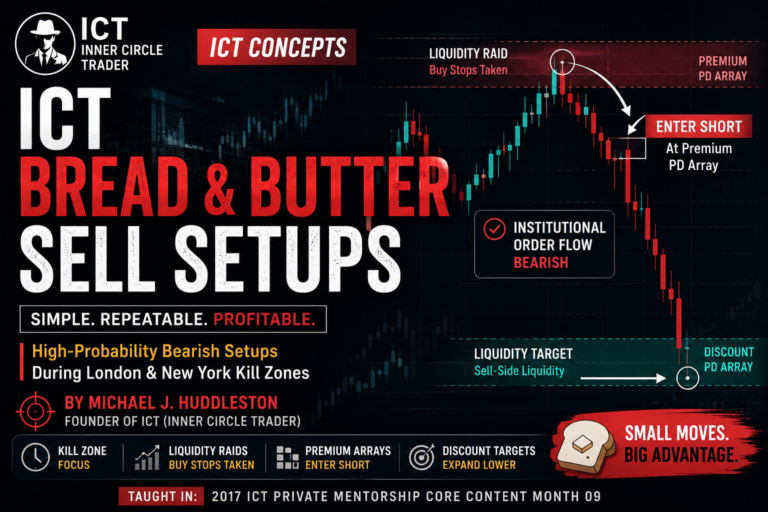
A previous day’s high reversal occurs when price trades above the prior day’s high, takes the buy stops resting above it and then reverses lower.
This is not a signal to sell every time price moves above yesterday’s high.
The preferred conditions include:
- Higher-timeframe institutional order flow is bearish
- Price is retracing higher within a larger bearish expansion
- A premium PD array is located above the previous day’s high
- Buy-side liquidity is resting above the high
- Price reaches the premium array and shows rejection
- A lower liquidity objective remains available
The previous day’s high becomes more significant when it aligns with:
- A bearish fair value gap
- A bearish order block
- A rejection block
- A premium portion of a dealing range
- An intermediate-term high
- Equal highs
The trader looks to sell after price raids the previous day’s high and confirms bearish delivery.
2. Previous Day’s Low Reversal
A previous day’s low reversal occurs when price trades below the prior day’s low, takes the sell stops and then reverses higher.
The setup becomes stronger when:
- Higher-timeframe institutional order flow is bullish
- Price is retracing lower within a larger bullish expansion
- A discount PD array exists below the previous day’s low
- Sell-side liquidity is resting below the low
- Price quickly rejects the lower level
- An upside liquidity objective remains available
Michael J. Huddleston explains that price may find institutional buyers below the previous day’s low when the low aligns with a discount array.
Useful bullish confluences may include:
- A bullish fair value gap
- A bullish order block
- A breaker block
- A mitigation block
- A discount dealing-range level
- An old sell-side liquidity pool
The setup is not simply “buy below yesterday’s low.”
The surrounding market context determines whether the liquidity raid is likely to reverse or continue.
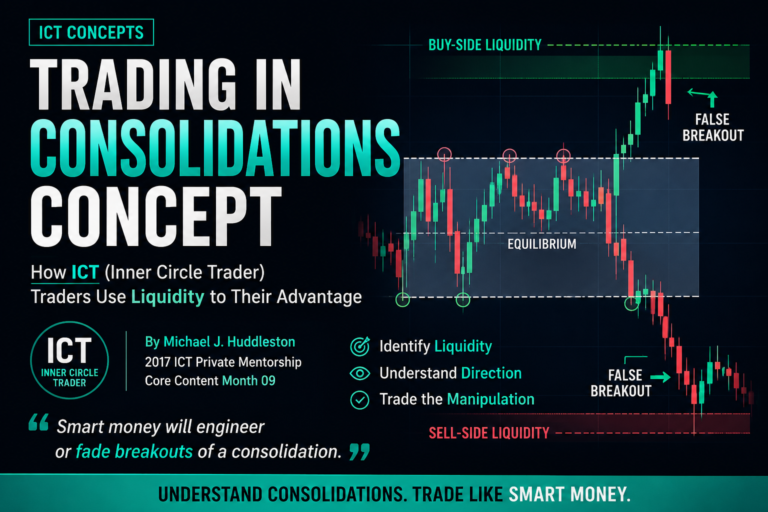
The Relationship With Turtle Soup
Previous day’s high and low reversals are closely connected to the ICT Turtle Soup concept.
A Turtle Soup setup is a false breakout above an old high or below an old low.
For a bearish Turtle Soup setup:
- Price trades above an old high
- Buy stops are triggered
- The breakout fails
- Price reverses lower
For a bullish Turtle Soup setup:
- Price trades below an old low
- Sell stops are triggered
- The breakdown fails
- Price reverses higher
The Trading Market Reversals Concept goes beyond the basic false-breakout pattern by adding:
- Higher-timeframe order flow
- PD array alignment
- Market profiling
- Session timing
- Liquidity objectives
3. Intraweek High Reversal
An intraweek high reversal occurs when price trades above the highest high formed during the current week, raids the buy stops and then reverses lower.
This setup often develops around the middle of the week.
For example:
- Tuesday forms an initial weekly high
- Wednesday or Thursday trades above Tuesday’s high
- Price reaches a higher-timeframe premium array
- Buy-side liquidity is taken
- The market reverses lower
This structure may help form the actual high of the week.
The strongest intraweek high reversals often include:
- Equal highs
- A previous daily high
- A weekly premium PD array
- A mature bullish expansion
- Tuesday or Wednesday liquidity
- A bearish weekly template
- New York or London session timing
Michael J. Huddleston explains that equal highs can attract buy stops because they are easily visible to retail traders.
Banks may use that liquidity to establish short positions.
4. Intraweek Low Reversal
An intraweek low reversal occurs when price trades below the lowest low formed during the current week, raids sell stops and then reverses higher.
An example may develop as follows:
- Monday or Tuesday forms the initial weekly low
- A later day trades below that low
- Price reaches a higher-timeframe discount array
- Sell-side liquidity is taken
- The market reverses higher
This may become the true low of the week.
The setup becomes stronger when the intraweek low overlaps with:
- Equal lows
- A previous week’s low
- A daily discount fair value gap
- A weekly bullish order block
- A lower dealing-range discount
- A bullish weekly profile
A raid below an intraweek low may also create a tradable intraday reaction even when the market does not begin a large multi-day reversal.
Weekly Templates and Intraweek Reversals
Intraweek reversals should be studied alongside ICT weekly templates.
The weekly template helps the trader anticipate:
- Which day may form the weekly high
- Which day may form the weekly low
- Whether early-week price action is manipulation
- Whether midweek price action is likely to reverse
- Where the weekly expansion may deliver
A liquidity raid becomes more meaningful when it occurs on a day that fits the expected weekly profile.
5. Intermediate-Term High Reversal
An intermediate-term high is an older high that may come from:
- The previous week
- Several weeks earlier
- The previous month
- A larger consolidation
- A major swing structure
An intermediate-term high reversal occurs when price trades above this old high, raids buy stops and then reverses lower.
These highs may hold larger pools of liquidity because institutional and longer-term traders may place stops around them.
However, the trader must understand why price is being permitted to trade above the high.
Possible reasons include:
- Providing liquidity for institutional selling
- Allowing long positions to exit
- Reaching a higher-timeframe premium array
- Completing a mature bullish expansion
- Engineering a false breakout
- Continuing through the level toward a higher objective
The trader should not automatically treat an old high as resistance.
The reversal idea becomes stronger when the old high is located inside or near a higher-timeframe premium array.
6. Intermediate-Term Low Reversal
An intermediate-term low reversal occurs when price trades below an old weekly, monthly or major swing low, takes sell-side liquidity and then reverses higher.
The old low may contain:
- Long-position stop losses
- Sell-stop breakout orders
- Institutional exit liquidity
- Liquidity from previous swing traders
The reversal becomes more probable when:
- Price is in higher-timeframe discount
- A bullish PD array is present
- The market has experienced a prolonged decline
- The liquidity raid completes a larger objective
- Institutional order flow is shifting bullish
- The market is trading inside a broad consolidation
The trader must decide whether the old low is a reversal location or only an intermediate target in a continuing bearish move.
Why Consolidations Support Intermediate-Term Reversals
Intermediate-term reversals often work well in range-bound markets.
During consolidation, price may repeatedly raid old highs and lows without establishing a sustained trend.
This creates opportunities to:
- Sell above old highs
- Buy below old lows
- Fade false breakouts
- Trade back toward the middle of the range
- Target the opposing side of the consolidation
Old weekly or monthly highs and lows can become especially important because they may contain larger pools of resting institutional liquidity.
7. New York Session Reversal
The New York session is generally expected to continue the directional movement established during London.
If London creates the low of the day and expands higher, New York will usually be viewed as a bullish continuation session.
If London creates the high of the day and expands lower, New York will usually be viewed as a bearish continuation session.
A New York reversal becomes more likely when price reaches a higher-timeframe PD array during the New York opening period.
Michael J. Huddleston explains:
“Unless the New York session opens up at a premium array on a higher time frame or discount array on the higher time frame, New York will always be expected to be a continuation of what was seen in London.”
Bullish New York Session Reversal
A bullish New York reversal may develop when:
- London trades lower
- London initially establishes the high of the day
- Price enters New York near a higher-timeframe discount array
- New York trades into the discount array
- Sell-side liquidity is taken
- Price reverses and closes higher
The New York session changes the daily profile from bearish to bullish.
The setup becomes stronger when the discount array aligns with:
- A daily fair value gap
- A four-hour bullish order block
- A previous day’s low
- An intraweek low
- A projected daily range level
- A weekly liquidity objective
Bearish New York Session Reversal
A bearish New York reversal may develop when:
- London trades higher
- London initially establishes the low of the day
- Price reaches New York near a higher-timeframe premium array
- New York trades into the premium array
- Buy-side liquidity is taken
- Price reverses and closes lower
The New York session changes the daily profile from bullish to bearish.
The setup becomes stronger when the premium array aligns with:
- A daily fair value gap
- A four-hour bearish order block
- A previous day’s high
- An intraweek high
- Equal highs
- A projected upper daily range
New York Continuation Versus Reversal
A trader should begin with the expectation that New York will continue London’s move.
That expectation changes only when a meaningful higher-timeframe level is reached.
Expect New York Continuation When:
- London establishes a clear directional move
- No higher-timeframe opposing PD array has been reached
- The average daily range remains incomplete
- The higher-timeframe bias supports continuation
- A clear external liquidity target remains available
Expect New York Reversal When:
- London delivers price into a major higher-timeframe PD array
- New York opens near the array
- Buy-side or sell-side liquidity is taken
- Price shows immediate rejection
- The expected daily profile supports reversal
- The weekly template supports a turning point
8. London Close Reversal
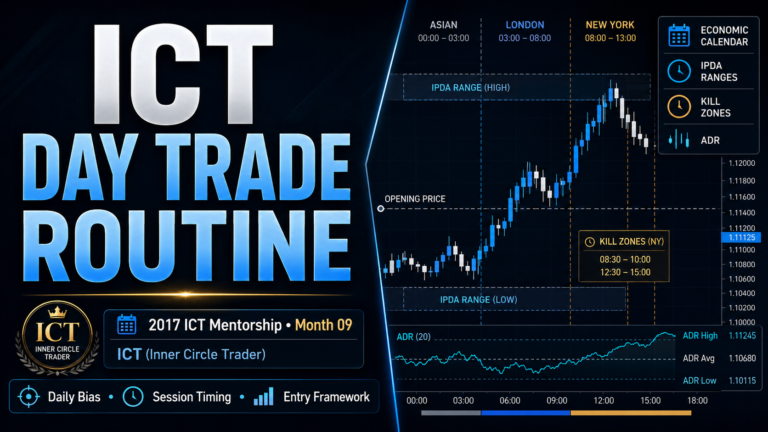
The London Close reversal occurs during approximately 10:00 to 12:00 New York time.
It can produce:
- A short-term intraday retracement
- A reversal of the New York move
- A second liquidity raid
- The beginning of a multi-day directional move
The most common London Close scalp occurs after price has produced an unusually large daily range.
Average Daily Range and London Close Reversals
Michael J. Huddleston explains that London Close reversals are more attractive when price has exceeded the five-day average daily range.
For example, if the five-day average daily range is 100 pips, the preferred condition may be a daily move of approximately:
- 125 pips
- 130 pips
- 150 pips
- Or more
After an aggressive one-sided move, intraday profit-taking may produce a measurable retracement.
Price may retrace approximately 20 percent of the total daily range.
The best London Close reversal conditions generally include:
- A large one-sided daily expansion
- The five-day ADR has been exceeded
- Price reaches a higher-timeframe PD array
- A session liquidity objective has been completed
- Weakness appears between 10:00 and 12:00 New York time
- Institutional profit-taking begins
The Second Liquidity Swipe at London Close
London Close may sometimes revisit a New York reversal level.
For example, during a bullish reversal:
- New York trades below a low
- Sell-side liquidity is taken
- Price rallies
- London Close trades below the New York low again
- Additional sell stops are taken
- Price reverses higher more aggressively
This second raid may stop out traders who correctly anticipated the first reversal but used tight stops.
A similar structure may occur above a New York high during a bearish setup.
PD Arrays and Market Reversals
PD arrays provide the institutional location for the reversal.
A liquidity raid is more useful when it occurs at a logical premium or discount array.
Premium PD Arrays for Bearish Reversals
- Bearish order block
- Bearish fair value gap
- Rejection block
- Breaker block
- Previous high
- Equal highs
- Premium dealing-range level
- Higher-timeframe imbalance
Discount PD Arrays for Bullish Reversals
- Bullish order block
- Bullish fair value gap
- Mitigation block
- Breaker block
- Previous low
- Equal lows
- Discount dealing-range level
- Higher-timeframe imbalance
The best reversals often contain several overlapping PD arrays.
Institutional Order Flow and Reversal Context
Higher-timeframe institutional order flow helps determine whether a liquidity raid should be faded.
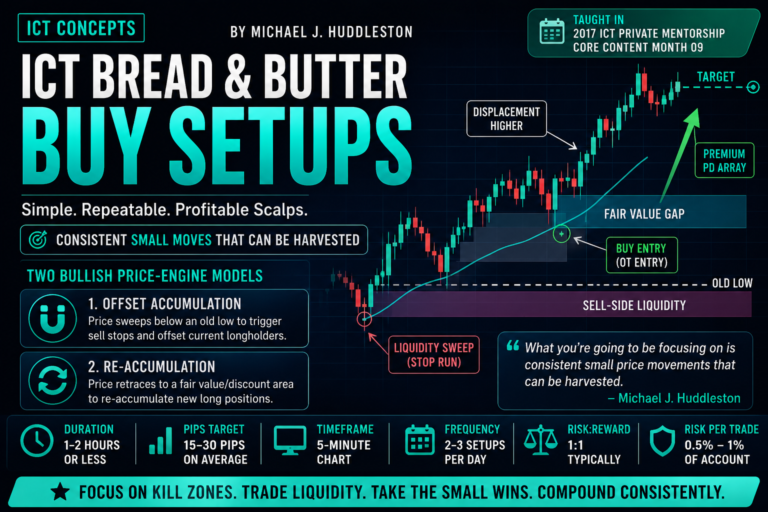
For a bullish reversal, the trader prefers:
- Bullish weekly or daily order flow
- A retracement into discount
- Sell-side liquidity being taken
- A clear upside target
For a bearish reversal, the trader prefers:
- Bearish weekly or daily order flow
- A retracement into premium
- Buy-side liquidity being taken
- A clear downside target
Without this context, the trader may attempt to reverse a market that is still expanding strongly in the original direction.
Reversal Versus Continuation
A common mistake is assuming every old high or low will create a reversal.
Price may raid liquidity for two different purposes.
Liquidity Used for Reversal
Price takes stops, reaches a PD array and moves in the opposite direction.
Liquidity Used for Continuation
Price takes stops, accepts the new price level and continues expanding.
Signs of a possible reversal include:
- Immediate rejection
- Strong displacement away from the level
- A market structure shift
- Failure to remain above or below the liquidity pool
- Repricing through a fair value gap
- Session timing supporting reversal
Signs of continuation may include:
- Price holding above the old high
- Price holding below the old low
- Repeated testing of the level
- Strong displacement through the PD array
- No opposing higher-timeframe objective
- Remaining external liquidity in the direction of the breakout
Why Immediate Price Response Matters
A strong reversal setup should normally produce a decisive reaction.
After liquidity is taken, the trader wants to see:
- Sharp rejection
- Strong displacement
- A clear change in short-term delivery
- Fair value gaps forming in the reversal direction
- Short-term market structure changing
- Price moving away from the PD array
If price remains around the old high or low for too long, the probability of reversal may decrease.
Acceptance beyond the liquidity level may indicate continuation.
Overlapping Reversal Concepts
The highest-quality setups may combine several reversal types.
For example, price may trade above:
- The previous day’s high
- An intraweek high
- Equal highs
- A higher-timeframe premium array
The raid may also occur during the New York session.
This single setup combines:
- Previous day’s high reversal
- Intraweek high reversal
- Equal-high liquidity
- New York session reversal
- Premium PD array confluence
The more relevant concepts overlap, the stronger the reversal narrative may become.
However, the trader should avoid adding unrelated confirmations simply to justify a trade.
Example of a Bullish Market Reversal
Assume the daily institutional order flow is bullish.
Price is retracing lower inside a larger bullish expansion.
The previous day’s low is located above a daily fair value gap.
During the London session, price trades below the previous day’s low and enters the fair value gap.
Sell stops are triggered.
At the New York open, price shows immediate bullish displacement and creates a five-minute market structure shift.
The trader may look for a long entry during a retracement into a lower-timeframe bullish PD array.
Possible targets include:
- The current day’s open
- The London high
- The previous day’s high
- Equal highs
- A higher-timeframe premium array
Example of a Bearish Market Reversal
Assume the daily institutional order flow is bearish.
Price is retracing higher inside a larger bearish expansion.
An intraweek high and the previous day’s high are positioned near a four-hour bearish fair value gap.
During New York, price trades above both highs and enters the fair value gap.
Buy stops are triggered.
Price rejects the premium array and creates bearish displacement.
The trader may look for a short entry during a retracement into a lower-timeframe bearish PD array.
Possible targets include:
- The daily opening price
- The London low
- The previous day’s low
- Equal lows
- A higher-timeframe discount array
Practical Trading Market Reversals Checklist
Higher-Timeframe Analysis
- Is weekly, daily or four-hour institutional order flow clear?
- Is price in premium or discount?
- Is a higher-timeframe PD array nearby?
- Is the market trending or consolidating?
- What is the main draw on liquidity?
Liquidity Analysis
- Is price approaching the previous day’s high or low?
- Is there an intraweek high or low nearby?
- Are equal highs or equal lows present?
- Is an intermediate-term swing being targeted?
- Which traders are likely to have stops around the level?
Session Analysis
- Is the setup occurring during London, New York or London Close?
- Should New York continue London or reverse it?
- Has the daily range already expanded significantly?
- Does the weekly template support a reversal?
Confirmation
- Has price raided the liquidity level?
- Has price reached the expected PD array?
- Is there immediate rejection?
- Has displacement appeared?
- Has short-term market structure shifted?
- Is there sufficient range to the target?
Risk Management
- Where is the setup invalidated?
- Is the stop beyond a logical liquidity level?
- Is the potential reward worth the risk?
- Has the reversal already delivered most of its move?
- Is the trader forcing a reversal without confirmation?
Common Mistakes
Common mistakes when trading market reversals include:
- Selling every old high
- Buying every old low
- Ignoring higher-timeframe institutional order flow
- Trading without a clear PD array
- Assuming every liquidity raid must reverse
- Entering before liquidity is taken
- Ignoring session timing
- Trading against strong displacement
- Using very tight stops around obvious liquidity
- Forcing a reversal after the daily objective is complete
- Failing to distinguish consolidation from expansion
The Importance of Chart Study
The Trading Market Reversals Concept requires experience.
A trader cannot fully understand every reversal scenario from one or two examples.
Michael J. Huddleston states:
“The best teacher you have is your charts and the time you spend over top of them.”
A practical study method is to select one market and review several months of historical price action.
For each reversal, record:
- The time and day
- The old high or low that was raided
- The higher-timeframe PD array
- The market’s directional bias
- The session in which the reversal occurred
- The liquidity objective
- The displacement after the raid
- The final size of the move
This process helps the trader recognize recurring market behavior.
Final Thoughts
The Trading Market Reversals Concept teaches traders to understand why price moves beyond an old high or low before reversing.
The eight primary reversal conditions are:
- Previous day’s high
- Previous day’s low
- Intraweek high
- Intraweek low
- Intermediate-term high
- Intermediate-term low
- New York session reversal
- London Close reversal
The common principle behind each setup is the interaction between:
- Liquidity
- Higher-timeframe institutional order flow
- Premium and discount PD arrays
- Session timing
- Weekly templates
- Immediate price displacement
A reversal is not confirmed simply because price raids a high or low.
The trader must understand the storyline behind the move, determine whether the liquidity raid completes a meaningful objective and wait for price to confirm rejection.
The goal is not to predict every turning point.
The goal is to recognize repeatable conditions where the probability of a reversal is meaningfully higher.