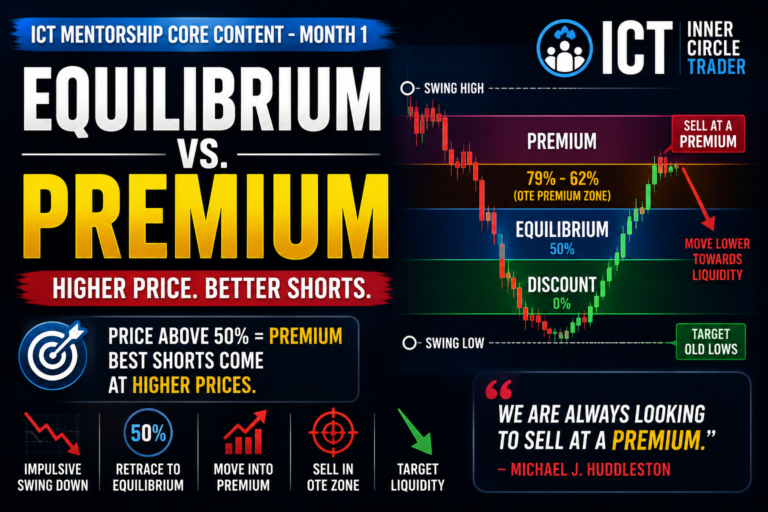
The ICT Impulse Price Swings & Market Protraction concept is an important price action framework taught by Michael J. Huddleston, the founder of ICT (Inner Circle Trader). This concept is taught in the ICT Mentorship Core Content – Month 1 and explains how traders can study individual price swings while also identifying smaller time-sensitive moves that may be designed to manipulate market participants.
At first, impulse price swings and market protraction may look very similar on a chart.
Both involve price moving sharply higher or lower.
But there is one important difference.
Market protraction has a time element.
Michael J. Huddleston explains:
“Market protraction is time sensitive. It’s an impulse price swing that is highly sensitive to a time of day.”
This is the main foundation of the ICT Impulse Price Swings & Market Protraction concept.
An impulse price swing helps the trader read price movement from one swing point to another. Market protraction takes this idea further by focusing on a small impulsive movement that occurs around a specific time of day and may move counter to the larger expected direction.
What is an ICT Impulse Price Swing?
An ICT impulse price swing is a directional movement of price from one market swing point to another.
Price continuously moves between highs and lows.
For example:
High → Low → High → Low
Or:
Low → High → Low → High
Each directional movement between these swing points can be studied as an impulse price swing.
Suppose price moves sharply from a high to a low.
This is an impulse swing lower.
Price then rallies from that low to another high.
This becomes an impulse swing higher.
The market may then move lower again and create another impulse price swing.
Therefore, price can be viewed as a continuous sequence of directional swings.
Michael J. Huddleston states:
“When you look at price action you need to be thinking in terms of impulse price swings.”
The purpose is not simply to label every high and low.
The trader studies the individual price swings because each swing can provide information about market structure, premium and discount, liquidity and the expected direction of price.
How Impulse Price Swings Form
Price does not normally travel in a perfectly straight line.
The market moves higher, retraces, moves lower and retraces again.
These movements create price swings.
A simple bearish price sequence may look like:
Swing High → Impulse Lower → Swing Low → Retracement Higher → New Impulse Lower
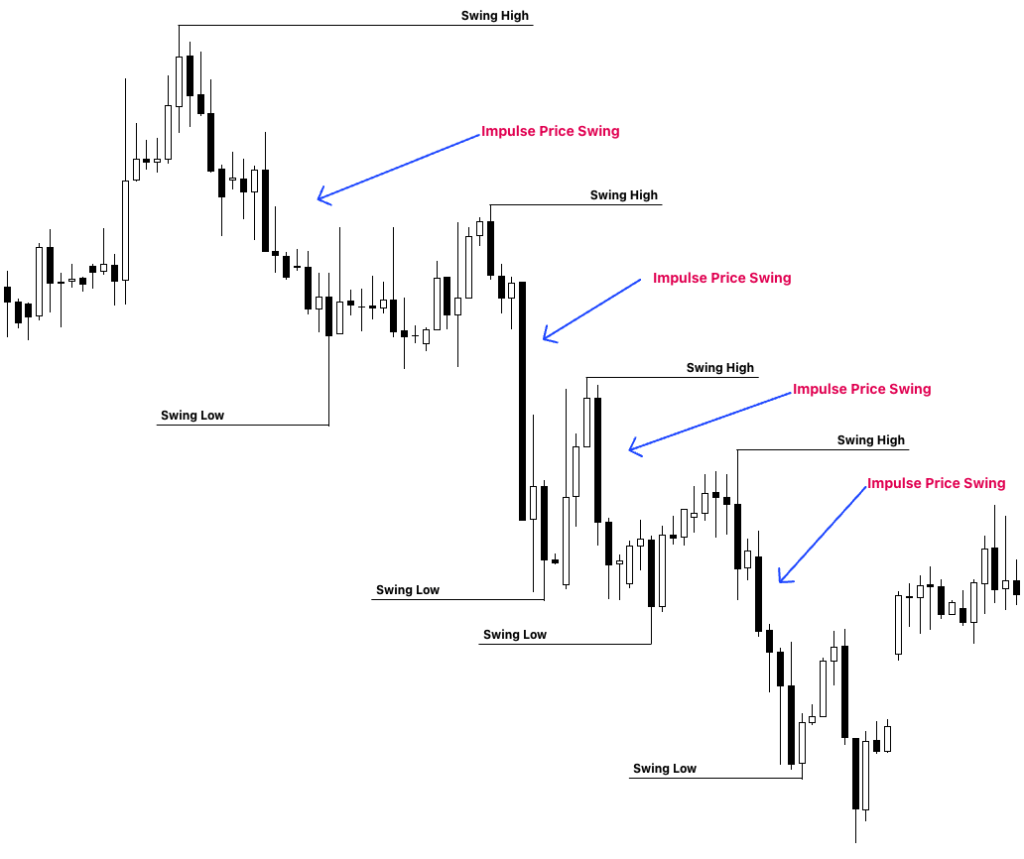
A bullish sequence may look like:
Swing Low → Impulse Higher → Swing High → Retracement Lower → New Impulse Higher
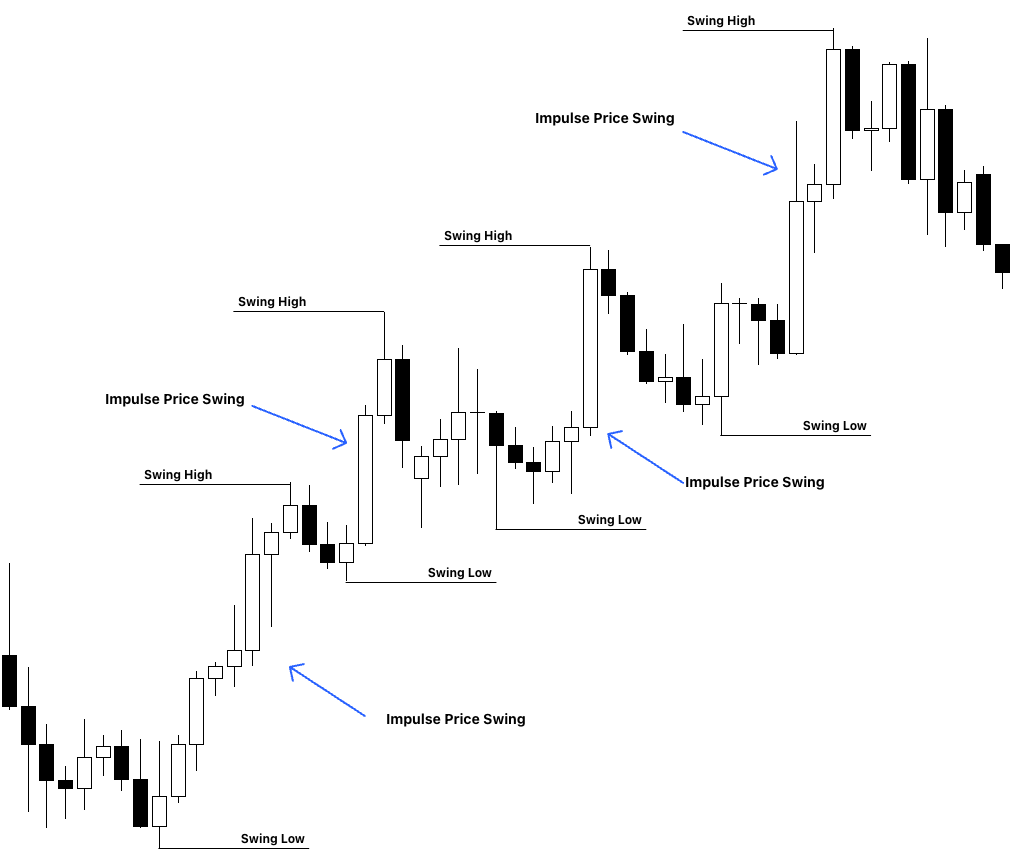
The trader studies where each impulse begins and where it ends.
This allows the individual price leg to be measured.
For example, when price moves from a high to a low, the trader can measure that bearish impulse swing.
If price retraces above equilibrium and enters premium, ICT concepts may be used to study a possible selling opportunity.
The impulse swing provides the price range.
Other ICT concepts provide additional context inside that range.
Why Impulse Price Swings Are Important in ICT
Impulse price swings help break a large chart into smaller understandable price movements.
Instead of looking at hundreds of candles together, the trader can study:
- Where the swing started
- Where the swing ended
- Direction of the impulse
- Depth of the retracement
- Premium and discount
- Liquidity above or below price
- Time of day
The impulse swing can therefore become a framework for analyzing price.
For example, suppose price makes a strong impulse swing lower.
The trader identifies the high and low of that swing.
Price later retraces above equilibrium into premium.
If the market bias is bearish, the trader may anticipate another move lower.
The potential target may be liquidity below the previous low.
The basic idea can be written as:
Impulse Lower → Retracement Into Premium → Bearish Setup → Expansion Lower → Sell-Side Liquidity
The opposite applies to bullish conditions.
Impulse Higher → Retracement Into Discount → Bullish Setup → Expansion Higher → Buy-Side Liquidity
What is Market Protraction in ICT?
ICT Market Protraction is a small, time-sensitive impulse price swing that can occur before the larger expected market movement.
It is not simply any sharp movement in price.
The time of day is important.
Michael J. Huddleston describes the difference clearly:
“The difference in determining impulse price swings and market protraction is the fact that there is a time element applied to the small impulse swing.”
Market protraction can initially move price in the opposite direction of the larger anticipated move.
Its purpose, according to the ICT framework, is to manipulate the short-term sentiment of market participants, reach for liquidity or encourage traders to enter on the wrong side of the market.
For example, the larger market direction may be bearish.
Around a time-sensitive market period, price initially rallies.
Traders may interpret the rally as bullish.
Buyers enter the market.
Price reaches liquidity above a short-term high.
The market then reverses and expands lower.
This initial bullish movement can be viewed as market protraction.
The sequence may look like:
Bearish Context → Short Rally Higher → Liquidity Run → Reversal → Bearish Expansion
In bullish conditions:
Bullish Context → Short Drop Lower → Liquidity Run → Reversal → Bullish Expansion
Market Protraction is Designed to Move Counter Direction
One of the most important ideas in the ICT Impulse Price Swings & Market Protraction concept is the counter-directional nature of protraction.
When the protractionary move initially travels higher, the trader considers the possibility of a later move lower.
When the initial move travels lower, the trader considers the possibility of a later move higher.
As Michael J. Huddleston explains:
“If it goes higher we think the opposite direction. If it goes lower we think the opposite direction.”
However, this does not mean every bullish candle should be sold or every bearish candle should be bought.
The move must be studied with:
- Time of day
- Larger directional bias
- Previous impulse price swing
- Liquidity
- Premium and discount
- Previous highs and lows
Market protraction is a contextual concept.
The time-sensitive impulse must fit the larger price narrative.
Three Important Market Protraction Times
According to the Month 1 ICT lesson, there are three primary protractionary periods within a 24-hour market cycle.
Using New York time with GMT-4 seasonal reference, these important periods can be studied around:
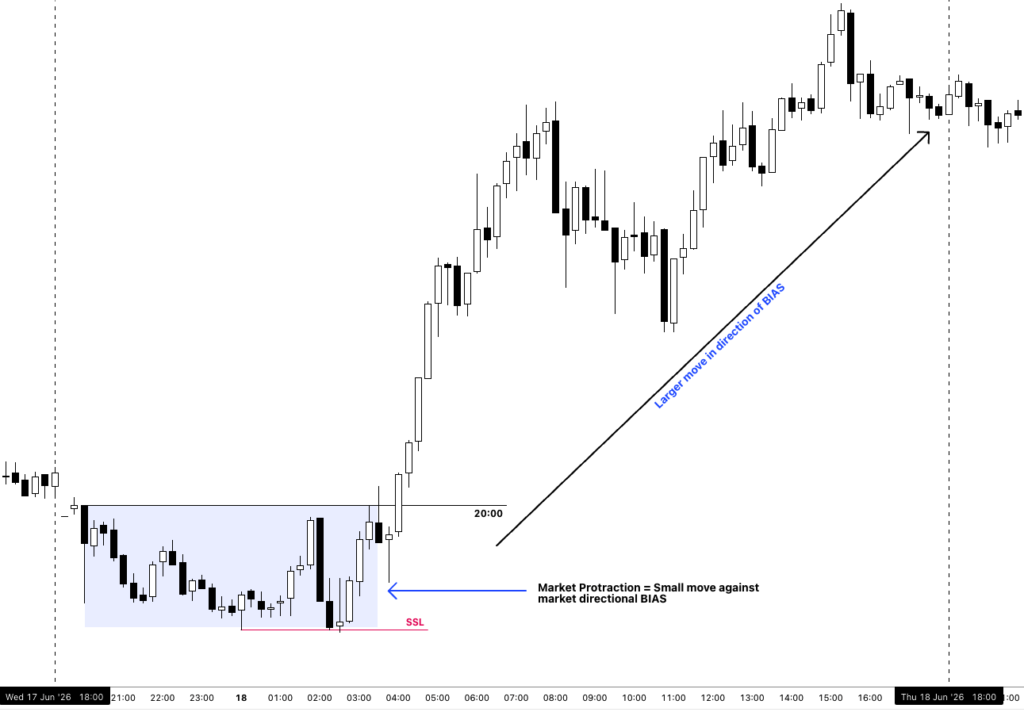
20:00 New York Time
The first protractionary movement is associated with the 00:00 GMT reference, which corresponds to approximately 20:00 New York time when New York is on GMT-4.
A small initial movement higher or lower may develop around this time.
The ICT treats this as part of the Asian session reference.
The trader studies the initial small impulse away from this time reference.
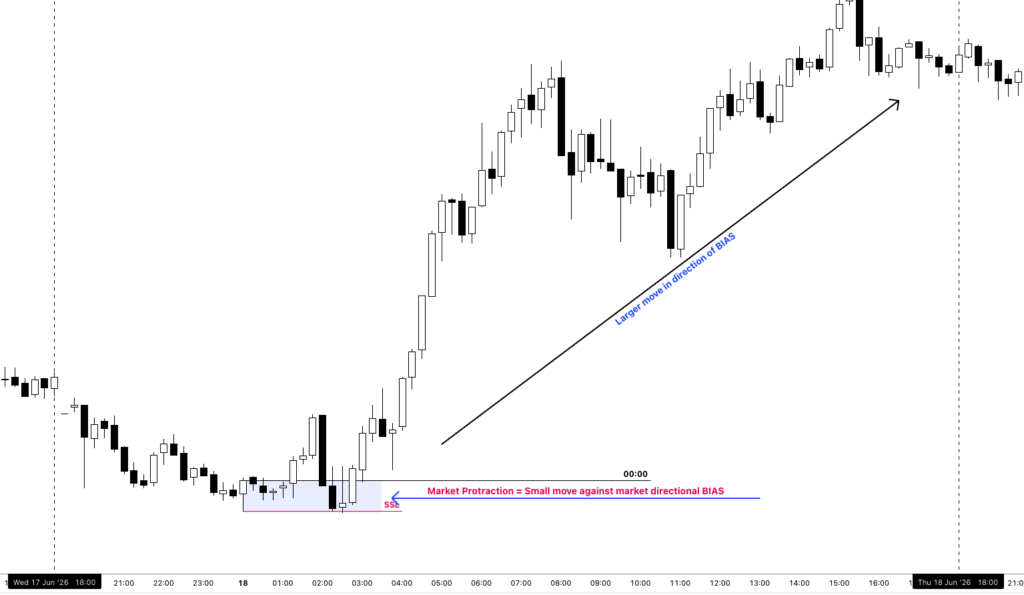
00:00 New York Time
The next important reference is around midnight New York time.
This period is connected with the London session development discussed in the mentorship.
Price may initially move higher or lower after midnight.
When this move is counter to the expected directional bias, it may represent a protractionary market phase.
For example:
Bearish Bias → Initial Rally After Midnight → False Bullish Move → Expansion Lower
This type of false initial movement is also associated with the ICT Judas Swing concept.
After 07:00 New York Time
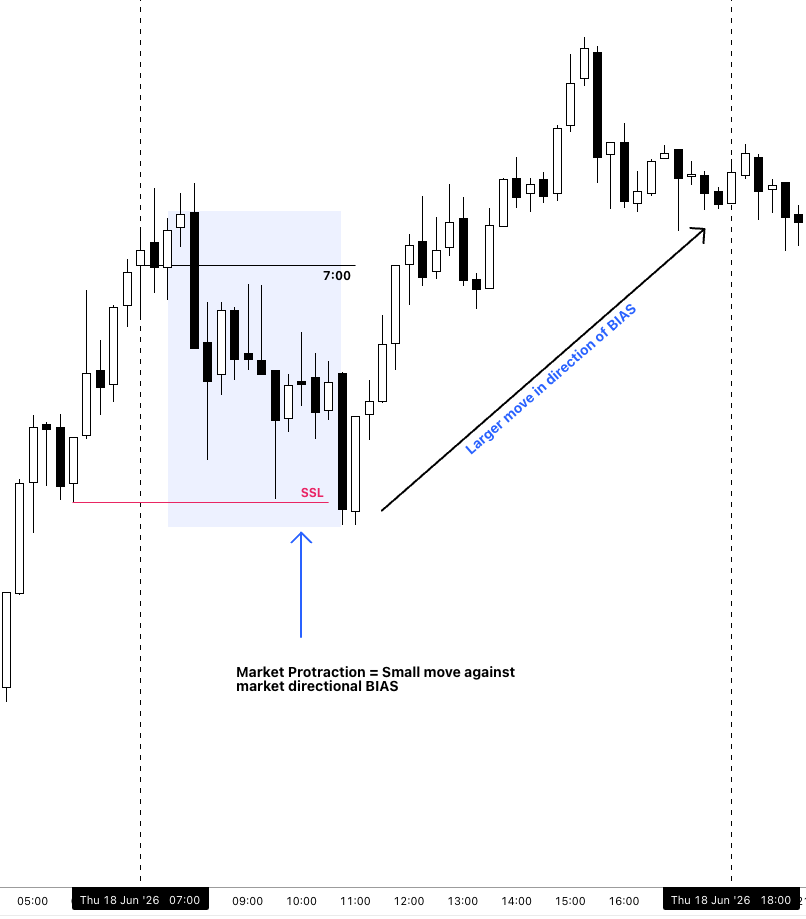
Another important protractionary period occurs after 07:00 New York time, approaching the New York session opening.
The ICT repeatedly emphasizes the importance of the move occurring after 07:00.
Suppose London has already moved lower and the larger context remains bearish.
After 07:00 New York time, price may retrace higher.
This bullish impulse may encourage traders to believe that a market low has formed.
However, under the ICT framework, the rally may instead be a protractionary move.
Price can reach for liquidity and then expand lower.
The sequence is:
London Move Lower → 07:00 NY Retracement Higher → Protraction → Liquidity Run → Bearish Expansion
The opposite concept can occur in bullish market conditions.
ICT Market Protraction and the Judas Swing
Market protraction has a close relationship with the ICT Judas Swing.
A Judas Swing is an initial false directional move that may occur before the larger anticipated market expansion.
For example, assume the market bias is bearish.
Price initially rallies during the London session.
The bullish move attracts buyers.
It may also reach above a short-term high where buy-side liquidity is resting.
Price then reverses.
The market expands lower in the anticipated bearish direction.
This can be described as:
False Rally → Reach for Liquidity → Bearish Reversal → Expansion Lower
In this condition, the initial rally can be viewed as both a Judas Swing and a protractionary market movement.
Michael J. Huddleston describes a bearish example as:
“It’s a false rally to sell into.”
The same concept can occur inversely in a bullish market.
An initial bearish move may raid liquidity below the market before price expands higher.
How Market Protraction Manipulates Traders
Market protraction can create the appearance that the market is beginning a new directional move.
Suppose price has been moving lower.
Around the New York session, price forms what appears to be a low.
The market then rallies.
Short-term traders see the rally and begin buying.
The move can create bullish sentiment.
But according to the ICT market protraction framework, this small impulse higher may be designed to draw market participants onto the wrong side of the market.
Michael J. Huddleston explains that the move can:
“Draw in participants on the wrong side of the marketplace or reach for liquidity.”
The market may then reverse.
Traders who chased the initial move become trapped.
Price expands in the larger anticipated direction.
This is why the ICT trader does not automatically chase the first movement of a session.
The trader studies whether the initial movement could be protraction.
Combining Impulse Price Swings With Premium and Discount
The ICT Impulse Price Swings & Market Protraction concept becomes more useful when combined with premium and discount analysis.
Suppose price creates a bearish impulse swing.
The trader measures the movement from the swing high to the swing low.
The price range can then be divided around equilibrium.
Above equilibrium is premium.
Below equilibrium is discount.
If the directional bias is bearish, the trader may prefer to study selling opportunities in premium.
The model becomes:
Bearish Impulse Swing → Retracement Above Equilibrium → Premium → Market Protraction → Sell Setup → Lower Liquidity
The ICT gives an example of price retracing into a premium market around the 62% retracement area before expanding lower.
The important idea is not to use a retracement level alone.
The trader blends:
- Impulse price swing
- Time of day
- Market protraction
- Premium or discount
- Liquidity target
When multiple concepts support the same directional expectation, the market narrative becomes clearer.
Bearish Market Protraction Example
Assume the larger market context is bearish.
Price has already made an impulse swing lower.
A previous low contains sell-side liquidity.
The trader expects price to continue lower.
Around a protractionary time window, price initially rallies.
The rally moves into premium.
Price may also return to an area where the market previously sold off.
This rally can be viewed as market protraction.
The trader studies the possibility of:
Impulse Lower → Retracement Higher → Premium → Protractionary Rally → Bearish Entry Model → Sell-Side Liquidity
Price then expands lower and attacks the stops resting below old lows or equal lows.
In this example, the initial bullish movement is not viewed as confirmation of a bullish market.
It is studied as a possible manipulation before bearish expansion.
Bullish Market Protraction Example
The concept can be reversed for bullish conditions.
Suppose price has created a strong impulse swing higher.
The larger bias remains bullish.
There is buy-side liquidity above an old high.
Around a time-sensitive market period, price initially trades lower.
The decline can make traders believe that price is becoming bearish.
Sell-side liquidity below a short-term low may be taken.
Price enters discount.
The market then reverses higher.
The sequence becomes:
Impulse Higher → Initial Drop → Discount → Protractionary Decline → Bullish Reversal → Buy-Side Liquidity
The initial move lower can be a manipulative impulse before the larger bullish expansion.
How to Identify ICT Market Protraction on a Chart
To identify market protraction, first determine the larger market context.
Do not begin with the small impulse move.
Start with the directional narrative.
Identify the Previous Impulse Price Swing
Mark the important swing high and swing low.
Determine whether the previous important impulse was bullish or bearish.
Determine the Expected Direction
Study the larger ICT market bias.
Ask whether price is likely seeking buy-side or sell-side liquidity.
Mark the Important Time of Day
Pay attention to the time-sensitive market periods discussed in the mentorship.
Especially study price around:
- 20:00 New York time under the GMT-4 reference
- 00:00 New York time
- After 07:00 New York time
Broker chart time can differ, so the trader should correctly convert the time reference used on their platform.
Watch the Initial Small Impulse
Observe the first small directional move around the important time.
Does price initially move counter to the anticipated larger direction?
Identify Nearby Liquidity
Look for:
- Short-term highs
- Short-term lows
- Equal highs
- Equal lows
- Old highs
- Old lows
The protractionary move may reach toward one of these liquidity areas.
Wait for the Larger Direction to Resume
The initial counter-directional movement alone does not complete the idea.
The trader wants to see price begin moving in the anticipated larger direction.
This is where market protraction becomes part of the market narrative.
Impulse Price Swing vs Market Protraction
An impulse price swing and market protraction are closely related but not exactly the same.
Impulse Price Swing
An impulse price swing is a directional price movement from one swing point to another.
It can occur at any time.
Its main characteristics are:
- Directional price movement
- Movement between highs and lows
- Can be bullish or bearish
- Used to study market structure
- Can define a price range
Market Protraction
Market protraction is a specific type of small impulse price swing.
Its main characteristics are:
- Time sensitive
- Develops around important session periods
- Often counter to the larger expected direction
- Can reach for liquidity
- Can manipulate short-term market sentiment
- May occur before directional expansion
The easiest way to remember the difference is:
Every market protraction is an impulse price swing, but every impulse price swing is not market protraction.
The time element makes market protraction unique.
Common Mistakes When Studying Market Protraction
One common mistake is labeling every counter-directional move as market protraction.
A retracement can occur at any time.
Market protraction is specifically connected with a time-sensitive price movement.
Another mistake is trading only because the first session move went higher or lower.
The trader must first understand the larger expected direction.
For example:
Initial Move Higher ≠ Automatic Sell
The trader should have a bearish context supporting the expectation of lower prices.
Similarly:
Initial Move Lower ≠ Automatic Buy
The larger market narrative should support bullish price delivery.
Another mistake is ignoring liquidity.
The protractionary move may be reaching for a previous high or low.
Understanding the liquidity objective can help explain why the initial counter-directional move occurs.
Why the ICT Impulse Price Swings & Market Protraction Concept Matters
The ICT Impulse Price Swings & Market Protraction concept teaches traders to combine price with time.
Impulse price swings provide information about how the market moves from one high or low to another.
Market protraction adds the time-of-day element.
This helps the trader study whether a small impulse is simply a normal price swing or a possible manipulative move before the larger market expansion.
For session traders, this can provide important context.
Instead of chasing the first move after an important time reference, the trader can ask:
Is this the real directional move, or is price entering a protractionary market phase?
This shift in thinking can help ICT students develop better anticipatory price skills.
Final Thoughts on ICT Impulse Price Swings & Market Protraction
The ICT Impulse Price Swings & Market Protraction concept is based on studying directional price swings and then applying a time-of-day framework to smaller market movements.
Michael J. Huddleston teaches traders to think of price as a continuous series of impulse swings moving between highs and lows.
Within these price swings, certain smaller moves can become more important because they occur around specific times of day.
These time-sensitive impulse movements are known as market protraction.
A protractionary move may initially travel counter to the larger anticipated direction, reach for liquidity and manipulate short-term market sentiment before price expands in the expected direction.
The main distinction is simple:
Impulse Price Swing = Directional movement between price swings.
Market Protraction = A time-sensitive small impulse swing that can move counter to the larger expected direction.
For an ICT (Inner Circle Trader) student, combining impulse swings, time of day, premium and discount, and liquidity can provide a more structured way to read session price action and practice anticipating the next market expansion.