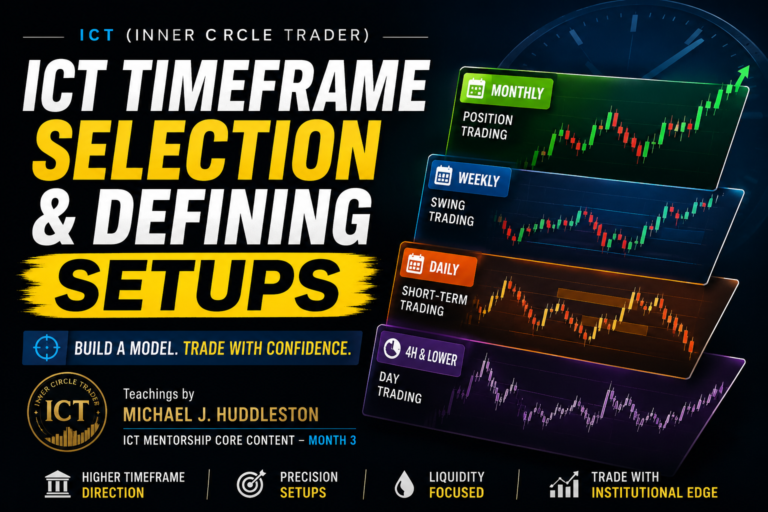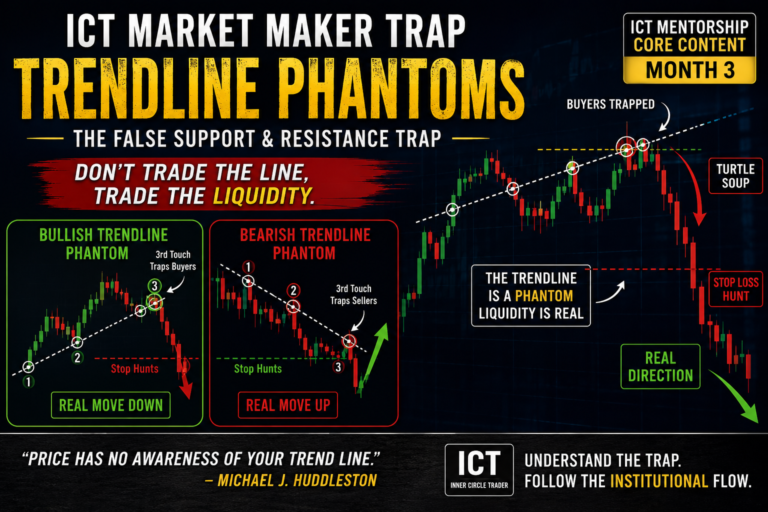
The ICT Institutional Sponsorship concept is an important price action framework taught by Michael J. Huddleston, the founder of ICT (Inner Circle Trader). This concept is taught in ICT Mentorship Core Content – Month 3 and explains how traders can identify whether banks and large institutional participants are supporting a particular price move.
A trading setup may look technically perfect. Price may run liquidity, reach an order block, or move into discount. But ICT teaches that a high-probability setup should also show evidence of Institutional Sponsorship.
Michael J. Huddleston defines the concept clearly:
“Institutional sponsorship is just the willingness to protect an underlying price swing that has high probability of unfolding.”
The main question is simple:
Are large institutional participants supporting and protecting the price move you expect?
What is ICT Institutional Sponsorship?
ICT Institutional Sponsorship is the evidence that banks, large institutions, or major equity participants are actively supporting one side of the marketplace.
In a bullish setup, Institutional Sponsorship should support higher prices.
In a bearish setup, Institutional Sponsorship should support lower prices.
This support is visible through price action.
The market may show:
- Strong higher timeframe price displacement
- Immediate price reaction from an institutional level
- Recapitalization of an old order block
- Protection of important price levels
- Repeated movement toward the expected liquidity objective
- Limited retracement against the expected direction
Institutional Sponsorship is therefore not an indicator.
It is identified by studying how price reacts and delivers from important institutional price levels.
Institutional Sponsorship in Long Setups
For a bullish or long setup, ICT looks for several important conditions.
The first condition is higher timeframe price displacement.
This displacement may develop from:
- A reversal
- A price expansion
- A return to Fair Value
- An intermediate-term imbalance
The next condition is price moving into discount or running sell-side liquidity.
Price may retrace lower into an important institutional area.
Another possibility is price trading below an old low and taking the sell stops resting underneath it.
After this occurs, the trader looks above the marketplace for short-term buy-side liquidity.
This buy-side liquidity provides a logical price objective.
The basic bullish Institutional Sponsorship framework is:
Higher timeframe bullish displacement
↓
Price moves into discount or runs sell-side liquidity
↓
Institutional buying appears
↓
Price is protected from moving significantly lower
↓
Price seeks buy-side liquidity above the market
This is the foundation of Institutional Sponsorship in a bullish setup.
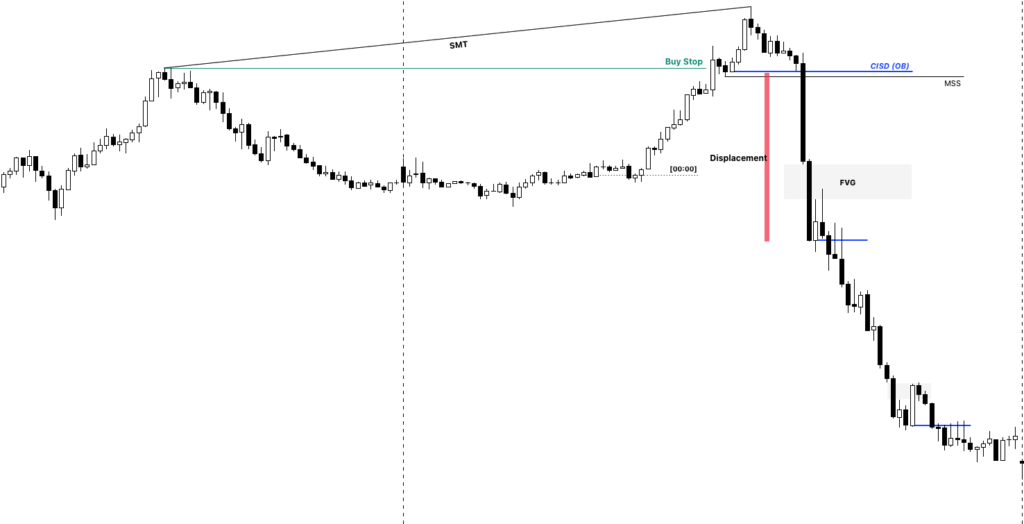
Institutional Sponsorship in Short Setups
The bearish model is the opposite.
First, identify higher timeframe bearish price displacement.
Price may then move into premium or attack buy-side liquidity.
For example, price may trade above an old high and run buy stops.
The trader then identifies short-term sell-side liquidity below the marketplace.
This liquidity may provide the objective for bearish price delivery.
The bearish framework becomes:
Higher timeframe bearish displacement
↓
Price moves into premium or runs buy-side liquidity
↓
Institutional selling appears
↓
Price is protected from moving significantly higher
↓
Price seeks sell-side liquidity below the market
The logic is simply reversed from the bullish model.
Higher Timeframe Price Displacement is the First Clue
One of the first signs of ICT Institutional Sponsorship is higher timeframe price displacement.
Suppose price reaches a significant Daily level and aggressively rallies higher.
The move is fast.
The candles show strong expansion.
Price quickly moves away from the level.
According to ICT, a Daily Chart generally does not create a major dynamic move without large participants supporting the move.
The displacement suggests that a large entity has entered the marketplace.
Huddleston uses a simple analogy.
Imagine an elephant stepping into a small children’s swimming pool.
The elephant displaces a large amount of water.
In the same way, a large institution entering the marketplace creates visible displacement in price.
The trader should therefore ask:
Where did the displacement begin?
Every major price swing has an origin.
The origin of the displacement may identify an important Institutional Sponsorship level.
Find the Origin of the Price Move
Once higher timeframe displacement is identified, go back to the beginning of the move.
Suppose price aggressively rallies higher.
The trader can study the last down candle before the bullish expansion.
This may form a bullish order block.
The order block represents the price area where the institutional move began.
If price later returns to this level, the trader can look for renewed institutional buying.
The idea is based on a simple expectation.
If large participants strongly bought price from an area before, price may show sensitivity when it returns to that same area.
However, the reaction is important.
The price should show that the level is still being sponsored.
Immediate Dynamic Response Confirms Institutional Sponsorship
A major lesson in the ICT Institutional Sponsorship concept is the importance of immediate price reaction.
Huddleston explains:
“You need to see immediate dynamic response.”
Suppose price returns to a bullish order block.
If Institutional Sponsorship exists, price should react strongly.
The market may immediately expand higher.
The bullish order block should appear protected.
But suppose price enters the level and moves sideways.
Price becomes lethargic.
There is no aggressive buying.
The market repeatedly trades back and forth around the entry.
According to ICT, this lack of dynamic reaction may suggest that institutional orders are not supporting the area.
A trader should consider:
- Reducing risk
- Closing part of the position
- Exiting the trade
- Waiting for another setup
Do not become emotionally attached to a setup simply because you entered the trade.
Institutional Sponsorship should become visible through price response.
Sell-Side Liquidity Run in a Bullish Setup
A common Institutional Sponsorship setup begins with a run below an old low.
Traders holding long positions may place protective sell stops below that low.
When many traders use the same protective level, the orders form a sell-side liquidity pool.
Price may trade below the old low and trigger these sell stops.
From the market maker perspective, these sell orders provide counterparties for institutional buying.
If large participants are building a net long position, they may buy into the sell-side liquidity.
The trader should then watch the reaction.
Does price immediately rally?
Does price form bullish displacement?
Does the market return to the same area and find buying again?
These are possible signs of Institutional Sponsorship.
Institutional Sponsorship and Buy-Side Liquidity
After identifying institutional buying, the next question is:
Where can the long positions be distributed or exited?
The answer may be found in buy-side liquidity above the marketplace.
Buy-side liquidity can exist above:
- Short-term highs
- Equal highs
- Old swing highs
- Major higher timeframe highs
Traders holding short positions commonly protect their trades with buy stops above previous highs.
There may also be breakout traders willing to buy when an old high is violated.
From the market maker perspective, this creates a pool of willing buyers.
If institutions accumulated long positions at lower prices, these buyers may provide counterparties when the institutions begin distributing their long positions.
The Institutional Sponsorship narrative may therefore be:
Buy below old low
↓
Protect the bullish price swing
↓
Drive price toward short-term highs
↓
Take buy-side liquidity
↓
Continue toward the next larger liquidity pool
Price Can Move From One Liquidity Pool to Another
Suppose price begins a bullish move.
The first short-term high is violated.
The buy stops above that high are now gone.
The trader should ask:
Where is the next pool of buy-side liquidity?
Price may continue toward another short-term high.
After that liquidity is taken, the next objective may be a larger old swing high.
This is important because traders often expect a reversal every time price reaches an old high.
ICT does not automatically assume that an old high will create a bearish reversal.
If Institutional Sponsorship remains bullish and a larger unfulfilled liquidity objective exists above price, the market may continue higher.
The trader should focus on whether price continues showing willingness to seek the larger objective.
Institutional Sponsorship Protects the Price Swing
One of the clearest characteristics of ICT Institutional Sponsorship is price protection.
Suppose institutions accumulated long positions from a bullish order block.
Price rallies and breaks above an important intermediate-term high.
Market structure now shows bullish characteristics.
If the larger buy-side liquidity objective remains above price, Institutional Sponsorship should protect the bullish price swing.
This means price should not repeatedly return to the original low.
The market may retrace.
But the retracement should normally move into logical institutional areas.
These areas may include:
- Bullish order blocks
- Previous sponsored levels
- Discount areas
- Liquidity voids
The underlying bullish price swing remains protected while price continues toward the higher liquidity objective.
Price Swing Origin, Equilibrium and Terminus
ICT can divide an expected price move into different stages.
Suppose the trader expects price to move from a bullish institutional level toward buy-side liquidity above an old high.
The price swing may be studied as:
Origin
↓
First grade of the price swing
↓
Equilibrium
↓
Higher grade of the swing
↓
Terminus
The origin is where the institutional price move begins.
Equilibrium represents the midpoint of the larger expected range.
The terminus is the final expected objective of the price swing.
Institutional Sponsorship should support price as it moves through the logical stages of the expected range.
The trader should not necessarily expect price to return completely to the origin after the market has already shown strong bullish structure and sponsorship.
Using the New York Midnight Opening Price
One of the important lower timeframe clues explained in the ICT Institutional Sponsorship concept is the New York midnight opening price.
In a bullish environment, ICT studies what price does when it moves below the midnight opening price.
If bullish Institutional Sponsorship exists, price moving below the New York midnight open may be accumulated.
The sequence may look like:
Midnight opening price forms
↓
Price trades below the opening price
↓
Bullish order block forms
↓
Institutional buying appears
↓
Price expands higher
This idea connects Institutional Sponsorship with ICT Power of Three.
On a bullish day, the trader generally wants to buy near or below the Daily opening price and participate in the expansion toward higher prices.
Repeated buying below or near the opening price may show that institutions are supporting the bullish price move.
Institutional Sponsorship and ICT Power of Three
ICT Power of Three studies the relationship between the Daily open, high, low, and close.
In a bullish condition, the preferred idea is to buy near or below the opening price.
Price may first trade lower.
This creates the manipulation or accumulation part of the Daily range.
Institutional buying then enters.
Price expands higher and may close above the Daily opening price.
The movement can be simplified as:
Open
↓
Manipulation below the open
↓
Institutional accumulation
↓
Bullish expansion
↓
Higher close
When the higher timeframe Institutional Sponsorship is bullish, the trader may repeatedly see daily price action moving from a low toward a higher close.
This repeated behavior supports the broader bullish narrative.
Recapitalized Order Blocks
An important characteristic of ICT Institutional Sponsorship is the recapitalization of old order blocks.
Suppose a bullish order block forms during a London or New York session.
Price rallies strongly from the level.
One or more sessions later, price returns to the same bullish order block.
If the underlying Institutional Sponsorship remains bullish, institutions may buy from the area again.
The old bullish order block is recapitalized.
This is why a trader should not only look for newly formed order blocks.
Previous order blocks from earlier London or New York sessions may remain important.
Price may return to these institutional levels before continuing toward the larger liquidity objective.
Focus on London and New York Session Order Blocks
Time is an important part of identifying Institutional Sponsorship.
Michael J. Huddleston gives specific importance to order blocks associated with the London and New York sessions.
In a bullish setup, the trader may study down candles formed during previous London or New York sessions.
If price later returns to these bullish order blocks while the larger price narrative remains bullish, institutional buying may reappear.
The same logic applies in bearish conditions.
Previous bearish order blocks from important trading sessions may provide renewed selling opportunities.
A random candle at a random time should not automatically receive the same importance.
Time of day helps provide context to the institutional price level.
London Open and New York Session Influence
For long setups, ICT may look for:
- London Open low of the day
- New York session low formation
For short setups, the opposite may occur:
- London Open high of the day
- New York session high formation
These session formations can help the trader study whether Institutional Sponsorship is appearing at the expected time.
Suppose higher timeframe analysis is bullish.
Price runs sell-side liquidity.
During London, price trades into a bullish order block and creates the low of the day.
Strong expansion then occurs.
This may provide evidence that institutional buyers are supporting the price move.
Fractal Nature of Institutional Sponsorship
Price is fractal.
A liquidity run visible on the Daily Chart may also contain a similar liquidity pattern on a lower timeframe.
Suppose the Daily Chart trades below an old low.
An aggressive trader may move to a lower timeframe.
On the lower timeframe, another short-term low may be violated.
Price may then show bullish displacement.
The trader is seeing a smaller version of the same price behavior.
This allows Institutional Sponsorship to be refined across timeframes.
For example:
Daily sell-side liquidity run
↓
4-hour bullish order block
↓
60-minute price trades below the midnight open
↓
Lower timeframe bullish order block forms
↓
Bullish displacement confirms sponsorship
The higher timeframe provides the setup narrative.
The lower timeframe provides greater detail.
How to Identify ICT Institutional Sponsorship
A simple process can be used when studying Institutional Sponsorship.
Step 1. Identify Higher Timeframe Displacement
Start with the Daily or another higher timeframe.
Look for a strong price move showing clear displacement.
Step 2. Find the Origin of the Displacement
Identify where the price move began.
Look for the relevant bullish or bearish order block.
Step 3. Identify Discount or Premium
For long setups, look for price moving into discount.
For short setups, look for price moving into premium.
Step 4. Study Liquidity Runs
In bullish setups, look for sell-side liquidity runs.
In bearish setups, look for buy-side liquidity runs.
Step 5. Identify the Opposing Liquidity Objective
For bullish trades, locate buy-side liquidity above price.
For bearish trades, locate sell-side liquidity below price.
Step 6. Look for Immediate Dynamic Response
When price reaches the institutional level, it should react.
Strong displacement supports the idea of Institutional Sponsorship.
Step 7. Study London and New York Order Blocks
Look for important order blocks formed during these sessions.
Older sponsored order blocks may be recapitalized.
Step 8. Monitor Price Protection
Institutional Sponsorship should protect the underlying price swing.
Price may retrace, but it should continue respecting logical institutional levels.
Step 9. Follow Liquidity From One Level to the Next
When one liquidity pool is taken, identify the next logical objective.
Do not automatically expect a reversal after every old high or low.
Signs That Institutional Sponsorship May Be Missing
Not every order block will create a strong trade.
Not every liquidity run will reverse.
The trader should study the response after entering a setup.
Possible signs of weak or missing Institutional Sponsorship include:
- Lethargic price action
- No immediate displacement
- Repeated stalling around the entry
- Failure to protect the institutional level
- Price continuously moving against the expected direction
Huddleston explains that traders should not force a trading idea simply because they entered the position.
When price does not show the expected characteristics, reducing risk or exiting can be appropriate.
A new trading opportunity may always form later.
Why Institutional Sponsorship Matters in ICT Trading
ICT Institutional Sponsorship helps answer an important problem.
A trader may identify ten bullish order blocks.
Which order block should be trusted?
The answer begins with understanding where price should go.
First identify the higher timeframe liquidity objective.
Then determine the expected Institutional Order Flow.
Study the important session timing.
Finally, look for order blocks that show repeated institutional protection and dynamic response.
The process is not:
Find order block → Buy
The better framework is:
Understand price objective
↓
Identify liquidity
↓
Determine directional expectation
↓
Find institutional level
↓
Look for Institutional Sponsorship
↓
Execute the setup
This creates context around the order block.
Final Thoughts
The ICT Institutional Sponsorship concept teaches traders how to identify whether large institutional participants are supporting an expected price move.
The first clue is higher timeframe price displacement.
The trader then finds the origin of that displacement and identifies important institutional price levels.
In a bullish setup, price may run sell-side liquidity, return to discount, and show immediate buying from a bullish order block.
Institutional Sponsorship should then protect the price swing as the market moves toward buy-side liquidity.
In a bearish setup, the same logic is applied in reverse.
The most important characteristic is price response.
As Michael J. Huddleston explains:
“If you’re on the right side of the marketplace, the market’s going to move dynamically immediately.”
Institutional Sponsorship should be visible.
Price should respect logical institutional areas, recapitalize important order blocks, and continue moving toward the expected liquidity objective.
When these characteristics are present, the trader has more than a simple chart pattern.
They have evidence that the expected price swing may be supported by institutional participation.