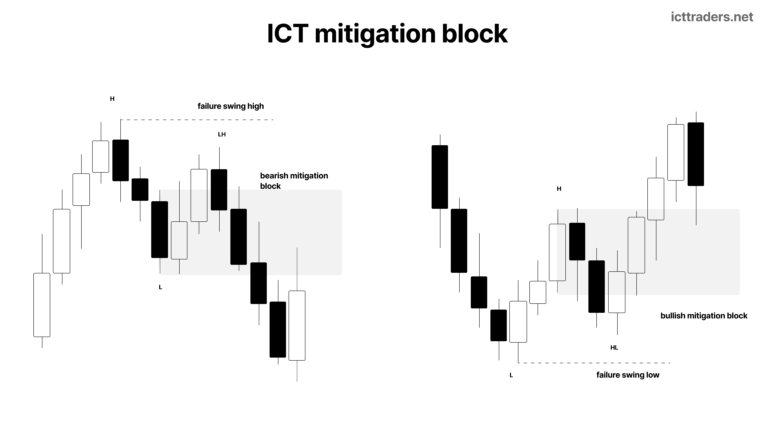
The Reclaimed ICT Orderblock is an advanced price action concept taught by Michael J. Huddleston, founder of the ICT (Inner Circle Trader) methodology. The concept explains how an old Order Block created during one side of a market move may later be reused or reclaimed when price develops the opposite side of the market maker model.
A normal ICT Order Block is commonly studied as a candle or price range connected with displacement and institutional price delivery.
A Reclaimed ICT Orderblock looks deeper into the complete price swing.
Instead of only focusing on the newest Order Block, traders study the old bullish or bearish Order Blocks formed while price was moving towards a major high or low.
These old Order Blocks may later become important entry areas.
For example, when price is moving lower towards a higher-time-frame support level, small bullish reactions may appear during the decline.
The down candles before these short-term price movements higher can form bullish Order Blocks.
Price may continue moving lower and these early bullish Order Blocks may initially appear to have failed.
However, after price reaches the main support level and begins moving higher, those old bullish Order Blocks can be revisited.
The old Order Block is then reclaimed.
According to the ICT model, the same price area may be used again for new positioning.
This is the basic idea behind a Reclaimed ICT Orderblock.
What is a Reclaimed ICT Orderblock?
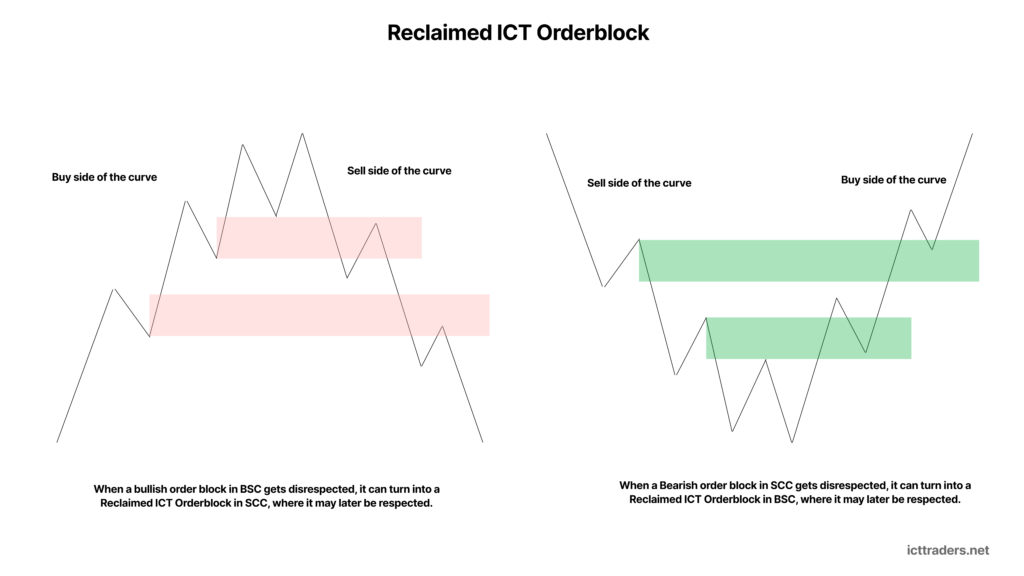
A Reclaimed ICT Orderblock is a previous bullish or bearish Order Block that formed during one side of a Market Maker Buy or Sell Model and is later revisited on the opposite side of the price curve.
In a bullish model, old down candles formed during the decline are studied.
A short-term bullish displacement after a down candle shows that price had the willingness to move higher from that range.
Price may still continue lower because the final market low has not yet formed.
After price reaches support, creates the final low and starts its bullish price swing, it may return to these previous down candles.
The old bullish Order Blocks are reclaimed for potential new long positions.
In a bearish model, old up candles formed during the rally are studied.
A short-term decline after an up candle shows bearish displacement.
Price may continue moving higher before the final high forms.
Once price reaches a premium area, forms the high and begins moving lower, it may retrace into the old up candles.
These previous bearish Order Blocks can then be reclaimed for new short positions.
The main idea is matching Order Blocks from one side of the price curve with potential entries on the opposite side.
Who Created the Reclaimed ICT Orderblock Concept?
The Reclaimed ICT Orderblock concept comes from the ICT trading methodology developed and taught by Michael J. Huddleston, known through his ICT or Inner Circle Trader mentorship content.
Michael J. Huddleston explains reclaimed blocks by connecting Order Block theory with the Market Maker Buy Model and Market Maker Sell Model.
The concept is not simply about finding an old candle and waiting for price to return.
The trader first needs to understand the complete price curve.
Is price moving lower to eventually move higher?
Or is price moving higher to eventually move lower?
The old Order Blocks are studied within this larger market narrative.
As Michael J. Huddleston explains in the mentorship lesson:
“The market is going lower to go higher.”
This simple statement describes the foundation of the Market Maker Buy Model and helps explain why early bullish Order Blocks may appear during a bearish price swing.
The Main Idea Behind Reclaimed ICT Orderblock
The main idea behind a Reclaimed ICT Orderblock is that price may reuse old institutional price references.
During a large price decline, the market does not always move lower in one continuous straight line.
Small rallies occur.
These short-term movements higher create minor displacement.
Before each small bullish movement, there may be a down-close candle.
In ICT terminology, the down candle before the movement higher can be studied as a bullish Order Block.
However, the market may not yet be ready for the main bullish price expansion.
Price can continue lower.
A trader who buys every early bullish Order Block may repeatedly become stopped out.
The important point is understanding why these small price reactions may be occurring.
In the ICT explanation, early positioning or hedging may be taking place while price continues towards a larger support objective.
Once the main low forms and price starts the buy side of the curve, the old bullish Order Blocks become important.
Price can retrace into these earlier down candles.
The old price range is reclaimed and used as a potential new buying area.
The same concept works in reverse during a Market Maker Sell Model.
Old bearish Order Blocks formed during the price rally can later be reclaimed after the main high has formed.
Why Does a Reclaimed ICT Orderblock Form?
According to the ICT (Inner Circle Trader) model, large positions cannot always be established at one single price level or through one transaction.
The ICT lesson describes the idea of scaling into positions as price moves towards the expected higher-time-frame objective.
Consider a Market Maker Buy Model.
Price is declining towards a support area.
The support can be an old high, an old low, a Bullish Order Block, a filled void, a Fair Value Gap area or another higher-time-frame support reference.
During the move lower, price creates small short-term rallies.
Each bullish reaction shows some degree of minor displacement higher.
The down candle immediately before one of these price movements may become a bullish Order Block.
But price continues lower because the main support objective has not yet been reached.
After the market finally reaches the expected support area, a more significant bullish price swing begins.
Price is now developing the buy side of the curve.
During this move higher, price may retrace.
The old bullish Order Blocks created during the previous decline can now provide reference points.
Price returns to the old down candle and uses the range again.
The Order Block has been reclaimed.
Michael J. Huddleston explains the idea in the lesson:
“These old blocks or down candles will be reclaimed for new longs.”
The same process occurs in reverse for bearish reclaimed blocks.
Reclaimed ICT Orderblock and the Market Maker Model
Understanding the Market Maker Model is very important when studying a Reclaimed ICT Orderblock.
There are two main models:
- Market Maker Buy Model
- Market Maker Sell Model
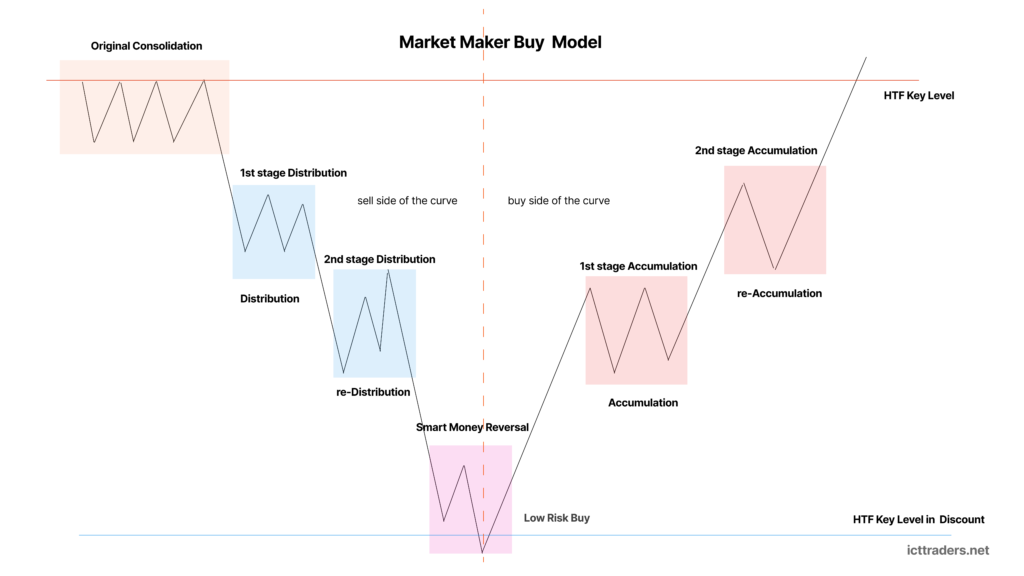
The Market Maker Buy Model represents a price swing where the market moves lower before expanding higher.
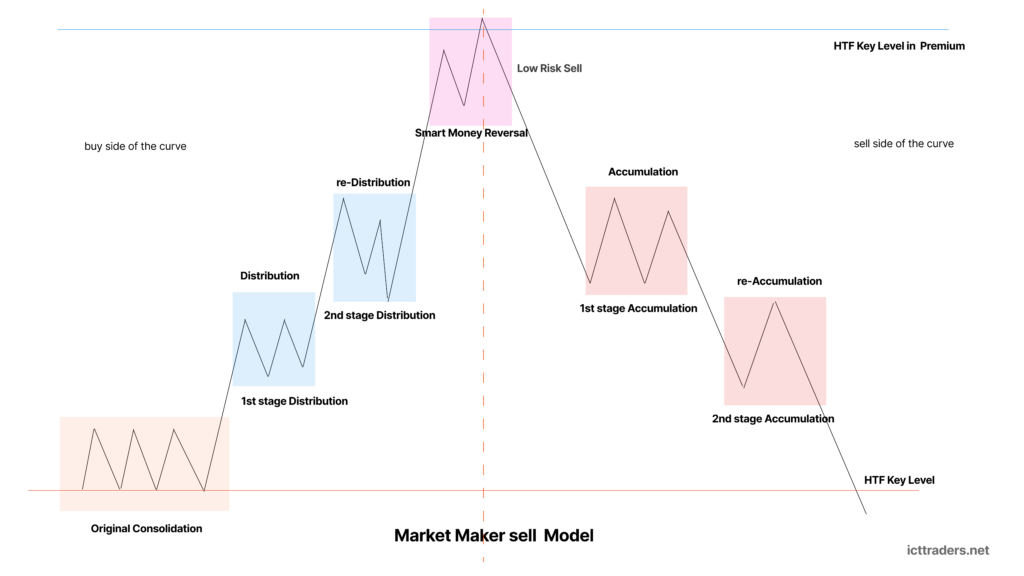
The Market Maker Sell Model represents a price swing where the market moves higher before expanding lower.
Each model has two sides or curves.
In a Market Maker Buy Model, there is a sell side of the curve and a buy side of the curve.
In a Market Maker Sell Model, there is a buy side of the curve and a sell side of the curve.
Reclaimed Order Blocks are identified by studying the candles formed on the first side of the curve and matching them with price opportunities on the second side.
This relationship is the foundation of the Reclaimed ICT Orderblock concept.
Reclaimed ICT Orderblock in Market Maker Buy Model
The Market Maker Buy Model is based on the idea that price moves lower before moving higher.
The first price swing is the sell side of the curve.
Price declines towards an important support level.
During the decline, the market creates lower prices.
However, small bullish reactions may occur.
A down candle forms.
Price then shows a short-term movement higher.
This movement represents minor bullish displacement.
The down candle before the displacement is identified as a bullish Order Block.
Price may then continue moving lower and create another lower low.
Another down candle may produce another short-term bullish displacement.
This creates another potential bullish Order Block.
The process can happen several times during the sell side of the curve.
Eventually, price reaches the major support level.
The final low forms.
A stronger bullish move begins.
The market is now developing the buy side of the curve.
Price starts creating higher prices.
When the market retraces during the bullish movement, traders look back towards the old down candles that created minor bullish displacement during the previous sell-side curve.
These old bullish Order Blocks may now be reclaimed.
Sell Side of the Curve in a Market Maker Buy Model
The sell side of the curve is the price movement lower before the major bullish expansion.
This part of the model is important because it creates the Order Blocks that may later be reclaimed.
Price may be reaching towards:
- An old high
- An old low
- Higher-time-frame support
- A Bullish Order Block
- A filled price void
- A Fair Value Gap
- Another important support reference
During this decline, traders should study each small bullish reaction.
Find the down candle immediately before the price moves higher.
The short-term bounce shows minor displacement.
The down candle can be marked as a bullish Order Block.
However, the existence of the bullish Order Block does not mean the final market low has already formed.
This is a common mistake.
The market may continue lower.
Therefore, the trader needs to understand the larger support objective.
The old Order Blocks are recorded and later studied when price transitions to the buy side of the curve.
Buy Side of the Curve in a Market Maker Buy Model
The buy side of the curve begins after the market reaches the important support area and starts expanding higher.
Price may begin forming higher highs.
The market is no longer moving lower towards support.
The major price low has already formed within the model.
Now the previous bullish Order Blocks become important.
Look back towards the sell side of the curve.
Find the old down candles that showed a small bullish displacement.
When price on the buy side retraces into these old candles, the Order Block may be reclaimed.
The previous price range becomes a new potential buying opportunity.
This is a Bullish Reclaimed ICT Orderblock.
The trader is matching an old bullish Order Block from the sell side of the curve with a retracement occurring on the buy side.
What is a Bullish Reclaimed ICT Orderblock?
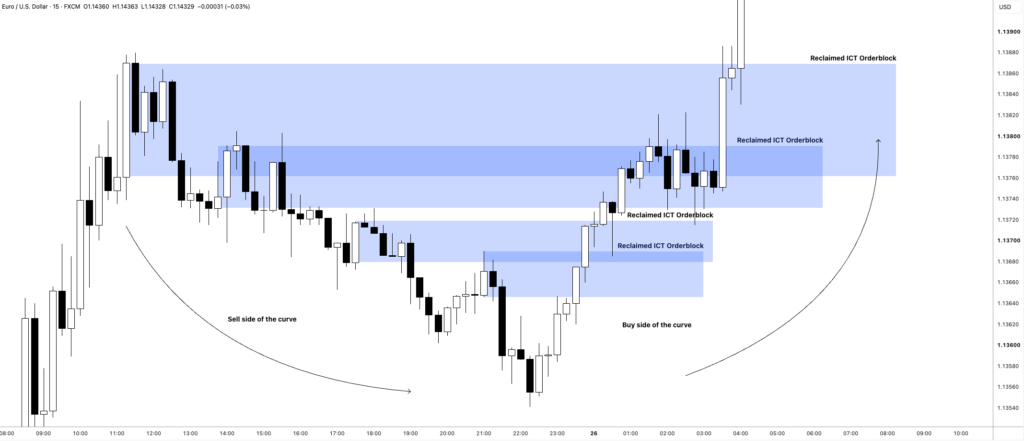
A Bullish Reclaimed ICT Orderblock is an old bullish Order Block that was previously associated with a short-term price movement higher and is later revisited after the market forms its major low.
The Order Block normally appears as a down-close candle.
The candle is followed by minor bullish displacement.
Price then continues lower during the sell side of the Market Maker Buy Model.
Once price reaches support and begins the main bullish price swing, the market may retrace into the old down candle.
The old bullish Order Block is reclaimed.
The area can then provide a potential new long entry.
A simple bullish reclaimed model is:
Price Declines → Down Candle Forms → Minor Bullish Displacement → Price Continues Lower → Major Support Reached → Final Low Forms → Price Expands Higher → Retracement to Old Down Candle → Bullish Order Block Reclaimed → Price Moves Higher
The entire sequence is important.
Simply finding an old down candle is not enough.
The candle should show previous willingness for price to move higher through minor displacement.
It should also be connected with the correct side of the Market Maker Buy Model.
How to Identify a Bullish Reclaimed ICT Orderblock
First, determine whether price is showing a Market Maker Buy Model.
Look for price moving lower towards an important support area.
Study the sell side of the curve.
As price declines, identify short-term bullish movements.
Every time price shows a small bounce, look immediately before the bullish move.
Find the last down candle.
Mark the down candle as a potential bullish Order Block.
Now continue observing price.
The market may trade lower and eventually reach its main support objective.
Wait for the major low to form.
Price should begin moving higher and develop the buy side of the curve.
Now look back at the bullish Order Blocks marked during the previous decline.
When price retraces into one of these old down candles, the area may become a Bullish Reclaimed ICT Orderblock.
Observe the price reaction from the reclaimed area.
The expectation is for price to continue expanding higher as the Market Maker Buy Model develops.
Rules of Bullish Reclaimed ICT Orderblock
A Bullish Reclaimed ICT Orderblock should be studied within a Market Maker Buy Model.
Price should initially be moving lower towards a logical support objective.
A down candle should form during the sell side of the curve.
The down candle should be followed by a short-term bullish price movement.
This minor displacement shows previous willingness for price to move higher from the range.
Price can continue moving lower after the Order Block forms.
A major support level should eventually be reached.
The final low should form.
Price should then begin developing the buy side of the curve.
The old bullish Order Block should be located on the previous sell side of the curve.
Price retraces into the old down candle.
The previous bullish Order Block is reclaimed.
The expected price direction is higher.
Minor Displacement and Reclaimed ICT Orderblock
Minor displacement is one of the most important clues when identifying a Reclaimed ICT Orderblock.
A trader should not mark every down candle during a decline as a potential bullish reclaimed block.
Look for evidence that price showed willingness to move higher after the candle.
Suppose the market is declining.
A down candle forms.
The next price movement creates a small bullish reaction.
This short-term movement higher is minor displacement.
The market may later continue lower.
But the small bullish price movement makes the previous down candle important.
According to the ICT model, this price action can provide evidence of early positioning during the decline.
The same concept applies to a bearish model.
An up candle forms during a rally.
Price then creates a short-term decline.
The bearish movement represents minor displacement.
The up candle becomes a potential bearish Order Block that may later be reclaimed.
Minor displacement therefore helps separate important Order Blocks from random candles.
Reclaimed ICT Orderblock and Hedging
The mentorship lesson connects reclaimed blocks with the idea of hedging and early positioning.
In a bullish model, price is still moving lower.
However, small bullish displacements appear during the decline.
The ICT framework interprets these reactions as evidence that buying may be occurring before the final low is formed.
The market continues lower because the larger support objective still needs to be reached.
This is why early bullish Order Blocks may initially fail as direct entry points.
After the major low forms, the market moves higher.
The previous bullish Order Blocks are then revisited.
The old price references can be used again during the bullish side of the model.
In a bearish model, the opposite occurs.
Price is still moving higher.
Small bearish displacements appear after up candles.
The ICT model studies these movements as possible evidence of selling during the rally.
After the major high forms, old bearish Order Blocks can be reclaimed as price moves lower.
Reclaimed ICT Orderblock in Market Maker Sell Model
The Market Maker Sell Model is the opposite of the Market Maker Buy Model.
Price moves higher before moving lower.
The initial rally forms the buy side of the curve.
Price may be moving towards a premium area or an important higher-time-frame resistance level.
During the rally, short-term bearish movements can occur.
An up candle forms.
Price then creates a small decline.
This minor bearish displacement makes the previous up candle important.
The up candle is identified as a bearish Order Block.
Price may continue moving higher.
Another up candle may produce another small bearish displacement.
More bearish Order Blocks can form during the buy side of the curve.
Eventually, price reaches the main higher price objective.
A climax high forms.
Price begins moving lower.
The market is now developing the sell side of the curve.
When price retraces higher during the decline, traders look back at the old up candles formed on the previous buy-side curve.
These bearish Order Blocks may be reclaimed.
What is a Bearish Reclaimed ICT Orderblock?
A Bearish Reclaimed ICT Orderblock is a previous bearish Order Block that showed short-term bearish displacement during a market rally and is later revisited after the main market high forms.
The Order Block usually appears as an up-close candle.
Price shows a short-term decline after the candle.
This minor displacement indicates bearish willingness from the price range.
However, price may continue higher.
The final high has not yet formed.
Once the market reaches its premium objective and begins moving lower, the old up candles become important.
A retracement into one of these old bearish Order Blocks may reclaim the price range.
The old Order Block can then become a new potential short entry.
The bearish reclaimed model is:
Price Rallies → Up Candle Forms → Minor Bearish Displacement → Price Continues Higher → Premium Objective Reached → Final High Forms → Price Declines → Retracement to Old Up Candle → Bearish Order Block Reclaimed → Price Moves Lower
This complete sequence creates the Bearish Reclaimed ICT Orderblock model.
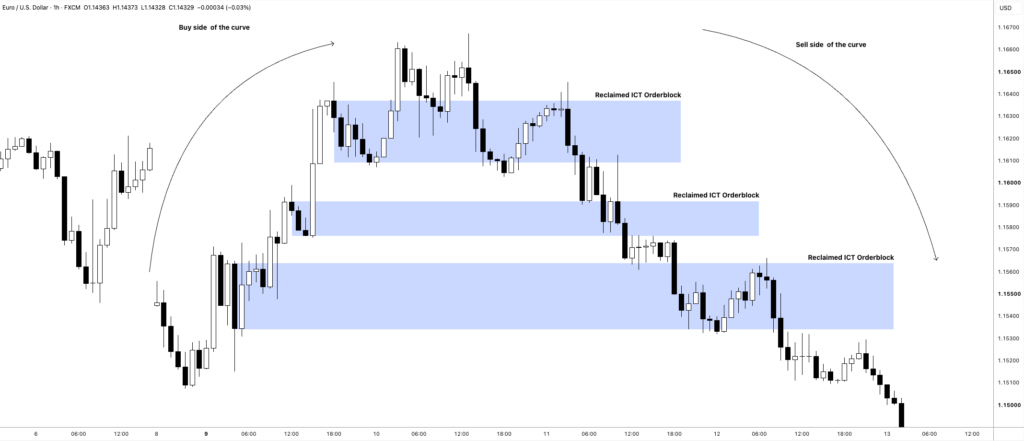
How to Identify a Bearish Reclaimed ICT Orderblock
First, identify a Market Maker Sell Model.
Price should be moving higher towards an important premium or resistance area.
Study the buy side of the curve.
Look for every short-term decline during the rally.
When price creates a small bearish displacement, find the up candle immediately before the decline.
Mark this candle as a potential bearish Order Block.
Continue observing price.
The market may trade through the Order Block and continue higher.
This does not automatically remove the candle from consideration within the reclaimed block model.
Wait for price to reach the higher objective.
A climax high or major market high should form.
Price then begins moving lower.
The sell side of the curve is now developing.
Look back at the bearish Order Blocks formed during the previous rally.
When price retraces into an old up candle, the Order Block may be reclaimed.
The area becomes a potential new short entry.
Rules of Bearish Reclaimed ICT Orderblock
A Bearish Reclaimed ICT Orderblock should form within a Market Maker Sell Model.
Price should initially move higher towards a premium or resistance objective.
An up candle should form during the buy side of the curve.
The up candle should be followed by a short-term bearish displacement.
Price may continue moving higher after the bearish Order Block forms.
The main high should eventually be created.
Price should begin developing the sell side of the curve.
The old bearish Order Block should come from the previous buy side of the curve.
Price retraces higher into the old up candle.
The previous Order Block is reclaimed.
The area may provide a potential new short entry.
The expected price direction is lower.
How to Draw a Reclaimed ICT Orderblock
The first step is not drawing a rectangle.
The first step is understanding the price model.
Determine whether the market is developing a Market Maker Buy Model or Market Maker Sell Model.
For a Bullish Reclaimed ICT Orderblock, study the decline on the left side of the major low.
Look for a down candle followed by minor bullish displacement.
Mark the relevant down candle range.
Allow price to continue towards the main support objective.
After the low forms and price begins moving higher, extend the old Order Block range forward.
When price on the buy side of the curve retraces into the old down candle, the block has become a reclaimed bullish Order Block area.
For a Bearish Reclaimed ICT Orderblock, study the rally on the left side of the major high.
Find an up candle followed by minor bearish displacement.
Mark the up candle as a bearish Order Block.
After the final high forms and price begins moving lower, extend the old range forward.
A retracement into the previous up candle can reclaim the bearish Order Block.
The most important part is matching the correct candle from one side of the price curve with price delivery on the opposite side.
How to Trade a Bullish Reclaimed ICT Orderblock
First, establish a bullish price narrative.
Price should be moving into an important support level or should have already reached the expected lower objective.
Study the decline that formed before the market low.
Mark the down candles that produced short-term bullish displacement.
Do not automatically buy every one of these candles while price is still declining.
Remember that the market may still be developing the sell side of the curve.
Wait for the major support area to be reached.
Observe the formation of the main market low.
Price should begin expanding higher.
Once the buy side of the curve is developing, study retracements.
Match the retracement with an old bullish Order Block from the previous sell side.
When price returns to the old down candle, the area becomes a potential bullish reclaimed block entry.
The trader can then combine the Reclaimed ICT Orderblock with an ICT entry model, lower-time-frame confirmation, displacement or market structure information.
The expected price movement is towards higher prices.
How to Trade a Bearish Reclaimed ICT Orderblock
First, establish a bearish price narrative.
Price should be moving towards a premium or higher-time-frame resistance objective.
Study the rally before the final high.
Mark each important up candle that produces minor bearish displacement.
Do not assume the first bearish Order Block will immediately cause a major market reversal.
Price may continue higher because the buy side of the curve is still developing.
Wait for the higher objective to be reached.
Observe the formation of the main high.
Price should then begin moving lower.
Once the sell side of the curve develops, look for retracements.
Match these retracements with previous bearish Order Blocks from the buy side of the curve.
When price trades back into an old up candle, the block may be reclaimed.
The area can provide a potential selling opportunity.
The expectation is for the Market Maker Sell Model to continue towards lower prices.
Reclaimed ICT Orderblock vs Normal ICT Order Block
A normal ICT Order Block is generally identified from a candle or price range connected with displacement and an expected price move.
A Reclaimed ICT Orderblock uses the same Order Block foundation but adds the Market Maker Model.
The trader studies where the Order Block originally formed.
Was the bullish Order Block created during the sell side of a Market Maker Buy Model?
Was the bearish Order Block created during the buy side of a Market Maker Sell Model?
Did the candle produce minor displacement?
Has the major low or high now formed?
Is price on the opposite side of the curve?
Has the market returned to the old Order Block?
A normal Order Block trader may ignore a bullish Order Block after price continues lower through it.
A trader studying reclaimed blocks may keep the old candle as a reference.
After the main low forms, the same bullish Order Block may become important again.
This reuse of an old price reference is what makes the Reclaimed ICT Orderblock different.
Reclaimed ICT Orderblock vs Breaker Block
The Reclaimed ICT Orderblock should not be confused with an ICT Breaker Block.
A Breaker Block generally involves a liquidity raid, failure and market structure shift.
For a bullish breaker, sell-side liquidity is taken and a short-term high is violated.
The previous swing high range can become support.
For a bearish breaker, buy-side liquidity is taken and a short-term low is violated.
The previous swing low range can become resistance.
A Reclaimed ICT Orderblock focuses on old Order Blocks formed during the first side of a Market Maker Model.
The old candles show minor displacement.
After the major market turning point forms, price on the opposite curve returns to these old Order Blocks.
The levels are reclaimed for new positions.
Therefore, Breaker Blocks and Reclaimed Order Blocks use different price narratives.
Why Traders Miss Reclaimed ICT Orderblocks
Many traders only study the most recent candles.
When price forms a low and begins moving higher, they search for a new bullish Order Block on the right side of the low.
They may completely ignore the candles formed during the previous decline.
The Reclaimed ICT Orderblock concept requires traders to look back across the complete price swing.
The same issue occurs in bearish conditions.
After price forms a high, traders may only look for newly created bearish Order Blocks.
They ignore the old up candles formed while the market was rallying.
However, the previous candles may have already shown bearish displacement.
These old price ranges can provide later short opportunities when reclaimed.
Another reason traders miss these setups is because an Order Block may appear to fail initially.
Price trades through the block.
The trader removes the level from the chart.
But within a Market Maker Model, the final high or low may not have formed yet.
Understanding the curve changes how the old Order Block is interpreted.
Common Mistakes When Trading Reclaimed ICT Orderblock
One common mistake is marking every candle as an Order Block.
A candle should show some evidence of displacement.
For a bullish block, look for a down candle followed by a short-term price movement higher.
For a bearish block, look for an up candle followed by a short-term price decline.
Another mistake is ignoring the Market Maker Model.
A Reclaimed ICT Orderblock is based on matching Order Blocks across the two sides of the price curve.
The major high or low should be understood.
Traders also enter too early.
During the sell side of a Market Maker Buy Model, early bullish Order Blocks may form.
Buying every block can cause repeated losses because price may still need to move lower.
The same problem occurs when selling every bearish Order Block during the buy side of a Market Maker Sell Model.
Another mistake is deleting an old Order Block immediately after price trades through it.
In a reclaimed model, an old Order Block can become important after the final turning point forms.
Traders may also confuse a Reclaimed ICT Orderblock with a Breaker Block.
The complete price narrative is different.
The trader should understand why the level is being used rather than simply drawing support and resistance rectangles.
Simple Reclaimed ICT Orderblock Checklist
Before trading a Reclaimed ICT Orderblock, ask the following questions:
Market Model: Is price showing a Market Maker Buy Model or Market Maker Sell Model?
Price Curve: Can you identify the first and second side of the curve?
Higher-Time-Frame Objective: Is price moving towards a logical support, resistance, discount or premium area?
Order Block: Is there a down candle before bullish displacement or an up candle before bearish displacement?
Minor Displacement: Did price show willingness to move away from the candle?
Major Turning Point: Has the important market high or low formed?
Opposite Curve: Is price now developing the other side of the Market Maker Model?
Old Price Reference: Is the Order Block from the earlier side of the curve still identifiable?
Retracement: Has price returned to the old Order Block?
Reclaimed Block: Is the previous Order Block being reused as a potential new entry area?
The more clearly these conditions can be identified, the easier it becomes to understand the reclaimed block narrative.
Final Understanding of Reclaimed ICT Orderblock
The Reclaimed ICT Orderblock is an advanced ICT concept created and taught within the trading methodology of Michael J. Huddleston, founder of ICT (Inner Circle Trader).
The concept focuses on old bullish and bearish Order Blocks formed during the development of a Market Maker Buy or Sell Model.
In a Market Maker Buy Model, price moves lower towards support.
During the sell side of the curve, down candles may create minor bullish displacement.
These bullish Order Blocks may initially be traded through as price continues lower.
After the main low forms and price begins moving higher, the market can retrace into these old down candles.
The bullish Order Blocks are reclaimed for potential new long positions.
In a Market Maker Sell Model, price moves higher towards a premium or resistance objective.
During the buy side of the curve, up candles may create short-term bearish displacement.
Price may continue higher before forming the final high.
After the market begins moving lower, retracements into the old up candles can reclaim the bearish Order Blocks.
These price ranges may provide potential new short positions.
The important lesson is to study the complete price curve.
Do not only look at the newest candle.
Study the previous decline.
Study the previous rally.
Identify where minor displacement occurred.
Mark the old Order Blocks.
Understand when the major market high or low has formed.
Then watch how price matches the Order Blocks from one side of the Market Maker Model with retracements on the opposite side.
This is the real logic behind the Reclaimed ICT Orderblock concept taught by Michael J. Huddleston in the ICT mentorship.