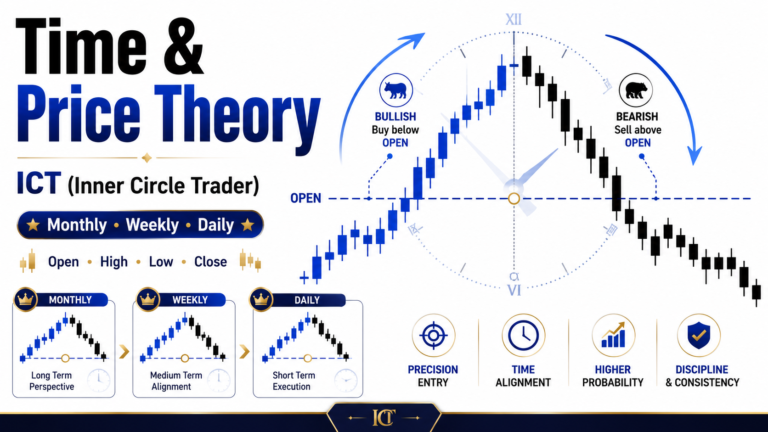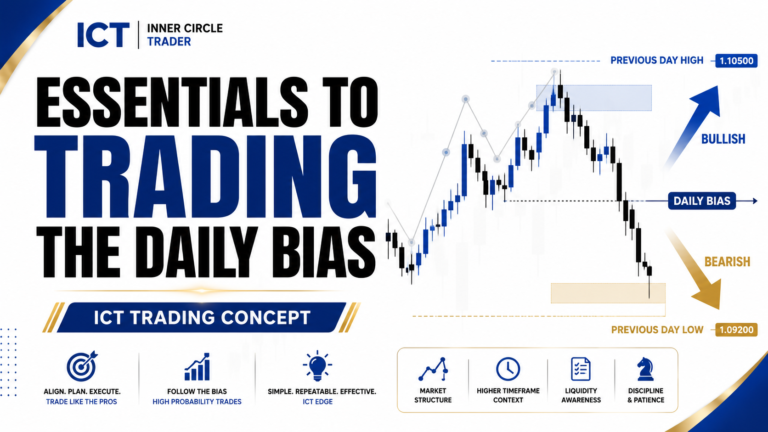
The ICT New York Killzone is one of the most important intraday trading windows for Forex traders studying time and price. In the ICT Forex – Market Maker Primer Course, Michael J. Huddleston, founder of The ICT (Inner Circle Trader) concepts, teaches traders to study the New York Open for Optimal Trade Entry setups, liquidity runs, and continuation of the Daily Bias.
Unlike trading randomly throughout the New York session, the ICT model focuses on a specific period when London and New York activity overlap.
Michael J. Huddleston explains:
“The key times to monitor are 7:00 a.m. to 9:00 a.m. New York time.”
The objective is to determine the Daily Bias, study what London has already done, and then look for a New York retracement that can offer approximately 20 to 30 pips in a short-term setup.
What Is The ICT New York Killzone?
The ICT New York Killzone is the specific time window surrounding the New York Open when traders look for high-probability Forex setups.
The classic ICT New York Open Killzone taught in this course is:
07:00–09:00 New York time
The basic framework is:
Determine Daily Bias
↓
Study London price action
↓
Wait for 07:00 New York time
↓
Look for a retracement or liquidity run
↓
Identify an ICT entry setup
↓
Anticipate continuation of the daily range
The Killzone is a time filter.
It tells traders when to focus on price.
However, time alone does not create a trade. The price action must align with the expected directional narrative.
ICT New York Killzone Time Window
The exact time window discussed by Michael J. Huddleston is:
07:00–09:00 New York time
This is what he refers to as the:
Classic ICT New York Open Killzone
Traders should use New York time as their primary reference.
Your broker may use a different server timezone, so first identify when 07:00 and 09:00 New York time appear on your trading platform.
The trading process becomes:
07:00 NY time → Begin monitoring the New York setup
↓
07:00–09:00 NY time → Classic ICT New York Killzone
↓
After 09:00 → Broader New York session continues
It is important not to confuse the New York Killzone with the complete New York trading session.
Huddleston explains that the broader New York session can continue until approximately 14:00 New York time.
Therefore:
ICT New York Killzone → 07:00–09:00 NY time
Broader New York Session → Extends beyond 09:00 toward 14:00 NY time
The Killzone is the specific window used to search for the New York Open trading setup.
Why Is the New York Killzone Important?
The New York Killzone has an important advantage.
London has already traded.
This means the trader can study what London did before making a decision at the New York Open.
Huddleston explains:
“It’s the easiest time to trade because we have the luxury of having London overlap and New York.”
By the time New York begins, traders may already have information about:
- The Daily Bias
- London High
- London Low
- London directional movement
- Existing liquidity
- Previous session retracements
- Whether London agrees with the higher timeframe direction
This creates additional context.
Instead of entering the market with no intraday information, the trader can use London’s price delivery to frame the New York setup.
Best Forex Pairs for The ICT New York Killzone
Michael J. Huddleston specifically focuses on major currency pairs connected with the US Dollar.
These are pairs coupled with the Dollar or influenced by Dollar Index movement.
Examples include:
- EUR/USD
- GBP/USD
- AUD/USD
- NZD/USD
- USD/CAD
- USD/JPY
- USD/CHF
The ICT approach is to scan the major Dollar-based pairs during the New York Open.
Huddleston explains that every individual pair will not necessarily provide a setup every day.
However, he encourages traders to study the majors because one or more may present a recognizable New York setup.
A beginner does not need to trade all of them.
Instead, study a small group of major Forex pairs and become familiar with their price action during 07:00–09:00 New York time.
The 20 to 30 Pip New York Scalp
The New York Open can frequently form an ICT Optimal Trade Entry pattern that may provide approximately 20 to 30 pips for a scalp.
Huddleston states:
“Between 7 o’clock in the morning and 9 o’clock in the morning New York time there’s typically a setup that forms that offers 20 to 30 pips.”
This should be treated as a study objective, not a guarantee.
It does not mean every trader should enter a live trade every day.
Huddleston specifically warns that a daily opportunity to study is not an invitation to trade live funds every trading day.
The correct mindset is:
Every day may provide something to study
Not:
I must make 20 to 30 pips every day
A trader should wait for the correct conditions.
The Secret Is What London Has Already Done
One of the most important ideas behind The ICT New York Killzone is the relationship between London and New York.
Huddleston explains:
“The secret to it is what’s going on in London.”
Before looking for a New York entry, ask:
What is the Daily Bias?
Then ask:
Did London support that Daily Bias?
For example, suppose the Daily chart is bullish.
If London creates a low and then price rallies, London has provided bullish confirmation.
If price then retraces lower into the New York Killzone, that retracement may offer a continuation setup.
The framework becomes:
Daily Bias bullish
↓
London creates a low
↓
Price rallies
↓
New York Open approaches
↓
Price retraces lower
↓
Bullish ICT entry setup forms
↓
Daily range expands higher
The same concept can be reversed for bearish price delivery.
Bullish ICT New York Killzone Setup
Suppose the Daily Bias is bullish.
The trader first studies London.
Ideally, London should support the bullish expectation.
A simple bullish model is:
Daily chart suggests higher prices
↓
London forms a low
↓
Price expands away from the London Low
↓
07:00 New York time approaches
↓
Price retraces lower
↓
Sell-side liquidity may be taken
↓
Bullish OTE or contextual entry forms
↓
Price continues higher
In this model, the New York decline is not automatically bearish.
The trader interprets it as a potential retracement within a larger bullish daily range.
Huddleston explains that if the Daily Bias is bullish and London supports that idea, traders can anticipate a retracement lower into the New York Open.
The objective is to locate the New York Low that may support continuation higher.
Bearish ICT New York Killzone Setup
The bearish setup is the opposite.
Suppose the Daily Bias is bearish.
London should ideally show agreement with the bearish expectation.
The model becomes:
Daily chart suggests lower prices
↓
London creates a high
↓
Price trades lower
↓
New York Killzone approaches
↓
Price retraces higher
↓
Buy-side liquidity may be taken
↓
Bearish OTE or contextual entry forms
↓
Price continues lower
In this scenario, the New York rally may create a short-term high before the broader bearish expansion continues.
The trader is not simply selling because price is inside the Killzone.
The setup must be supported by:
Daily Bias
London confirmation
New York retracement
ICT entry model
London Continuation Is the Easier New York Model
The New York session can generally create two broad scenarios:
Continuation of London’s move
or
A reversal in the daily direction
Huddleston explains that the continuation model is easier for developing traders.
Reversal trading can require more experience and additional conditions.
For beginners, the simpler approach is:
Identify Daily Bias
↓
Check whether London agrees
↓
Look for New York continuation
Huddleston states:
“The continuation of the London move I believe is the easiest.”
Suppose the Daily Bias is bullish.
London forms a low and moves higher.
The New York Killzone creates a retracement.
The trader looks for a bullish setup.
This is easier than attempting to predict that New York will completely reverse the London move.
Trade in Agreement With the Daily Bias
The ICT New York Killzone should be studied within the context of Daily Bias.
Huddleston repeatedly emphasizes the importance of higher timeframe direction.
For a developing trader:
Bullish Daily Bias → Focus on New York buys
Bearish Daily Bias → Focus on New York sells
This does not mean price will move in one direction all day.
Intraday retracements will occur.
However, the trader is trying to participate in the side of the market expected to produce the larger range expansion.
Huddleston explains:
“It’s much easier to trade with the daily bias and to look for your daily ranges to expand in that direction.”
The objective is not to trade every intraday movement.
The objective is to align with the expected daily expansion.
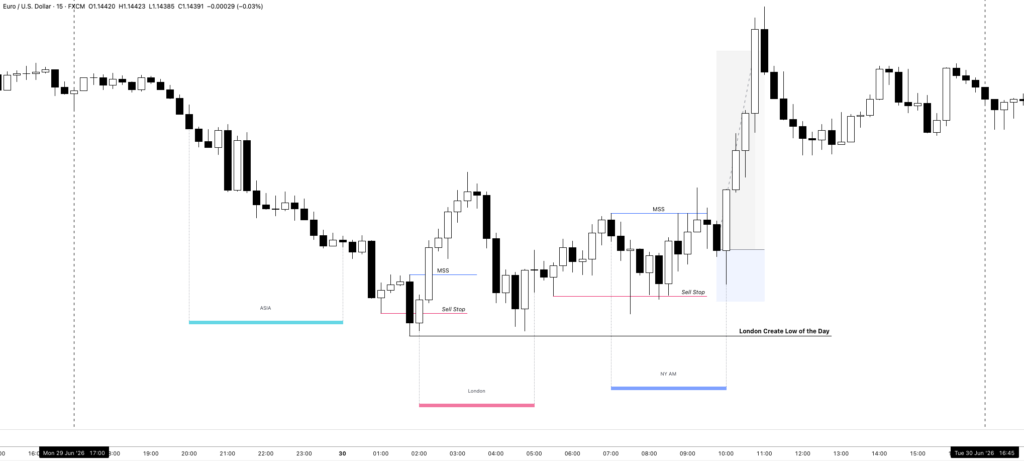
Using the London Low in a Bullish New York Setup
The London Low can become an important reference point when the Daily Bias is bullish.
Suppose London creates a low.
Price then rallies and establishes a short-term range.
As New York approaches, price retraces.
The trader can study the range formed between important London and intraday price points.
A bullish framework may be:
London Low forms
↓
Price rallies
↓
Intraday high forms
↓
New York retracement begins
↓
Price enters bullish OTE
↓
Long entry is considered
↓
Price expands toward higher liquidity
The London Low provides context for the New York retracement.
The trader is studying how New York interacts with price structure already established during London.
Using the London High in a Bearish New York Setup
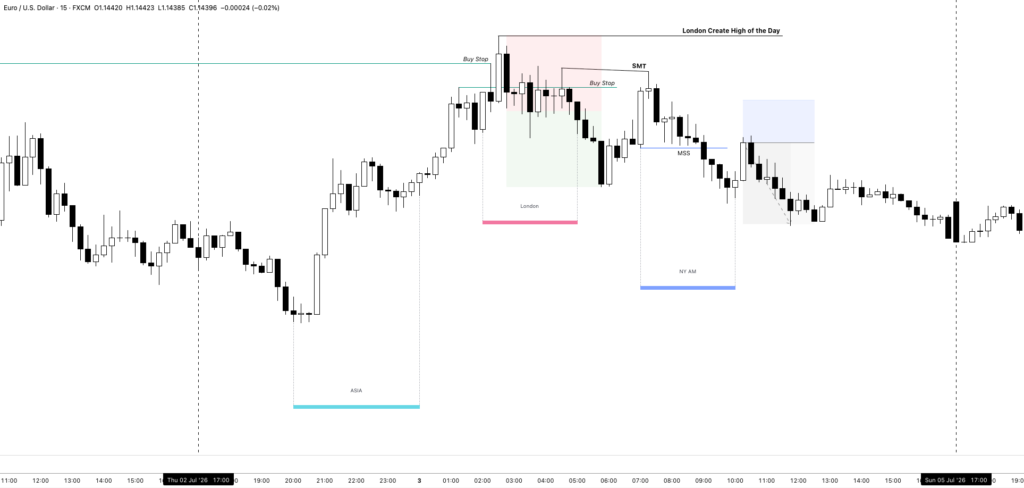
For a bearish Daily Bias, the London High can become an important reference.
Suppose London creates an important high and price declines.
During the New York Killzone, price retraces higher.
The trader may identify:
London High
↓
Bearish expansion
↓
New York retracement
↓
Bearish OTE
↓
New York high forms
↓
Price continues lower
The New York retracement may provide a better short entry than chasing the initial London decline.
This is one reason New York can provide useful opportunities for traders who missed the original London setup.
Optimal Trade Entry in The ICT New York Killzone
The ICT Optimal Trade Entry or OTE is an important entry concept discussed in the New York Killzone model.
Suppose price has already established a directional move.
The trader identifies the relevant price swing.
Price then retraces into the OTE area.
If the retracement occurs during the New York Killzone and agrees with the Daily Bias, the trader may have a potential continuation setup.
Bullish example:
Daily Bias bullish
↓
London confirms bullish direction
↓
Price rallies
↓
New York retraces
↓
Bullish OTE forms
↓
Long opportunity
Bearish example:
Daily Bias bearish
↓
London confirms bearish direction
↓
Price declines
↓
New York retraces
↓
Bearish OTE forms
↓
Short opportunity
OTE is not a standalone signal.
Time and directional context make the setup meaningful.
Liquidity Runs During the New York Killzone
The New York retracement may also run a liquidity pool before continuing in the Daily Bias direction.
For example, suppose the market is bullish.
Equal lows form before New York.
Sell stops may be resting below those lows.
During the New York Killzone:
Price retraces lower
↓
Equal lows are attacked
↓
Sell-side liquidity is taken
↓
Bullish setup forms
↓
Price expands higher
Huddleston describes an example where equal lows are present in a bullish market.
Price comes down during the New York Open, takes the stops below the equal lows, and then rallies.
The bearish equivalent is:
Bearish Daily Bias
↓
Equal highs form
↓
New York retraces higher
↓
Buy-side liquidity is taken
↓
Bearish setup develops
↓
Price expands lower
Liquidity can therefore support the New York continuation narrative.
The ICT New York Killzone and Power of Three
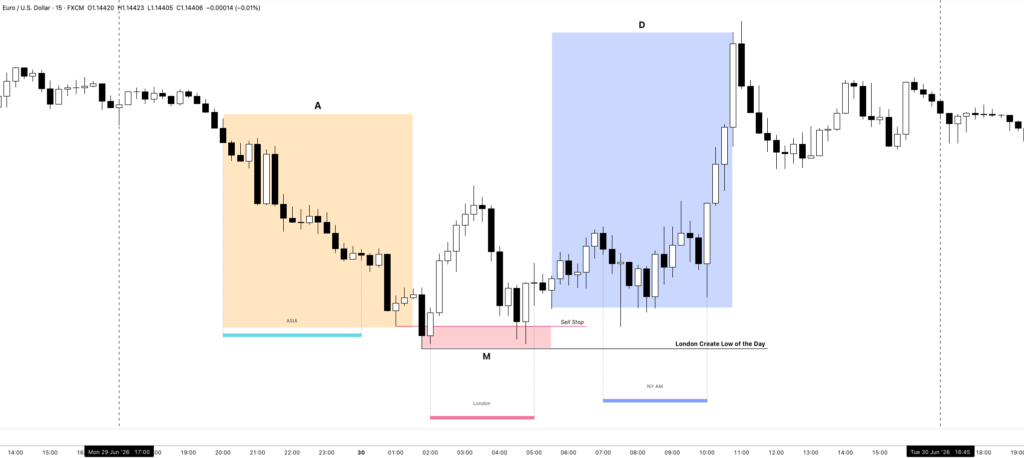
The New York session can also display a fractal Power of Three profile.
The general Power of Three concept is:
Accumulation
↓
Manipulation
↓
Distribution
In a bullish New York session, price may:
Open
↓
Decline slightly
↓
Create the session low
↓
Expand higher
↓
Create the session high
↓
Retrace from the high
This resembles a bullish Power of Three profile.
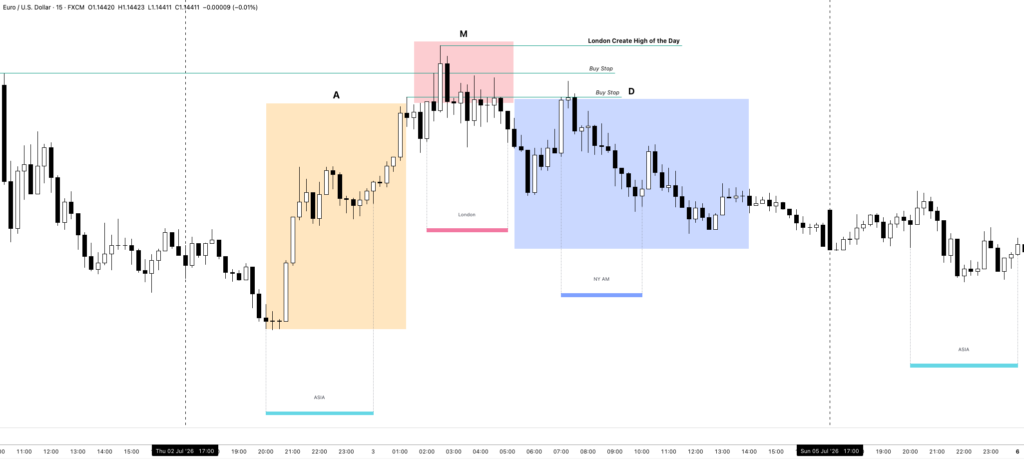
A bearish session can form the opposite structure:
Open
↓
Rally
↓
Create the session high
↓
Expand lower
↓
Create the session low
↓
Retrace from the low
Huddleston explains that price is fractal.
The same types of patterns visible on a Daily Candle can also appear inside individual trading sessions.
Economic News and New York Price Action
The broader New York session contains a consistent series of economic news releases.
These events can stimulate price movement.
News may:
- Create a market reversal
- Increase volatility
- Add momentum to the existing Daily Bias
- Produce a deeper retracement
The trader should be aware of scheduled economic releases before trading.
A news release alone does not create an ICT setup.
The trader should still consider:
Daily Bias
↓
London price action
↓
Liquidity
↓
New York Killzone
↓
ICT entry model
News may provide volatility, but the price narrative remains important.
New York Can Continue London or Reverse It
The New York session can produce two important outcomes.
London Continuation
Price continues in the direction supported by London and the Daily Bias.
This is the preferred model for developing traders.
Example:
Daily bullish
↓
London bullish
↓
New York retracement
↓
Bullish continuation
Daily Reversal
New York completely changes the directional price delivery.
This model can provide large movements but requires more experience and additional understanding.
Huddleston advises developing traders to focus on continuation setups rather than trying to predict every reversal.
The simple lesson is:
Do not make trading more complicated than necessary.
Trade with Daily Bias and use London as confirmation.
What If London Does Not Agree With the Daily Bias?
Suppose your Daily Bias is bullish.
However, London fails to create the expected bullish profile.
The trader should become cautious.
You do not need to force a New York long simply because the Daily chart appears bullish.
The ideal New York continuation setup is stronger when London has already supported your directional premise.
Huddleston’s logic can be simplified as:
Daily Bias
London confirmation
New York retracement
=
Higher-quality continuation framework
When these elements do not align, the trader may choose to study rather than trade.
The Killzone creates an opportunity to observe price.
It does not require execution.
Every New York Open Is for Study, Not Mandatory Trading
Huddleston encourages traders to study the New York Open Monday through Friday.
However, he clearly distinguishes chart study from live trading.
He explains:
“Every day there is an opportunity for you to study, but that does not mean to go in and try to trade with live funds every single trading day.”
This is especially important for new traders.
The correct training process is:
Mark 07:00–09:00 New York time
↓
Study major Dollar pairs
↓
Record the Daily Bias
↓
Mark London High and Low
↓
Observe New York retracement
↓
Identify OTE and liquidity
↓
Record whether continuation occurred
By repeating this process, traders can build pattern recognition.
A Simple ICT New York Killzone Trading Framework
Use this process to study The ICT New York Killzone:
Step 1: Determine Daily Bias
Bullish or bearish
↓
Step 2: Study London
Did London agree with the Daily Bias?
↓
Step 3: Mark the London High and Low
Use them as intraday reference points
↓
Step 4: Mark liquidity
Equal Highs → Equal Lows → Previous Highs → Previous Lows
↓
Step 5: Wait for 07:00 New York time
The classic Killzone begins
↓
Step 6: Look for a retracement
Bullish Bias → Retracement lower
Bearish Bias → Retracement higher
↓
Step 7: Watch for a liquidity run
Sell-side liquidity for bullish setups
Buy-side liquidity for bearish setups
↓
Step 8: Identify an ICT entry model
OTE or another contextual entry setup
↓
Step 9: Anticipate Daily Bias continuation
Look for range expansion
↓
Step 10: Manage toward the intended price objective
A short-term setup may offer approximately 20 to 30 pips
When to Avoid The ICT New York Killzone
Avoid forcing a New York trade when:
- Daily Bias is unclear
- London does not support your directional premise
- Price is trapped in a larger consolidation
- No clear liquidity objective is visible
- The expected retracement does not develop
- Price has already completed a large daily expansion
- The valid OTE has already passed
- You are trying to chase a fast-moving price
- Economic news creates conditions you do not understand
- You are trading simply because it is between 07:00 and 09:00
Remember:
Killzone = Time to look
It does not mean:
Killzone = Automatic entry
Key Characteristics of The ICT New York Killzone
The ICT New York Killzone has several characteristics that separate it from the Asian and London trading windows. Understanding these features helps traders determine what type of price movement to anticipate between 07:00 and 09:00 New York time.
1. Focuses Primarily on US Dollar-Based Major Pairs
The New York Open is particularly important for Forex pairs coupled with the US Dollar.
Common pairs to study include:
- EUR/USD
- GBP/USD
- AUD/USD
- NZD/USD
- USD/CAD
- USD/JPY
- USD/CHF
These markets can become more active as New York financial participation enters the market.
2. London Has Already Provided Price Information
One of the greatest advantages of the New York Killzone is that the London session has already developed.
Before New York opens, traders can study:
London High
London Low
London directional move
Existing liquidity
Whether London confirms the Daily Bias
This provides additional context for the New York setup.
As Michael J. Huddleston explains:
“The secret to it is what’s going on in London.”
3. New York Often Retraces Before Continuing the Daily Move
When London agrees with the Daily Bias, New York may create a retracement before continuing in the same direction.
For a bullish market:
London creates a low → Price rallies → New York retraces lower → Bullish continuation
For a bearish market:
London creates a high → Price declines → New York retraces higher → Bearish continuation
This retracement may provide an ICT Optimal Trade Entry or another contextual entry setup.
4. The Session Can Continue London or Reverse the Daily Direction
According to ICT, the New York session generally presents two potential scenarios:
Continuation of the London move
or
A reversal in the daily direction
For developing traders, London continuation is generally the simpler model to study.
If the Daily Bias and London price action agree, the trader can look for New York to continue the expected daily range expansion.
5. Economic News Can Stimulate Price Action
The New York session frequently includes scheduled economic news releases.
These events may:
- Increase volatility
- Accelerate the existing Daily Bias
- Create deep retracements
- Trigger market reversals
Because of this, traders should always know whether important economic events are scheduled before trading the New York Killzone.
News can provide volatility, but it does not replace the need for market context.
6. Liquidity Runs Frequently Appear Around the New York Open
New York price action may target obvious liquidity before continuing in the expected direction.
In a bullish market, price may run sell-side liquidity below equal lows before rallying.
In a bearish market, price may run buy-side liquidity above equal highs before declining.
The basic idea is:
Daily Bias
↓
New York retracement
↓
Liquidity raid
↓
ICT entry setup
↓
Range expansion
Liquidity should be studied together with London price action and the Daily Bias.
7. Optimal Trade Entry Setups Can Offer 20–30 Pip Scalp Opportunities
The New York Open frequently forms an ICT Optimal Trade Entry pattern.
Huddleston teaches that these setups can sometimes offer approximately 20 to 30 pips for a scalp.
However, this should be used as a study framework rather than a mandatory daily profit target.
The existence of the Killzone does not mean a trader must execute every day.
8. Power of Three Can Appear Inside the New York Session
New York price delivery can display a fractal Power of Three formation.
A bullish session may develop as:
Open → Decline → Session Low → Bullish Expansion → Session High
A bearish session may develop as:
Open → Rally → Session High → Bearish Expansion → Session Low
This reflects the same Accumulation, Manipulation, and Distribution logic that can appear on higher timeframes.
Overall, the key characteristic of The ICT New York Killzone is the information advantage created by the London session. Traders can first establish the Daily Bias, study London’s price delivery, and then wait for a New York retracement, liquidity run, or OTE that supports the expected daily range expansion.
Final Thoughts on The ICT New York Killzone
The ICT New York Killzone, taught by Michael J. Huddleston in the ICT Forex – Market Maker Primer Course, focuses on the New York Open between:
07:00–09:00 New York time
This window can frequently provide an Optimal Trade Entry or continuation setup offering approximately 20 to 30 pips for a scalp.
The main advantage of New York is that London has already provided price information.
The trader can determine the Daily Bias, study whether London supports that direction, and then wait for a New York retracement.
The basic framework is:
Daily Bias
↓
London confirmation
↓
07:00–09:00 New York Killzone
↓
Retracement
↓
Liquidity run or OTE
↓
Continuation of the daily range
For developing traders, the simplest model is to trade in agreement with the Daily Bias and focus on continuation rather than attempting to predict every market reversal.
As Huddleston explains, the key advantage is understanding what London has already done.
Study the Daily chart. Observe London. Then wait patiently for New York to offer a retracement into a setup that aligns with the expected daily expansion.