Integrating Daytrades With HTF Trade Entries is a practical ICT trading framework developed by Michael J. Huddleston, the founder of ICT (Inner Circle Trader). This concept is taught in the 2017 ICT Private Mentorship Core Content Month 08.
The model explains how traders can use intraday timing and daily opening prices to enter positions based on higher-timeframe analysis.
The objective is not necessarily to close the trade within the same day. A day-trade entry can be used to position for a move that may continue for several days or even longer.
“We can use day trading entries to position ourselves in our longer-term higher-time-frame trades.”
— Michael J. Huddleston
What Does Integrating Daytrades With HTF Trade Entries Mean?
This concept combines two separate parts of trading:
- Higher-timeframe analysis determines the direction and final objective.
- Intraday concepts determine where and when the trade is entered.
The trader may establish the trade using a daily opening price, but manage the position according to a daily, weekly, or higher-timeframe target.
This allows the trader to use the precision of day trading without being limited to a one-day holding period.
The trade may begin as an intraday entry and develop into:
- A short-term swing trade
- A weekly trade
- A position trade
- A higher-timeframe continuation setup
Higher-Timeframe Direction Comes First
The entry cannot be separated from the higher-timeframe narrative.
Before placing a trade, the trader should determine whether price is expected to move:
- From discount toward premium
- From premium toward discount
A bullish higher-timeframe idea should normally begin after price has reacted from a discount PD Array.
A bearish higher-timeframe idea should normally begin after price has reacted from a premium PD Array.
The trader should study:
- Daily chart
- Four-hour chart
- Institutional order flow
- PD Array Matrix
- IPDA data ranges
- Quarterly direction
- Seasonal tendencies
- Draw on liquidity
The intraday entry is only valid when it supports this broader analysis.
The Role of Power of Three
Power of Three describes the relationship between the daily open, daily range expansion, and daily close.
A bullish daily candle commonly has:
- Opening price near the low
- Small move below the open
- Expansion higher
- Close near the daily high
A bearish daily candle commonly has:
- Opening price near the high
- Small move above the open
- Expansion lower
- Close near the daily low
In a bullish setup, the trader wants to buy near the opening price or during the small initial decline below it.
In a bearish setup, the trader wants to sell near the opening price or during the initial rally above it.
The main question becomes:
- How far below the open may price move before an up-close day?
- How far above the open may price move before a down-close day?
This is where the daily opening price and higher-timeframe PD Arrays become important.
The Two Important Daily Opening Prices
ICT monitors two important opening references.
Zero GMT Opening Price
The Zero GMT opening price marks the beginning of the new daily candle on a properly calibrated platform.
This is the primary reference used for the entry model discussed here.
The trader should identify the exact local or broker-platform time that corresponds with Zero GMT.
Midnight New York Opening Price
The midnight New York opening price is commonly used when trading the London session.
It helps frame:
- Judas Swing
- Protractionary movement
- Daily low on bullish days
- Daily high on bearish days
- London Kill Zone entries
However, the London session is not required for integrating day trades with higher-timeframe entries.
A trader who cannot participate during London can still use the Zero GMT opening price.
Why the London Kill Zone Is Not Required
Many traders cannot remain awake during the London session because of:
- Work
- Family responsibilities
- Health
- Local time-zone differences
- Sleep schedule
- Other commitments
This does not prevent them from using ICT day-trading concepts.
When the higher-timeframe analysis is strong, the trader can use the Zero GMT opening price as an entry reference.
The trader does not need to watch every lower-timeframe candle or identify the exact Judas Swing.
Instead, the trader can:
- Establish the daily bias
- Identify the Zero GMT open
- Enter at or near that opening price
- Use a volatility-based stop
- Hold for the higher-timeframe objective
This is a less precise entry than a refined London Kill Zone setup, but it may be more practical.
Bullish Higher-Timeframe Conditions
Before using the bullish version of the model, price should have recently respected a discount PD Array.
Examples include:
- Bullish Order Block
- Discount Fair Value Gap
- Bullish Breaker
- Old low rejection
- Sell-side liquidity raid
- Discount liquidity void
- Lower portion of a dealing range
Price should show a willingness to move away from that discount area.
Signs of bullish institutional order flow may include:
- Bullish displacement
- Higher short-term highs
- Bearish PD Arrays being violated
- Fair Value Gaps below price supporting the market
- Rejection of old lows
- Clear premium objective above the market
The strongest condition is when the reaction from discount occurred during the previous trading day.
The next day’s Zero GMT open can then be used to frame the entry.
Bearish Higher-Timeframe Conditions
Before using the bearish version, price should have recently respected a premium PD Array.
Examples include:
- Bearish Order Block
- Premium Fair Value Gap
- Bearish Breaker
- Old high rejection
- Buy-side liquidity raid
- Premium liquidity void
- Upper portion of a dealing range
Price should show evidence that it is unwilling to continue higher.
Signs of bearish institutional order flow may include:
- Bearish displacement
- Lower short-term lows
- Bullish PD Arrays being violated
- Fair Value Gaps above price creating resistance
- Rejection of old highs
- Clear discount objective below the market
Ideally, the market should have reacted from premium during the previous trading day.
The next Zero GMT opening price can then provide the entry reference.
Bullish Zero GMT Entry Model
Assume the daily chart has traded into a discount PD Array and reacted positively.
The higher-timeframe analysis suggests that price should move toward a premium objective.
The trader may use one of the following entries.
Direct Entry at Zero GMT
The trader buys at the Zero GMT opening price.
This approach is used when the bullish bias is strong and the trader is comfortable accepting a wider stop.
Limit Order Below Zero GMT
The trader places a buy limit:
- 10 pips below the Zero GMT open
- Or 20 pips below the Zero GMT open
This attempts to capture some of the expected bullish-day protraction.
Price may initially trade below the open, collect sell-side liquidity, and then expand higher.
Split Entry
The position can be divided into two parts:
- First portion entered at Zero GMT
- Second portion placed 10 to 20 pips below the open
This reduces the risk of completely missing the trade if price rallies immediately.
It may also improve the average entry if the market produces a small Judas Swing lower.
Bearish Zero GMT Entry Model
Assume the daily chart has reacted from a premium PD Array and the higher-timeframe analysis suggests lower prices.
The trader may use one of the following entries.
Direct Entry at Zero GMT
The trader sells at the Zero GMT opening price.
This provides immediate participation when the market begins declining without a meaningful retracement.
Limit Order Above Zero GMT
The trader places a sell limit:
- 10 pips above the Zero GMT open
- Or 20 pips above the Zero GMT open
This attempts to capture the initial rally that may occur before a bearish daily expansion.
Split Entry
The position can be divided into two parts:
- First portion sold at Zero GMT
- Second portion sold 10 to 20 pips above the open
This allows participation if price declines immediately while still providing an opportunity to improve the entry if a short-term rally occurs.
Using the Five-Day Average Daily Range as a Stop
This model does not use an extremely tight day-trading stop.
The protective stop is based on the five-day Average Daily Range.
For bullish trades:
- Calculate the five-day Average Daily Range.
- Subtract that value from the entry price or opening reference.
- Place the protective stop at that lower level.
For bearish trades:
- Calculate the five-day Average Daily Range.
- Add that value to the entry price or opening reference.
- Place the protective stop at that upper level.
For example, if the five-day Average Daily Range is 90 pips, the stop may be approximately 90 pips from the entry.
This may appear large compared with a normal five-minute or 15-minute trade.
However, the model is designed for higher-timeframe objectives that may offer several hundred pips.
Why the Stop Is Wider
A wider stop allows price to complete the normal protractionary movement without removing the trader from the higher-timeframe setup.
The purpose is not to achieve an extremely large reward-to-risk ratio from a tiny intraday stop.
The purpose is to remain positioned for a larger move.
A 70-, 90-, or 100-pip stop may be reasonable when the expected objective is:
- 300 pips
- 500 pips
- A weekly liquidity objective
- A major Fair Value Gap
- A daily or weekly Order Block
- A premium or discount PD Array
Position size must be reduced so that the total monetary risk remains controlled.
The distance of the stop should never determine the percentage risk. Position size should be calculated from the stop distance.
The Previous Day’s Reaction Is Essential
The model is most effective when the previous daily candle has already shown a reaction from the correct PD Array.
For a bullish setup:
- Previous day trades into discount
- Price reacts positively
- Institutional order flow remains bullish
- Next day’s Zero GMT open becomes the entry reference
For a bearish setup:
- Previous day trades into premium
- Price reacts negatively
- Institutional order flow remains bearish
- Next day’s Zero GMT open becomes the entry reference
Without that previous-day reaction, there is less evidence that the higher-timeframe setup is active.
The trader should not use the Zero GMT open simply because price is located somewhere inside premium or discount.
Price must demonstrate respect for the PD Array.
Combining the Model With the Central Bank Dealers Range
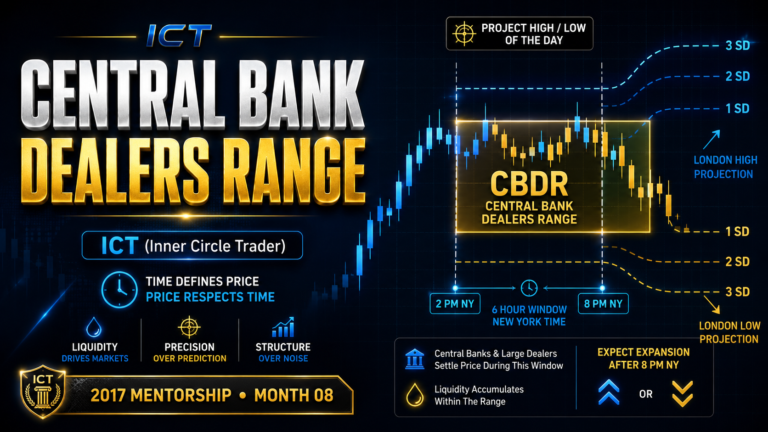
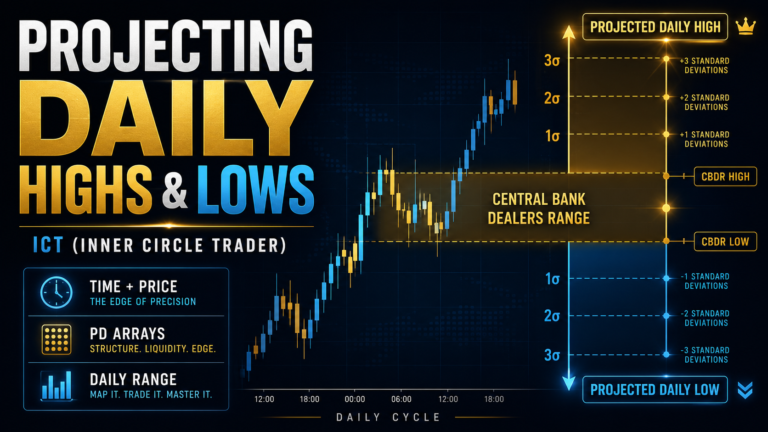
The Central Bank Dealers Range can provide additional information about the expected protractionary movement.
A narrow range may help the trader estimate:
- How far price could move below the open on a bullish day
- How far price could move above the open on a bearish day
- Whether one or two standard deviations are realistic
- Whether the market has accumulated before the new session
The Central Bank Dealers Range is useful, but it is not required for the basic version of this model.
The trader can use only:
- Higher-timeframe direction
- PD Array reaction
- Zero GMT opening price
- Five-day Average Daily Range
- Higher-timeframe target
Adding the Central Bank Dealers Range can refine the entry but should not replace the directional analysis.
Using the Model as a One-Day Trade
The same concept can be used for a single-day position.
A high-probability bullish day may be anticipated when:
- Daily chart has reacted from discount
- Institutional order flow is bullish
- Quarterly direction is bullish
- Seasonal tendency supports higher prices
- Recent daily ranges have been small
- The day is Monday, Tuesday, or Wednesday
- A clear premium target remains above the market
The trader can buy at or below the Zero GMT opening price and target the expected daily range expansion.
A bearish one-day trade uses the opposite conditions.
In this version, the trader may close the position when:
- Average Daily Range is reached
- Opposing intraday PD Array is reached
- Daily liquidity objective is completed
- London Close or New York timing suggests the move is mature
Using the Model for a Swing or Position Trade
For a longer-term trade, the daily opening price is only the entry mechanism.
The target is determined from the higher-timeframe chart.
Possible objectives include:
- Daily Fair Value Gap
- Weekly Fair Value Gap
- Daily Order Block
- Weekly Order Block
- Previous weekly high or low
- Previous monthly high or low
- Premium or discount array
- Major liquidity pool
- Higher-timeframe imbalance
The trader may hold through multiple daily candles as long as the higher-timeframe narrative remains valid.
Daily fluctuations should not automatically cause the trader to exit.
The position should be managed according to the original higher-timeframe thesis.
Position Sizing
Because the stop may be wider than a normal day-trading stop, position size must be smaller.
A trader should define:
- Maximum percentage risk
- Entry price
- Stop-loss price
- Stop distance
- Value per pip
- Correct lot size
For example, a trader risking 1% with a 100-pip stop should use a much smaller position than a trader risking 1% with a 20-pip stop.
The wider stop does not justify taking greater monetary risk.
The trade should be sized so that a full stop-out remains acceptable.
Integrating Intraday Precision With HTF Targets
The trader can improve the basic Zero GMT model by combining it with lower-timeframe confirmations.
Possible refinements include:
- Liquidity raid around the opening price
- Five-minute Order Block
- 15-minute Order Block
- Fair Value Gap
- Market Structure Shift
- Change in State of Delivery
- Standard-deviation overlap
- Asian Range high or low
- Previous New York session high or low
These refinements may improve entry precision and reduce the required stop distance.
However, they are optional.
The main advantage of the Zero GMT model is that the trader can participate without watching the entire London Kill Zone.
Example of a Bullish HTF Integration
Assume the daily chart trades into a bullish Order Block.
Price rejects the Order Block and closes with bullish displacement.
The next premium objective is a daily Fair Value Gap above the market.
The following day:
- Mark the Zero GMT opening price.
- Buy a partial position at the opening price.
- Place another buy order 10 to 20 pips below the open.
- Calculate the five-day Average Daily Range.
- Place the stop using that volatility measurement.
- Hold the position toward the daily Fair Value Gap.
- Reduce risk or take partial profits as price reaches intermediate liquidity.
The entry is based on a daily reference, but the target comes from the higher-timeframe setup.
Example of a Bearish HTF Integration
Assume the daily chart trades above an old high and reaches a bearish Order Block.
Price rejects the premium PD Array and begins delivering lower.
The next higher-timeframe objective is a discount Fair Value Gap.
The following day:
- Mark the Zero GMT opening price.
- Sell a partial position at the opening price.
- Place another sell limit 10 to 20 pips above the open.
- Calculate the five-day Average Daily Range.
- Place the protective stop above the entry.
- Hold toward the discount Fair Value Gap.
- Take partial profits at intermediate sell-side liquidity.
Again, the daily opening price provides the execution, while the higher-timeframe chart provides the reason for the trade.
Common Mistakes
Using the Opening Price Without a Bias
The Zero GMT open is not automatically a buy or sell signal.
The trader must first establish the higher-timeframe direction.
Ignoring the Previous Day’s Reaction
Price should have already respected an important premium or discount PD Array.
Without this reaction, the setup is weaker.
Using Too Much Position Size
A wider stop requires a smaller position.
Risk should remain fixed in monetary or percentage terms.
Expecting a Perfect London Entry
This model is designed for traders who may not participate during London.
The entry may not be as precise as a Kill Zone setup.
Closing the Trade Too Early
A higher-timeframe setup should not automatically be closed after a small intraday profit.
The original target may require several days of holding.
Holding After the HTF Narrative Fails
The wider stop is not an excuse to ignore invalidation.
If the higher-timeframe idea is no longer valid, the trader should reassess the position.
Applying the Model Every Day
The setup requires:
- Clear directional bias
- PD Array reaction
- Higher-timeframe objective
- Suitable market conditions
It is not a daily mechanical strategy.
Integrating Daytrades With HTF Trade Entries Checklist
Before entering, confirm:
- Is the daily or four-hour direction clear?
- Is institutional order flow bullish or bearish?
- Has price reacted from a discount or premium PD Array?
- Did the reaction occur during the previous trading day?
- Is the opposing higher-timeframe target clear?
- Have I marked the Zero GMT opening price correctly?
- Am I entering at the open or using a 10-to-20-pip limit?
- Would a split entry reduce the risk of missing the move?
- What is the five-day Average Daily Range?
- Is the position size adjusted for the wider stop?
- Is the expected reward large enough for the stop distance?
- Am I managing the trade as a day trade, swing trade, or position trade?
- What price action would invalidate the higher-timeframe idea?
- Where will partial profits be taken?
- Am I following the higher-timeframe narrative rather than reacting emotionally to intraday movement?
Final Thoughts
Integrating Daytrades With HTF Trade Entries allows traders to combine simple intraday execution with larger market objectives.
The model begins with a clear daily or four-hour bias. Price must have already reacted from an important premium or discount PD Array. The Zero GMT opening price then provides a practical reference for entering the next trading day.
Bullish traders may buy at the opening price or slightly below it. Bearish traders may sell at the opening price or slightly above it. A five-day Average Daily Range can be used to build a wider protective stop suitable for the higher-timeframe setup.
The most important distinction is that the daily opening price is not the reason for the trade. It is only the entry mechanism.
The real reason for the trade comes from:
- Higher-timeframe institutional order flow
- Premium and discount
- PD Arrays
- Liquidity objectives
- Expected daily or weekly direction
When these elements align, a simple day-trade entry can provide access to a much larger higher-timeframe move.