
Interest Rate Differentials are an important higher timeframe concept taught by Michael J. Huddleston, founder of the ICT (Inner Circle Trader) concepts. This concept is taught in the ICT Mentorship Core Content – Month 5 and explains how differences between central bank interest rates can help traders identify currencies with the potential for large macro price moves.
The basic idea is simple. Large funds generally look for fundamental reasons to move capital into one currency and away from another. Interest rates provide one of the clearest macro foundations for this process.
As Michael J. Huddleston explains:
“You can’t get any more fundamental than interest rates.”
By comparing a higher-yielding currency with a lower-yielding currency, ICT traders can build a higher timeframe directional idea and then use technical analysis to qualify the trade.
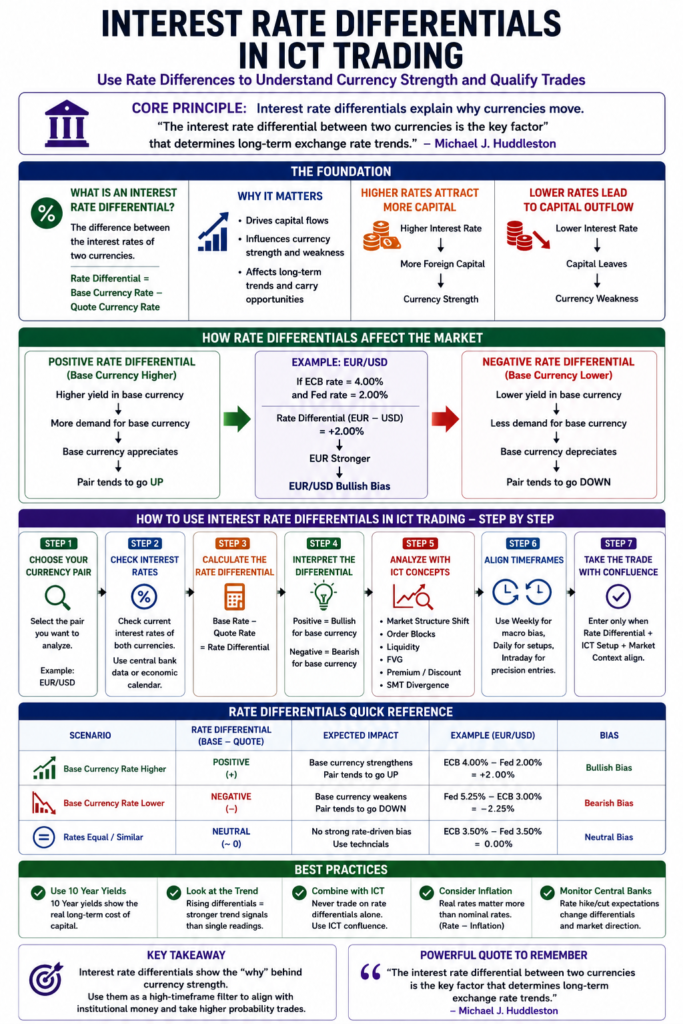
What Are Interest Rate Differentials?
An interest rate differential is the difference between the interest rates of two countries or central banks.
For example:
Country A interest rate → 1.50%
Country B interest rate → 0.50%
Interest rate differential → 1.00%
The currency associated with the higher interest rate is considered the higher-yielding currency.
The currency associated with the lower interest rate is considered the lower-yielding currency.
ICT uses this difference to understand where large funds may have a fundamental reason to allocate capital.
Why Interest Rates Matter in Forex
Currency pairs represent two different currencies.
Therefore, when a trader studies a Forex pair, they are also comparing two different economies and two different central bank interest rate environments.
Money generally seeks better yield.
Michael J. Huddleston states:
“Funds will seek to trade high yielding currencies and place that against a weak yielding currency.”
The general macro idea is:
Buy stronger or higher-yielding currency
Sell weaker or lower-yielding currency
This creates a fundamental basis for selecting a Forex pair.
The interest rate differential does not provide an exact trade entry. It helps the trader determine which currency may attract capital and which currency may experience weakness.
How ICT Selects Currency Pairs Using Interest Rate Differentials
The process begins at the central bank level.
First, find a country with a relatively high interest rate.
Then find another country with a lower interest rate.
The rates do not need to be the absolute highest and lowest available.
There simply needs to be a meaningful difference between them.
The process is:
High-interest-rate country → Identify its currency
Low-interest-rate country → Identify its currency
Combine both currencies → Build the Forex pair
After selecting the pair, the trader studies higher timeframe technical conditions.
High Yielding Currency vs Low Yielding Currency
Suppose the Australian central bank offers a higher interest rate than the Federal Reserve.
Australian Dollar → Higher yield
US Dollar → Lower yield
From a fundamental perspective, the trader may expect strength in the Australian Dollar relative to the US Dollar.
The corresponding Forex pair is:
AUD/USD
Because AUD is the base currency, strength in the Australian Dollar against the US Dollar would normally cause AUD/USD to move higher.
The macro expectation becomes:
Higher Australian yield → AUD strength
Lower US yield → Relative USD weakness
AUD/USD → Bullish expectation
This creates the fundamental premise.
The trader must then look for technical confirmation.
Interest Rate Differentials Are Not Standalone Trade Signals
A common mistake would be buying a currency only because its interest rate is higher.
ICT does not use the concept in this way.
Interest rate differentials establish the fundamental background.
Technical analysis is then used to identify whether institutional buying or selling is actually visible.
The trader may look for:
Higher timeframe support or resistance
Institutional order flow
Open interest
Seasonal tendencies
SMT divergence
Dollar Index confirmation
Michael J. Huddleston explains that traders do not need every tool to confirm the idea.
“We only need one or two to confirm.”
The goal is to align the interest rate premise with strong technical evidence.
AUD/USD Interest Rate Differential Example
ICT uses the Australian Dollar as an example of a higher-yielding currency.
The Australian interest rate was higher than the Federal Reserve rate during the period being analyzed.
This created a fundamental reason to look for Australian Dollar strength.
On the higher timeframe chart, the Australian Dollar traded into an old low around 71.50, which acted as higher timeframe support.
However, the support level alone was not enough.
The important confirmation appeared in open interest.
Open interest declined sharply.
ICT interprets a significant reduction in open interest in this context as possible short covering by large commercial traders or smart money.
If large traders are reducing short positions, they may no longer want exposure to further downside.
This can indicate anticipation of higher prices.
The conditions were aligned:
Australian Dollar → Higher interest rate
US Dollar → Lower interest rate
AUD → Higher timeframe support
Open interest → Significant reduction
Smart money clue → Short covering
The Australian Dollar then experienced a strong rally.
The interest rate differential created the fundamental basis, while the technical conditions qualified the trade idea.
Using Open Interest With Interest Rate Differentials
Open interest is useful because it can help traders study the activity of larger market participants.
For example, assume a higher-yielding currency trades into higher timeframe support.
At the same time, open interest suddenly declines.
This may indicate that large traders are covering short positions.
The analysis becomes:
Higher-yielding currency → Fundamental strength
Higher timeframe support → Technical location
Declining open interest → Possible short covering
This combination can support a bullish macro idea.
The interest rate differential tells the trader why capital may move into the currency.
Open interest and price action help determine whether institutional behavior supports the idea.
Dollar Index Confirmation
ICT also uses the US Dollar Index or DXY to qualify Forex setups involving the US Dollar.
For example, if the trader expects AUD/USD to move higher, the Dollar Index should not show overwhelming strength against that idea.
ICT may also look for SMT divergence between DXY and the currency being studied.
In the Australian Dollar example, DXY produced a higher high while the Australian Dollar failed to make a corresponding lower low.
This difference can indicate relative strength in the Australian Dollar.
Interest rate differential → Fundamental premise
Higher timeframe support → Technical location
Open interest → Smart money confirmation
DXY divergence → Directional qualification
When these elements align, the higher timeframe trade condition becomes stronger.
USD/JPY Interest Rate Differential Example
Another example involves the US Dollar and Japanese Yen.
Suppose the Federal Reserve rate is higher than the Bank of Japan rate.
US Dollar → Higher yielding currency
Japanese Yen → Lower yielding currency
The corresponding Forex pair is:
USD/JPY
The macro idea is to buy the stronger currency and sell the weaker currency.
Since USD is the base currency in USD/JPY, Dollar strength and Yen weakness would support a move higher in the pair.
The relationship is:
Higher US yield → USD strength
Lower Japanese yield → JPY weakness
USD/JPY → Bullish expectation
However, ICT first studies the Japanese Yen itself for technical weakness.
Understanding the Pair Formation
The formation of the Forex pair is very important.
A trader may identify Japanese Yen weakness.
But this does not mean USD/JPY should move lower.
USD/JPY is formed as:
USD / JPY
When the Japanese Yen weakens against the Dollar, USD/JPY normally moves higher.
Therefore:
JPY weakness → USD/JPY bullish
AUD strength → AUD/USD bullish
USD strength against JPY → USD/JPY bullish
The trader must understand which currency is the base currency and which is the quote currency before applying the interest rate differential.
Combining Interest Rates With ICT Technicals
In the Japanese Yen example, price traded into higher timeframe resistance.
A bearish order block was also present.
The technical analysis suggested potential Yen weakness.
At the same time, the interest rate differential favored the US Dollar over the Japanese Yen.
The conditions were therefore aligned:
USD → Higher yielding currency
JPY → Lower yielding currency
JPY → Higher timeframe resistance
Bearish order block → Technical weakness
Expected Yen weakness → Bullish USD/JPY
The resulting move produced a significant higher timeframe expansion.
This is the purpose of combining fundamental interest rate analysis with ICT technical concepts.
Why Large Funds Follow Interest Rate Differentials
Large institutional funds generally operate with a longer-term perspective.
They require a fundamental reason to move significant capital into or out of a currency.
Interest rate differences can provide this reason.
As Michael J. Huddleston explains:
“Money seeks yield.”
When one currency offers a relatively stronger yield than another, funds may have more reason to favor that currency.
This can create large capital flows.
These flows may produce trends lasting several weeks or months.
ICT traders then look for the technical footprints of these large flows.
Interest Rate Differentials and Higher Timeframe Trading
Interest rate differentials are primarily a higher timeframe analysis tool.
They are not designed to identify a five-minute scalping entry.
Instead, they help identify the broader market direction.
ICT generally studies the previous three to six months and looks for significant price moves that were supported by differences in central bank rates.
A trader may use weekly and daily charts to identify:
Major support and resistance
Institutional order flow
Order blocks
Seasonal tendencies
Open interest changes
SMT divergence
Once the higher timeframe direction is understood, lower timeframe trades can be taken in alignment with that macro idea.
Can Day Traders Use Interest Rate Differentials?
Yes.
A day trader does not need to hold a position for several months to benefit from this concept.
Interest rate differentials can be used as a directional filter.
For example, suppose macro analysis strongly favors USD strength against JPY.
The trader may prioritize bullish USD/JPY setups.
Instead of randomly buying and selling both directions, the trader can focus on lower timeframe opportunities aligned with the higher timeframe flow.
The interest rate differential creates the macro premise.
ICT entry models can then be used for execution.
Simple ICT Interest Rate Differential Process
A trader can follow this basic process:
Step 1: Study Central Bank Interest Rates
Identify relatively high-yielding and low-yielding currencies.
Step 2: Select Two Currencies
Choose a stronger yielding currency and a weaker yielding currency.
Step 3: Build the Forex Pair
Determine how the two currencies are paired.
Step 4: Establish the Macro Direction
Decide whether the pair should theoretically move higher or lower.
Step 5: Study Higher Timeframe Levels
Look for major support, resistance, old highs, or old lows.
Step 6: Look for ICT Technical Confirmation
Use institutional order flow, order blocks, open interest, or seasonal tendencies.
Step 7: Check DXY When Relevant
Use Dollar Index direction or SMT divergence to qualify USD-related setups.
Step 8: Trade With the Higher Timeframe Premise
Use the macro direction to filter swing, short-term, or day trade setups.
Final Thoughts
Interest Rate Differentials provide ICT traders with a fundamental method for understanding why major currency trends may develop.
The core idea is to compare central bank interest rates and identify a higher-yielding currency against a lower-yielding currency.
However, the interest rate difference is only the foundation.
ICT traders then combine the fundamental premise with higher timeframe support and resistance, institutional order flow, open interest, seasonal tendencies, SMT divergence, and Dollar Index confirmation.
When the interest rate environment and technical analysis align, traders may be able to identify the footprint of large institutional capital flows.
The goal is not to trade every small market fluctuation. The goal is to understand which currencies have the strongest fundamental and technical conditions for a significant higher timeframe move.