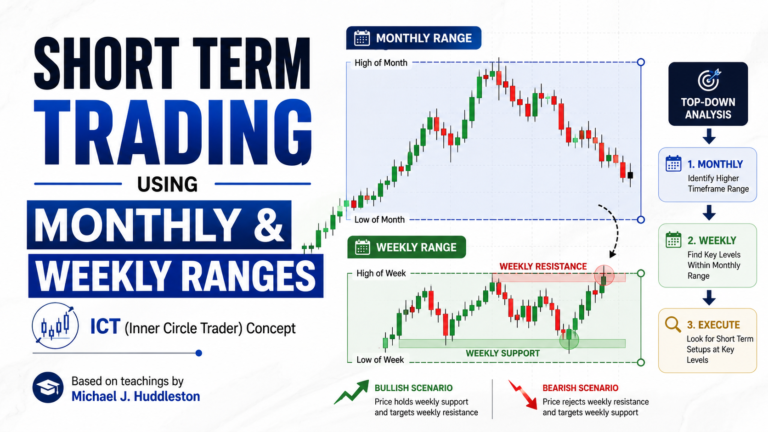
Short Term Trading Low Resistance Liquidity Runs Part 1 is a framework taught by Michael J. Huddleston, the founder of the ICT methodology. This concept is covered in the 2017 ICT Private Mentorship Core Content Month 07.
The purpose of this model is to help traders identify easier price movements from one institutional reference point to another, especially when the market is trading inside a consolidation.
Rather than depending on traditional overbought and oversold indicators, the ICT inner circle trader studies time, price, premium, discount and the location of institutional PD Arrays.
As Michael J. Huddleston explains:
“We’re looking for low resistance liquidity runs from one PD array to another, from a discount to a premium.”
What Is a Low Resistance Liquidity Run?
A low resistance liquidity run is a price movement that has relatively few obstacles between the entry area and the target.
In a bullish setup, price may move from a discount PD Array toward a premium PD Array.
In a bearish setup, price may move from a premium PD Array toward a discount PD Array.
The cleaner the path between these two areas, the easier it may be for price to expand toward its objective.
This does not mean the market will move without retracements. It means the trader has identified a logical path where institutional price delivery has fewer opposing reference points.
Time and Price Must Work Together
Every short-term trade should be framed through both time and price.
The time element is based on the recent IPDA data ranges:
- Last 20 trading days
- Last 40 trading days
- Last 60 trading days
For short-term trading, the last 60 trading days provide approximately three months of price history.
This lookback period helps the trader locate recent institutional reference points that may influence the next move.
The price element comes from the PD Array Matrix.
This includes:
- Order Blocks
- Fair Value Gaps
- Breakers
- Mitigation Blocks
- Rejection Blocks
- Old highs and lows
- Liquidity pools
- Other premium and discount PD Arrays
A trade becomes more meaningful when an important PD Array is positioned correctly within the recent dealing range.
First Determine Whether the Market Is Trending or Consolidating
Before looking for a setup, determine whether the market is trending or trading inside a range.
A trending market shows continued directional expansion.
A consolidating market repeatedly moves between a defined high and low without sustaining a breakout.
For this model, the trader studies approximately the previous 60 trading days on the daily chart.
If price has remained between a clear upper and lower boundary, it can be treated as a consolidation.
The consolidation then becomes the main dealing range for the analysis.
How to Define the Consolidation Range
ICT defines the consolidation using the highest and lowest candlestick bodies, rather than relying only on the extreme wicks.
Look back over the previous 60 trading days and identify:
- The highest candle opening or closing price
- The lowest candle opening or closing price
These two levels form the main consolidation range.
The candle wicks may briefly extend beyond the range because of liquidity raids. However, the candle bodies often provide a clearer representation of the accepted trading range.
Mark the Midpoint of the Range
After defining the highest and lowest candle bodies, use the Fibonacci tool to locate the 50 percent level.
This midpoint divides the consolidation into two main sections.
The area above the midpoint is the overall premium range.
The area below the midpoint is the overall discount range.
The midpoint also acts as an important reference for judging whether price is relatively expensive or inexpensive inside the consolidation.
Premium and Discount Logic
The highest-probability long positions are generally found in discount.
The highest-probability short positions are generally found in premium.
In simple terms:
- Buy in discount and target premium.
- Sell in premium and target discount.
However, premium and discount alone are not entry signals.
The trader must combine the location with a valid institutional PD Array.
For example, a bullish Order Block in discount may provide a long setup.
A bearish Order Block in premium may provide a short setup.
Divide the Range Into Quadrants
The overall consolidation can be divided into smaller sections.
First, divide the full range at its 50 percent midpoint.
Next, divide the upper half into two equal sections.
Then divide the lower half into two equal sections.
This creates four major quadrants.
Each quadrant may also be divided further into its own premium and discount ranges.
This creates a more detailed view of price inside the consolidation.
Instead of viewing the entire upper half as simply overbought, the trader can identify smaller discount areas inside that upper premium range.
Similarly, the trader can identify smaller premium areas inside the lower discount range.
Why Smaller Premium and Discount Ranges Matter
Price does not always travel directly from the lowest point of the consolidation to the highest point.
It may move through several smaller dealing ranges during the process.
A market can be in the premium half of the overall consolidation while temporarily trading in discount within a smaller internal range.
This may still provide a valid long setup if there is enough room for price to reach a higher premium PD Array.
The same principle applies in reverse.
A market can be in the discount half of the larger consolidation while temporarily trading in premium within a smaller internal range.
This may create a short-term selling opportunity toward a lower internal target.
Context determines whether the trade is logical.
Best Long Positions Inside a Consolidation
The highest-probability long positions generally form near the lower part of the overall consolidation.
The ideal conditions include:
- Price is in the discount half of the total range.
- Price reaches the lower discount quadrant.
- A fresh bullish PD Array is present.
- Sell-side liquidity has been taken.
- Price has room to reach a premium objective.
Useful bullish PD Arrays may include:
- Bullish Order Blocks
- Bullish Breakers
- Discount Fair Value Gaps
- Old highs acting as support
- Sell-side liquidity raids
- Bullish rejection areas
The lower price is inside the overall consolidation, the easier it may be for the market to reach a profitable premium target.
Best Short Positions Inside a Consolidation
The highest-probability short positions generally form near the upper part of the consolidation.
The ideal conditions include:
- Price is in the premium half of the total range.
- Price reaches the upper premium quadrant.
- A fresh bearish PD Array is present.
- Buy-side liquidity has been taken.
- Price has room to reach a discount objective.
Useful bearish PD Arrays may include:
- Bearish Order Blocks
- Bearish Breakers
- Premium Fair Value Gaps
- Old lows acting as resistance
- Buy-side liquidity raids
- Bearish rejection areas
The higher price is inside the overall consolidation, the easier it may be for the market to reach a profitable discount target.
Fresh PD Arrays Are More Important
A PD Array that has not yet been revisited is generally more useful than one that has already been traded through.
Once price has already returned to an Order Block, Fair Value Gap or other institutional reference point, part of its usefulness may have been consumed.
The algorithm may then seek a new source of liquidity or another fresh PD Array.
For this reason, the trader should prioritize levels that:
- Have not been revisited
- Remain relatively clean
- Align with premium or discount
- Have liquidity positioned nearby
- Offer room toward an opposing target
Repeatedly using old and already-mitigated levels can lead to lower-quality setups.
Targeting the Opposing PD Array
A long trade should normally target a premium PD Array.
A short trade should normally target a discount PD Array.
The target may be found on a lower timeframe.
For example, a daily bullish Order Block may provide the entry framework.
The trader can then move to the four-hour or one-hour chart to identify the first premium PD Array for partial profit.
Possible bullish objectives include:
- A four-hour bearish Order Block
- A one-hour premium Fair Value Gap
- Buy-side liquidity
- An old high
- A premium Breaker
- The midpoint of a higher dealing range
Possible bearish objectives include:
- A four-hour bullish Order Block
- A one-hour discount Fair Value Gap
- Sell-side liquidity
- An old low
- A discount Breaker
- The midpoint of a lower dealing range
Taking First Profit
The first profit should normally be taken when price reaches an opposing lower-timeframe PD Array.
For a long position, the first exit may occur when price enters a four-hour or one-hour premium area.
For a short position, the first exit may occur when price enters a four-hour or one-hour discount area.
This allows the trader to secure part of the position before price encounters stronger resistance or support.
The remaining portion can be held for a larger premium or discount objective if the higher-timeframe conditions remain valid.
Why the Middle of the Range Is Difficult
The center of a consolidation is often the most difficult place to trade.
Price may move in both directions without reaching a meaningful higher-timeframe objective.
Liquidity can be taken above and below short-term highs and lows.
PD Arrays may have already been used.
Directional bias may also be unclear.
This creates the conditions for repeated stop-outs and false signals.
The middle of the range is especially dangerous when the trader does not understand:
- Open float
- Buy-side liquidity
- Sell-side liquidity
- The next likely draw on price
- Whether the active PD Array is fresh
- The higher-timeframe directional bias
When the market is trading near equilibrium without a clear objective, waiting is often the better decision.
Why Traditional Indicators May Be Misleading
Traditional indicators may label the market as overbought simply because price is in the upper part of a range.
However, price may still have room to move higher.
Similarly, an indicator may label price as oversold even though lower discount objectives remain unfinished.
ICT analyzes overvaluation and undervaluation through actual price ranges.
The trader studies:
- The overall consolidation
- Internal quadrants
- Premium and discount
- Institutional PD Arrays
- Liquidity
- Time-based lookback periods
This provides an algorithmic framework rather than a mathematically derived indicator reading.
One Shot One Kill Does Not Require a Full Week
A One Shot One Kill trade does not always begin on Monday and end on Friday.
It is a short-term trading model that may last:
- One trading session
- One day
- Several days
- Up to one week
The important point is not the duration.
The important point is identifying one clean movement from the entry PD Array to the target PD Array.
A 100-pip move that develops over two days can still qualify as a short-term One Shot One Kill opportunity.
Bullish Example
Assume the market is consolidating over the previous 60 trading days.
Price declines into the lower half of the range and reaches a fresh daily bullish Order Block.
The Order Block is positioned inside a discount quadrant.
Sell-side liquidity below an old low is also taken.
The trader looks for a long entry from the bullish PD Array.
The first objective may be a four-hour premium Fair Value Gap.
A larger target may be a daily bearish Order Block near the upper half of the consolidation.
This creates a low resistance liquidity run from discount to premium.
Bearish Example
Assume price rallies into the upper part of the 60-day consolidation.
The market reaches a fresh weekly rejection block and trades above an old high.
This removes buy-side liquidity inside the highest premium quadrant.
The trader looks for a bearish entry.
The first target may be a four-hour discount Fair Value Gap.
The larger objective may be a daily bullish Order Block in the lower half of the consolidation.
This creates a low resistance liquidity run from premium to discount.
Practical Trading Process
Begin on the daily chart.
Look back over the previous 60 trading days.
Identify whether the market is trending or consolidating.
If it is consolidating, mark the highest and lowest candle bodies.
Find the 50 percent midpoint.
Divide the upper and lower halves into quadrants.
Mark monthly, weekly and daily PD Arrays.
Identify which arrays are fresh.
Determine where buy-side and sell-side liquidity are resting.
Move to the four-hour and one-hour charts.
Look for an entry PD Array in the correct premium or discount location.
Select the nearest opposing PD Array as the first target.
Avoid trades that begin in the middle of the range without a clear directional objective.
Trading Checklist
Before entering a trade, confirm:
- Has the market been analyzed over the last 20, 40 and 60 trading days?
- Is the market trending or consolidating?
- Are the consolidation boundaries based on candle bodies?
- Has the 50 percent midpoint been marked?
- Is the trade located in premium or discount?
- Which internal quadrant is price trading inside?
- Is there a valid PD Array at the entry location?
- Is the PD Array fresh?
- Has relevant liquidity been taken?
- Where is the next opposing PD Array?
- Is the price path relatively clear?
- Is the trade too close to the middle of the range?
- Does the target provide enough range for the risk?
- Is the directional bias clear?
Common Mistakes
Buying Only Because Price Is in Discount
Discount alone does not create a long setup.
A bullish PD Array, liquidity event and logical upside target should also be present.
Selling Only Because Price Is in Premium
Premium alone does not create a short setup.
The trader still needs a bearish PD Array and a clear draw toward lower liquidity.
Ignoring Internal Ranges
A market in overall premium can still form an internal discount buying opportunity.
A market in overall discount can still form an internal premium selling opportunity.
The smaller dealing range must be considered within the larger context.
Trading Used PD Arrays
A level that has already been mitigated may not produce the same reaction again.
Fresh institutional reference points are generally more desirable.
Trading in the Middle
The middle of the range often contains the most indecisive and difficult price action.
Without a strong bias, traders can be repeatedly caught in both directions.
Using Indicators Instead of Price
Indicators do not identify institutional PD Arrays or the true liquidity objective.
Premium, discount, dealing ranges and liquidity provide more useful context for this model.
Final Thoughts
Short Term Trading Low Resistance Liquidity Runs Part 1 teaches traders how to study consolidation through an institutional framework.
The model begins with the previous 20, 40 and 60 trading days.
The trader defines the consolidation using candle bodies, marks the midpoint and divides the range into premium, discount and smaller internal quadrants.
The best long positions usually form near the lower part of the total consolidation at fresh discount PD Arrays.
The best short positions usually form near the upper part of the total consolidation at fresh premium PD Arrays.
The objective is to find a clean movement from one PD Array to another.
When time, price, liquidity, premium, discount and fresh institutional levels align, the trader may identify a genuine low resistance liquidity run.