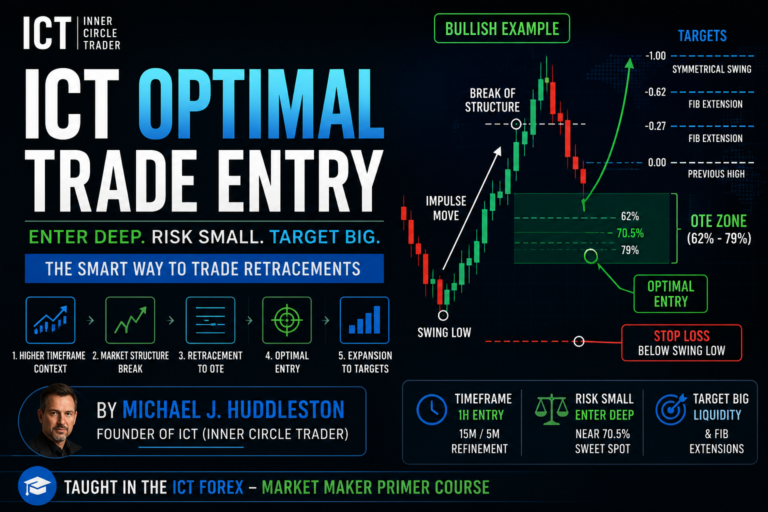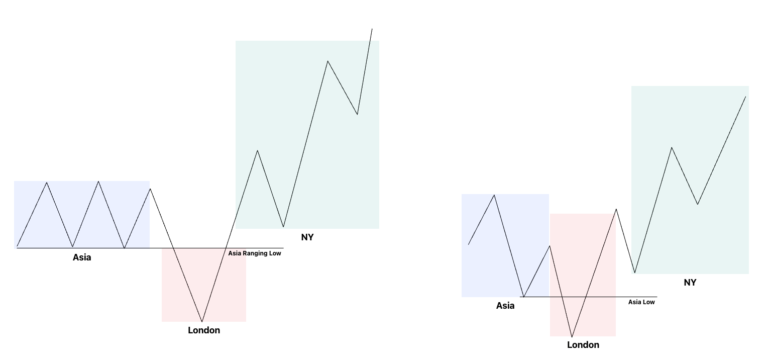
The ICT Judas Swing is a price manipulation model used to anticipate the false directional move that can occur during the early London trading session before price expands toward its real intraday objective.
This concept was taught by Michael J. Huddleston, founder of ICT (Inner Circle Trader), in the ICT Forex – Market Maker Primer Course. The model combines higher timeframe directional bias, the Asian Range, the midnight opening price, liquidity, and London session timing.
The basic concept is:
Determine Daily Bias → Asian Range Forms → False Move Traps Traders → Judas Swing Forms → Price Expands in the True Direction
Michael J. Huddleston explains:
“The Judas swing is a false run that trips traders that lack the understanding of true direction of the day.”
The key is understanding that the Judas Swing is not simply any move above or below an opening price. It has specific characteristics and must be supported by a higher timeframe directional premise.
What Is the ICT Judas Swing?
The ICT Judas Swing is an energetic false price move that commonly develops during the early London session.
It can:
- Raid liquidity.
- Trigger breakout traders into the wrong direction.
- Stop out correctly positioned traders.
- Create the London high or London low.
- Establish the high or low of the daily range.
The name reflects the deceptive nature of the move.
Price appears to lead traders in one direction, encouraging them to commit to a breakout. It then reverses and aggressively expands in the opposite direction.
In bullish conditions:
False Bearish Move → Traders Sell → Price Reverses Higher
In bearish conditions:
False Bullish Move → Traders Buy → Price Reverses Lower
This false move is the Judas Swing.
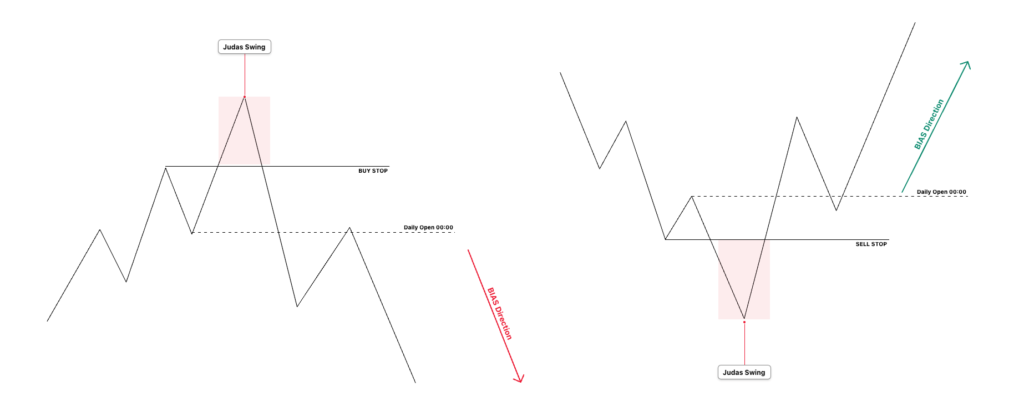
ICT Judas Swing Time Window
Huddleston teaches traders to begin hunting for the Judas Swing from:
00:00 New York Time → 05:00 New York Time
The reference point begins with the midnight New York opening price.
This five-hour window covers the period when the London session high or low may develop.
The trader should mark:
- Asian Range High
- Asian Range Low
- 00:00 New York opening price
These three references help reveal whether price is creating a bullish or bearish Judas Swing.
The model is primarily focused on the early London session, when an energetic liquidity raid may create one side of the daily range.
Higher Timeframe Bias Comes First
The Judas Swing cannot be traded correctly without directional bias.
Before studying the London session, the trader must have an expectation for the day.
Ask:
Are higher prices expected?
Or:
Are lower prices expected?
A bullish higher timeframe premise means the trader should anticipate a potential bullish Judas Swing.
A bearish higher timeframe premise means the trader should anticipate a potential bearish Judas Swing.
The process is:
Higher Timeframe Analysis → Daily Directional Bias → Judas Swing Expectation
Without a directional premise, the trader may mistake genuine expansion for manipulation.
For example, a rally above the Asian Range high is not automatically a bearish Judas Swing.
Similarly, a decline below the Asian Range low is not automatically bullish manipulation.
The broader market storyline must support the setup.
Bullish ICT Judas Swing
A bullish ICT Judas Swing occurs when higher timeframe analysis suggests price should move higher.
The trader is expecting a bullish daily range or higher close.
A classic bullish Judas Swing sequence is:
Bullish Bias → Tight Asian Range → Asian High Raided → Price Drops Below Midnight Open → Asian Low Raided → London Low Forms → Bullish Expansion
The exact sequence is important.
Initial Asian Range High Raid
Price may first move above the Asian Range high.
Buy stops are triggered and breakout traders may enter long positions.
This is the first layer of manipulation.
Traders see price breaking higher and interpret the movement as bullish continuation.
Price then reverses.
Price Drops Below the Midnight Open
The market moves below the 00:00 New York opening price.
This is an important element of the bullish Judas Swing.
A small random move below the opening price is not enough.
Huddleston emphasizes that the Judas Swing should lead traders into the wrong idea and then deliver an energetic movement lower.
Asian Range Low Is Raided
Price then trades below the Asian Range low.
The decline can:
- Stop out Asian session buyers.
- Trigger breakout sellers.
- Create bearish sentiment.
- Raid sell-side liquidity.
Traders begin selling as price appears weak.
However, the higher timeframe premise remains bullish.
The complete move below the midnight opening price and through the Asian Range low forms the bullish Judas Swing.
The false bearish movement may establish the London low and, in favorable conditions, the low of the day.
Bullish Judas Swing Sequence
The bullish model can be mapped as:
Bullish HTF Bias
↓
Asian Range Forms
↓
Price Raids Asian Range High
↓
Breakout Buyers Enter
↓
Price Reverses Below Midnight Open
↓
Asian Range Low Is Swept
↓
Sellers Enter and Longs Are Stopped
↓
London Low Forms
↓
Price Aggressively Expands Higher
The trader is not supposed to chase the decline.
The decline is studied as potential manipulation because the broader directional bias is bullish.
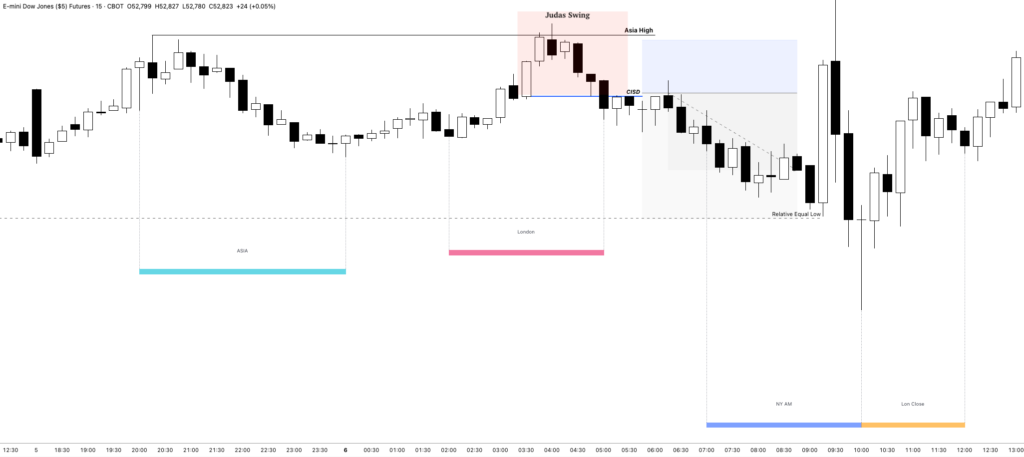
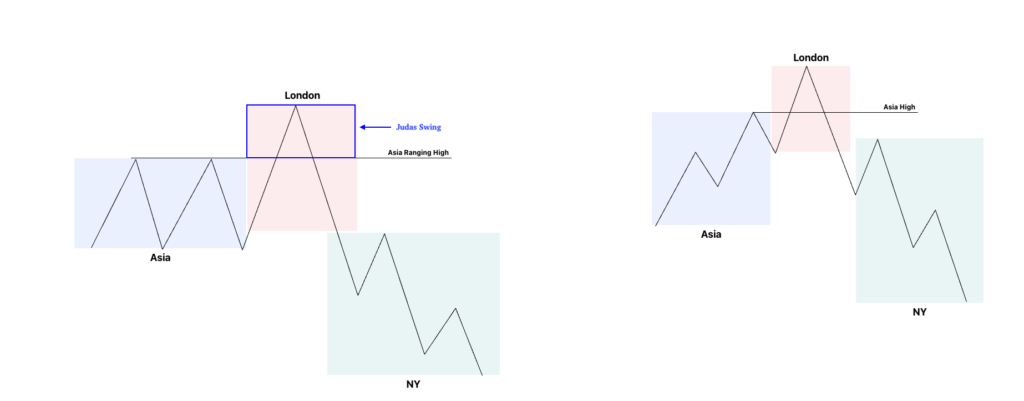
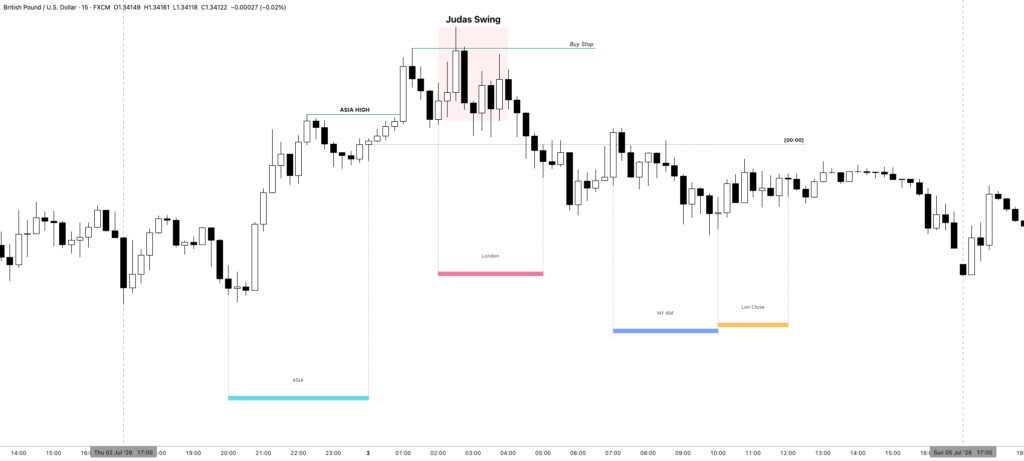
Bearish ICT Judas Swing
A bearish ICT Judas Swing forms when higher timeframe analysis suggests lower prices.
The trader expects a bearish daily range or lower close.
The classic sequence is:
Bearish Bias → Tight Asian Range → Asian Low Raided → Price Rallies Above Midnight Open → Asian High Raided → London High Forms → Bearish Expansion
The bearish Judas Swing is the inverse of the bullish model.
Initial Asian Range Low Raid
Price initially moves below the Asian Range low.
Breakout traders may sell short.
Their protective buy stops will commonly rest above nearby short-term highs or the Asian Range high.
The market has now encouraged bearish participation.
Price Rallies Above the Midnight Open
Price reverses and moves above the 00:00 New York opening price.
Because the higher timeframe bias is bearish, this rally should be viewed with suspicion.
The trader should not automatically interpret the movement as genuine bullish strength.
Asian Range High Is Raided
Price moves through the Asian Range high.
This can:
- Stop out short sellers.
- Trigger breakout buyers.
- Raid buy-side liquidity.
- Create bullish sentiment.
The market may move energetically as the Judas Swing creates the London high.
Traders see strength and buy.
However, the broader market premise remains bearish.
Once the manipulation is complete, price may aggressively expand lower.
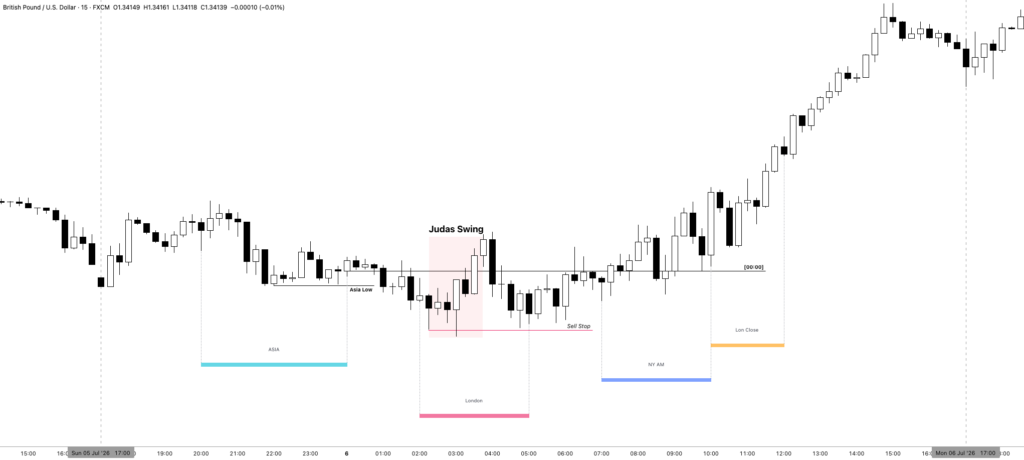
Bearish Judas Swing Sequence
The bearish model is:
Bearish HTF Bias
↓
Asian Range Forms
↓
Price Raids Asian Range Low
↓
Breakout Sellers Enter
↓
Price Reverses Above Midnight Open
↓
Asian Range High Is Swept
↓
Buyers Enter and Shorts Are Stopped
↓
London High Forms
↓
Price Aggressively Expands Lower
One important confirmation is how price behaves after creating the high.
Huddleston explains that aggressive movement away from the Judas Swing high can be a hallmark that traders have been trapped.
A slow, uncertain rejection is different from clear bearish price delivery.
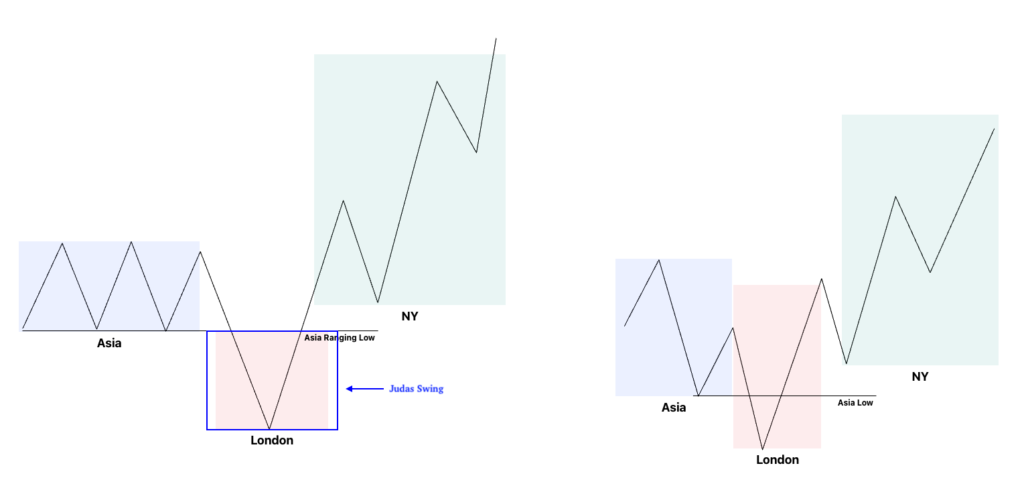
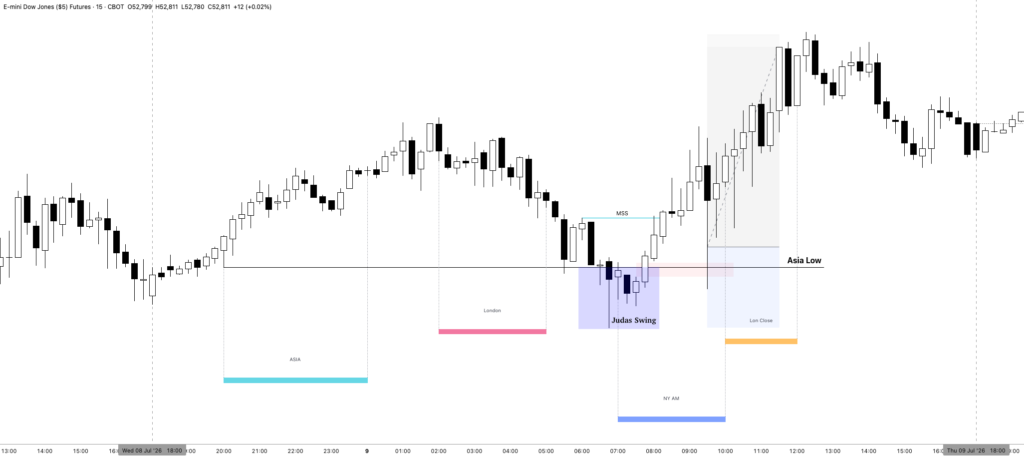
The Asian Range and Judas Swing
The Asian Range is an important component of the Judas Swing model.
In Huddleston’s implementation, the Asian Range is defined from:
19:00 → 00:00 New York Time
The trader marks the highest high and lowest low formed during this period.
A tight Asian Range is particularly useful because liquidity can become concentrated around both boundaries.
Above the high:
Buy Stops and Breakout Buyers
Below the low:
Sell Stops and Breakout Sellers
The Judas Swing uses these liquidity pools to create a false directional move during London.
Bullish Model
Asian High Raid → Asian Low Raid → Bullish Expansion
Bearish Model
Asian Low Raid → Asian High Raid → Bearish Expansion
The first movement helps lead traders into the wrong directional expectation.
The later manipulation creates the Judas Swing before true distribution.
Judas Swing and ICT Power of Three
The Judas Swing also fits into the ICT Power of Three (PO3) model.
Power of Three consists of:
Accumulation → Manipulation → Distribution
The Asian Range can provide the accumulation phase.
The Judas Swing forms the manipulation.
The major London or New York directional move can represent distribution.
Bullish PO3
Asian Accumulation → Judas Swing Lower → Distribution Higher
Bearish PO3
Asian Accumulation → Judas Swing Higher → Distribution Lower
This is why chasing the energetic London move without understanding bias can be dangerous.
The most aggressive-looking movement may actually be manipulation.
What Is Not an ICT Judas Swing?
Not every liquidity sweep is a Judas Swing.
Not every move below the midnight open is a bullish Judas Swing.
Not every rally above the midnight open is bearish manipulation.
For a bullish Judas Swing, Huddleston specifically describes a model where traders are first led into the wrong side before price tears lower below the opening price and Asian Range low.
The bullish sequence is:
Asian High Manipulation → Move Below Midnight Open → Asian Low Raid
For the bearish model:
Asian Low Manipulation → Move Above Midnight Open → Asian High Raid
Directional bias must also support the setup.
Without these elements, the movement may simply be ordinary intraday price action.
How to Trade the ICT Judas Swing
A practical trading process is:
Step 1: Determine Higher Timeframe Bias
Decide whether the market is expected to seek higher or lower prices.
Step 2: Mark the Asian Range
Mark the high and low formed between 19:00 and 00:00 New York time.
Step 3: Mark the Midnight Opening Price
Identify the exact opening price at 00:00 New York time.
Step 4: Monitor the 00:00–05:00 Window
This is the primary Judas Swing hunting period taught in the model.
Step 5: Wait for the First Asian Range Manipulation
Bullish bias → Watch for the Asian high to be attacked first.
Bearish bias → Watch for the Asian low to be attacked first.
Step 6: Anticipate the Judas Swing
Bullish → Price moves below the midnight open and Asian low.
Bearish → Price moves above the midnight open and Asian high.
Step 7: Look for Aggressive Price Delivery
Price should begin moving in agreement with the higher timeframe bias.
Bullish → Strong movement away from the London low.
Bearish → Strong movement away from the London high.
Step 8: Target Opposing Liquidity
Bullish → Look toward buy-side liquidity.
Bearish → Look toward sell-side liquidity.
The complete process is:
Bias → Asian Range → Midnight Open → False Move → Judas Swing → London High/Low → Distribution
Common Judas Swing Trading Mistakes
Trading Without Higher Timeframe Bias
The Judas Swing requires an expectation for true intraday direction.
Calling Every Asian Range Sweep a Judas Swing
There are specific sequencing and timing characteristics.
Chasing the Manipulation
The false move is designed to appear convincing.
A bullish Judas Swing may look extremely bearish at the low.
A bearish Judas Swing may look extremely bullish at the high.
Ignoring the Midnight Opening Price
The 00:00 New York opening price is a key reference in Huddleston’s model.
Expecting a Judas Swing Every Day
The setup will not form every trading day.
Huddleston states:
“If you don’t see this phenomenon take place, it’s probably better for you to stay out of the marketplace.”
The goal is to trade high-probability London conditions, not force a setup every morning.
Final Thoughts
The ICT Judas Swing is a London session manipulation model that helps traders understand how price may create a false directional move before expanding toward the true daily objective.
The setup combines:
Higher Timeframe Bias + Asian Range + Midnight Open + Liquidity + London Timing
In bullish conditions:
Asian High Raid → Move Below Midnight Open → Asian Low Raid → London Low → Expansion Higher
In bearish conditions:
Asian Low Raid → Move Above Midnight Open → Asian High Raid → London High → Expansion Lower
The Judas Swing is designed to trap traders who react to short-term price movement without understanding the likely direction of the daily range.
For ICT (Inner Circle Trader) traders, the core lesson is simple: determine the higher timeframe bias first, study liquidity around the Asian Range, and watch for the false London move between 00:00 and 05:00 New York time before anticipating the true intraday expansion.