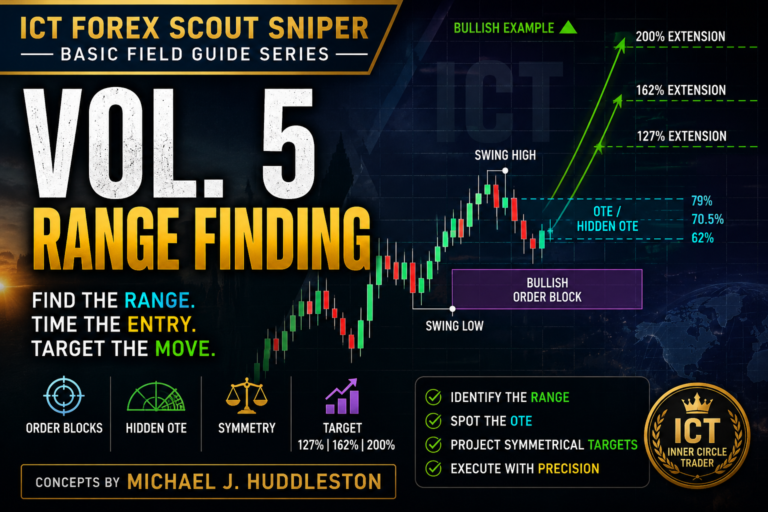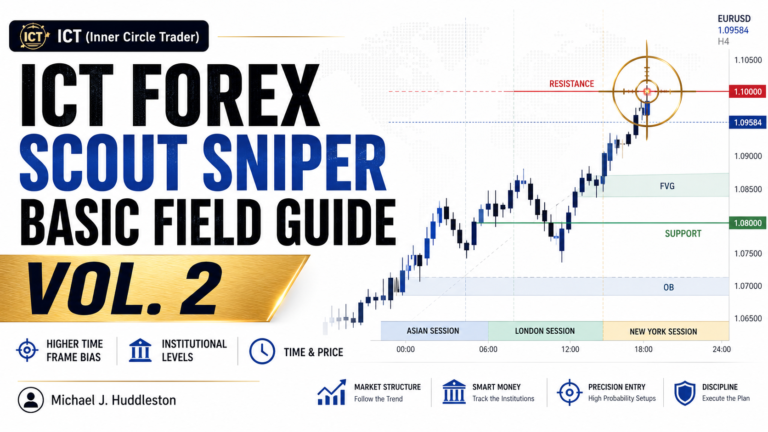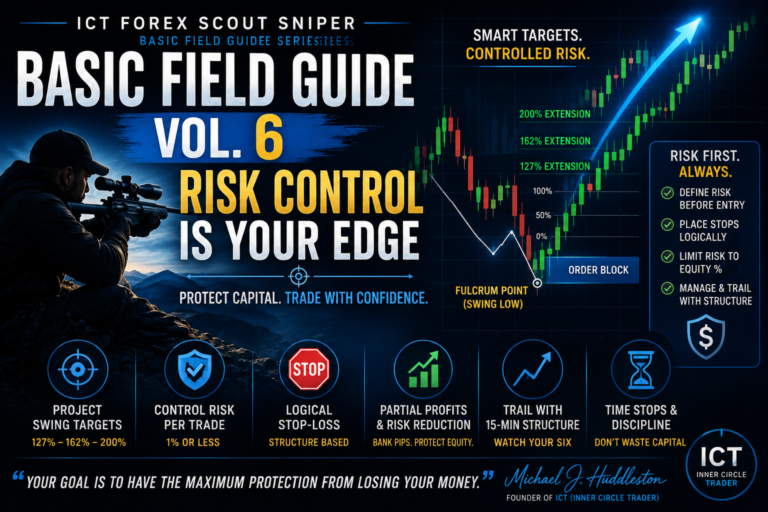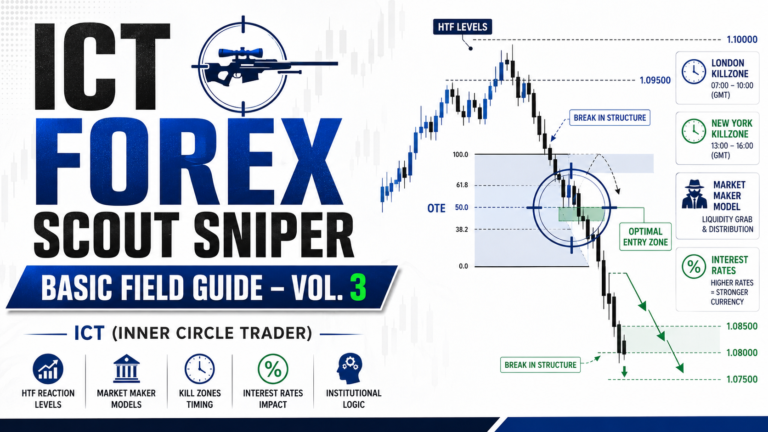
The ICT Forex Scout Sniper Basic Field Guide – Vol. 1 introduces traders to the foundational skills required to study price action, identify precise trading opportunities, and develop disciplined execution. This concept was taught by Michael J. Huddleston, founder of the ICT (Inner Circle Trader) methodology, as part of the ICT Forex Scout Sniper Basic Field Guide Series.
The first volume is not focused on giving traders a shortcut or an instant trading strategy. Instead, it establishes the mindset, tools, expectations, and chart-reading exercises needed before a trader can begin identifying high-precision setups.
The central message is simple: accurate trading decisions come from studying recurring relationships between time, price, market direction, swing points, targets, and risk.
What Is the ICT Forex Scout Sniper Approach?
The ICT Forex Scout Sniper approach is a precision-based method of trading. Rather than entering randomly or reacting emotionally to fast price movements, the trader waits for a specific setup to develop at a predetermined price and time.
A sniper-style trade generally includes:
- A clearly defined market direction
- A precise entry price
- A specific time-of-day condition
- A predetermined target
- Controlled risk
- Patient and disciplined execution
Michael J. Huddleston explains:
“We know exactly what we’re looking for in advance, and we wait for that to unfold.”
This statement summarizes the foundation of sniper trading. The trader does not chase price. The trader studies the market, anticipates a possible scenario, and waits for price to reach the planned area.
The Importance of Practical Chart Study
Many traders spend too much time collecting strategies but very little time applying individual concepts on charts. The ICT Forex Scout Sniper Basic Field Guide encourages traders to study one component of price action at a time.
Each concept should be practiced repeatedly in a demo environment until the trader can recognize it without assistance.
The recommended learning process is:
Learn one concept → Find it on historical charts → Observe it in real time → Record the result → Repeat the exercise
Simply watching examples is not enough. A trader must spend time marking charts, observing price movements, recording turning points, and comparing different trading days.
As Huddleston states:
“You’re always going to be theoretically a student of price.”
A trader should therefore approach the market as an ongoing study rather than something that can be mastered after watching a few lessons.
What Classifies a Trade as a Sniper Setup?
A sniper setup is not defined by a single candlestick pattern or indicator. It is created by combining several important conditions.
1. Precision Entry Price
A sniper setup should provide a clearly defined entry level. The trader should know where the trade becomes attractive before price reaches that level.
Limit orders may be used when the trader has identified a specific price where an entry is expected. This can provide better control over the entry price and help reduce the distance between the entry and stop-loss.
However, precision does not eliminate risk. Even a carefully selected setup can fail.
2. Time-of-Day Criteria
Time is one of the most important components of the ICT methodology. Forex price movements do not occur randomly throughout the day. Significant highs, lows, reversals, and expansions frequently develop during specific trading sessions and time windows.
The trader should study:
- When the daily high forms
- When the daily low forms
- When major intraday reversals occur
- When price begins its strongest expansion
- Which trading session produces the main move
By combining a specific price level with a recurring time window, the trader can narrow down the conditions for a potential setup.
3. Predetermined Target
A sniper trader should know the likely target before entering the position.
The target may be based on:
- A previous swing high
- A previous swing low
- An old daily high or low
- A liquidity pool
- A support or resistance level
- The opposite side of an intraday range
The purpose of identifying a target in advance is to prevent emotional decision-making after the trade has been entered.
4. Strict Risk Management
Every setup must include a defined level of risk.
Before entering a trade, the trader should know:
- The entry price
- The stop-loss level
- The amount being risked
- The target price
- The expected risk-to-reward relationship
- How risk will be managed if price moves favourably
Risk management does not begin after the trade is open. It must be part of the plan before execution.
5. Emotional Discipline
A sniper trader must remain calm, patient, and selective. Impatience often causes traders to enter before the setup is complete, chase an expanding market, or take trades outside their trading plan.
Discipline means accepting that some opportunities will be missed.
Huddleston compares trading opportunities to buses:
“The next one’s going to come around. It’s just like buses—they’ll come by if you wait around long enough.”
Missing one setup should not encourage the trader to chase price. There will always be another opportunity.
Realistic Expectations for Developing Traders
The ICT Forex Scout Sniper Basic Field Guide places strong emphasis on realistic expectations.
No trading method can guarantee a 100% win rate. Even a setup that appears perfect can fail because the market is uncertain.
A developing trader should accept that:
- Losing trades will occur
- Some textbook setups will fail
- Good opportunities will occasionally be missed
- Different traders will produce different results
- Progress requires consistent practice
- Trading success develops gradually
The objective is not to eliminate every loss. The objective is to manage losses while improving the trader’s ability to recognize high-quality conditions.
Michael J. Huddleston makes this clear:
“You will not profit on every setup.”
A trader who expects perfection will eventually become frustrated, abandon discipline, and begin forcing trades. A trader who accepts uncertainty can remain focused on process and risk management.
Why Traders Should Begin With a Demo Account
The lessons in the ICT Forex Scout Sniper Basic Field Guide are intended to be practiced in a demo environment.
A demo account allows the trader to:
- Learn the trading platform
- Practice placing limit orders
- Test stop-loss placement
- Record price behaviour
- Study time-of-day tendencies
- Make mistakes without risking real capital
- Develop confidence through repetition
The demo balance should ideally reflect the amount of capital the trader could realistically use in the future. Practising with an unrealistically large account may encourage poor position sizing and distorted expectations.
The purpose of demo trading is not simply to produce virtual profits. It is to develop repeatable decision-making habits.
Understanding Swing Points
Swing points are among the first price-action structures traders should learn to identify.
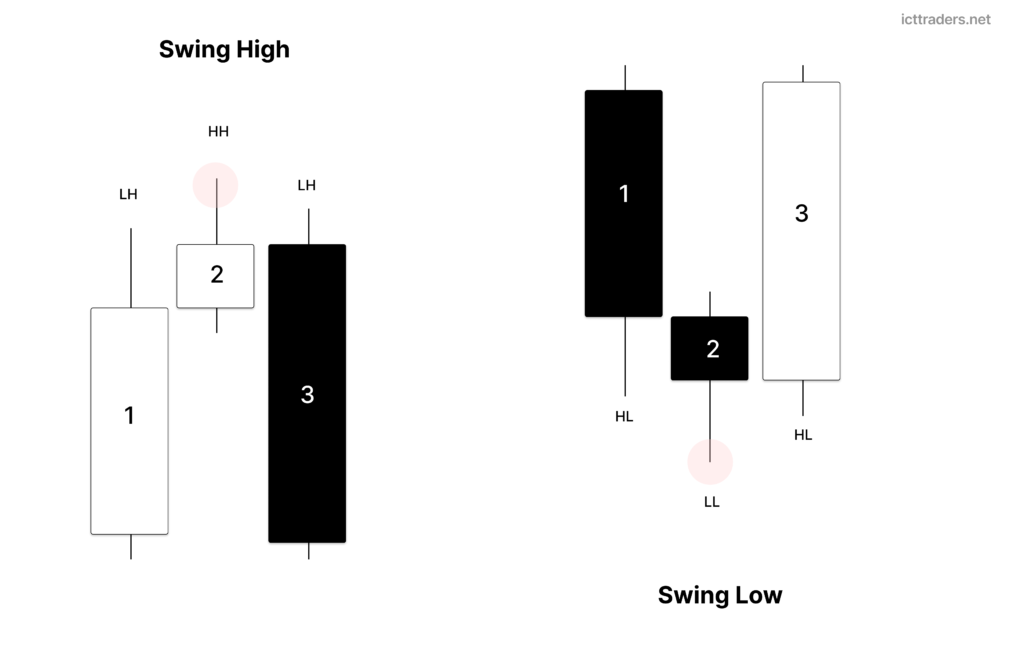
Swing High
A swing high forms when a candle has lower highs on both sides of it. It represents a short-term peak in price.
A basic swing-high structure can be understood as:
Lower high → Highest candle → Lower high
Swing Low
A swing low forms when a candle has higher lows on both sides of it. It represents a short-term bottom in price.
A basic swing-low structure can be understood as:
Higher low → Lowest candle → Higher low
Swing points help traders identify:
- Short-term turning points
- Previous highs and lows
- Potential liquidity areas
- Intraday range boundaries
- Changes in price direction
- Possible entry and target locations
Indicators such as fractals may initially help a beginner locate these points. However, the long-term objective is to train the eye to identify swing highs and swing lows directly from price action.
The trader must eventually learn to recognize these structures as they are developing rather than waiting for an indicator to confirm them.
Using Multiple Time Frames
The Scout Sniper methodology is influenced by the principle of studying multiple time frames.
The general purpose of multiple-time-frame analysis is to determine the likely market direction from a broader chart and then search for an entry on a lower time frame.
A basic structure may include:
Higher time frame → Determine probable direction
Intermediate time frame → Identify market structure and important price levels
Lower time frame → Refine the entry and manage risk
For example, a trader may use:
- The one-hour chart for directional context
- The 15-minute chart for intraday structure
- The five-minute chart for detailed turning points
The objective is to trade in the direction supported by the larger market context rather than taking every lower-time-frame signal.
The Time-and-Price Observation Exercise
The main practical assignment in ICT Forex Scout Sniper Basic Field Guide – Vol. 1 is to study how price repeatedly forms turning points at particular times and price levels.
Choose one currency pair and study it consistently. Possible markets include:
- EUR/USD
- GBP/USD
- USD/JPY
- AUD/USD
- NZD/USD
- GBP/JPY
- US Dollar Index
It is better to study one market deeply than to switch constantly between many currency pairs.
For each trading day, record:
- The time of the daily high
- The time of the daily low
- The time of important intraday swing highs
- The time of important intraday swing lows
- The price level of each turning point
- The direction that produced the largest move
- The session in which the main expansion occurred
- Repeating characteristics around the turning points
Complete this exercise on both the five-minute chart and the 15-minute chart.
The goal is to collect at least 30 trading days of observations.
How to Complete the 30-Day Chart Exercise
Use the following process for each trading day:
Step 1: Select One Market
Choose one currency pair and remain focused on it for the entire exercise.
Step 2: Open the Five-Minute and 15-Minute Charts
Use both charts to study the detailed structure of the trading day.
Step 3: Mark Every Important Swing Point
Identify meaningful swing highs and swing lows. Do not rely permanently on indicators. Use them only while learning to recognize the structure.
Step 4: Record the Time
Write down the time at which each important turning point formed.
Make sure you understand the time zone used by your trading platform before comparing your observations with specific market sessions.
Step 5: Mark the Daily High and Low
Record when price formed the high of the day and the low of the day.
Step 6: Identify the Strongest Price Move
Determine whether the largest move was bullish or bearish. Then study the price action that formed before the expansion.
Step 7: Annotate the Chart
Add notes directly to the chart or print the chart and mark it manually.
Your notes may include:
- Time of reversal
- Price of reversal
- Directional move
- Session name
- Previous swing level
- Support or resistance
- Size of the move
- Repeating conditions
Step 8: Review the Charts at the End of the Week
Compare all five trading days and look for recurring patterns.
Ask:
- Did daily highs form during similar times?
- Did daily lows form during similar sessions?
- Did price repeatedly move toward old highs or lows?
- Which session produced the strongest expansion?
- What happened before the major move?
- Were similar swing structures present?
Step 9: Continue Until You Have 30 Trading Days
Thirty trading days provide a meaningful sample size for observing repeated market behaviour. This requires more than one calendar month because weekends are not counted as trading days.
Why Chart Annotation Is Important
Beginners often try to keep their charts completely clean. Clean charts can be useful after a trader understands what to look for, but detailed annotation is valuable during the learning stage.
Marking charts forces the trader to interact with price action.
It helps develop:
- Visual memory
- Pattern recognition
- Time awareness
- Understanding of market structure
- Familiarity with one trading pair
- Confidence in identifying turning points
A chart should become a study document rather than simply a screen used to place trades.
During the learning process, it is acceptable for the chart to contain lines, notes, arrows, time labels, and observations. The purpose is to understand why price moved from one swing point to another.
The Six-Month Commitment
The ICT Forex Scout Sniper Basic Field Guide is not designed for traders seeking instant results. The concepts require repeated chart observation, note-taking, demo execution, and review.
Huddleston recommends approaching the material with a minimum six-month commitment.
During this period, the trader should focus on:
- Studying one market consistently
- Learning how price forms swing points
- Recording daily highs and lows
- Observing time-of-day tendencies
- Practising entries in a demo account
- Reviewing both winning and losing trades
- Developing a personal trading niche
The trader may eventually discover that they are better suited to scalping, day trading, swing trading, or position trading. This can only be learned through practical experience.
Key Lessons From ICT Forex Scout Sniper Basic Field Guide – Vol. 1
The first volume provides several important lessons:
- Trading requires preparation before execution.
- A sniper setup combines time, price, direction, targets, and risk.
- Precision entries do not remove the possibility of loss.
- Missed trades should not be chased.
- Demo practice is essential during development.
- Swing highs and swing lows form the foundation of price structure.
- Multiple time frames help connect direction with execution.
- Chart annotation improves pattern recognition.
- One market should be studied deeply before expanding to others.
- Progress should be measured in small, consistent improvements.
Final Thoughts
The ICT Forex Scout Sniper Basic Field Guide – Vol. 1 establishes the foundation for becoming a precise and disciplined trader. Michael J. Huddleston does not present sniper trading as a shortcut to easy profits. Instead, he teaches traders to build their understanding through repeated observation of time, price, swing points, directional movement, and risk.
The most important assignment is to study one currency pair across at least 30 trading days using five-minute and 15-minute charts. Record the daily highs, daily lows, important turning points, and the times at which they form.
Over time, this exercise can reveal that price action contains recurring characteristics. The trader’s responsibility is to study those characteristics, develop realistic expectations, and practise the concepts patiently in a demo environment.
A sniper trader does not attempt to trade every movement.
The objective is to prepare carefully, wait patiently, identify a specific target, control risk, and act only when the planned conditions appear.