The ICT Forex Scout Sniper Basic Field Guide – Vol. 7 teaches traders how to manage profitable positions through multiple targets, partial exits, structured stop-loss placement, and trade classification. These concepts were taught by Michael J. Huddleston, founder of the ICT (Inner Circle Trader) methodology, as part of the ICT Forex Scout Sniper Basic Field Guide Series.
This volume focuses on an area that many developing traders overlook: what to do after entering a trade.
Finding a good entry is only one part of trading. A complete trading model must also define:
- Where the stop-loss should be placed
- How volatility affects the setup
- When partial profits should be taken
- How much of the position should be closed
- Which portion should remain open
- Whether the trade is aligned with the higher time frame
- When the trader should preserve capital instead of seeking more profit
The central lesson is that traders should not treat every position as an all-or-nothing event. A professional approach pays the trader gradually as price reaches logical objectives.
What Is the Main Focus of Volume 7?
Volume 7 is built around the concept of multiple targets.
Rather than holding the entire position for one distant objective, the trader divides the position into smaller portions and takes profits at predetermined price levels.
A basic multiple-target model may look like this:
Entry → First target → Partial profit → Second target → Additional profit → Final target
This method helps reduce emotional pressure because some profit has already been secured before the final objective is reached.
It also protects the trader when price reaches an initial target but reverses before completing the entire projected move.
Average Daily Range in ICT Trading
The Average Daily Range measures the approximate distance a market travels between its daily high and daily low.
For example, a currency pair may produce daily ranges such as:
- 70 pips
- 74 pips
- 103 pips
- 62 pips
- 48 pips
These values help the trader understand whether market volatility is expanding or contracting.
In the ICT (Inner Circle Trader) framework, the Average Daily Range is not used as a standalone directional signal.
It does not tell the trader whether price will move higher or lower.
It helps answer a different question:
Is the market preparing for a larger move?
Range Contraction and Volatility Expansion
When daily ranges become progressively smaller, volatility is contracting.
A sequence may look like:
100 pips → 78 pips → 62 pips → 45 pips
This contraction indicates that price is becoming compressed.
Compression often precedes expansion:
Range contraction → Reduced volatility → Order accumulation → Strong price expansion
Michael J. Huddleston describes this as:
“The quiet before the storm.”
The trader should become more attentive when the recent daily ranges are significantly smaller than normal.
However, contraction does not provide directional bias. The trader must still use:
- Higher-time-frame market structure
- Daily or four-hour institutional order flow
- Support and resistance
- Order blocks
- Liquidity
- Killzone timing
- Previous highs and lows
The contraction simply warns that a larger move may be approaching.
Why Volatility Matters
Forex traders require movement to generate meaningful returns.
When price remains trapped in a narrow range, there may not be enough distance between entry and target to justify the risk.
When volatility begins expanding, the market may produce:
- Larger daily candles
- Stronger displacement
- Cleaner breaks of structure
- Wider intraday ranges
- Better risk-to-reward opportunities
The objective is not to chase price after expansion begins.
The trader should identify compression in advance and prepare for the potential release.
The One-Shot, One-Kill Trading Model
The Scout Sniper framework encourages traders to seek one carefully selected setup during the trading week.
This is called the one-shot, one-kill approach.
The trader is not expected to participate in every daily movement.
The weekly process is:
- Establish higher-time-frame direction.
- Wait for the weekly high or low to form.
- Monitor the London or New York Killzone.
- Identify a liquidity raid or institutional setup.
- Enter with controlled risk.
- Manage the position toward multiple targets.
Huddleston explains that professional traders focus on conditions offering high potential with controlled risk rather than chasing every market fluctuation.
The trader should not behave like someone constantly searching for the next opportunity. Patience is part of the strategy.
Understanding the 30-Pip Stop-Loss Model
Volume 7 revisits the use of a 30-pip stop-loss.
Huddleston uses a generic 100-pip daily range for pairs such as EUR/USD and GBP/USD as a practical framework. One-third of that range is approximately 30 pips.
This does not mean that these pairs move exactly 100 pips every day.
Some days may produce:
- 40-pip ranges
- 70-pip ranges
- 100-pip ranges
- 150-pip ranges
- Even larger expansions
The 30-pip stop is used as a practical template when the trader is entering during a carefully selected weekly setup.
It gives price enough room to fluctuate while still defining the maximum risk.
Why a Wider Stop Can Be Necessary
A precise setup does not always produce a perfect entry.
Price may:
- Sweep an old low
- Trade slightly deeper into an order block
- Raid a cluster of sell stops
- Move through the ideal Fibonacci level
- Manipulate around a previous daily high or low
A stop placed too close to the entry may remove the trader before the real expansion begins.
In a valid bullish setup, price may temporarily trade lower to collect liquidity before moving higher.
In a bearish setup, price may trade above a short-term high before delivering lower.
The stop must therefore be placed beyond the area where the trading idea becomes invalid, not merely at an emotionally comfortable distance.
Combining Stop Placement With Time and Price
A 30-pip stop should not be applied randomly.
It becomes more effective when the trader has already identified:
- Higher-time-frame direction
- A valid order block
- A Killzone
- A likely weekly high or low
- Previous-day liquidity
- An Optimal Trade Entry
- A market structure shift
The setup may be framed as:
Bullish daily bias → Tuesday or Wednesday low → London or New York liquidity sweep → Long entry → 30-pip protective stop
The stop is only one component of the setup.
A poor entry cannot be repaired simply by using a wider stop.
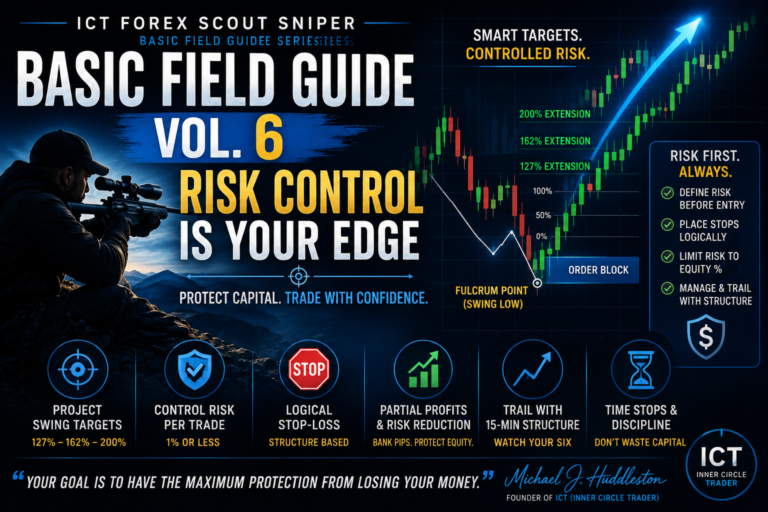
Using Swing Lows to Trail a Bullish Position
Once a bullish trade begins moving higher, the trader can manage risk using recent swing lows.
The process is:
- Enter the bullish setup.
- Place the original protective stop.
- Allow price to form new swing lows.
- Identify the two most recent confirmed swing lows.
- Move the stop below the relevant protected low.
- Continue adjusting as price creates higher structure.
The stop should not be moved simply because price has moved a few pips in profit.
It should be moved in response to market structure.
In a bearish position, the process is reversed using recent swing highs.
Rules Before Emotions
A position may retrace after moving in profit.
The trader may become nervous when price forms a lower short-term low or moves against the open position.
The important question is not whether the trader feels uncomfortable.
The question is:
Has the structural trailing stop been violated?
If the stop has not been reached and the setup remains valid, the trader should follow the management rules.
Huddleston asks:
“What do you follow—the rules or your emotions? The rules.”
This is a fundamental principle of professional trading.
Trade Classification
Not every trade should be managed in the same way.
Volume 7 divides trading into four broad classifications:
- Intermediate-term trading
- Short-term trading
- Day trading
- Scalping
The classification determines:
- Which chart creates the directional premise
- How long the trade may remain open
- How aggressively profits should be taken
- How much of the position may be left running
Without classification, traders frequently turn short-term trades into long-term hopes.
Intermediate-Term Trading
Intermediate-term trades are generally based on the daily chart.
These setups may remain open for several days or longer.
The trader may use:
- Daily directional bias
- Four-hour structure
- Previous weekly highs or lows
- Monthly liquidity
- Fibonacci extensions
- Multi-stage profit-taking
Because the setup is aligned with a larger move, the trader may leave a greater portion of the position open for extended targets.
Short-Term Trading
Short-term trades are commonly framed from the four-hour chart.
They may last from one trading session to several days.
Targets may include:
- Previous four-hour highs or lows
- Previous daily highs or lows
- 127% extensions
- 162% extensions
- The next major order block
Short-term trades require more active management than intermediate-term positions.
Day Trading
Day trades are generally framed from the one-hour chart and refined on the 15-minute or five-minute chart.
The main objective is usually a portion of the current daily range.
Potential targets include:
- Previous-day high
- Previous-day low
- London high or low
- New York session liquidity
- Average Daily Range boundary
- Intraday Fibonacci extensions
A day trade may leave a small runner open if the setup strongly aligns with the daily and four-hour charts.
Scalping
Scalping is associated with 15-minute and five-minute execution.
In this framework, scalping does not mean attempting to collect only two or three pips.
Huddleston argues that a setup should provide the potential for at least approximately 15 to 20 pips before it is considered worthwhile.
The scalp may aim for:
- 15 pips
- 20 pips
- 30 pips
The management is generally simpler:
- Reach the target
- Reduce risk
- Move to breakeven
- Take partial profit
Scalping against the higher-time-frame direction requires greater experience and faster management.
Trading in Sync
A trade is considered in sync when its direction agrees with the daily or four-hour directional premise.
For example:
Daily bullish + Four-hour bullish + Intraday long = In-sync trade
Daily bearish + Four-hour bearish + Intraday short = In-sync trade
In-sync trades generally justify:
- Holding a larger portion of the position
- Using multiple profit targets
- Allowing more time for the trade to develop
- Seeking larger extensions
- Leaving a runner open
The higher-time-frame flow supports the trade.
Trading Out of Sync
A trade is out of sync when it moves against the daily or four-hour direction.
For example:
Daily bullish + Intraday short = Out-of-sync trade
Daily bearish + Intraday long = Out-of-sync trade
Counter-directional trades may still produce profit, but they require more aggressive management.
The trader should generally:
- Take larger partial profits sooner
- Reduce risk quickly
- Avoid expecting extended moves
- Use closer targets
- Avoid converting the trade into a long-term position
A countertrend position should not be managed as if it were aligned with the institutional flow.
What Is the ICT Split-Gain Ratio?
The ICT Split-Gain Ratio is a method of dividing the position into smaller percentages and taking profits at multiple price objectives.
The percentage removed at each target depends on:
- Trade classification
- Higher-time-frame alignment
- Confidence in the setup
- Number of targets
- Expected duration
- Market volatility
The ratios are templates rather than fixed laws.
The trader may adjust them to suit their risk tolerance and personality.
Why Scale Out of a Position?
Scaling out provides several benefits.
It allows the trader to:
- Secure profit during favourable movement
- Reduce emotional pressure
- Lower exposure
- Protect against sudden reversals
- Keep a smaller runner for extended targets
- Avoid the all-or-nothing mindset
A trade can move toward the first target, reverse, and eventually reach the original stop.
Without partial profit-taking, the trader may receive nothing from an otherwise accurate analysis.
Huddleston repeatedly emphasizes:
“Take something off the trade.”
The objective is to pay yourself as the market confirms the analysis.
Intermediate-Term Split Ratios
When an intermediate-term trade is aligned with the higher time frame, possible scaling models include:
Five-Stage Model
20% → 20% → 20% → 20% → 20%
This evenly distributes the position across five objectives.
Four-Stage Model
25% → 25% → 25% → 25%
This model is simpler while still allowing several profit levels.
Three-Stage Model
20% → 40% → 40%
The trader takes a smaller initial partial and holds larger portions for extended objectives.
Possible targets may include:
- Average Daily Range objective
- Previous daily high or low
- Weekly high or low
- Monthly high or low
- 127% extension
- 162% extension
- 200% extension
Out-of-Sync Intermediate-Term Ratios
An intermediate-term trade moving against the dominant higher-time-frame direction should be managed more defensively.
Possible models include:
Five-Stage Defensive Model
40% → 20% → 20% → 10% → 10%
Four-Stage Defensive Model
50% → 30% → 10% → 10%
Three-Stage Defensive Model
60% → 20% → 20%
The larger initial exit reduces exposure before the higher-time-frame direction reasserts itself.
Short-Term Split Ratios
For an in-sync short-term trade, possible ratios include:
Three-Stage Model
30% → 35% → 35%
Two-Stage Model
25% → 75%
The trader takes a smaller portion at the first target and holds more for the final objective because the trade is aligned with the larger flow.
For an out-of-sync short-term trade:
Three-Stage Defensive Model
60% → 20% → 20%
Two-Stage Defensive Model
80% → 20%
Double-Tap Model
50% → 50%
The double-tap model is simple:
- Close half at the first target.
- Move the stop to breakeven.
- Hold the remaining half for the next objective.
Day-Trading Split Ratios
For an in-sync day trade, one possible three-stage model is:
30% → 60% → 10%
The trader secures most of the position during the day while leaving a small runner.
When the daily, four-hour, and intraday charts are strongly aligned, another possible model is:
20% → 20% → 60%
This preserves a larger final position for a continued higher-time-frame move.
A two-stage model may be:
20% → 80%
This may be suitable when the day-trade entry is being used to enter a larger swing position.
Out-of-Sync Day-Trading Ratios
When day trading against the higher-time-frame direction, profits should generally be secured quickly.
Possible ratios include:
Three-Stage Defensive Model
80% → 10% → 10%
Two-Stage Defensive Model
70% → 30%
Double-Tap Model
50% → 50%
The first target should be a logical nearby level rather than an unrealistic extension.
Scalping Ratios
Scalping requires a simpler approach.
Possible methods include:
- Full position closed at the target
- Full position stopped at the original stop
- Partial profit at 15–20 pips
- 50% closed at the first target
- Remaining 50% moved to breakeven
- Small runner held when higher time frames align
If the scalp is countertrend, the trader should secure profit quickly.
The setup should not be allowed to become a losing swing trade.
Logical Profit Targets
Split-gain ratios should be applied at meaningful price levels.
Suitable targets include:
- Previous daily high
- Previous daily low
- Previous weekly high
- Previous weekly low
- Intraday swing high or low
- Order block
- Liquidity pool
- Average Daily Range boundary
- 127% Fibonacci extension
- 162% Fibonacci extension
- 200% measured-move projection
The percentage split answers how much should be closed.
The price objective answers where it should be closed.
Both decisions should be made before entry.
Do Not Demand the Maximum Profit
One of the most damaging expectations in trading is the belief that every position should capture the entire movement.
The trader may close at a planned target and then watch price continue much farther.
That does not make the original exit incorrect.
A successful trade is one in which the trader:
- Followed the plan
- Controlled risk
- Reached a logical objective
- Secured profit
- Avoided emotional interference
Huddleston explains that he generally works within roughly 75% to 80% of the move he expects rather than demanding the absolute maximum.
Professional trading does not require buying the exact low and selling the exact high.
Avoid Comparing Trades With Other Traders
A trader may see someone else profit from a market move that they did not take.
That does not mean the opportunity belonged to them.
A trade belongs to the trader only when they:
- Completed the analysis
- Identified the setup beforehand
- Defined the risk
- Planned the entry
- Planned the targets
Huddleston summarizes this idea clearly:
“If you didn’t do the homework on that trade going into it, it’s not your trade.”
Comparing results often creates unnecessary greed, overtrading, and frustration.
The Three Possible Market Actions
At any moment, the trader has only three meaningful choices:
- Take action
- Sit on their hands
- Protect and preserve capital
Taking action means entering a valid setup.
Sitting on the hands means remaining inactive when conditions are incomplete.
Protecting capital means managing an open trade, reducing risk, taking profit, or exiting when the setup fails.
There is no requirement to be entering new trades constantly.
Practical Volume 7 Trading Framework
The lessons from ICT Forex Scout Sniper Basic Field Guide – Vol. 7 can be organized into a practical process.
Step 1: Check Higher-Time-Frame Direction
Determine whether the daily and four-hour charts are bullish, bearish, or unclear.
Step 2: Measure Recent Daily Ranges
Observe whether volatility is expanding or contracting.
Step 3: Wait for the Weekly Setup
Focus on Monday, Tuesday, or Wednesday for the likely weekly high or low.
Step 4: Monitor the Killzones
Look for the setup during London or New York.
Step 5: Identify Liquidity
Mark previous-day highs, lows, equal highs, equal lows, and order blocks.
Step 6: Enter With Defined Risk
Use a stop that reflects structural invalidation and normal volatility.
Step 7: Classify the Trade
Define it as intermediate-term, short-term, day trade, or scalp.
Step 8: Determine Sync
Decide whether the trade is aligned with or opposed to the daily and four-hour direction.
Step 9: Select a Split-Gain Ratio
Choose the percentage to close at each target.
Step 10: Place Profit Orders
Use logical levels such as old highs, lows, and Fibonacci extensions.
Step 11: Trail Structurally
Use recent swing lows in bullish trades and swing highs in bearish trades.
Step 12: Follow the Plan
Do not change the targets or position size because of fear or greed.
Final Assignment
The final assignment for Volume 7 is to review the complete Scout Sniper series and organize all notes into a repeatable trading procedure.
For each historical setup, record:
- Higher-time-frame direction
- Average Daily Range
- Whether volatility was contracting
- Likely weekly high or low
- Killzone used
- Entry level
- Initial stop
- Trade classification
- In-sync or out-of-sync status
- First target
- Second target
- Final target
- Split-gain ratio
- Stop-management decisions
- Final outcome
The purpose is not merely to discover winning examples.
The trader should also study:
- Trades that failed
- Trades that reached only the first target
- Trades that reversed before the final objective
- Trades that worked after a liquidity sweep
- Trades where the stop was moved too early
- Trades where no partial profit was taken
This review develops realistic expectations and strengthens rule-based execution.
Final Thoughts
The ICT Forex Scout Sniper Basic Field Guide – Vol. 7 teaches that profitability depends on far more than finding an entry.
A complete trade must include:
Higher-time-frame direction → Volatility condition → Weekly setup → Killzone entry → Defined stop → Trade classification → Multiple targets → Partial exits → Structural trailing
Range contraction warns that volatility may soon expand. The 30-pip stop provides a practical risk framework for selected weekly setups. Trade classification determines how long the position should be held, while in-sync and out-of-sync analysis determines how aggressively profits should be secured.
The ICT Split-Gain Ratio helps traders avoid the all-or-nothing mentality by taking profits at logical objectives.
The most important principle is simple:
Plan the entry, define the risk, pay yourself as price moves in your favour, and preserve capital when the market no longer supports the trade.