ICT The Sentiment Effect is a day-trading framework taught by Michael J. Huddleston, the founder of ICT (Inner Circle Trader). This concept was presented in the 2017 ICT Private Mentorship Core Content Month 09 as part of the ICT Amplified Day Trading and Scalping teachings.
The central idea is simple: the best intraday trading opportunities often appear when short-term market sentiment temporarily moves against the higher-timeframe institutional direction.
A bullish trading day may first create bearish sentiment by trading below the opening price and the Asian range low. A bearish trading day may first create bullish sentiment by trading above the opening price and the Asian range high.
This temporary move can trap uninformed traders before price delivers in the intended institutional direction.
What Is ICT The Sentiment Effect?
The ICT The Sentiment Effect explains how price creates a short-term emotional bias among retail traders before reversing toward its higher-timeframe objective.
Retail traders commonly react to the initial intraday price movement.
When price breaks above an obvious high, they may become bullish and buy the breakout. When price breaks below an obvious low, they may become bearish and sell the breakdown.
However, institutional traders may use these movements to take the opposite position.
Michael J. Huddleston explains:
“We wait for opposing market directions for high odds setups.”
The sentiment effect therefore focuses on entering when the majority of short-term traders are emotionally committed to the wrong side of the market.
The Role of Higher-Timeframe Institutional Order Flow
The sentiment effect should not be traded without directional context.
The trader must first determine institutional order flow from the:
- Daily chart
- Four-hour chart
- Higher-timeframe PD Array Matrix
- Current premium or discount location
- Expected liquidity objective
The daily or four-hour directional bias provides the framework for the trade.
If institutional order flow is bullish, the trader looks for a temporary bearish intraday move.
If institutional order flow is bearish, the trader looks for a temporary bullish intraday move.
The intraday move should oppose the expected direction of the daily close.
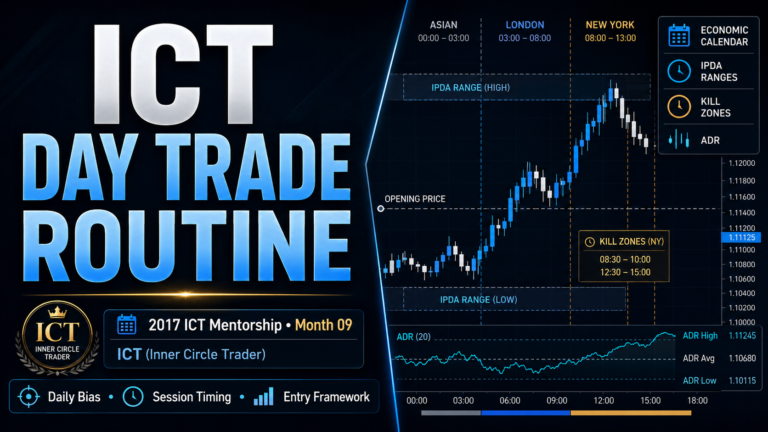
The Opening Price and Asian Range
Two important reference points within the ICT The Sentiment Effect are:
- The New York midnight opening price
- The Asian session range
The New York midnight opening price helps determine whether price is trading above or below the daily opening level.
The Asian range provides an identifiable area of short-term liquidity.
Its main reference points are:
- Asian range high
- Asian range low
These levels often become targets for liquidity raids before the main intraday expansion begins.
Bearish Sentiment Effect Setup
When higher-timeframe institutional order flow is bearish, the trader should not immediately sell weakness.
The preferred condition is for price to first trade higher.
Price may rally:
- Above the New York midnight opening price
- Above the Asian range high
- Into a 15-minute premium PD array
- Into buy-side liquidity
- Into a bearish order block or fair value gap
The rally creates bullish short-term sentiment.
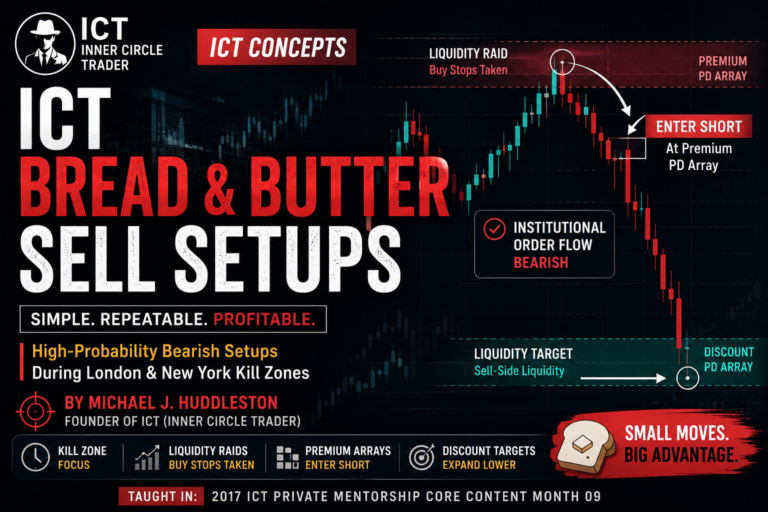
Retail traders may interpret the move above the Asian range high as a breakout and begin buying.
Institutional traders may use the same movement to establish short positions.
Michael J. Huddleston states:
“Smart money sells above the Asian Range High.”
The ideal short entry therefore appears when short-term sentiment is strongly bullish, but higher-timeframe institutional order flow remains bearish.
Bullish Sentiment Effect Setup
When higher-timeframe institutional order flow is bullish, the trader should avoid chasing price higher.
The preferred condition is for price to first decline.
Price may trade:
- Below the New York midnight opening price
- Below the Asian range low
- Into a 15-minute discount PD array
- Into sell-side liquidity
- Into a bullish order block or fair value gap
The decline creates bearish short-term sentiment.
Retail traders may interpret the break below the Asian range low as confirmation that price will continue lower.
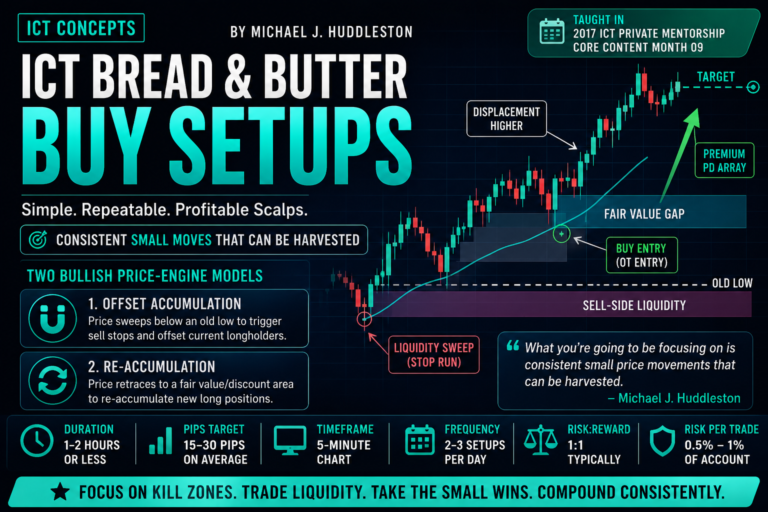
Institutional traders may use the sell-side liquidity to accumulate long positions.
Michael J. Huddleston explains:
“Smart money buys below the Asian range low and below that opening price.”
The preferred long entry forms when short-term sentiment is strongly bearish, while the higher-timeframe institutional direction remains bullish.
Buy Conditions for the Sentiment Effect
A valid bullish setup begins with a higher-timeframe discount array.
Price should have recently traded into or reacted from a discount PD array on the daily or four-hour chart.
This reaction suggests that institutional support may be present.
The trader should then evaluate whether sufficient range exists between the current price and the opposing premium array.
A strong bullish setup may include the following conditions:
- Daily or four-hour institutional order flow is bullish
- A higher-timeframe discount PD array is supporting price
- Price trades below the midnight opening price
- Price trades below the Asian range low
- Sell-side liquidity is taken
- Price reaches a logical 15-minute discount array
- Price responds quickly from the discount area
- A sufficient range exists toward the next premium objective
The setup becomes weaker when price remains near the discount array for too long.
A strong institutional reaction should normally produce a sharp move away from the level.
Sell Conditions for the Sentiment Effect
A valid bearish setup begins with a higher-timeframe premium array.
Price should have recently traded into or reacted from a premium PD array on the daily or four-hour chart.
The trader should then determine whether enough range exists between current price and the opposing discount objective.
A strong bearish setup may include:
- Daily or four-hour institutional order flow is bearish
- A higher-timeframe premium PD array is influencing price
- Price trades above the midnight opening price
- Price trades above the Asian range high
- Buy-side liquidity is taken
- Price enters a logical 15-minute premium array
- Price rejects the premium area quickly
- Sufficient range exists toward a lower discount objective
The longer price remains around the 15-minute premium array, the lower the probability of immediate bearish delivery.
A high-quality setup normally produces a clear and decisive rejection.
The Importance of Immediate Price Response
Time spent at a PD array matters.
When price reaches a valid institutional level, a strong setup should produce an immediate reaction.
For a bullish trade, price should move sharply away from a discount array.
For a bearish trade, price should move sharply away from a premium array.
If price repeatedly tests the level or remains near it for an extended period, the setup becomes less attractive.
Michael J. Huddleston explains that the odds can fall considerably when price hovers around the entry area.
This principle helps traders avoid entering weak setups simply because price has reached a technical level.
Sentiment Confirmation With Williams Percent R
Michael J. Huddleston uses a 10-period Williams Percent R on the 15-minute chart as a sentiment tool.
The indicator is not used as a traditional standalone overbought or oversold signal.
Price action remains the primary decision-making tool.
Williams Percent R is used only to confirm whether short-term market sentiment has reached an extreme.
For a bullish setup, sentiment should ideally be strongly bearish.
For a bearish setup, sentiment should ideally be strongly bullish.
The indicator therefore acts as confluence rather than an independent entry signal.
Why Retail Traders Become Trapped
The sentiment effect works because many traders react to visible price movements without considering higher-timeframe context.
Above the Asian range high, retail traders may see:
- A bullish breakout
- Strong buying momentum
- Confirmation of an intraday uptrend
- A reason to enter long positions
Below the Asian range low, they may see:
- A bearish breakdown
- Strong selling momentum
- Confirmation of an intraday downtrend
- A reason to enter short positions
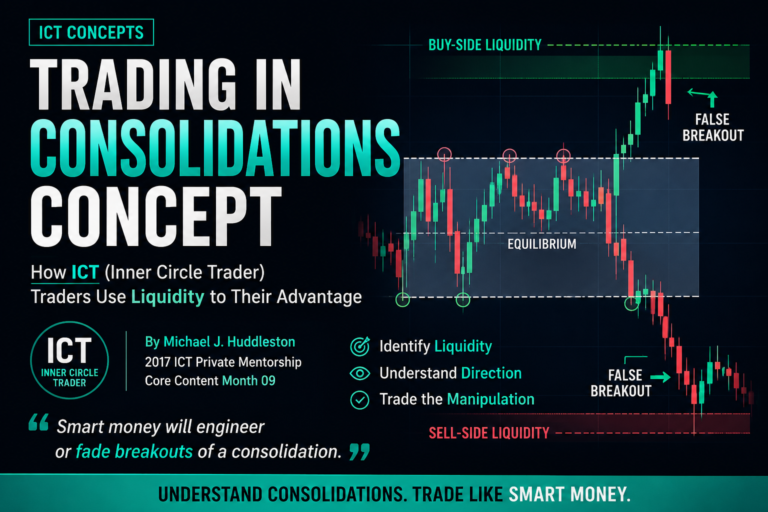
However, these movements may simply be liquidity raids.
The breakout traders provide the liquidity needed for institutional traders to enter in the opposite direction.
The Relationship With the Judas Swing
The sentiment effect is closely connected to the ICT Judas Swing.
The Judas Swing is an early intraday movement that initially travels in the opposite direction of the anticipated daily expansion.
On a bullish day, price may first decline below the opening price and Asian range low.
On a bearish day, price may first rally above the opening price and Asian range high.
This false initial movement creates the sentiment necessary to trap traders before the true directional move begins.
The Judas Swing should therefore be studied as a manipulation phase within the sentiment effect.
Using PD Arrays With the Sentiment Effect
The Asian range alone is not enough to validate a trade.
Price should ideally raid the Asian range and then reach a logical PD array.
For bullish setups, useful discount arrays may include:
- Bullish order blocks
- Fair value gaps
- Breaker blocks
- Mitigation blocks
- Previous lows
- Discount portions of a dealing range
For bearish setups, useful premium arrays may include:
- Bearish order blocks
- Fair value gaps
- Rejection blocks
- Breaker blocks
- Previous highs
- Premium portions of a dealing range
The PD array provides the potential entry location, while the higher-timeframe objective provides the draw on liquidity.
Measuring the Available Trading Range
Before entering a day trade, the trader must determine whether enough range exists to justify the position.
The distance between the entry area and the opposing higher-timeframe PD array should provide a reasonable profit opportunity.
Michael J. Huddleston explains that a range of approximately 50 to 60 pips may provide a healthy day-trading opportunity in suitable forex markets.
A smaller range may still offer a scalp, but it may not qualify as a full day-trading setup.
The exact distance will vary according to:
- Instrument volatility
- Market session
- Current daily range
- News conditions
- The location of the liquidity objective
The important point is that the trader should identify the target before entering the trade.
Bullish Sentiment Effect Example
Consider a market with bullish daily institutional order flow.
Price has recently reacted from a daily discount array, and a premium fair value gap remains above the market.
During the Asian session, price forms a clear high and low.
After the New York midnight opening, price declines below:
- The opening price
- The Asian range low
- A previous intraday low
The move triggers sell stops and encourages retail traders to sell.
Price then reaches a bullish 15-minute order block in discount.
Short-term sentiment becomes strongly bearish.
Price quickly rejects the discount array, creates bullish displacement and begins moving toward the higher-timeframe premium objective.
The bearish sentiment was used to provide liquidity for the bullish expansion.
Bearish Sentiment Effect Example
Consider a market with bearish daily institutional order flow.
Price has recently reacted from a daily premium array, while a discount fair value gap remains below.
During the New York session, price rallies above:
- The midnight opening price
- The Asian range high
- A previous short-term high
Breakout traders begin buying the apparent bullish move.
Price enters a 15-minute bearish order block in premium.
Short-term sentiment becomes strongly bullish.
Price then rejects the premium array, creates bearish displacement and moves toward the lower discount objective.
The bullish sentiment provided liquidity for institutional selling.
When the Setup Becomes Lower Probability
The ICT The Sentiment Effect should not be forced when the required conditions are missing.
The setup becomes less reliable when:
- Higher-timeframe order flow is unclear
- Price is positioned in the middle of a dealing range
- No logical premium or discount array is present
- The Asian range is unusually wide
- Price has already completed most of its daily range
- There is insufficient space to the target
- Price remains too long around the entry array
- The liquidity raid lacks displacement
- The trader enters solely because an indicator is overbought or oversold
The sentiment effect is a complete framework, not a single-pattern strategy.
Day Trading Is Not Everyday Trading
One of the most important lessons within ICT The Sentiment Effect is selectivity.
The setup will not appear every trading day.
Michael J. Huddleston warns:
“Day trading is not everyday trading.”
Trading every day can increase exposure to poor conditions and unnecessary losses.
A trader may also develop false confidence after a short series of winning trades.
When market conditions change, the same aggressive approach can quickly produce losses.
The objective is not to find a trade every day.
The objective is to participate only when the market presents the correct combination of:
- Higher-timeframe bias
- Liquidity
- Premium or discount
- Asian range manipulation
- Opening-price displacement
- Sentiment extreme
- Immediate institutional response
Practical ICT The Sentiment Effect Checklist
Before taking a trade, confirm the following:
Higher-Timeframe Context
- Is daily or four-hour institutional order flow clear?
- Is price reacting from a premium or discount PD array?
- Is there a clear opposing liquidity objective?
Intraday Conditions
- Has the Asian range been clearly defined?
- Is the New York midnight opening price marked?
- Has price moved against the higher-timeframe direction?
- Has the Asian range high or low been raided?
Entry Conditions
- Has price reached a logical 15-minute PD array?
- Is short-term sentiment extreme?
- Has price shown immediate rejection?
- Is there displacement away from the entry area?
Risk and Target Conditions
- Is there sufficient range to the next objective?
- Can the stop be placed beyond a logical invalidation level?
- Is the expected reward worth the risk?
- Has the main daily expansion already occurred?
Final Thoughts
ICT The Sentiment Effect teaches traders to avoid following the emotional direction of the initial intraday move.
The highest-probability opportunity may appear when short-term sentiment is most strongly positioned against the higher-timeframe institutional direction.
On bullish days, the market may create bearish sentiment below the opening price and Asian range low before rallying.
On bearish days, the market may create bullish sentiment above the opening price and Asian range high before declining.
The model becomes most effective when the trader combines:
- Daily or four-hour institutional order flow
- The PD Array Matrix
- The New York midnight opening price
- The Asian session range
- Liquidity raids
- Fifteen-minute premium and discount arrays
- Immediate price displacement
- A clearly defined liquidity objective
The main lesson is not to trade against sentiment blindly. Instead, wait for sentiment to become temporarily opposed to a properly established higher-timeframe bias.
That is where the strongest ICT day-trading opportunities may form.